 Podit
Podit
This study material has been compiled from a lecture audio transcript and copy-pasted text provided by the user.
🌊 The Earth's Hydrosphere: Properties and Significance of Water
📚 Introduction to the Hydrosphere
The Earth is often called the "Blue Planet" due to its abundant water. The hydrosphere refers to the total amount of water on a planet. On Earth, approximately 71% of the surface is covered by water, with the remaining 29% being land (terra firma). This vast body of water, particularly in the oceans, plays a crucial role as a buffer against extreme temperature fluctuations. Water exists in three states—solid (ice), liquid (water), and gas (water vapor)—all of which are essential for life as we know it.
💡 Beyond Earth: The scientific community's interest in water extends to other celestial bodies. Missions like the Falcon Heavy Rocket to Mars (Feb 2018) and ongoing research into ancient Martian lakebeds and water ice mapping highlight the search for water as a key indicator for potential life.
🔄 The Hydrologic Cycle
The hydrologic cycle describes the continuous movement of water on, above, and below the surface of the Earth. It's a fundamental process that sustains life and shapes our planet.
✅ Key Processes:
- Evaporation: Water transforms from liquid to gas, rising into the atmosphere.
- Precipitation: Water vapor condenses and falls back to Earth as rain, snow, etc.
- Transpiration: Terrestrial plants withdraw water from the ground through their roots, transport it to stems and leaves, and then release it as vapor into the atmosphere.
- Weathering & Erosion: Water is a primary agent for breaking down rocks (weathering) and transporting material (erosion), often driven by rainfall.
⚠️ Human Impact: Human activities significantly affect both the quality and quantity of available water resources, influencing the natural balance of the hydrologic cycle.
📊 Distribution of Water on Earth
Water is distributed unevenly across various components of the hydrosphere.
| Component | Volume (10³ km³) | % of Total | | :-------------- | :--------------- | :--------- | | Oceans | 1,350,000 | 94.12 | | Groundwater | 60,000 | 4.18 | | Ice | 24,000 | 1.67 | | Lakes | 230 | 0.016 | | Soil moisture | 82 | 0.006 | | Atmosphere | 14 | 0.001 | | Streams | 1 | <0.001 |
🔬 The "Anomalous" Properties of Water
Water's unique molecular structure gives it several extraordinary properties that are crucial for life and Earth's systems.
1. Molecular Structure of H₂O
- Distorted Tetrahedral Arrangement: While a perfect tetrahedral geometry would suggest an H-O-H bond angle of 109.5°, water has a distorted angle of 104.5°. This is due to the repulsion between the lone pairs of electrons on the oxygen atom, pushing the hydrogen atoms closer together.
- Polar Molecule: Water is a polar molecule, meaning there is an uneven distribution of electrical charge. The oxygen atom is slightly negative, and the hydrogen atoms are slightly positive.
- Hydrogen Bonding: This polarity causes water molecules to be attracted to other water molecules through hydrogen bonds, which are relatively strong intermolecular forces.
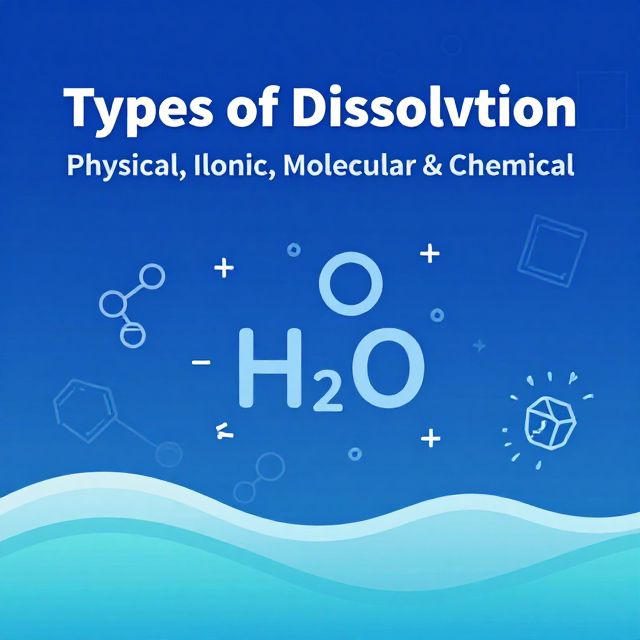
2. Universal Solvent
Water is known as the universal solvent because of its exceptional ability to dissolve many other substances.
- Mechanism: Its polarity allows it to surround and separate ions or polar molecules, effectively dissolving them. For example, it dissolves salts by neutralizing the ionic bonds holding the molecule together.
- Importance: This property is vital for transferring nutrients in animals and plants. Raindrops dissolve atmospheric gases as they fall and contribute to weathering by dissolving rocks on Earth.
3. High Dielectric Constant
- Definition: The ability to keep oppositely charged ions in solution apart from each other. Water has one of the highest dielectric constants (except H₂O₂ and HCN).
- Effect: This property contributes to water's high dissolving power and facilitates ion hydration, where water molecules surround dissolved ions (cations and anions). This significantly influences the behavior and bioavailability of dissolved inorganic substances.
4. High Heat Capacity
- Definition: The amount of heat needed to raise the temperature of a unit mass of a substance by 1°C. Water has one of the highest heat capacities (except ammonia).
- Reason: A large amount of energy is required to break the extensive hydrogen bonds and change the structure of water.
- Importance:
- Temperature Buffering: Oceans can store vast amounts of heat, moderating global temperatures and preventing extreme fluctuations. This leads to more gradual seasonal changes near coastal areas.
- Energy Transport: Ocean currents transport large amounts of thermal energy around the globe.
5. High Heat of Evaporation
- Definition: The heat required to change a unit mass of water from liquid to steam/water vapor. Water has the highest heat of evaporation among all liquids.
- Reason: Significant energy is needed to overcome the strong hydrogen bonds and allow water molecules to escape into the gaseous phase.
- Importance:
- Cooling: Mammals use this property to cool down through sweating.
- Climate Regulation: It's a major factor in heat transfer between the ocean and atmosphere, driving weather and climate patterns.
6. Low Heat of Freezing
- Contrast: While a lot of energy is needed to evaporate water (540 cal/g/°C), relatively less energy is needed to freeze it (80 cal/g/°C).
- Reason: The number of hydrogen bonds is similar in liquid water and ice, so less energy change is required for this phase transition compared to evaporation.
7. High Boiling Point & High Freezing Point
- Anomalous Behavior: When comparing water (H₂O) to other hydrides in Group VIA of the Periodic Table (H₂S, H₂Se, H₂Te), their boiling and freezing points generally decrease with decreasing molecular weight. However, water's boiling point (100°C) and freezing point (0°C) are exceptionally high.
- Example: Based on trends, water's freezing point should be around -90°C.
- Importance: These high points ensure water exists in all three phases (solid, liquid, gas) within the critical temperature range for life on Earth.
- Altitude Effect: Water boils at a lower temperature at higher altitudes due to lower atmospheric pressure.
- Example: Water boils quicker in Çeşme (sea level) than on Mount Ağrı, making it harder to cook food like eggs at high altitudes because the water boils at a lower temperature, insufficient to fully cook the food.
8. High Surface Tension
- Definition: A measure of the strength of the water's surface film, caused by the strong attraction between water molecules at the surface. The molecules at the surface experience an inward pull, minimizing the surface area. Water has the highest surface tension except for mercury.
- Effects:
- Droplet Formation: Water forms spherical droplets.
- Floating Objects: Allows denser objects (e.g., a steel needle) to float on the surface.
- Aquatic Life: Enables some aquatic insects to "walk" on water.
- Capillary Action: Facilitates water movement in plants (easier for roots to withdraw water).
- Sea Salt Aerosols: When air bubbles break at the sea surface, high surface tension causes the surrounding water to snap back, injecting small droplets of seawater into the atmosphere. As water evaporates, it leaves behind sea salt aerosols.
- Modification: Detergents reduce surface tension, allowing water to wet surfaces more effectively.
🧊 The Paradox of Ice
Unlike most substances, water is less dense in its solid form (ice) than in its liquid form.
- Density Anomaly: Water reaches its maximum density at 4°C.
- Above 4°C: Water molecules become more energetic and move farther apart, decreasing density.
- Below 4°C: Water molecules begin to form hexagonal polymer structures with open spaces, making ice approximately 8% less dense than liquid water.
- Importance for Aquatic Life:
- In cold climates, as surface water cools, it becomes denser and sinks until it reaches 4°C.
- Below 4°C, water expands and becomes less dense, floating to the surface.
- This allows ice to form on the surface, insulating the water below, which remains at 4°C. This prevents large bodies of water from freezing solid, allowing aquatic life to survive through winter.
💧 Freshwater vs. Seawater
Salinity is the total amount of dissolved salts in water, typically measured in parts per thousand (‰ or ppt). The average salinity of the ocean is about 35‰. The presence of dissolved salts significantly alters water's properties.
| Property | Freshwater | Seawater …