 Podit
Podit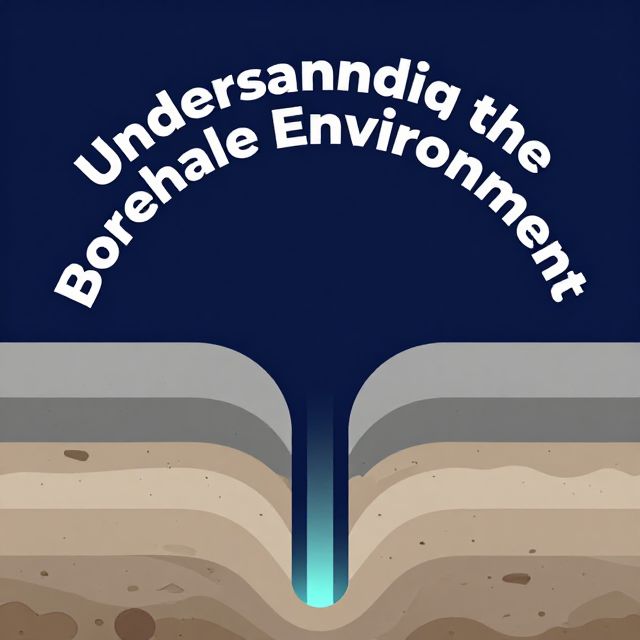
Borehole Environment: A Comprehensive Study Guide
Source Information: This study material has been compiled from a lecture audio transcript.
📚 1. Introduction to the Borehole Environment
The borehole environment refers to the intricate and dynamic conditions found within and immediately surrounding a drilled wellbore. This subsurface space is created for a variety of critical purposes, including:
- 🌍 Geological exploration
- 🛢️ Hydrocarbon extraction
- ♨️ Geothermal energy production
- 💧 Groundwater monitoring
- 🔬 Scientific research
Understanding this environment is paramount for ensuring successful and safe operations. It directly impacts drilling efficiency, wellbore stability, the accuracy of data acquisition, and the long-term integrity of the well. The characteristics of the borehole environment are shaped by a complex interplay of geological, physical, chemical, and operational factors, making it a challenging field of study.
📚 2. Key Characteristics and Influencing Factors
The borehole environment is defined by several interdependent parameters and is influenced by a multitude of factors.
2.1. Fundamental Characteristics
✅ Physical Interactions: Continuous interaction occurs between the circulating drilling fluid, the installed wellbore casing, and the diverse surrounding rock formations. ✅ Temperature and Pressure Gradients: These are ubiquitous and typically increase with depth. They significantly affect: * Rheological properties of drilling fluids. * Geomechanical behavior of rock formations. * Performance of downhole instrumentation. ✅ Chemical Influences: The environment is intricately shaped by: * Composition of the drilling fluid. * Geochemistry of encountered formation waters. * Mineralogical makeup of drilled rock strata. * Potential issues: Corrosive degradation, mineral scale formation, formation damage. ✅ Biological Presence: Microorganisms, especially in certain geological contexts, can lead to: * Biofouling of equipment. * Microbially induced corrosion (MIC).
2.2. Influencing Factors
💡 A multitude of factors profoundly influence the borehole environment:
-
Drilling Fluid Type:
- Types: Water-based, oil-based, or synthetic-based formulations.
- Role: Establishes the primary chemical and physical interface with the geological formation.
- Critical Properties:
- Density: For hydrostatic pressure control.
- Viscosity: For efficient cuttings transport.
- Filtration Characteristics: For minimizing invasive fluid loss.
- Importance: Paramount for maintaining wellbore stability and preventing detrimental fluid migration into permeable zones.
-
Geological Properties of Formations:
- Characteristics: Porosity, permeability, mechanical strength, and chemical reactivity.
- Impact: Dictate how the rock mass responds to mechanical stresses from drilling and chemical invasion from drilling fluids.
-
Operational Parameters:
- Examples: Drilling rate, drill bit design, casing and cementing programs.
- Effect: Directly impact mechanical stresses and fluid dynamics within the wellbore, dynamically shaping its immediate environment and long-term behavior.
📚 3. Applications in Borehole Operations
A comprehensive understanding of the borehole environment is crucial across a wide range of industrial and scientific applications:
- Oil and Gas Industry:
- Optimizing drilling operations.
- Ensuring wellbore stability.
- Maximizing hydrocarbon recovery.
- Accurate characterization of reservoir properties, fluid contacts, and formation pressures.
- Geothermal Energy Projects:
- Understanding subsurface temperature profiles.
- Assessing rock thermal conductivity for efficient and sustainable heat extraction.
- Hydrogeology:
- Providing essential access points for groundwater sampling.
- Monitoring contaminant plumes.
- Assessing aquifer characteristics and dynamics.
- Scientific Research:
- Initiatives like the International Ocean Discovery Program.
- Acquisition of deep crustal rock and fluid samples.
- Gaining insights into Earth's interior processes and microbial life in extreme environments.
📚 4. Challenges in Borehole Operations
Operating within and accurately characterizing the borehole environment presents a formidable array of challenges:
- ⚠️ Wellbore Instability:
- Causes: Mechanical stresses, fluid-rock interactions, or tectonic activity.
- Consequences: Costly operational delays, financial expenditures, and safety hazards.
- ⚠️ Accurate Measurement:
- Difficulty: Harsh subsurface conditions (extreme temperatures, high pressures) and limitations of current logging and measurement-while-drilling technologies.
- Impact: Complicates precise measurement of critical downhole parameters and fluid compositions.
- ⚠️ Formation Damage:
- Problem: Can severely impair the desired flow of reservoir fluids into the wellbore.
- Mitigation: Requires meticulous selection of drilling fluids, sophisticated completion techniques, and careful well management.
- ⚠️ Environmental Considerations:
- Issues: Responsible disposal of drilling waste materials and stringent prevention of groundwater contamination.
- Requirement: Demands a thorough understanding of the borehole's complex interactions with its surrounding geological and hydrological systems.
Addressing these multifaceted challenges necessitates the adoption of highly interdisciplinary approaches, integrating principles from geology, geophysics, chemistry, and various branches of engineering.
📚 5. Conclusion
The borehole environment is a complex and dynamic subsurface domain, indispensable for a wide array of industrial and scientific endeavors. Its characteristics are shaped by intricate interactions among geological formations, drilling fluids, and operational parameters. A comprehensive understanding of this environment is crucial for ensuring the safety, efficiency, and success of drilling operations, resource extraction, environmental monitoring, and scientific exploration. Overcoming the inherent challenges associated with this unique setting demands continuous innovation in technology and a multidisciplinary scientific approach, underscoring its ongoing significance in subsurface engineering and Earth sciences.