The Nervous and Endocrine Systems: Body's Control Centers - kapak
Bilim#nervous system#endocrine system#brain#spinal cord

The Nervous and Endocrine Systems: Body's Control Centers

Explore the intricate workings of the nervous and endocrine systems, their structures, functions, and how they maintain the body's homeostasis.

izemApril 25, 2026 ~16 dk toplam
01

Görsel Özet

İnfografik

Konunun tüm parçalarını tek bakışta gör.

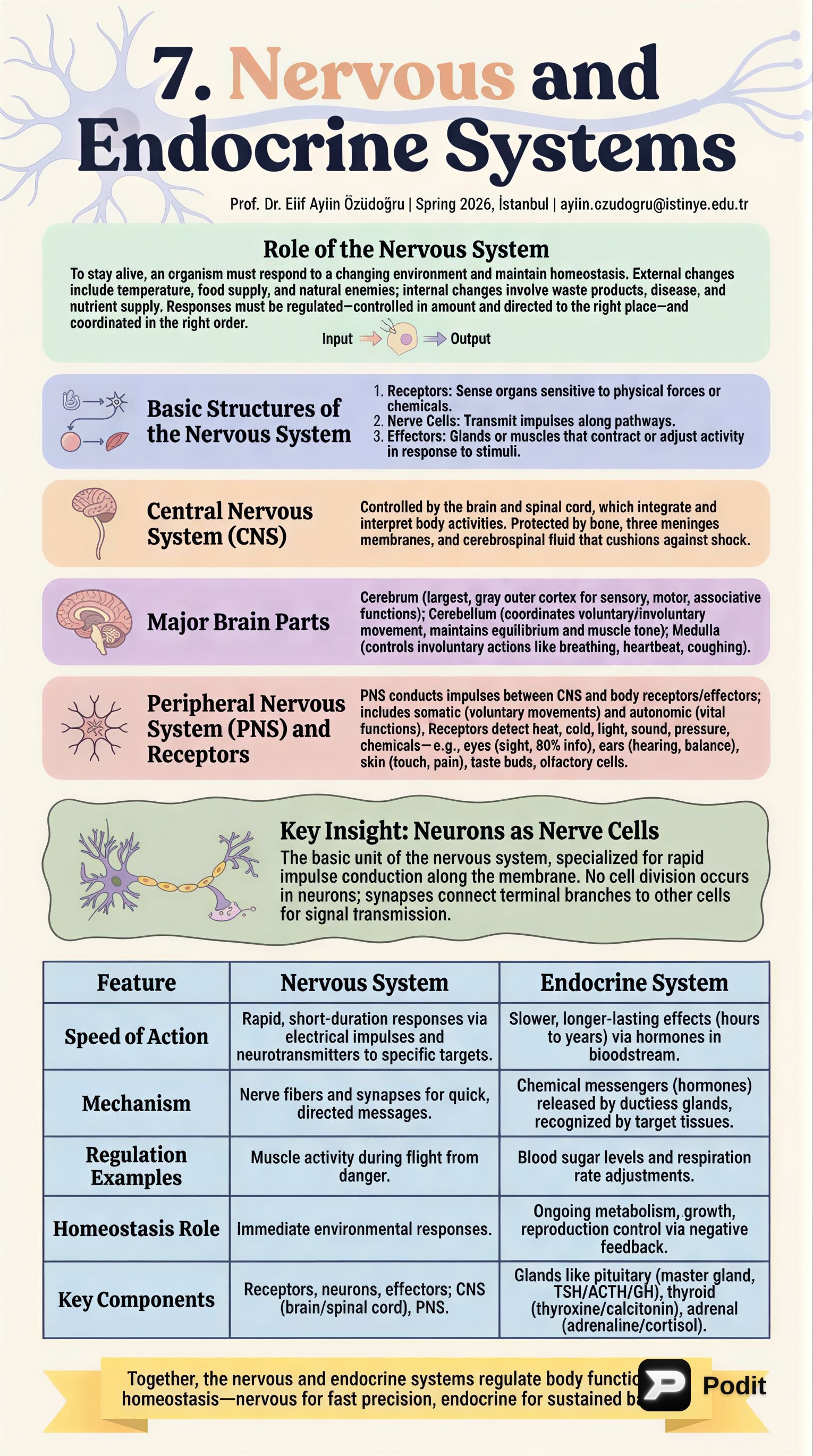
The Nervous and Endocrine Systems: Body's Control Centers - görsel özet infografik
Tam boyutta görüntüle →
02

Flash Kartlar

25 kart

Karta tıklayarak çevir. ← → ile gez, ⎵ ile çevir.

1 / 25
Tüm kartları metin olarak gör
  1. 1. What is homeostasis and why is it crucial for an organism?

    Homeostasis is the ability of an organism to maintain a stable internal environment despite external changes. It's crucial because it allows the body to function optimally by regulating internal conditions like temperature, nutrient levels, and waste removal, ensuring survival and proper physiological processes.

  2. 2. Explain the concept of 'irritability' at the cellular level.

    Irritability refers to a cell's fundamental capacity to respond as a whole to stimuli. This innate ability is the basic mechanism by which individual cells and, consequently, complex body systems react and adapt to changes in their environment, forming the foundation of sensory and response mechanisms.

  3. 3. What are the two main control systems responsible for maintaining homeostasis in the body?

    The two main control systems are the Nervous System and the Endocrine System. The nervous system uses rapid electrical impulses for quick, short-duration responses, while the endocrine system uses chemical messengers (hormones) for slower, longer-lasting effects, both working to regulate body functions.

  4. 4. Name the three fundamental structures upon which the true nervous system is built.

    The three fundamental structures are receptors, nerve cells (neurons), and effectors. Receptors detect stimuli, neurons transmit impulses, and effectors (like glands or muscles) carry out the response, forming a complete pathway for nervous system activity.

  5. 5. Define a 'receptor' in the context of the nervous system and give its primary role.

    Receptors are specialized sense organs or cells highly sensitive to specific changes, physical forces, or chemicals in the environment. Their primary role is to detect stimuli and convert them into nerve impulses, initiating a response pathway within the nervous system.

  6. 6. What is the role of 'neurons' in the nervous system?

    Neurons, or nerve cells, are the fundamental units of the nervous system responsible for transmitting impulses. They form pathways along which electrical signals travel from receptors to the central nervous system and then to effectors, enabling communication throughout the body.

  7. 7. What are 'effectors' and how do they function in the nervous system?

    Effectors are typically glands or muscles that carry out the response to a nervous impulse. When stimulated by neurons, muscles contract, or glands increase/decrease their activity, leading to a physical or chemical change in the body.

  8. 8. What is a 'stimulus' in the context of the nervous system?

    A stimulus is any factor that causes a receptor to trigger impulses in a nerve pathway. It's the detectable change in the internal or external environment that elicits a response from the nervous system, such as light, sound, pressure, or chemical changes.

  9. 9. What are the main components of the Central Nervous System (CNS)?

    The Central Nervous System (CNS) comprises the brain and the spinal cord. It is the body's main integration and interpretation center, processing sensory information and coordinating motor responses. Most motor neuron cell bodies and interneurons are housed within the CNS.

  10. 10. How are the brain and spinal cord protected from damage?

    The brain is protected by the skull, and the spinal cord by vertebrae. Additionally, both are enveloped by three tough membranes called meninges and cushioned against shock by cerebrospinal fluid, which acts as a protective buffer.

  11. 11. What is the primary function of the brain?

    The brain is a specialized group of nerve cells that controls and coordinates the nervous system's activities. It is responsible for processing sensory information, initiating motor commands, and enabling higher cognitive functions like thought, memory, and emotion.

  12. 12. Describe the cerebrum, including its size and the nature of its outermost layer.

    The cerebrum is the largest part of the brain, making up two-thirds of its total mass. Its outermost layer, the cerebral cortex, is composed of gray matter. It is responsible for higher functions like thought, voluntary movement, language, reasoning, and perception.

  13. 13. What is the main function of the cerebellum?

    The cerebellum controls involuntary movements and maintains equilibrium and muscle tone. It coordinates voluntary movements such as posture, balance, coordination, and speech, resulting in smooth and balanced muscular activity.

  14. 14. What vital involuntary functions does the medulla control?

    The medulla plays a crucial role in controlling essential involuntary functions such as breathing and heartbeat. It also regulates other autonomic functions like digestion, sneezing, and swallowing, making it vital for survival.

  15. 15. What is the function of the thalamus in the brain?

    The thalamus serves as a relay center for sensory impulses. It processes and relays most sensory information (except smell) to the appropriate areas of the cerebral cortex for further processing, acting as a crucial hub for sensory input.

  16. 16. List some key functions controlled by the hypothalamus.

    The hypothalamus is involved in controlling body temperature, blood pressure, sleep, emotions, and endocrine function. It plays a vital role in maintaining homeostasis by regulating many autonomic functions and linking the nervous and endocrine systems.

  17. 17. What is the role of the pons in the brain?

    The pons links various brain regions and the spinal cord. It acts as a bridge, facilitating communication between the cerebrum and the cerebellum, and also contains nuclei that relay signals from the forebrain to the cerebellum, along with nuclei that deal primarily with sleep, respiration, swallowing, bladder control, hearing, equilibrium, taste, eye movement, facial expressions, facial sensation, and posture.

  18. 18. What is the primary function of the spinal cord?

    The spinal cord extends from the base of the brain and connects the nerves of the Peripheral Nervous System (PNS) with the brain. It serves as a major pathway for sensory and motor information and also controls certain reflexes independently of the brain.

  19. 19. What is the Peripheral Nervous System (PNS) and what are its main components?

    The PNS is a vast network of nerves that conducts impulses between the CNS, receptors, and effectors. It consists of sensory neurons (afferent) and the axons and dendrites of motor neurons (efferent), essentially connecting the CNS to the rest of the body.

  20. 20. How is the Peripheral Nervous System (PNS) divided functionally?

    The PNS is divided into the somatic nervous system, which controls voluntary body movements, and the autonomic nervous system, which regulates vital involuntary body functions like heart rate, digestion, and respiration.

  21. 21. Give examples of different types of receptors and the stimuli they detect.

    Receptors are specialized for various stimuli. For instance, the eye detects light (sight), the ear detects sound and helps with balance (hearing), skin receptors detect touch, pressure, heat, cold, and pain, taste buds detect taste, and olfactory cells detect smell.

  22. 22. What is the basic unit of the nervous system, and what is a key characteristic regarding its division?

    The basic unit of the nervous system is the nerve cell, or neuron, specialized for rapid impulse conduction. A key characteristic is that neurons generally do not undergo cell division, meaning they have limited regenerative capacity.

  23. 23. Define a 'synapse' in the context of neural communication.

    A synapse is the specialized junction where a neuron's terminal branch contacts another cell's membrane. It is the point at which a nerve impulse is transmitted from one neuron to another, or from a neuron to an effector cell, typically via neurotransmitters.

  24. 24. How does the endocrine system primarily regulate body functions, and how does this differ from the nervous system?

    The endocrine system regulates body functions through chemical messengers called hormones, which are released into the bloodstream for slower, longer-lasting effects. This differs from the nervous system, which uses rapid electrical impulses and neurotransmitters for quick, short-duration responses to specific body parts.

  25. 25. What are hormones, and how do they reach their target organs?

    Hormones are chemical messengers released by cells in one part of the body to exert an effect elsewhere. They are released directly into the bloodstream, which then carries them to specific target organs or tissues throughout the body.

03

Bilgini Test Et

15 soru

Çoktan seçmeli sorularla öğrendiklerini ölç. Cevap + açıklama.

Soru 1 / 15Skor: 0

What is the term for an organism's ability to maintain internal balance despite constant changes in its environment?

04

Detaylı Özet

6 dk okuma

Tüm konuyu derinlemesine, başlık başlık.

🧠📚 The Nervous and Endocrine Systems: Control and Coordination of the Body

Source Information: This study material has been compiled from a lecture audio transcript and copy-pasted text provided by the user.

🎯 Introduction to Body Control Systems

To maintain life, organisms must constantly adapt to their ever-changing environment and diligently preserve internal stability, a state known as homeostasis. This involves responding to both external factors (e.g., temperature, food availability, threats) and internal changes (e.g., waste concentration, pathogens, nutrient supply). These responses require precise regulation (controlled amount and direction) and coordination (correct sequence and relationship). At a cellular level, the capacity of a cell to respond as a whole is termed irritability. The nervous and endocrine systems are the body's primary control mechanisms, working together to achieve this vital balance.


🧠 The Nervous System

The nervous system is specialized for rapid communication and immediate responses.

1. 📚 Basic Structures of the Nervous System

A true nervous system involves three fundamental components:

  1. Receptors: 👁️ Specialized sense organs sensitive to specific environmental changes, physical forces, or chemicals.
  2. Nerve Cells (Neurons): ⚡ When a receptor is stimulated, these cells transmit electrical impulses along a pathway.
  3. Effectors: 💪 Glands or muscles that carry out the response, either by contracting or by increasing/decreasing their activity.
    • A stimulus is any factor that causes a receptor to trigger impulses in a nerve pathway.

2. 🌐 Divisions of the Nervous System

The nervous system is broadly divided into two main parts:

2.1. Central Nervous System (CNS)

The CNS is the body's control center, responsible for integration and interpretation of most activities. ✅ Components: Brain and Spinal Cord. ✅ Protection: * Bone: Brain (skull), Spinal Cord (vertebrae). * Meninges: Three tough membranes covering the brain and spinal cord. * Cerebrospinal Fluid: Cushions delicate tissues against shock. ✅ Key Cells: Contains cell bodies of most motor neurons and interneurons.

The Brain

The brain is a specialized group of nerve cells that controls and coordinates nervous system activities. 💡 High Activity: Receives 20% of heart's blood, replaces most proteins every three weeks, and is the major user of glucose. ✅ Major Parts: * Cerebrum: 🧠 Largest part (2/3). * Cerebral Cortex (Gray Matter): Outermost layer, convolutions increase surface area. * White Matter: Inner area beneath gray matter. * Functions: Sensory, motor, and associative functions. * Cerebellum: 🤸‍♂️ Divided into two hemispheres. * Structure: Outer white matter, inner gray matter. * Functions: Controls voluntary and some involuntary movements, maintains equilibrium (with inner ear), and muscle tone. * Medulla Oblongata: 🌬️ Controls involuntary movements like breathing, heartbeat, and coughing. ✅ Other Important Parts: * Thalamus: 🚦 Relay center between brain and spinal cord. Receives and modifies sensory impulses (except smell), involved in pain perception and consciousness. * Hypothalamus: 🌡️ Controls body temperature, blood pressure, sleep, emotions, and endocrine system function. * Pons: 🔗 Serves as a relay system linking the spinal cord, medulla, cerebellum, and cerebrum.

The Spinal Cord

The spinal cord extends about 45 cm from the base of the brain through the vertebrae. ✅ Structure: Inner H-shaped gray matter surrounded by white matter. ✅ Functions: Connects PNS nerves with the brain and controls certain reflexes (automatic responses not involving the brain).

2.2. Peripheral Nervous System (PNS)

The PNS is a vast network of nerves that conduct impulses between the CNS and the body's receptors and effectors. ✅ Components: Sensory neurons (including cell bodies) and axons/dendrites of motor neurons. ✅ Divisions: * Somatic Nervous System: Controls voluntary body movements. * Autonomic Nervous System: Regulates vital body functions (involuntary).

3. 👂 Sensory Receptors

Different types of receptors are sensitive to specific stimuli:

  • Eye: 👁️ Sight is the dominant sense, providing over 80% of information.
  • Ear: 👂 Responsible for hearing and maintaining balance/equilibrium.
  • Skin Receptors: 👋 Detect touch, pressure, heat, cold, and pain.
  • Taste Buds: 👅 Located within papillae on the tongue, sense taste.
  • Olfactory Cells: 👃 In the mucous membrane of the nasal cavity, responsible for smell.

4. ⚡ Neurons: The Basic Unit

Neurons are the basic structural and functional units of the nervous system. ✅ Specialization: Rapid conduction of impulses along the cell membrane. ⚠️ No Cell Division: Neurons generally do not undergo cell division. ✅ Synapse: The junction where a terminal branch of one neuron makes contact with the membrane of another cell.


⚖️ The Endocrine System

The endocrine system works alongside the nervous system to regulate and coordinate body functions, primarily through chemical messengers.

1. ⚡ vs. 🧪: Nervous vs. Endocrine System

| Feature | Nervous System | Endocrine System | | :-------------- | :---------------------------------------------- | :------------------------------------------------ | | Mechanism | Electrical impulses, neurotransmitters | Chemical messengers (hormones) in bloodstream | | Speed | Rapid | Slower | | Duration | Short-duration responses | Longer-lasting effects (hours, days, years) | | Targeting | Specific body parts | Target organs/tissues via bloodstream | | Example | Muscle activity during danger | Blood sugar levels, respiration rate during danger |

2. 📚 Glands and Hormones

  • Glands: Organs made of epithelial cells specialized for secreting substances.
    • Exocrine Glands: Discharge secretions into ducts (e.g., digestive glands).
    • Endocrine Glands: Release secretions directly into the bloodstream. Also called 'ductless glands.'
  • Hormones: 🧪 Chemical messengers secreted by endocrine glands.
    • Released into the bloodstream and exert effects elsewhere in the body.
    • Each hormone is recognized only by a specific target tissue.
    • Functions: Regulate overall metabolism, maintain homeostasis, control growth, and reproduction.
    • Types:
      • Protein-type hormones: Chains of amino acids (e.g., insulin, oxytocin).
      • Steroid hormones: Lipid-like, carbon-ring compounds similar to cholesterol (e.g., cortisone, testosterone, estrogen).

3. 🔄 Hormone Regulation

Endocrine glands do not secrete hormones at a constant rate; their activity varies with the body's needs. ✅ Trigger Signals: Nerve impulses or, more commonly, chemical stimuli (including other hormones). ✅ Negative Feedback: 📈📉 The primary mechanism that alters gland activity, ensuring hormone levels remain within a narrow range. ✅ Mechanisms of Action: Hormones produce effects within target cells via mechanisms like the one-messenger model and the two-messenger model.


🧍 Human Endocrine System: Key Glands

The human endocrine system consists of numerous glands, and their improper functioning (hypersecretion or hyposecretion) can lead to diseases or disorders.

  1. Pituitary Gland (Master Gland): 👑 Controls many other glands. Connected to the hypothalamus, forming a major link between nervous and endocrine systems.
    • Hormones: TSH, ACTH, GH, Prolactin.
  2. Thyroid Gland: 🦋 Located in the neck.
    • Thyroxine: Increases metabolism (protein, carbohydrate, fat), essential for mental and physical development.
    • Calcitonin: Regulates blood calcium levels.
  3. Parathyroid Glands: ⚪ Four tiny glands behind the thyroid.
    • Parathyroid Hormone: Regulates calcium-phosphorus metabolism.
  4. Adrenal Glands: 🔺 On top of the kidneys, each with two layers.
    • Medulla (Inner): Hormones (adrenaline, noradrenaline) deal with sudden stress.
    • Cortex (Outer): Hormones (e.g., cortisol, aldosterone) deal with long-term stress.
  5. Pancreas (Islets of Langerhans): 🌿
    • Alpha (α) cells: Secrete glucagon.
    • Beta (β) cells: Secrete insulin.
    • Both control carbohydrate metabolism.
  6. Gonads (Sex Glands): ♀️♂️ Ovaries (females) and testes (males).
    • Ovaries: Estrogen, Progesterone.
    • Testes: Androgens (e.g., Testosterone).
    • Control sexual development and reproduction.
  7. Thymus: 🛡️ In the upper chest, near the heart.
    • Involved in lymphocyte processing early in life.
    • Produces Thymosin during childhood; no function in adults.
  8. Pineal Gland: 🌲 Pea-sized structure at the base of the brain.
    • Produces Melatonin, which may inhibit sexual development.
  9. Prostaglandins: 📍 'Local hormones' that act on cells where they are synthesized, without entering the bloodstream.
    • Influence heartbeat, blood pressure, urine excretion, and uterine contractions during childbirth.

💡 Other Hormone-Secreting Tissues

Some tissues not organized as separate glands also secrete hormones:

  • Stomach Lining: Special cells secrete Gastrin, stimulating gastric juice flow.
  • Small Intestine Lining: Cells secrete Secretin, stimulating pancreatic juice flow.
Kendi çalışma materyalini oluştur

PDF, YouTube videosu veya herhangi bir konuyu dakikalar içinde podcast, özet, flash kart ve quiz'e dönüştür. 1.000.000+ kullanıcı tercih ediyor.

Sıradaki Konular

Tümünü keşfet
Anatomy of the Nervous System

Anatomy of the Nervous System

An academic overview of the nervous system, detailing the Central Nervous System (CNS) and Peripheral Nervous System (PNS), their components, functions, and associated disorders.

8 dk Özet 25 15
The Nervous System: Structure, Tissue, and Communication

The Nervous System: Structure, Tissue, and Communication

An academic overview of the nervous system's anatomical and functional divisions, its cellular components, the role of myelination, and the electrical and chemical mechanisms of neuronal communication.

7 dk Özet 25 15
The Developing Brain: Structure, Function, and Growth

The Developing Brain: Structure, Function, and Growth

Explore the intricate structure of the brain, its cellular components, major regions, and the complex processes of brain development and physical growth from conception to adulthood.

Özet 25 15
Nervous System: Structure, Function, and Signaling

Nervous System: Structure, Function, and Signaling

An academic overview of the nervous system's anatomical and functional divisions, cellular components, electrical signaling mechanisms, and inter-neuronal communication.

5 dk Özet 25 15
General Characteristics and Mechanisms of Hormone Action

General Characteristics and Mechanisms of Hormone Action

Explore the definition, classification, mechanisms of action, regulation, storage, transport, and degradation of hormones in the human body, providing a comprehensive overview.

Özet 25 15
The Neural Bases of Behaviour: An Introduction

The Neural Bases of Behaviour: An Introduction

An introductory guide to how the nervous system and brain support human behaviour, covering the CNS, PNS, and the role of neurons.

3 dk 22 10
Histology of Glands and Membranes

Histology of Glands and Membranes

An academic overview of glandular classification, secretion mechanisms, and the structural and functional characteristics of various biological membranes in histology.

5 dk Özet 25 15
Neurolinguistics: Language, Brain, and Aphasia

Neurolinguistics: Language, Brain, and Aphasia

This audio summary explores neurolinguistics, its interdisciplinary nature, the structure and functions of the brain's language areas, and various types of aphasia resulting from brain damage.

6 dk Özet 25 15