Podit
Podit
Study Material: The Reproductive System and Cell Division
Source Information: This study material has been compiled from a lecture audio transcript and supplementary copy-pasted text provided by Prof. Dr. Elif Aylin Özüdoğru, Spring 2026, İstanbul.
📚 Introduction to Reproduction and Cell Division
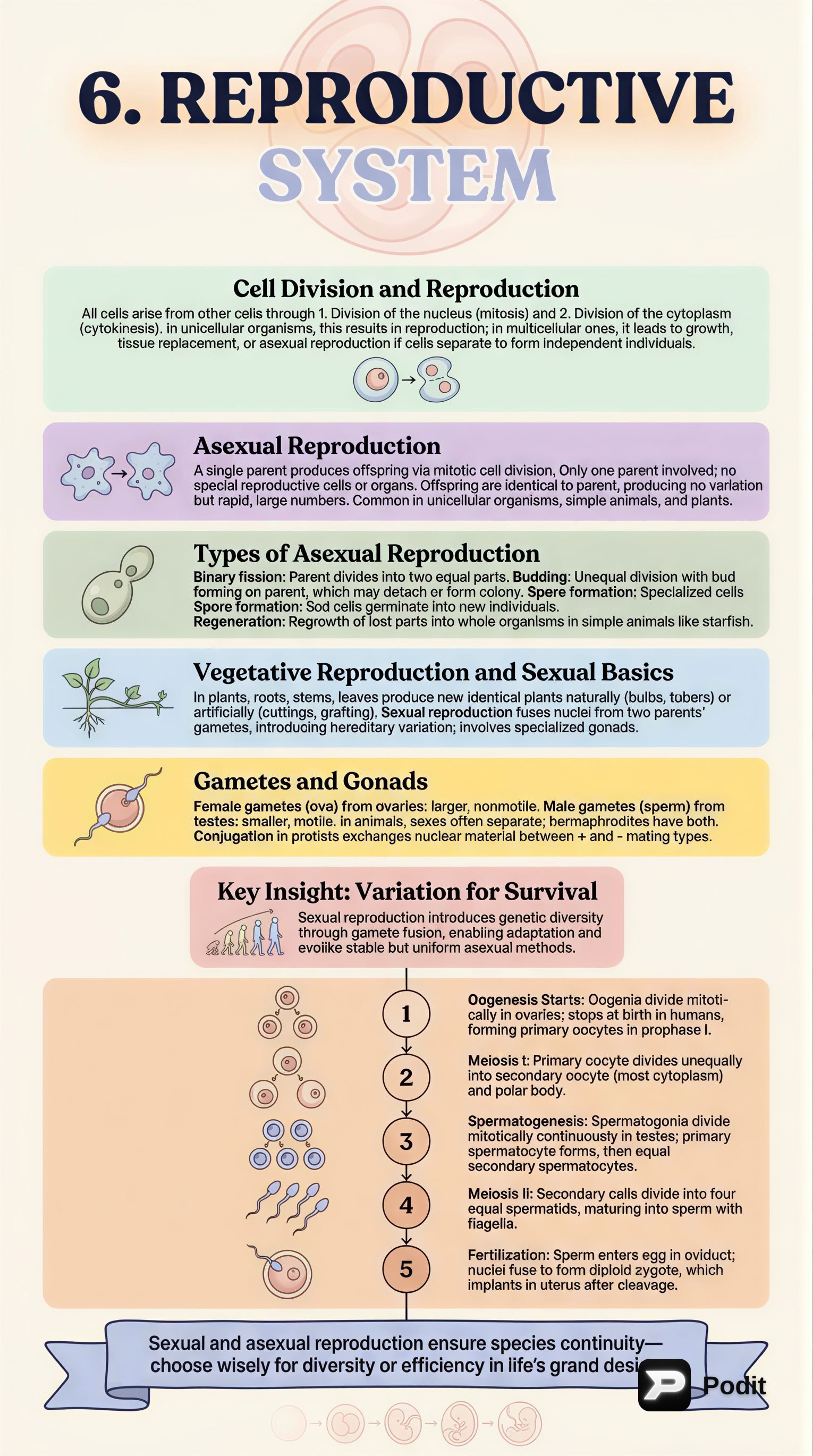
All living organisms originate from pre-existing cells. This fundamental biological process involves two main stages:
- Mitosis: The division of the nucleus.
- Cytokinesis: The division of the cytoplasm.
In unicellular organisms, cell division directly leads to reproduction, creating new, independent individuals. In multicellular organisms, cell division primarily contributes to growth, development, and the replacement of damaged or old tissues. However, in some cases, cell division in multicellular organisms can also serve as a method of reproduction if new cells separate from the parent and form a complete, independent individual.
There are two fundamental types of reproduction observed across living organisms: asexual and sexual reproduction.
🧬 Types of Reproduction
1. Asexual Reproduction
Asexual reproduction involves a single parent giving rise to new offspring through mitotic cell division. ✅ Key Characteristics:
- Only one parent is involved.
- No specialized reproductive cells or organs are required.
- Offspring are genetically identical to the parent, showing little variation.
- Does not introduce hereditary variation.
- Generally rapid and often results in a large number of offspring.
Asexual reproduction is common in unicellular organisms, many simple animals, and numerous plant species. In multicellular organisms, offspring develop from undifferentiated, unspecialized cells of the parent.
Forms of Asexual Reproduction:
- Binary Fission:
- The simplest form of asexual reproduction.
- The parent organism divides into approximately two equal parts.
- Each daughter cell becomes a separate, independent individual.
- No parent organism remains after division.
- Budding:
- The parent divides into two unequal parts.
- A new individual develops as a small bud on the outer surface of the parent.
- The bud may break off to live independently or remain attached to form a colony.
- The parent and offspring are not of equal size.
- Spore Formation:
- Spores are single, specialized cells.
- Upon release, they can germinate and grow to form a new individual.
- Each spore contains the usual cellular components and is often protected by a robust cell wall.
- Regeneration:
- The ability of an organism to regrow lost body parts.
- Highly pronounced in simple animals (e.g., hydra, earthworms, starfish), where a part can regenerate into a whole organism.
- The capacity for regeneration decreases as animals become more complex (e.g., crabs, mammals).
- Vegetative Reproduction:
- Specific to plants, where vegetative structures (roots, stems, leaves) give rise to new plants.
- Undifferentiated cells divide mitotically and then differentiate to form an independent plant.
- The new plant has the same hereditary characteristics as its parent.
- Can occur naturally (e.g., bulbs, corms, tubers, runners, rhizomes) or artificially (e.g., cutting, layering, grafting, plant tissue culture).
2. Sexual Reproduction
Sexual reproduction always involves the fusion of nuclei from two cells, generally originating from two distinct parents. ✅ Key Characteristics:
- Introduces hereditary variation, leading to genetically diverse offspring.
- Involves specialized reproductive cells called gametes.
Simplest Form: Conjugation
- Observed in protists and other simple organisms.
- Involves two different mating types (e.g., plus (+) and minus (-)).
- A cytoplasmic bridge forms between two cells, allowing for the exchange of nuclear material.
Sexual Reproduction in Animals:
- Typically involves two sexes: female and male.
- Sex can be identified by physical appearance or internal differences.
- Gametes: Specialized cells providing nuclear material for reproduction.
- Female Gamete (Egg/Ovum): Generally larger and nonmotile.
- Male Gamete (Sperm): Generally smaller and motile.
- Gonads: Specialized organs where gametes develop.
- Ovaries: Female gonads producing egg cells.
- Testes: Male gonads producing sperm cells.
- Reproductive System: Gonads and other associated organs.
- Hermaphroditism: Some animals possess both testes and ovaries within a single individual (e.g., earthworms, snails). Self-fertilization is rare; they typically exchange sperm with another individual.
🔬 Gametogenesis: Formation of Gametes
Gametogenesis is the process by which gametes develop in the gonads.
1. Oogenesis (Egg Formation in Ovaries)
- Oogonia: Immature cells in the ovary that divide mitotically to form a supply of oogonia. In human females, oogonia production stops at birth, resulting in a limited number.
- Primary Oocytes: Oogonia develop into primary oocytes during fetal development. By birth, these primary oocytes are arrested in prophase of the first meiotic division.
- Meiotic Completion: Periodically (e.g., monthly after sexual maturity), one primary oocyte completes meiosis I.
- Unequal Division: Meiosis I results in unequal cytoplasmic division:
- A larger secondary oocyte (receives most cytoplasm).
- A very small first polar body.
- Meiosis II: The secondary oocyte begins meiosis II and arrests at metaphase II. It only completes meiosis II if fertilized.
- Second Unequal Division: If fertilized, the secondary oocyte divides unequally again:
- A large cell called an ootid.
- Another polar body.
- The first polar body may also divide into two polar bodies.
- Mature Egg: The ootid grows into a mature egg. Polar bodies disintegrate. 💡 Insight: Unequal division ensures the egg has sufficient cytoplasm and nutrients for early embryonic development.
2. Spermatogenesis (Sperm Formation in Testes)
- Spermatogonia: Immature cells in the testes that divide mitotically throughout childhood and continually after sexual maturity, ensuring a continuous supply.
- Primary Spermatocyte: A spermatogonium increases in size to become a primary spermatocyte.
- Meiosis I: The primary spermatocyte undergoes the first meiotic division, forming two equally sized secondary spermatocytes.
- Meiosis II: Each secondary spermatocyte undergoes the second meiotic division, forming four equally sized spermatids.
- Maturation: Each spermatid develops into a mature sperm with a flagellum (tail) without further division. 💡 Result: Each primary spermatocyte gives rise to four functional sperm.
💑 Fertilization and Zygote Formation
Fertilization is the fusion of male and female gametes to form a zygote. ✅ Requirements:
- A fluid medium for sperm motility.
- Gametes must be released together due to their short lifespan.
Types of Fertilization:
- External Fertilization:
- Occurs in the environment outside the female's body.
- Limited to aquatic animals.
- Large numbers of sperm and eggs are released into the water.
- Internal Fertilization:
- Occurs within the female's body.
- Characteristic of animals that reproduce on land.
- Requires a specialized sex organ to transfer sperm to the female.
- Fewer eggs are needed, but large numbers of sperm are still released.
- Sperm and egg are viable for fertilization only for a brief period (e.g., ~24 hours for human eggs).
Human Fertilization Process:
- Millions of sperm are ejaculated into the female reproductive tract.
- If an egg is present in the oviduct, it secretes chemicals that attract sperm.
- One sperm breaks through the membranes surrounding the egg, and its nucleus enters the egg's cytoplasm.
- The egg's membranes change immediately, preventing penetration by other sperm.
- The sperm nucleus fuses with the egg nucleus, forming a diploid cell called a zygote.
- The zygote undergoes rapid cell divisions (cleavage) and develops into a blastula as it travels down the oviduct towards the uterus.
- Approximately 5-10 days after fertilization, the embryo enters the uterus.
- Implantation: The outer cell layer of the embryo secretes enzymes to digest part of the thick uterine lining, and the embryo attaches itself to this spot.
🌿 Parthenogenesis
Parthenogenesis is the development of an unfertilized egg into an adult animal without fusion with sperm.
- Occurs in many insects (e.g., ants, bees, wasps, aphids), rotifers, and some microscopic animals.
🚻 Human Reproductive Systems
1. Male Reproductive System
- Testes:
- Two testes located in the scrotum (a sac of skin outside the body wall).
- The scrotum keeps the testes at a slightly lower temperature than the rest of the body, which is optimal for sperm production and storage.
- Produce sperm and the hormone testosterone.
- Each testis contains 300-600 small, coiled seminiferous tubules where immature sperm are produced.
- Epididymis: A storage area where immature sperm mature.
- Vas Deferens: A tube leading upward from each testis, carrying sperm from the epididymis into the lower abdomen.
- Urethra: The two vas deferens join at the urethra, which passes through the penis to the outside of the body.
- Accessory Glands:
- Seminal vesicles, Cowper's glands, and prostate gland secrete fluids into the urethra.
- This mixture of sperm and glandular fluids is called semen.
- Ejaculation: During and shortly before/after ejaculation, the bladder outlet is kept closed to prevent urine from entering the urethra.
2. Female Reproductive System
- Ovaries:
- Two ovaries, each containing about 200,000 tiny egg sacs called follicles.
- Each follicle contains an immature egg (approximately 500 mature eggs are produced during a woman's reproductive life).
- Produce eggs and the hormone estrogen.
- Ovulation: When an egg matures, the follicle ruptures, releasing the egg from the surface of the ovary. This process occurs about once a month, starting at puberty.
- Oviducts (Fallopian Tubes):
- Located near each ovary but not directly connected.
- Have funnel-like openings.
- Ciliated cells lining the oviduct create a current that draws the released egg into the tube.
- The egg travels through the oviduct to the uterus.
- Fertilization typically occurs in the oviduct.
- Uterus:
- A muscular organ where a fertilized egg implants and completes its development.
- Cervix: The narrow neck of the uterus.
- Vagina (Birth Canal):
- The cervix opens into the vagina, which leads to the outside of the body.
- During birth, the baby passes through this canal.
- Urethra: The female urethra has its own separate opening and is completely distinct from the reproductive system.
🤰 Pregnancy and Birth
- Gestation: Implantation marks the beginning of pregnancy, or gestation, which lasts a little over nine months in humans.
- Gastrulation: After implantation, the embryo undergoes gastrulation, forming the three primary germ layers from which all tissues and organs develop through growth and differentiation.
- Embryo vs. Fetus:
- The developing human is called an embryo up to about 8 weeks.
- After 8 weeks, it is typically called a fetus.
- Birth: When the fetus is ready to be born, uterine muscles contract, and the cervix begins to enlarge to permit the baby's passage through the birth canal.