 Podit
Podit
This study material has been compiled from a lecture audio transcript and copy-pasted text provided by the user.
📚 Introduction to Basic Genetics
Genetics is a fundamental branch of biology that explores how living organisms inherit traits from their parents. This guide will introduce you to the core concepts of genetics, from the basic building blocks of life to the mechanisms of heredity and variation.
🔬 The Study of Life: Biology
Biology is the scientific study of life, examining living systems at various hierarchical levels:
- Whole Organisms: Studying an entire living being.
- Organs: Investigating specific body parts with distinct functions (e.g., heart, brain).
- Tissues: Examining groups of similar cells working together (e.g., muscle tissue).
- Cells: The fundamental units of life.
- Intracellular Organelles: Structures within cells that perform specific tasks (e.g., mitochondria, nucleus).
- Chemical Components: The molecules that make up all living matter (e.g., DNA, proteins).
🦠 The Cellular Basis of Life
All living things are composed of cells. Before the 17th century, the existence of cells was unknown. The Modern Cell Theory provides foundational principles for understanding life:
✅ Key Principles of Modern Cell Theory
- All living things are made of cells.
- The cell is the basic unit of life.
- Cells arise from pre-existing cells.
- The energy of organisms is formed within cells.
- Cells contain DNA (in chromosomes) and RNA (in the nucleus and cytoplasm).
- Hereditary information (DNA) is passed from cell to cell.
- All cells have a basic chemical composition.
🧬 Types of Cells: Prokaryotic vs. Eukaryotic
Cells are broadly categorized into two main types:
| Feature | Prokaryotic Cells | Eukaryotic Cells | | :-------------------- | :---------------------------------------------- | :---------------------------------------------- | | Size | Smaller | Bigger | | Complexity | Simpler | More complex | | Nucleus | No true nucleus (genetic material in cytoplasm) | True nucleus (genetic material enclosed) | | Organelles | No membrane-bound organelles | Membrane-bound organelles present | | Example | Bacteria, Archaea | Animals, Plants, Fungi, Protists |
✅ Common Features in All Cells
Despite their differences, all cells share several fundamental characteristics:
- Cell membrane
- Cytoplasm
- Ribosomes
- DNA / RNA (as genetic material)
- Metabolism (chemical processes for life)
- Cell division (reproduction)
🧬 Genetic Material: The Molecules of Heredity
Life critically depends on three essential molecules:
- DNA (Deoxyribonucleic Acid)
- RNA (Ribonucleic Acid)
- Protein
🔑 Properties of Genetic Material
For a molecule to serve as genetic material, it must possess four crucial properties:
- Replication: 1️⃣ The genetic material must be able to make accurate copies of itself. This is fundamental for cell division and the continuity of life.
- Storage of Information: 2️⃣ It must contain all the hereditary features of an organism, coded as genes.
- Expression of Information: 3️⃣ The stored information must be able to be expressed to produce functional molecules (like proteins) that carry out cellular processes. This forms the basis of information flow in the cell.
- Diversification by Mutation (Variation): 4️⃣ Genetic material must be capable of undergoing changes (mutations). These mutations, especially those in reproductive cells (gametes), can be passed to future generations, leading to genetic diversity. Genetic diversity, including recombination, is the raw material for evolution.
📚 Core Concepts in Genetics
- GENETICS: The study of the mechanisms by which living organisms pass their characteristics to their offspring.
- Examples: Eye color, hair color, height, body build, blood types, intelligence, gender.
- HEREDITY: The specific characteristics a child receives from both parents.
🔬 Cellular Components of Heredity
- Cell: The basic unit of all living matter. An adult human body contains over 10 trillion cells.
- Cytoplasm: The substance of a cell outside the nucleus.
- Nucleus: The central control point of the cell, containing the genetic coding for maintaining life systems and issuing commands for growth and reproduction.
- Chromosomes: Structures found in the nucleus, composed of DNA and proteins.
- Humans have 46 chromosomes (23 pairs) in somatic (body) cells.
- Germ cells (reproductive cells like egg and sperm) have 23 chromosomes (n).
- Genes: Specific segments or "bands" on chromosomes that carry instructions for particular traits.
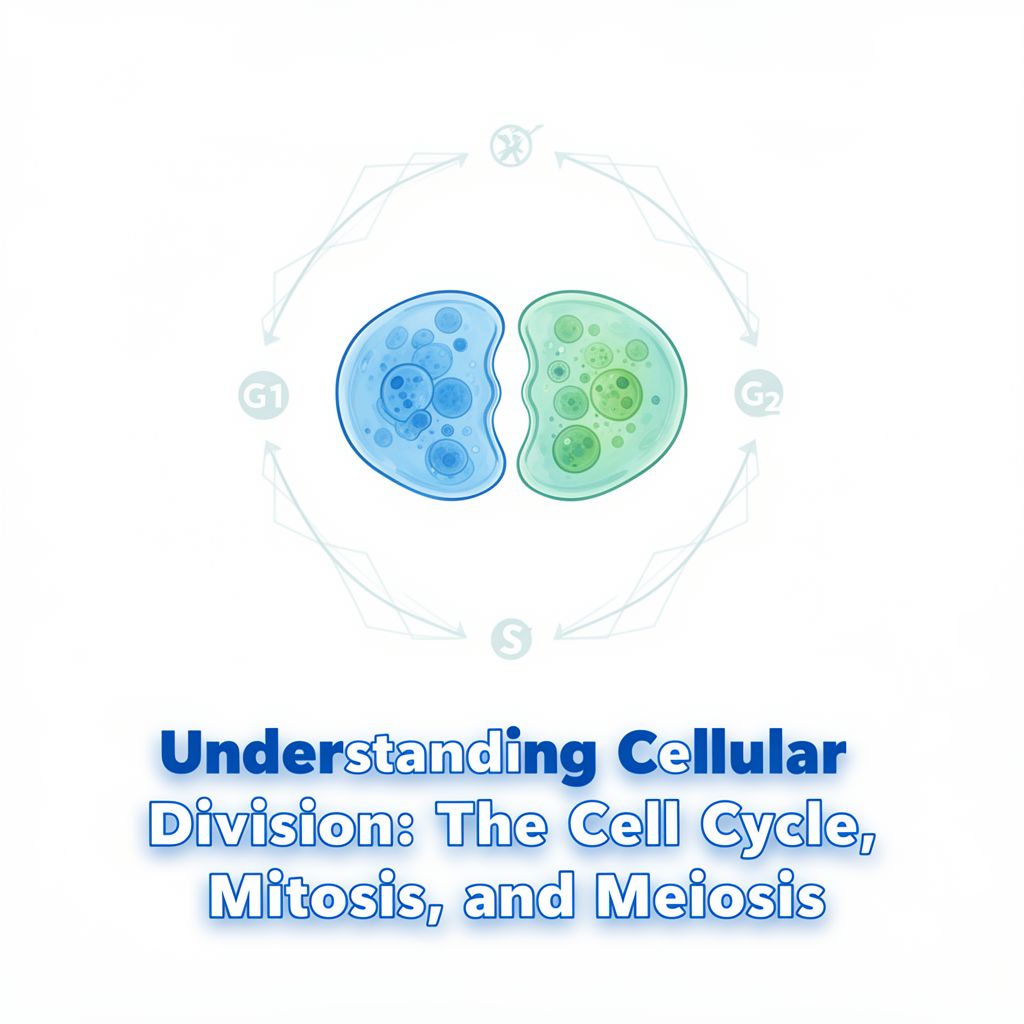
🔄 Cell Division: Mitosis and Meiosis
Cells divide through two primary processes:
-
MITOSIS:
- Purpose: Cell growth and repair.
- Process: A cell copies its DNA and then splits.
- Outcome: Produces two diploid (normal number of chromosomes) daughter cells that are genetically identical to the parent cell.
-
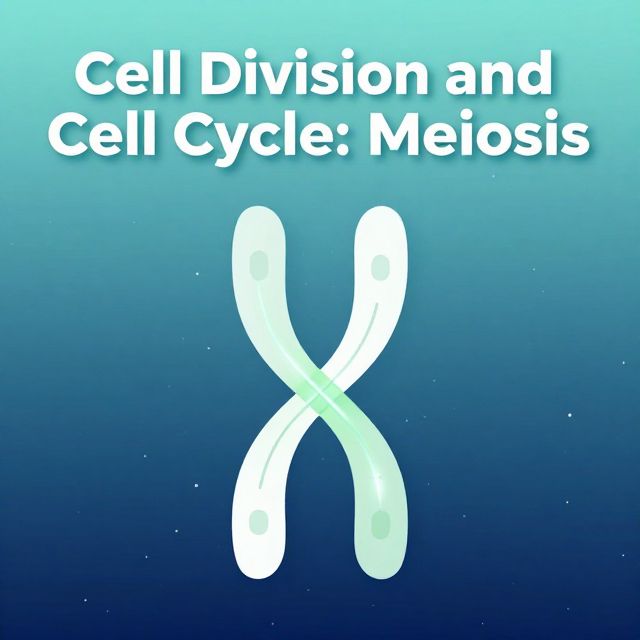
MEIOSIS:
- Purpose: Sexual reproduction (creation of gametes).
- Process: Creates cells with half the number of chromosomes.
- Outcome: Produces four haploid (half the number of chromosomes) daughter cells that are not genetically identical to the parent cell.
- 💡 Insight: Gender is determined by the father's sperm (carrying either an X or Y chromosome).
👨👩👧👦 Inheritance Patterns and Traits
- DOMINANT Gene: A more powerful gene whose trait is always expressed (seen) in the person if present.
- RECESSIVE Gene: A weaker gene whose trait is only expressed when two copies are present. It can be hidden in the background and may appear in future generations.
- CARRIER: An individual who possesses a recessive gene but does not display the associated trait because a dominant gene is also present.
🔗 Sex-Linked Traits
- Traits carried on the sex chromosomes (X or Y).
- Example: Color Blindness
- A color-blind male typically receives the trait from his mother.
- The mother is usually a carrier (has the recessive gene on one X chromosome) but is not color-blind herself because she has a dominant gene on her other X chromosome.
👶👶 Multiple Births
Multiple births occur when more than one baby is born from a single pregnancy. They can be identical, fraternal, or conjoined.
-
MONOZYGOTIC (Identical) Twins:
- Origin: One egg fertilized by one sperm.
- Process: The fertilized ovum splits into two identical cells.
- Characteristics: Always the same gender, genetically identical.
-
DIZYGOTIC (Fraternal) Twins:
- Origin: Two separate eggs fertilized by different sperm.
- Characteristics: May look different, can be different or the same gender, genetically no more alike than regular siblings.
-
CONJOINED (Siamese) Twins:
- Origin: An ovum splits, but the separation is incomplete.
- Characteristics: Babies are joined at some part of their bodies.
📈 Factors Contributing to Multiple Births
- Family History: A genetic predisposition for multiple births.
- Increased Natural Hormones: Leading to the release of more than one egg during ovulation.
- Fertility Drugs: Medications that stimulate the ovaries to release multiple eggs.
- Maternal Age (32-36): Women in this age range have a higher likelihood of releasing multiple eggs.
📊 Branches of Genetics
Genetics is broadly divided into four main areas of study:
-
Transmission Genetics:
- Focus: How genes are passed from one generation to the next.
- Concepts: Mendel's pea experiments (e.g., white & purple flowers), two copies of each gene (one from each parent), homozygous (same alleles), heterozygous (different alleles), dominant, recessive, and incompletely dominant inheritance patterns.
-
Molecular Genetics:
- Focus: The structure and function of genes at the molecular level.
- Concepts:
- DNA: The primary genetic material for most organisms (some viruses have RNA genomes).
- DNA Structure: A double helix composed of two chains of nucleotides. Each nucleotide contains a deoxyribose sugar, a phosphate group, and a base.
- Genes: Specific sequences of nucleotides that pass traits from parents to offspring.
- Genome: The total amount of genetic material in an organism's nuclear chromosomes.
-
Population Genetics:
- Focus: The distribution and behavior of genes within and between populations.
- Questions: What is the level of genetic variation? How do allele frequencies change over time?
- Forces of Evolution:
- Mutation: Heritable changes in genetic material.
- Recombination: Exchange of genetic material.
- Selection: Favoring particular gene combinations in a given environment.
-
Quantitative Genetics:
- Focus: The heredity of traits in groups of organisms, especially those associated with multiple genes.
- Concepts:
- Continuous Traits: Traits that display a range of phenotypes (e.g., height, weight).
- Polygenic Traits: Traits influenced by multiple genes.
- Environmental factors' influence on trait expression.
- Heritability: The proportion of phenotypic variation in a population that is attributable to genetic variation.
- 💡 Insight: Genetic maps (like for Drosophila melanogaster chromosome 2) help understand gene locations, their functions, and aid in cloning and genome projects.