Biochemistry and Cellular Structure: Foundations of Life - kapak
Bilim#biochemistry#cell biology#metabolism#enzymes

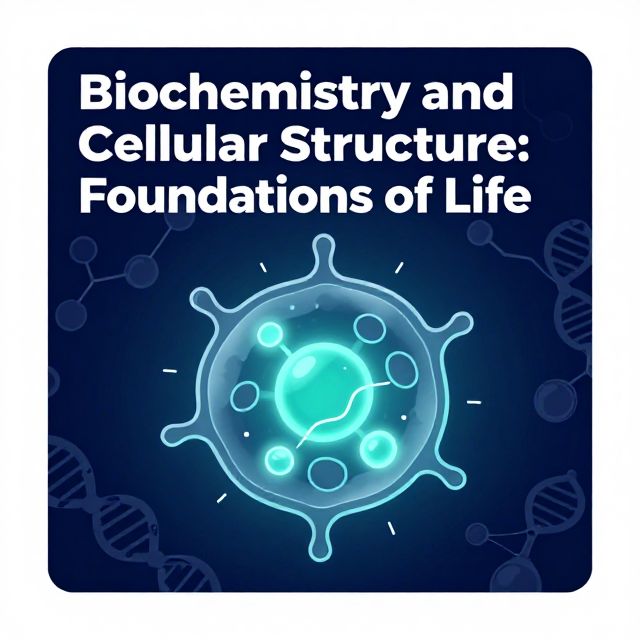
Biochemistry and Cellular Structure: Foundations of Life

This summary explores biochemistry as the chemical basis of life, detailing metabolic processes, cellular organization, and the specialized functions of prokaryotic and eukaryotic cell components.

maysairiApril 7, 2026 ~24 dk toplam
01

Sesli Özet

8 dakika

Konuyu otobüste, koşarken, yolda dinleyerek öğren.

Sesli Özet

Biochemistry and Cellular Structure: Foundations of Life

0:007:30
02

Flash Kartlar

25 kart

Karta tıklayarak çevir. ← → ile gez, ⎵ ile çevir.

1 / 25
Tüm kartları metin olarak gör
  1. 1. What is the fundamental definition of biochemistry?

    Biochemistry is defined as the science concerned with the chemical basis of life. It investigates how non-living molecules within living organisms interact under universal chemical laws to sustain life's continuity. This field explores the chemical processes and substances that occur within living organisms.

  2. 2. From a biochemical perspective, what distinguishes living organisms from non-living entities?

    Living organisms are distinguished by their capacity to perform biochemical processes such as metabolism, growth, reproduction, and response to environmental stimuli. They possess enzyme-driven metabolic reactions, mechanisms for energy production, and utilize genetic information encoded in DNA and RNA, functionalities absent in non-living entities.

  3. 3. Which significant areas does biochemistry encompass?

    Biochemistry encompasses significant areas of cell biology, molecular biology, and molecular genetics. It systematically examines the fundamental biomolecules present in organisms, including carbohydrates, proteins, lipids, and nucleic acids, along with their structures, interactions, and metabolic pathways.

  4. 4. Name the four fundamental biomolecules essential for life and cellular functions.

    The four fundamental biomolecules essential for life and cellular functions are carbohydrates, proteins, lipids, and nucleic acids. Biochemistry studies their structures, interactions, and metabolic pathways, which are crucial for maintaining cellular integrity and biological processes.

  5. 5. Define metabolism and state its vital functions within living cells.

    Metabolism represents the comprehensive biological process encompassing all chemical reactions occurring within living cells. This includes vital functions such as energy production, the synthesis of essential substances, and the elimination of waste products. It is a highly regulated network of pathways that ensures the cell's survival and proper functioning.

  6. 6. List the key metabolic pathways mentioned in the context of carbohydrate, lipid, protein, and nucleic acid metabolism.

    Key metabolic pathways include carbohydrate metabolism (glycolysis, gluconeogenesis, TCA cycle), lipid metabolism (lipogenesis, lipolysis, beta-oxidation), protein and amino acid metabolism (transamination, deamination), and nucleic acid metabolism (synthesis and degradation of DNA and RNA). These pathways are crucial for energy balance and cellular maintenance.

  7. 7. Explain the difference between catabolism and anabolism.

    Catabolism refers to reactions that release free energy by breaking down organic nutrients into simpler end products. Conversely, anabolism involves synthesis reactions that form complex molecules, such as proteins and nucleic acids, from small precursor molecules, requiring energy input. These two processes are interconnected and constitute the entirety of cellular metabolism.

  8. 8. What is the role of ATP in metabolic processes?

    ATP, or adenosine triphosphate, serves as the universal carrier of metabolic energy. It effectively links catabolic and anabolic processes as the primary energy compound. Energy released from catabolic reactions is captured in ATP, which is then utilized to power anabolic reactions and other cellular activities requiring energy.

  9. 9. What is the function of enzymes in cellular chemical reactions?

    Enzymes are biological catalysts that significantly accelerate reaction rates in cellular chemical reactions, often by factors of 10^10 to 10^20. They achieve this by lowering the activation energy required for reactions to proceed, thereby consuming less energy. With the exception of ribozymes, all enzymes involved in metabolism are protein in structure.

  10. 10. Who first discovered cells, and when?

    Cells were first discovered by Robert Hooke in 1665. He observed cork tissue under a microscope and coined the term 'cell' due to the box-like structures he saw, which reminded him of the small rooms (cells) in a monastery.

  11. 11. State the three main postulates of the Cell Theory.

    The Cell Theory, established in 1839, posits three main ideas: first, that all organisms are composed of one or more cells; second, that cells are the fundamental unit of structure and function in all living organisms; and third, that all cells originate from pre-existing cells. This theory is a cornerstone of modern biology.

  12. 12. Describe the hierarchical organization of living systems.

    Living systems exhibit a hierarchical organization, progressing from the simplest to the most complex levels. This hierarchy starts with atoms, which form molecules, then organelles, which are components of cells. Cells combine to form tissues, tissues form organs, organs form organ systems, and finally, all these levels integrate to form a complete organism.

  13. 13. What are the two broad categories of cells, and what is a key distinguishing feature?

    Cells are broadly categorized into prokaryotic and eukaryotic types. A key distinguishing feature is the presence or absence of a true nucleus and membrane-bound organelles. Prokaryotic cells lack these, while eukaryotic cells possess them.

  14. 14. Provide characteristics of prokaryotic cells and give examples.

    Prokaryotic cells are simple and single-celled organisms that lack a true nucleus and extensive internal membranous structures. Their genetic material is typically found in a nucleoid region, not enclosed by a membrane. Examples include bacteria and Archaea, which are among the earliest forms of life.

  15. 15. Provide characteristics of eukaryotic cells and give examples.

    Eukaryotic cells possess a true nucleus, which houses their genetic material, and contain various membrane-bound organelles that perform specialized functions. These cells are typically larger and more complex than prokaryotic cells. Examples include fungi, plants, and animals.

  16. 16. What are the shared features between prokaryotic and eukaryotic cells?

    Despite their differences, both prokaryotic and eukaryotic cells share several fundamental features. These include a cell membrane that encloses the cell, cytoplasm which is the jelly-like substance filling the cell, and genetic material (DNA and RNA) that carries hereditary information. They also both contain ribosomes for protein synthesis.

  17. 17. What is the primary function of the nucleus in a eukaryotic cell?

    The nucleus, the largest organelle in a eukaryotic cell, is enclosed by a double nuclear membrane and controls cellular activities. It contains the cell's genetic material, DNA and RNA, and is responsible for regulating gene expression, thereby dictating protein synthesis and overall cell function.

  18. 18. Explain the roles of DNA and RNA within the nucleus.

    Within the nucleus, DNA carries the genetic information, serving as the blueprint for all cellular structures and activities. RNA facilitates the use of this genetic information for protein production. Specifically, DNA is transcribed into various types of RNA, which then carry the genetic code out of the nucleus to the ribosomes for translation into proteins.

  19. 19. How does cell differentiation relate to gene expression?

    Cell differentiation involves stem cells specializing into distinct cell types as they express specific genes to produce unique proteins. Gene expression is the process by which genetic information from DNA is converted into a functional product, typically a protein, via DNA transcription to RNA and subsequent protein translation. This selective gene activation drives differentiation.

  20. 20. What is the cytoplasm, and what are its main functions?

    The cytoplasm is a jelly-like substance, primarily water, that fills the cell and surrounds the organelles. It serves as a site for chemical storage, holding various molecules and ions necessary for cellular processes. Many metabolic pathways also occur within the cytoplasm, making it a crucial environment for cellular activity.

  21. 21. Describe the function of ribosomes and differentiate between eukaryotic and prokaryotic ribosomes.

    Ribosomes are the sites of protein synthesis, composed of ribosomal RNA and proteins. They translate messenger RNA into polypeptide chains. Eukaryotic ribosomes are larger (80S) and consist of a small subunit for mRNA reading and a large subunit for amino acid linkage, while prokaryotic ribosomes are smaller (70S) but perform the same fundamental function.

  22. 22. What are the two types of endoplasmic reticulum (ER), and what are their respective functions?

    The endoplasmic reticulum (ER) acts as the cell's transport system. Rough ER, studded with ribosomes, is involved in protein folding, quality control, and transport of proteins destined for secretion or insertion into membranes. Smooth ER, lacking ribosomes, is crucial for detoxification, lipid synthesis, and calcium storage within the cell.

  23. 23. What is the primary role of the Golgi apparatus?

    The Golgi apparatus is responsible for modifying, sorting, and packaging lipids and proteins synthesized in the ER. It processes these molecules, often adding carbohydrates to form glycolipids and glycoproteins, and then packages them into vesicles for transport to their final destinations, either within the cell or for secretion outside the cell.

  24. 24. List the key functions of mitochondria.

    Mitochondria are often called the 'powerhouses' of the cell because they primarily produce ATP through aerobic respiration. Beyond energy production, they also regulate calcium levels, initiate apoptosis (programmed cell death), generate heat, and participate in various metabolic pathways like the citric acid cycle. They are unique for possessing their own mitochondrial DNA.

  25. 25. What are lysosomes, and what is their main function?

    Lysosomes are sac-like compartments within the cell that contain powerful digestive enzymes. Their main function is to break down harmful products, waste materials, cellular debris, and foreign invaders such as bacteria and viruses. They act as the cell's recycling and waste disposal system, maintaining cellular health.

03

Bilgini Test Et

15 soru

Çoktan seçmeli sorularla öğrendiklerini ölç. Cevap + açıklama.

Soru 1 / 15Skor: 0

Which of the following best defines biochemistry according to the provided text?

04

Detaylı Özet

6 dk okuma

Tüm konuyu derinlemesine, başlık başlık.

This study material has been compiled from various sources, including copy-pasted text and an audio lecture transcript, to provide a comprehensive overview of biochemistry and cell biology.


📚 Biochemistry and Cell Biology: The Foundations of Life

💡 Introduction to Biochemistry

Biochemistry is the scientific discipline dedicated to understanding the chemical basis of life. It explores how non-living molecules within living organisms interact under universal chemical laws to sustain life's continuity and persistence.

Key Distinctions of Living Organisms (from a biochemical perspective):

  • Perform biochemical processes like metabolism, growth, reproduction, and response to environmental stimuli.
  • Possess enzyme-driven metabolic reactions.
  • Utilize mechanisms for energy production.
  • Employ genetic information (DNA/RNA) for cellular functions.

Biochemistry integrates significant aspects of cell biology, molecular biology, and molecular genetics. It investigates the fundamental biomolecules found in organisms, their structures, interactions, and the pathways they participate in.

📚 Biomolecules: Organic molecules essential for life and cellular functions. The main types include:

  • Carbohydrates
  • Proteins
  • Lipids
  • Nucleic Acids

🔬 Metabolism: The Chemical Engine of Life

Metabolism is the sum of all chemical reactions occurring within living cells. These vital processes include energy production, synthesis of essential substances, and the removal of waste products.

🔄 Metabolic Pathways

Metabolism is organized into specific pathways:

  1. Carbohydrate Metabolism: Involves processes like glycolysis (glucose breakdown), gluconeogenesis (glucose synthesis), and the TCA cycle (energy production).
  2. Lipid Metabolism: Includes lipogenesis (lipid synthesis), lipolysis (lipid breakdown), and β-oxidation (fatty acid breakdown).
  3. Protein and Amino Acid Metabolism: Characterized by transamination (amino group transfer) and deamination (amino group removal).
  4. Nucleic Acid Metabolism: Describes the synthesis and degradation of DNA and RNA.

⚖️ Catabolism vs. Anabolism

Metabolic reactions are broadly categorized into two types:

  • Catabolism: 📉 Reactions that break down complex organic nutrients into simpler end products, releasing free energy. This energy is captured for cellular use.
  • Anabolism: 📈 Synthesis reactions that build complex molecules (e.g., proteins, nucleic acids) from small precursor molecules, requiring energy input.

The entirety of these enzyme-catalyzed pathways constitutes cellular metabolism. Adenosine Triphosphate (ATP) acts as the universal carrier of metabolic energy, linking catabolic and anabolic pathways as the primary energy compound.

⚡ The Role of Enzymes

Every cellular chemical reaction in living organisms is facilitated by enzymes.

  • 📚 Enzymes: Biological catalysts that significantly increase reaction rates (often 10¹⁰–10²⁰ times faster than uncatalyzed reactions) and consume less energy.
  • Most enzymes involved in metabolism are protein in structure, with the exception of ribozymes (RNA enzymes).

🧬 The Cell: The Fundamental Unit of Life

The cell is the basic membrane-bound unit containing the fundamental molecules of life, forming the composition of all living things. It is the basic structural and functional unit of all living organisms.

Key Milestones:

  • 1665: Robert Hooke discovered cells, naming them "cellula" (small room).
  • 1839: The Cell Theory was established, stating:
    1. All organisms are composed of one or more cells.
    2. Cells are the fundamental unit of structure and function in all organisms.
    3. All cells come from pre-existing cells.

📊 Levels of Organization

Living systems exhibit a hierarchical organization, from the simplest to the most complex:

  1. Chemical Level: Atoms, molecules.
  2. Cellular Level: Organelles, cells.
  3. Tissue Level: Tissues.
  4. Organ Level: Organs.
  5. Organ System Level: Organ systems.
  6. Organism Level: The complete organism.

🦠 Types of Cells: Prokaryotic vs. Eukaryotic

Cells are broadly classified into two main types:

| Feature | Prokaryotic Cells | Eukaryotic Cells | | :------------------ | :--------------------------------------------------- | :------------------------------------------------------ | | Meaning | "Before nucleus" (pro: before, karyon: kernel) | "True nucleus" (eu: true, karyon: kernel) | | Nucleus | ❌ No true nucleus | ✅ True nucleus | | Internal Structure | Simple, no extensive internal membranous structures | Complex, contain membrane-bound organelles | | Size | Smaller (1-10 µm) | Larger (5-100 µm) | | Examples | Bacteria, Archaea | Fungi, plants, animals (including some parasites) |

⚠️ Note: Viruses are acellular entities and are neither prokaryotic nor eukaryotic.

🧱 Basic Parts of a Cell

Both prokaryotic and eukaryotic cells share fundamental components:

  • Cell Membrane: Surrounds the cell, controlling substance movement.
  • Cytoplasm: Jelly-like fluid inside the cell where organelles are located and many reactions occur.
  • Genetic Material: Contains genetic information and controls cell activities (DNA/RNA). In eukaryotic cells, DNA is primarily within the nucleus.

🏰 Eukaryotic Cell Architecture: Organelles and Their Functions

Eukaryotic cells possess a complex internal structure with specialized membrane-bound organelles, each performing distinct functions.

  1. Nucleus 🧠

    • Structure: Largest organelle, enclosed by a double nuclear membrane (nuclear envelope), which is continuous with the Endoplasmic Reticulum.
    • Contents: Contains DNA (Deoxyribonucleic acid) and RNA (Ribonucleic acid).
    • Function: Controls cell activities through proteins. DNA carries genetic information, while RNA helps use this information to produce proteins.
    • Cell Differentiation: The process where stem cells become specialized. All cells have the same DNA, but express only certain genes, leading to the production of specific proteins that dictate their unique functions.
    • Gene Expression: The process by which information encoded in a gene is converted into a functional product, typically via transcription of DNA to RNA and then translation into proteins.
  2. Cytoplasm 🌊

    • Structure: Jelly-like substance, primarily water, found between the cell membrane and the nucleus.
    • Function: Site of storage for chemical substances and many metabolic pathways.
  3. Ribosomes 🛠️

    • Structure: Composed of ribosomal RNA (rRNA) and proteins. Consist of a small subunit and a large subunit.
    • Location: Found free in the cytosol or attached to the Endoplasmic Reticulum.
    • Function: Primary sites of protein synthesis.
    • Types:
      • Prokaryotic ribosomes: Smaller (70S).
      • Eukaryotic ribosomes: Larger (80S).
    • Process:
      1. mRNA enters the ribosome (small subunit reads the genetic message).
      2. tRNA brings amino acids.
      3. The large subunit joins amino acids into a polypeptide chain.
      4. The chain folds into a protein.
  4. Endoplasmic Reticulum (ER) 🚚

    • Function: The "transport system" of the cell.
    • Types:
      • Rough ER (RER): Has ribosomes attached to its surface, giving it a "rough" appearance. Involved in protein folding, quality control, and transport of proteins destined for secretion or insertion into membranes.
      • Smooth ER (SER): Lacks ribosomes. Involved in detoxification of poisonous molecules, lipid synthesis (e.g., steroids), and calcium storage.
  5. Golgi Apparatus 📦

    • Function: Modifies, sorts, and packages lipids and proteins (often with carbohydrates to form glycolipids and glycoproteins). Stores and prepares materials (e.g., hormones) for export out of the cell.
  6. Mitochondria 🔋

    • Structure: Double-membraned organelle. Cells requiring more energy (e.g., muscle cells) have more mitochondria. Possess their own mitochondrial DNA (mDNA) and replication method.
    • Function:
      • ATP Production: Primary site of aerobic respiration, producing ATP through oxidative phosphorylation and the electron transport chain.
      • Calcium Storage: Regulate intracellular calcium ion concentrations.
      • Programmed Cell Death (Apoptosis): Initiate and regulate this process for removing damaged cells.
      • Heat Production (Thermogenesis): Generate heat in certain cells.
      • Metabolic Functions: Play roles in metabolic pathways like the citric acid cycle (Krebs cycle).
      • Signaling: Involved in hormone, immune, and intercellular signaling.
  7. Lysosomes ♻️

    • Structure: Sac-like compartments containing powerful digestive enzymes.
    • Function: Break down harmful cell products, waste materials, cellular debris, and foreign invaders (e.g., bacteria). Degrade old, dead cells and participate in phagocytosis of microorganisms.
    • Origin: Derived from the ER and Golgi apparatus.
  8. Peroxisomes 🛡️

    • Structure: Small, single membrane-bound vesicles containing oxidative enzymes like peroxidase and catalase.
    • Function: Involved in lipid metabolism, catabolism of D-amino acids, polyamines, and bile acids. Break down metabolic hydrogen peroxide (H₂O₂), protecting the cell from its harmful effects.
    • Origin: Derived from the ER but can replicate independently.

🔄 Lysosome vs. Peroxisome Comparison

| Feature | Lysosome | Peroxisome | | :------------------ | :------------------------------------------- | :--------------------------------------------- | | Main Function | Breaks down macromolecules; intracellular digestion | Oxidizes organic compounds; breaks down H₂O₂ | | Enzymes | Digestive enzymes | Oxidative enzymes (peroxidase, catalase) | | Protection | Against waste, debris, foreign invaders | Against hydrogen peroxide | | Origin | Derived from ER + Golgi | Derived from ER; can self-replicate | | Size | Large | Small | | Involvement | Endocytosis, autophagy, phagocytosis | Lipid metabolism, catabolism of D-amino acids | | ATP Production | ❌ Do not directly produce ATP | ✅ Can generate ATP through its reactions |


This study material highlights the intricate and interconnected nature of biochemical processes and cellular structures, forming the fundamental basis for all life functions.
Kendi çalışma materyalini oluştur

PDF, YouTube videosu veya herhangi bir konuyu dakikalar içinde podcast, özet, flash kart ve quiz'e dönüştür. 1.000.000+ kullanıcı tercih ediyor.

Sıradaki Konular

Tümünü keşfet
Unlocking Life's Chemistry: An Intro to Biochemistry

Unlocking Life's Chemistry: An Intro to Biochemistry

Explore the fascinating world of biochemistry, understanding the chemical processes and molecules that make life possible, from DNA to energy production.

Özet 25 15
Molecular Bases of Cellular Organization: Nucleic Acids and Cytoplasmic Matrix

Molecular Bases of Cellular Organization: Nucleic Acids and Cytoplasmic Matrix

Explore the fundamental molecular bases of cellular organization, focusing on nucleic acids, the cytoplasmic matrix, and key cytoplasmic differentiations like myosin, actin, and intermediate filaments.

16 dk Özet 25 15
Introduction to Cell and Molecular Biology: History, Methods, and Significance

Introduction to Cell and Molecular Biology: History, Methods, and Significance

Explore the fundamental concepts of cell and molecular biology, tracing its historical development, key scientific discoveries, advanced investigative techniques, and its profound importance in modern medicine.

7 dk Özet 25 15
Molecular Structure of the Cell: Nucleic Acids and Genetic Information

Molecular Structure of the Cell: Nucleic Acids and Genetic Information

Explore the chemical structure of cells, focusing on nucleic acids (DNA and RNA), their components, replication, and roles in protein synthesis and genetic information transfer.

9 dk Özet 25 15
Protein Synthesis and Enzyme Function

Protein Synthesis and Enzyme Function

Explore the intricate process of protein synthesis, from genetic information to functional proteins, and delve into the vital role and classification of enzymes in biological systems.

13 dk Özet 25 15
Understanding Protein Synthesis and Enzyme Function

Understanding Protein Synthesis and Enzyme Function

Explore the intricate process of protein synthesis, from genetic code translation to protein folding, and delve into the vital role and classification of enzymes in biological reactions.

9 dk Özet 25 15
Heme and Cholesterol Metabolism: Essential Biochemical Pathways

Heme and Cholesterol Metabolism: Essential Biochemical Pathways

Explore the vital biochemical pathways of heme and cholesterol, from their intricate synthesis and diverse functions to their regulation, catabolism, and clinical implications in human health.

Özet 25
Understanding the TCA Cycle: Enzymes and Regulation

Understanding the TCA Cycle: Enzymes and Regulation

Explore the intricacies of the Tricarboxylic Acid (TCA) cycle, its key enzymes, regulatory mechanisms, and clinical implications, providing a detailed overview of this central metabolic pathway.

Özet 25 15