Podit
Podit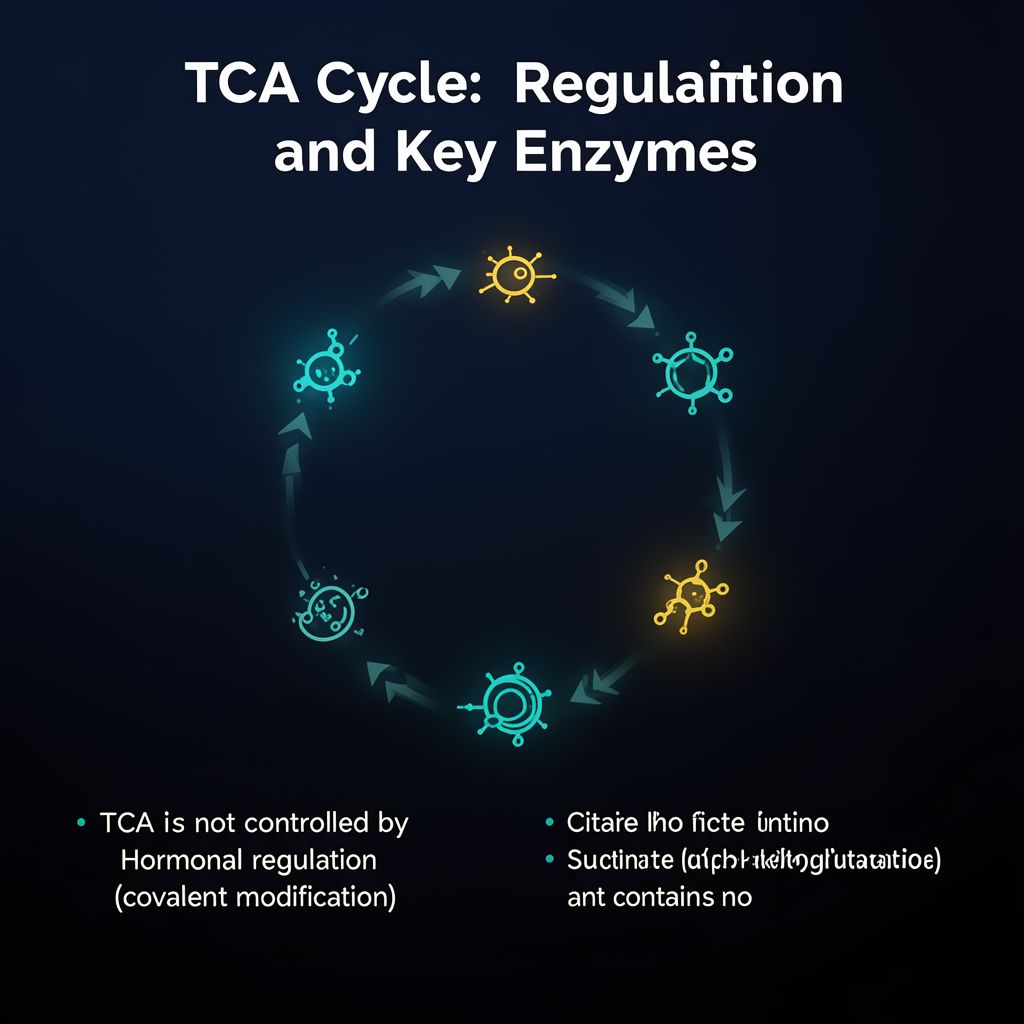
Study Material: The Tricarboxylic Acid (TCA) Cycle
Source Information: This study material has been compiled from a lecture audio transcript and a copy-pasted text provided by the user.
📚 Introduction to the TCA Cycle (Krebs Cycle / Citric Acid Cycle)
The Tricarboxylic Acid (TCA) cycle, also known as the Krebs cycle or Citric Acid Cycle, is a central metabolic pathway crucial for cellular energy production. It serves as the final common pathway for the oxidation of carbohydrates, fats, and amino acids, converting their acetyl groups into carbon dioxide and generating reduced electron carriers (NADH and FADH2) that fuel ATP synthesis in the electron transport chain.
✅ Key Characteristics & Regulation
- Not Hormonally Regulated: Unlike many other metabolic pathways, the TCA cycle is not controlled by hormonal mechanisms involving covalent modification.
- No Phosphorylated Sugars: The cycle does not involve phosphorylated sugar intermediates.
- Mitochondrial Location: All enzymes of the TCA cycle are located in the mitochondrial matrix, except for Succinate Dehydrogenase, which is embedded in the inner mitochondrial membrane.
⚡ Energy Production from One Acetyl CoA
One complete turn of the TCA cycle, starting from a single molecule of Acetyl CoA, yields significant energy:
- 3 NADH molecules: Each NADH contributes approximately 2.5 ATP via oxidative phosphorylation.
- Total: 3 * 2.5 = 7.5 ATP
- 1 FADH2 molecule: Each FADH2 contributes approximately 1.5 ATP via oxidative phosphorylation.
- Total: 1 * 1.5 = 1.5 ATP
- 1 GTP molecule: Produced via substrate-level phosphorylation, energetically equivalent to 1 ATP.
- Total: 1 ATP
- Overall Yield: Approximately 10 ATP molecules per Acetyl CoA.
⚙️ The TCA Cycle Steps: Enzymes and Reactions
The cycle begins with the condensation of Acetyl CoA and oxaloacetate and proceeds through a series of eight enzymatic reactions.
1️⃣ Citrate Synthase
- Reaction: Acetyl CoA + Oxaloacetate → Citrate
- Type: Condensation (Aldol Condensation)
- Rate-Limiting Step: Yes, this is a crucial regulatory point.
- Regulation:
- Inhibitors: High levels of ATP, Citrate (feedback inhibition).
- 💡 Role of Citrate: Beyond being a cycle intermediate, citrate is vital for:
- Providing Acetyl CoA for fatty acid, cholesterol, and ketone body synthesis.
- Activating Acetyl CoA carboxylase (fatty acid synthesis).
- Inhibiting Phosphofructokinase-1 (PFK-1) in glycolysis, coordinating carbohydrate and lipid metabolism.
2️⃣ Aconitase
- Reaction: Citrate ⇌ Isocitrate
- Type: Dehydration followed by Hydration.
- Features:
- Contains an iron-sulfur (Fe-S) cluster.
- Considered a 'moonlighting enzyme' 🌙: It functions in both the TCA cycle and iron metabolism.
- Regulation:
- Inhibitor: Fluoroacetate.
- Enzyme Class: Lyase.
3️⃣ Isocitrate Dehydrogenase (IDH)
- Reaction: Isocitrate → α-Ketoglutarate
- Type: Oxidative Decarboxylation.
- Rate-Limiting Step: Yes, another key regulatory point.
- Products: NADH, CO2.
- Cofactors: Mg²⁺, Mn²⁺.
- Regulation:
- Activators: ADP, Ca²⁺, Isocitrate (signals low energy and substrate availability).
- ⚠️ Clinical Relevance:
- Mutations in IDH are frequently observed in Acute Myeloid Leukemia (AML) and Glioma.
- Mutant IDH produces 2-hydroxyglutarate, an oncometabolite implicated in cancer development.
4️⃣ α-Ketoglutarate Dehydrogenase Complex
- Reaction: α-Ketoglutarate → Succinyl CoA
- Type: Oxidative Decarboxylation.
- Rate-Limiting Step: Yes, the third major regulatory step.
- Products: NADH, CO2.
- Coenzymes: This complex requires a suite of coenzymes:
- Thiamine pyrophosphate (TPP, from Vitamin B1)
- FAD (from Vitamin B2)
- NAD⁺ (from Vitamin B3)
- Coenzyme A (from Vitamin B5)
- Lipoic acid
- Regulation:
- Activators: ADP, Ca²⁺.
- Inhibitors: NADH, ATP, Arsenite.
- 💡 Similarity: This complex shares many characteristics with the Pyruvate Dehydrogenase complex.
5️⃣ Succinyl CoA Synthetase (Succinate Thiokinase)
- Reaction: Succinyl CoA → Succinate
- Type: Substrate-Level Phosphorylation.
- Product: GTP (energetically equivalent to ATP).
- Features: Succinyl CoA is a high-energy thioester compound, driving GTP synthesis.
- Interconnections: Succinyl CoA is also an intermediate in heme synthesis and the breakdown of odd-chain fatty acids.
6️⃣ Succinate Dehydrogenase (SDH)
- Reaction: Succinate → Fumarate
- Type: Oxidation.
- Location: Uniquely embedded in the inner mitochondrial membrane.
- Product: FADH2.
- Dual Role: This enzyme is unique as it functions in both the TCA cycle and the Electron Transport Chain (as Complex II), directly linking the two pathways.
- Regulation:
- Competitive Inhibitor: Malonate.
- ⚠️ Clinical Relevance:
- Mutations in SDH are associated with Hereditary Paraganglioma.
- Interconnections: Fumarate connects the TCA cycle with the urea cycle.
7️⃣ Fumarase
- Reaction: Fumarate → Malate
- Type: Hydration (addition of water).
- Enzyme Class: Lyase.
- ⚠️ Clinical Relevance:
- Fumarase mutations can lead to severe neurological conditions like microcephaly, hypotonia, and frontal bossing.
- Also linked to Uterine Leiomyoma.
8️⃣ Malate Dehydrogenase
- Reaction: Malate → Oxaloacetate
- Type: Oxidation.
- Product: NADH.
- Cycle Completion: This reaction regenerates oxaloacetate, allowing the cycle to continue.
This intricate series of reactions ensures the continuous and efficient production of energy for cellular functions, highlighting the TCA cycle's central role in metabolism.