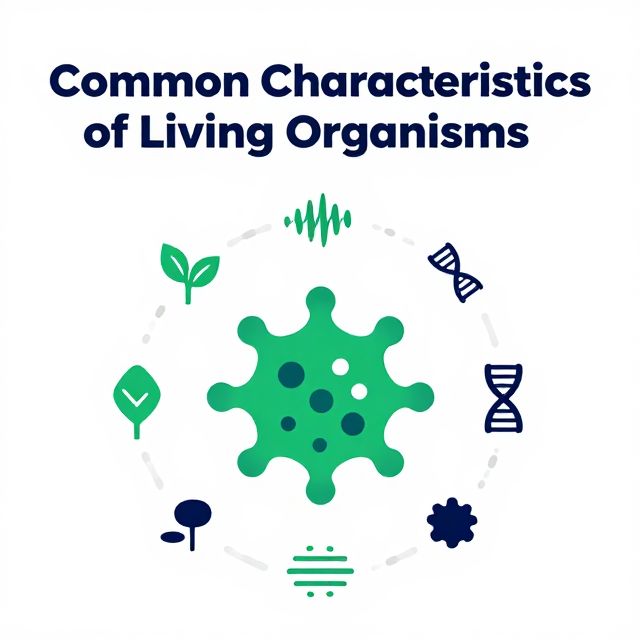
Common Characteristics of Living Organisms - kapak
Bilim#biology#living organisms#characteristics of life#metabolism

Common Characteristics of Living Organisms

An academic summary detailing the fundamental properties that define living organisms, including cellular organization, metabolism, reproduction, growth, and adaptation, for foundational biological understanding.

riverskyMarch 18, 2026 ~21 dk toplam
01

Sesli Özet

6 dakika

Konuyu otobüste, koşarken, yolda dinleyerek öğren.

Sesli Özet

Common Characteristics of Living Organisms

0:006:25
02

Flash Kartlar

25 kart

Karta tıklayarak çevir. ← → ile gez, ⎵ ile çevir.

1 / 25
Tüm kartları metin olarak gör
  1. 1. What fundamental properties distinguish living organisms from non-living matter?

    Living organisms possess a set of fundamental properties that collectively differentiate them from non-living matter. These include cellular organization, metabolism, reproduction, growth, development, response to stimuli, homeostasis, and adaptation. These characteristics are universally observed across all known life forms, from bacteria to complex multicellular organisms, providing a comprehensive framework for understanding biological principles.

  2. 2. What is the basic structural and functional unit of life?

    The basic structural and functional unit of life is the cell. All living organisms are composed of one or more cells, which perform all essential life processes. Cells themselves exhibit internal organization, containing various structures that carry out specific functions necessary for the organism's survival and perpetuation.

  3. 3. How are organisms broadly categorized based on their cellular composition?

    Organisms are broadly categorized as unicellular or multicellular based on their cellular composition. Unicellular organisms, like bacteria and protozoa, consist of a single cell. Multicellular organisms, such as plants and animals, are composed of numerous specialized cells organized into tissues, organs, and organ systems, demonstrating a higher level of complexity.

  4. 4. Differentiate between prokaryotic and eukaryotic cells based on their internal organization.

    Prokaryotic cells lack a membrane-bound nucleus and other membrane-bound organelles, meaning their genetic material is free within the cytoplasm. In contrast, eukaryotic cells possess a true nucleus that encloses their genetic material, as well as various membrane-bound organelles like mitochondria and endoplasmic reticulum. This internal complexity allows eukaryotic cells to perform more specialized functions.

  5. 5. Describe the hierarchical organization of life, starting from the most basic level mentioned.

    The hierarchical organization of life extends from the simplest components to the most complex. It begins with atoms, which combine to form molecules, then macromolecules. These macromolecules assemble into organelles, which are components of cells. Cells then organize into tissues, tissues into organs, organs into organ systems, and finally, all these levels combine to form a complete organism.

  6. 6. Define metabolism and its two main categories.

    Metabolism is defined as the sum of all chemical reactions occurring within an organism, meticulously regulated to sustain life processes. It is broadly divided into two main categories: anabolism and catabolism. Anabolism involves the synthesis of complex molecules from simpler ones, requiring energy input, while catabolism entails the breakdown of complex molecules into simpler ones, releasing energy.

  7. 7. Explain the difference between anabolism and catabolism.

    Anabolism and catabolism are the two main categories of metabolism. Anabolism refers to constructive metabolic processes where complex molecules are synthesized from simpler ones, such as protein synthesis from amino acids, and these processes typically require an input of energy. Conversely, catabolism involves destructive metabolic processes where complex molecules are broken down into simpler ones, like the digestion of food, which releases energy for cellular activities.

  8. 8. How do organisms primarily acquire energy for their metabolic activities?

    Organisms primarily acquire energy for their metabolic activities through processes like cellular respiration or photosynthesis. Cellular respiration involves the breakdown of organic molecules to release energy, which is common in heterotrophic organisms. Photosynthesis, on the other hand, is utilized by autotrophic organisms to convert light energy into chemical energy, forming the basis of most food chains.

  9. 9. What is nutrition, and how do autotrophic and heterotrophic organisms differ in their nutritional strategies?

    Nutrition is the process by which organisms obtain and utilize food substances for energy, growth, and repair. Autotrophic organisms, such as plants and some bacteria, produce their own food, typically through photosynthesis or chemosynthesis, making them self-sufficient. Heterotrophic organisms, including animals and fungi, obtain nutrients by consuming other organisms or organic matter, relying on external food sources.

  10. 10. Define respiration and mention the two main types based on oxygen presence.

    Respiration is the process of releasing chemical energy from food molecules to power cellular activities. This vital process can occur in two main ways: aerobically, which requires oxygen, or anaerobically, which happens in the absence of oxygen. Both aerobic and anaerobic respiration ultimately yield adenosine triphosphate (ATP), which serves as the primary energy currency of the cell.

  11. 11. What is the significance of excretion in living organisms?

    Excretion is a crucial process for living organisms, involving the removal of metabolic waste products from the body. Its significance lies in maintaining the internal balance, or homeostasis, of the organism. By eliminating toxic substances and excess materials, excretion prevents their accumulation, which could otherwise disrupt cellular functions and lead to harmful effects, ensuring optimal physiological conditions.

  12. 12. Provide examples of movement observed in living organisms, ranging from microscopic to macroscopic.

    Movement in living organisms encompasses a wide spectrum, from the macroscopic locomotion of animals, such as walking or flying, to more subtle internal processes. Examples include the intracellular streaming of cytoplasm within cells, the growth of plant roots actively moving towards water sources, or the bending of plant stems towards light. Even seemingly stationary organisms exhibit some form of movement at a cellular or growth level.

  13. 13. What is meant by "response to stimuli" or "irritability" in living organisms?

    Response to stimuli, also known as irritability, refers to the ability of organisms to detect and react to changes in their internal or external environment. These stimuli can include factors like light, temperature, touch, or chemical signals. This responsiveness is vital for survival, allowing organisms to find food, avoid danger, and adapt to changing conditions, thereby maintaining their well-being.

  14. 14. Define homeostasis and provide examples of how it is maintained in mammals.

    Homeostasis is the ability of living organisms to maintain a stable internal environment despite external fluctuations. This regulatory process ensures optimal conditions for cellular functions. In mammals, examples include the precise regulation of body temperature, maintaining a stable pH balance in blood, and controlling blood glucose levels within a narrow range, all crucial for survival and proper physiological functioning.

  15. 15. What is reproduction, and what are the two main types?

    Reproduction is the fundamental process by which organisms produce offspring, ensuring the continuation of their species. There are two main types: asexual reproduction and sexual reproduction. Asexual reproduction involves a single parent producing genetically identical progeny, while sexual reproduction involves two parents, leading to genetic recombination and increased diversity within the offspring.

  16. 16. Differentiate between asexual and sexual reproduction.

    Asexual reproduction involves a single parent producing offspring that are genetically identical to itself, often through processes like budding or binary fission. This method is efficient for rapid population growth in stable environments. Sexual reproduction, conversely, typically involves two parents contributing genetic material, leading to offspring with a combination of traits from both parents, which introduces genetic recombination and diversity, crucial for adaptation in changing environments.

  17. 17. Explain the concepts of growth and development in living organisms.

    Growth in living organisms refers to an irreversible increase in size and mass, typically achieved through cell division and cell enlargement. Development, on the other hand, encompasses the series of progressive changes an organism undergoes throughout its entire life cycle. This includes maturation, the differentiation of cells into specialized types, and the formation of complex structures, leading to a fully functional organism.

  18. 18. What are adaptation and evolution, and how are they related?

    Adaptation refers to specific traits or characteristics that enhance an organism's survival and reproductive success in a particular environment. Evolution is the process by which populations of organisms undergo changes over successive generations, leading to the development of these adaptations. These two concepts are intrinsically linked, as adaptations are the result of evolutionary processes, primarily driven by mechanisms like natural selection, shaping the diversity of life.

  19. 19. What is the role of natural selection in adaptation and evolution?

    Natural selection is a primary mechanism driving adaptation and evolution. It acts on the variation within a population, favoring individuals with traits that are better suited to their environment. These advantageous traits increase an individual's chances of survival and reproduction, leading to their more frequent inheritance by subsequent generations. Over long periods, this differential survival and reproduction result in populations becoming better adapted to their environment and ultimately in evolutionary change.

  20. 20. What is the primary energy currency of the cell, produced during respiration?

    The primary energy currency of the cell, produced during respiration, is adenosine triphosphate, or ATP. ATP molecules store and release energy in their chemical bonds, providing the immediate energy source for nearly all cellular activities, including muscle contraction, active transport, and synthesis of macromolecules. Both aerobic and anaerobic respiration pathways aim to generate ATP for the cell's energy needs.

  21. 21. What is the significance of maintaining internal balance in an organism?

    Maintaining internal balance, known as homeostasis, is of paramount significance for an organism's survival. It ensures that critical physiological parameters, such as temperature, pH, and nutrient levels, remain within optimal ranges despite external fluctuations. This stability is essential for enzymes to function correctly, for metabolic reactions to proceed efficiently, and for cells to operate effectively, preventing damage and ensuring overall health.

  22. 22. How do cells themselves exhibit internal organization?

    Cells themselves exhibit internal organization through the presence of various structures, each with specialized functions. Eukaryotic cells, for instance, possess a membrane-bound nucleus containing genetic material and organelles like mitochondria for energy production, endoplasmic reticulum for protein and lipid synthesis, and Golgi apparatus for modification and transport. Even prokaryotic cells, though simpler, have organized components like ribosomes and a nucleoid region.

  23. 23. What is the overarching characteristic that explains the diversity and interconnectedness of life on Earth?

    The overarching characteristic that explains the diversity and interconnectedness of life on Earth is adaptation and evolution. Through evolutionary changes over successive generations, populations develop specific adaptations that enhance their survival and reproductive success in particular environments. This dynamic process, driven by natural selection, has led to the vast array of life forms we observe and highlights the shared ancestry and relationships among all living things.

  24. 24. What is the difference between photosynthesis and cellular respiration in terms of energy?

    Photosynthesis and cellular respiration are complementary processes with opposite energy flows. Photosynthesis is the process by which autotrophic organisms convert light energy into chemical energy, storing it in organic molecules like glucose. Cellular respiration, conversely, is the process by which organisms break down these organic molecules to release the stored chemical energy, primarily in the form of ATP, for cellular activities.

  25. 25. Why is the intricate and ordered complexity considered a hallmark of all living systems?

    The intricate and ordered complexity is considered a hallmark of all living systems because life is organized hierarchically, from atoms to molecules, cells, tissues, organs, and ultimately, the complete organism. Each level builds upon the previous one with increasing complexity and specific functions. This highly structured arrangement, from the internal organization of a cell to the coordination of organ systems, is essential for maintaining life processes and distinguishing living matter from non-living matter.

03

Bilgini Test Et

15 soru

Çoktan seçmeli sorularla öğrendiklerini ölç. Cevap + açıklama.

Soru 1 / 15Skor: 0

Which of the following is considered the basic structural and functional unit of life, according to the text?

04

Detaylı Özet

5 dk okuma

Tüm konuyu derinlemesine, başlık başlık.

This content is based on a YouTube video.


📚 Common Characteristics of Living Organisms

Introduction

Despite the vast diversity in form, size, and habitat, all living organisms share a fundamental set of properties that distinguish them from non-living matter. These defining characteristics are universally observed across all known life forms, from the simplest bacteria to the most complex multicellular organisms. This study material systematically outlines these essential attributes, providing a comprehensive framework for understanding the biological principles that underpin life itself. We will explore aspects ranging from the basic unit of life, the cell, to complex processes like metabolism, reproduction, and adaptation, establishing a foundational understanding for advanced biological studies.


1. 🔬 Cellular Organization: The Basic Unit of Life

The first and most fundamental characteristic of life is cellular organization. ✅ All living organisms are composed of one or more cells, which serve as the basic structural and functional units of life.

Types of Organisms by Cell Number:

  • Unicellular Organisms: Consist of a single cell.
    • Examples: Bacteria, Protozoa.
  • Multicellular Organisms: Comprise numerous specialized cells organized into higher levels of structure.
    • Examples: Plants, Animals. These cells work together, forming tissues, organs, and organ systems.

Types of Cells by Internal Structure:

Cells themselves exhibit intricate internal organization:

  • Prokaryotic Cells:
    • Lack a membrane-bound nucleus.
    • Lack membrane-bound organelles.
    • Generally simpler in structure.
  • Eukaryotic Cells:
    • Possess a membrane-bound nucleus, which houses the genetic material.
    • Contain various membrane-bound organelles (e.g., mitochondria, endoplasmic reticulum, Golgi apparatus) that perform specialized functions.
    • Generally more complex and larger than prokaryotic cells.

Hierarchical Organization:

The intricate and ordered complexity of life extends beyond the cellular level, forming a hierarchy:

  1. Atoms: The basic building blocks of matter.
  2. Molecules: Combinations of atoms (e.g., water, glucose).
  3. Macromolecules: Large, complex molecules essential for life (e.g., proteins, nucleic acids).
  4. Organelles: Specialized structures within cells that perform specific functions (e.g., mitochondria, ribosomes).
  5. Cells: The fundamental unit of life.
  6. Tissues: Groups of similar cells working together to perform a specific function (e.g., muscle tissue, nervous tissue).
  7. Organs: Structures composed of multiple tissues working together (e.g., heart, stomach).
  8. Organ Systems: Groups of organs that cooperate to perform major functions (e.g., digestive system, circulatory system).
  9. Organism: A complete living being.

This hierarchical organization is a hallmark of all living systems, demonstrating a remarkable level of order and complexity.


2. ⚡ Metabolism: The Sum of Chemical Reactions

Central to the maintenance of life is metabolism, which encompasses the sum of all chemical reactions occurring within an organism. ✅ These reactions are meticulously regulated and essential for sustaining life processes.

Categories of Metabolism:

  • Anabolism:
    • Involves the synthesis of complex molecules from simpler ones.
    • Requires an input of energy.
    • Example: Photosynthesis, protein synthesis.
  • Catabolism:
    • Entails the breakdown of complex molecules into simpler ones.
    • Releases energy.
    • Example: Cellular respiration, digestion.

Energy Acquisition:

Energy for metabolic activities is primarily acquired through:

  • Cellular Respiration: Organic molecules are broken down to release energy.
  • Photosynthesis: Light energy is converted into chemical energy by autotrophic organisms.

3. 🍎 Nutrition: Obtaining and Utilizing Food

Nutrition is the process by which organisms obtain and utilize food substances for energy, growth, and repair.

Nutritional Strategies:

  • Autotrophic Organisms:
    • Produce their own food.
    • Examples: Plants and some bacteria (typically through photosynthesis or chemosynthesis).
  • Heterotrophic Organisms:
    • Obtain nutrients by consuming other organisms or organic matter.
    • Examples: Animals, Fungi.

4. 🌬️ Respiration: Energy Release

Following nutrient acquisition, respiration is the process of releasing chemical energy from food molecules. ✅ This process yields Adenosine Triphosphate (ATP), the primary energy currency of the cell.

Types of Respiration:

  • Aerobic Respiration: Requires oxygen.
  • Anaerobic Respiration: Occurs in the absence of oxygen.

5. 🚽 Excretion: Waste Removal

The removal of metabolic waste products is achieved through excretion. ✅ This is a crucial process for maintaining internal balance and preventing the accumulation of toxic substances.


6. 🚶 Movement: Internal and External

All living organisms exhibit some form of movement.

  • Macroscopic Movement: Locomotion of entire organisms (e.g., animals walking, birds flying).
  • Microscopic/Intracellular Movement: Subtle movements within cells (e.g., cytoplasmic streaming) or growth-related movements (e.g., plant roots growing towards water).

7. 💡 Response to Stimuli (Irritability)

Organisms detect and react to changes in their internal or external environment, a characteristic known as response to stimuli or irritability. ✅ This responsiveness is vital for survival and adaptation.

  • Examples: Reacting to light, temperature, touch, or chemical signals.

8. ⚖️ Homeostasis: Maintaining Internal Balance

Homeostasis is the ability to maintain a stable internal environment despite external fluctuations. ✅ This regulatory ability ensures optimal conditions for cellular functions.

  • Examples: Temperature regulation, pH balance, blood glucose control in mammals.

9. 🧬 Reproduction: Perpetuating the Species

Reproduction is the process by which organisms produce offspring, ensuring the continuation of life.

Modes of Reproduction:

  • Asexual Reproduction:
    • Involves a single parent.
    • Produces genetically identical progeny.
  • Sexual Reproduction:
    • Involves two parents.
    • Leads to genetic recombination and diversity.

10. 🌱 Growth and Development: Life Cycle Progression

All living organisms undergo growth and development.

  • Growth: An irreversible increase in size and mass, typically through cell division and enlargement.
  • Development: Encompasses the series of progressive changes an organism undergoes throughout its life cycle, leading to maturation, differentiation of cells, and the formation of specialized structures.

11. 📈 Adaptation and Evolution: Change Over Time

Adaptation and evolution are overarching characteristics that explain the diversity of life. ✅ Over successive generations, populations of organisms undergo evolutionary changes, developing specific adaptations that enhance their survival and reproductive success in particular environments.

  • This dynamic process, driven by mechanisms like natural selection, explains the diversity and interconnectedness of life on Earth.

Conclusion: The Unifying Principles of Life

The common characteristics of living organisms—cellular organization, intricate hierarchical organization, regulated metabolism, diverse nutritional strategies, energy release through respiration, waste elimination via excretion, various forms of movement, responsiveness to environmental stimuli, maintenance of internal homeostasis, the capacity for reproduction, sustained growth and development, and the overarching ability to adapt and evolve—collectively define the essence of life. These interconnected and interdependent properties demonstrate the profound complexity, dynamic nature, and remarkable resilience of biological systems. A thorough understanding of these fundamental principles is paramount for any comprehensive study in biology, providing a unified perspective on the diverse and interconnected forms of life inhabiting our planet.
Kendi çalışma materyalini oluştur

PDF, YouTube videosu veya herhangi bir konuyu dakikalar içinde podcast, özet, flash kart ve quiz'e dönüştür. 1.000.000+ kullanıcı tercih ediyor.

Sıradaki Konular

Tümünü keşfet
Common Characteristics of Living Organisms

Common Characteristics of Living Organisms

An academic summary detailing the fundamental characteristics shared by all living organisms, including cellular organization, metabolism, homeostasis, reproduction, growth, response to stimuli, and adaptation.

5 dk Özet 25 15
Introduction to Basic Genetics

Introduction to Basic Genetics

Explore the fundamental principles of genetics, from cell theory and the nature of genetic material to heredity, cell division, and the diverse branches of genetic study.

Özet 25 15
Unlocking Life's Chemistry: An Intro to Biochemistry

Unlocking Life's Chemistry: An Intro to Biochemistry

Explore the fascinating world of biochemistry, understanding the chemical processes and molecules that make life possible, from DNA to energy production.

Özet 25 15
Understanding Reproduction: Sexual, Asexual, Plant, and Human Systems

Understanding Reproduction: Sexual, Asexual, Plant, and Human Systems

Explore the fundamental mechanisms of reproduction, from the genetic diversity of sexual reproduction to the efficiency of asexual methods, covering plant and human reproductive processes in detail.

12 dk Özet
Understanding Core Biological Concepts

Understanding Core Biological Concepts

Explore fundamental biological concepts including human body systems, nutrition, photosynthesis, respiration, reproduction, and key ecological principles.

4 dk Özet
The Nervous and Endocrine Systems: Body's Control Centers

The Nervous and Endocrine Systems: Body's Control Centers

Explore the intricate workings of the nervous and endocrine systems, their structures, functions, and how they maintain the body's homeostasis.

Özet 25 15 Görsel
Riboflavin and Niacin: Essential B Vitamins

Riboflavin and Niacin: Essential B Vitamins

Explore the absorption, functions, metabolism, and clinical aspects of Riboflavin (Vitamin B2) and Niacin (Vitamin B3), including their roles as coenzymes and implications of deficiency and toxicity.

Özet 15
Understanding Connective Tissues and Their Cells

Understanding Connective Tissues and Their Cells

Explore the fundamental types, structures, and cellular components of connective tissues, including their crucial roles in the body's support, protection, and immunity.

Özet 25 15