 Podit
Podit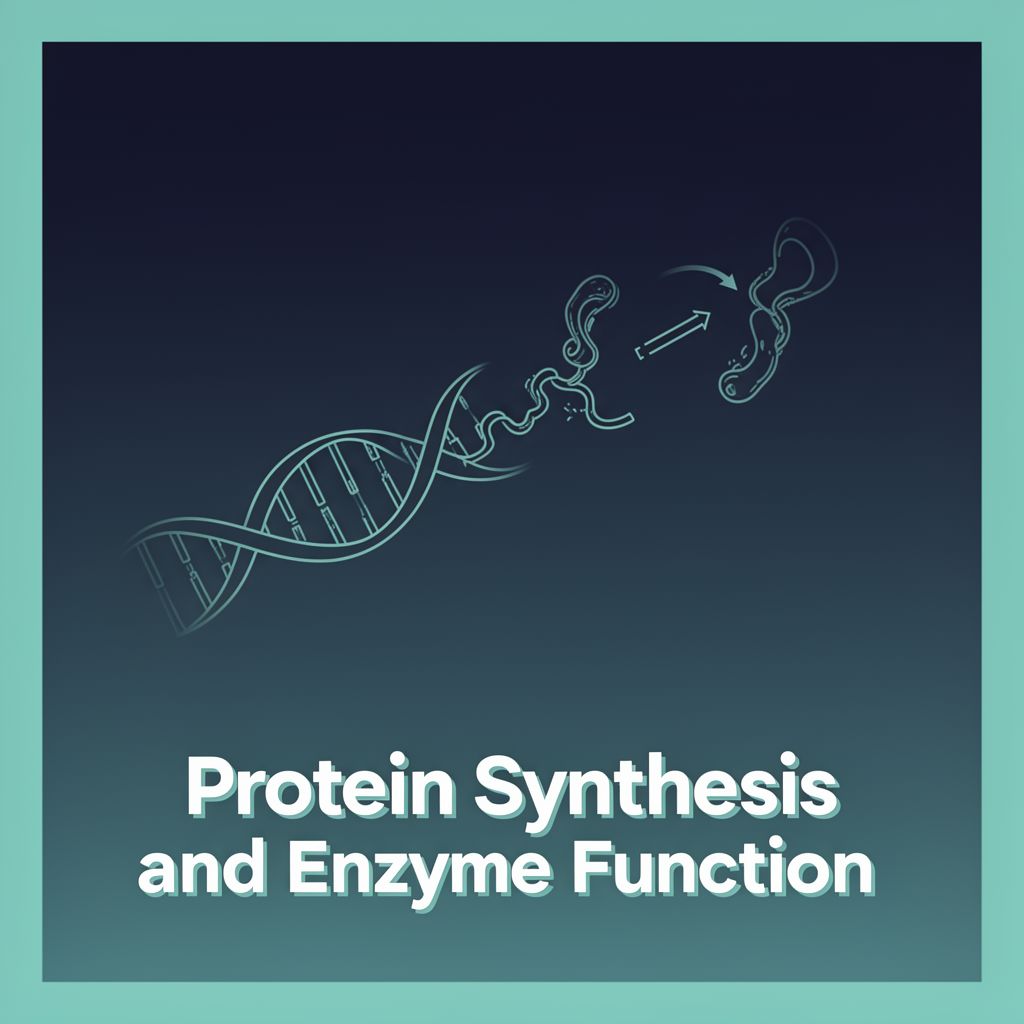
This study material has been compiled from various sources, including copy-pasted text and a lecture audio transcript, to provide a comprehensive overview of protein synthesis and enzyme function.
🧬 Protein Synthesis and Enzyme Function: A Comprehensive Guide
Introduction
Protein synthesis is a fundamental biological process where cells build proteins, the workhorses of the cell, based on genetic information. This intricate process is essential for all life forms, enabling growth, repair, and the execution of countless cellular functions. Closely related to protein function are enzymes, which are primarily proteins that act as biological catalysts, accelerating biochemical reactions vital for life. This guide will delve into the mechanisms of protein synthesis and the critical roles and characteristics of enzymes.
1. Protein Synthesis: Building the Molecules of Life
1.1. Prerequisites for Protein Synthesis
For the complex process of protein synthesis to occur efficiently, several key components must be present:
- ✅ DNA: Contains the genetic blueprint for protein sequences.
- ✅ Activating Enzymes: Specifically, aminoacyl tRNA synthetases.
- ✅ Three Types of RNA:
- mRNA (messenger RNA): Carries the genetic message from DNA.
- tRNA (transfer RNA): Transports specific amino acids to the ribosome.
- rRNA (ribosomal RNA): Forms the structural and catalytic core of ribosomes.
- ✅ Ribosomes: The cellular machinery where protein synthesis takes place.
- ✅ Protein Factors: Various initiation, elongation, and termination factors.
- ✅ Energy Molecules: ATP (Adenosine Triphosphate) and GTP (Guanosine Triphosphate) for energy supply.
- ✅ Mg+2 Ions: Essential cofactors for various enzymatic steps.
1.2. Overview of Protein Synthesis Stages
Protein synthesis, also known as translation, involves converting the genetic information encoded in mRNA into a sequence of amino acids. The process generally follows these steps:
- An mRNA copy of the DNA information (gene) is made.
- mRNA carries this message to the ribosomes.
- Ribosomes read the mRNA message in triple base groups (codons), each specifying an amino acid.
- The protein chain grows by adding amino acids sequentially, typically from the NH2 (amino-terminal) end to the COOH (carboxyl-terminal) end.
- tRNA molecules with complementary anticodons bring the appropriate amino acids to the ribosome.
- The process continues until a stop codon is reached, signaling completion.
- The newly synthesized protein folds into its active three-dimensional configuration.
1.3. Amino Acid Activation: The Pre-Synthesis Step
Before protein synthesis can begin, amino acids must be activated and linked to their specific tRNA molecules.
- Activation Enzyme: This process is catalyzed by aminoacyl tRNA synthetase enzymes.
- Recognition: Each synthetase enzyme recognizes a specific amino acid and its corresponding tRNA.
- Enzyme Structure: These enzymes typically have a molecular weight of ~100,000 daltons and possess three specific binding sites:
- For the amino acid to be activated.
- For ATP (energy source).
- For the specific tRNA molecule.
- Loading: The amino acid's carboxyl group attaches to the 3’-OH group of the adenine nucleotide on the tRNA. This binding is called loading.
- Proofreading: Aminoacyl tRNA synthetase is crucial for accuracy. If a wrong amino acid is attached to a tRNA, the enzyme recognizes this error and hydrolyzes (removes) the incorrect amino acid from the 3’ end of the tRNA.
- Energy & Cofactor: Both ATP and Mg+2 ions are utilized in this activation step.
1.4. The Three Main Stages of Protein Synthesis (Translation)
Protein synthesis proceeds through three highly conserved stages in both prokaryotes and eukaryotes:
1.4.1. 1️⃣ Initiation
- Definition: The process of converting genetic information from RNA bases (Adenine, Guanine, Cytosine, Uracil) into an amino acid sequence.
- Start Codon: Translation universally begins with the start codon, AUG.
- First Amino Acid: AUG also codes for the amino acid methionine. Therefore, methionine is typically the first amino acid in every newly synthesized protein.
- Mechanism: The first aminoacyl-tRNA (carrying methionine) attaches to the ribosome, forming a hydrogen bond with the AUG start codon on the mRNA.
1.4.2. 2️⃣ Elongation
- Polypeptide Chain Growth: After initiation, the ribosome moves along the mRNA in the 5’ → 3’ direction, adding new amino acids to the growing polypeptide chain.
- tRNA-Codon Complex: An appropriate tRNA with its anticodon pairs with the next codon on the mRNA.
- Peptide Bond Formation: A peptide bond is formed between the carboxyl group of the previous amino acid and the amine group of the incoming amino acid. This is a dehydration reaction, releasing one molecule of water.
- tRNA Release: After peptide bond formation, the now "unloaded" tRNA detaches from the ribosome and returns to the cytoplasm to pick up another amino acid.
- Continuation: Elongation continues until a stop codon is encountered (e.g., UAG).
1.4.3. 3️⃣ Termination
- Stop Codons: Elongation ceases when the ribosome reaches a stop codon on the mRNA. The universal stop codons are UAA, UAG, and UGA.
- Release Factors: Ribosomes require specific protein factors, called termination factors or release factors, to recognize these stop codons.
- Process: These factors bind to the stop codon, triggering the release of the completed polypeptide chain from the ribosome.
- Ribosome Disassembly: Following termination, the unloaded tRNA molecules leave the ribosome, and the ribosomal subunits separate, ready for a new round of synthesis.
1.5. Polysomes (Polyribosomes)
💡 Efficiency Boost: mRNA translation can be performed simultaneously by numerous ribosomes in both prokaryotes and eukaryotes.
- Definition: A complex of multiple ribosomes translating the same mRNA molecule is called a polyribosome or polysome.
- Function: An average of 8-10 ribosomes can form a polysome, allowing for the simultaneous synthesis of a considerable amount of protein from a single mRNA molecule, significantly increasing protein production efficiency.
1.6. Protein Folding and Maturation
After synthesis, proteins undergo crucial modifications to become functional:
- 3D Configuration: The primary amino acid sequence folds into specific secondary (e.g., alpha helix, beta sheet), tertiary, and sometimes quaternary structures. This folding is driven by electrostatic interactions between amino acid side chains.
- Location-Dependent Maturation:
- Free Ribosomes (Cytoplasm): Synthesize structural proteins that the cell retains for its own use.
- Ribosomes on Endoplasmic Reticulum (ER): Synthesize proteins destined for secretion, insertion into membranes, or delivery to organelles like lysosomes. These proteins are often sent to the Golgi apparatus for further processing and maturation (e.g., integral membrane proteins, lysosomal secretion proteins).
- Functional Form: The specific 3D shape is critical for the protein's biological activity.
1.7. Protein Lifespan and Regulation
- Dynamic Turnover: Proteins generally have a short lifespan and are rapidly broken down into their constituent amino acids.
- Regulation: This continuous synthesis and degradation process regulates enzyme levels, prevents the accumulation of abnormal proteins, and controls tissue growth.
- Error Prevention: Protein synthesis is a complex process with built-in safeguards against errors in genetic information transfer. Even a single misplaced amino acid can lead to serious problems due to protein specificity.
1.8. Protein Specificity and Transplantation
- Unique Identity: Each living being possesses proteins specific to itself, contributing to its individual distinctive features.
- Transplantation Challenge: This specificity is critical in organ transplantation. The recipient's immune system recognizes donor proteins as foreign, leading to an immune attack and organ rejection.
- Exception: Identical twins are an exception. Since they originate from a single fertilized egg, their DNA and proteins are identical, allowing for successful organ transplants between them.
2. Enzymes: Biological Catalysts
2.1. Definition and Role
📚 Definition: Enzymes are organic molecules, primarily proteins, that act as biological catalysts, accelerating the rate of specific biochemical reactions within cells without being consumed in the process.
- Catalytic Action: Enzymes initiate and terminate reactions by lowering the activation energy required for the reaction to proceed.
- Protein Structure: Because enzymes are proteins, any factor that alters protein structure (e.g., extreme temperature, pH changes) will also affect enzyme activity.
2.2. Enzyme Structure: Simple vs. Compound
Enzymes can be categorized based on their structural composition:
- Simple Enzymes: Composed solely of protein molecules.
- Examples: Pepsin, trypsin, chymotrypsin.
- Compound Enzymes (Holoenzymes): Require additional non-protein components to exert their activity.
- Components:
- Apoenzyme: The protein part of the enzyme.
- Cofactor: An inorganic metal ion (e.g., Cu+2, Zn+2, Ni+2, Cl-).
- Coenzyme: A complex organic molecule, often derived from vitamins (e.g., FMN, FAD, NAD+, Thiamin, Biotin, Pyridoxal phosphate).
- Binding: Cofactors and coenzymes typically bind temporarily during a reaction, but some can form permanent covalent bonds.
- ⚠️ Crucial Note: Compound enzymes cannot function without their specific cofactors or coenzymes.
- Components:
2.3. Examples of Cofactors and Coenzymes
📊 Enzymes and their Essential Non-Protein Components:
| Enzyme | Cofactor (Inorganic Element) | Coenzyme (Organic Molecule) | | :--------------------- | :--------------------------- | :-------------------------- | | Amylase | Cl- | | | Arginase | Mn+2 | | | Hexokinase | Mg+2 | | | Cytochrome oxidase | Cu+2 | | | Catalase | Fe+2, Fe+3 | | | Peroxidase | Fe+2, Fe+3 | | | DNA Polymerase | Zn+2 | | | Urease | Ni+2 | | | Glucose 6 Phosphatase | Mg+2 | | | Xanthine oxidase | | FAD | | Pyruvic decarboxylase | | Thiamin (Vitamin B1) | | Cytochrome c reductase | | FMN | | Malic dehydrogenase | | NAD+ | | Acetyl CoA carboxylase | | Biotin | | Isocitric dehydrogenase| | NADP+ | | Glutamic oxaloacetic transaminase | | Pyridoxal phosphate (Vitamin B6) |
2.4. Enzyme Specificity and Efficiency
- Substrate Specificity: Enzymes are highly specific, meaning each enzyme typically catalyzes only one or a very limited set of reactions involving a particular substrate (the substance entering the reaction).
- Example: Urease enzyme specifically breaks down urea into ammonium and carbon dioxide; it cannot process other substances.
- High Efficiency: Enzymes work extremely fast compared to non-biological catalysts, processing millions of molecules per minute.
- Lower Activation Energy: Enzymes significantly lower the activation energy of reactions, allowing them to proceed rapidly and efficiently at physiological temperatures (e.g., body temperature) with less energy expenditure. Chemical catalysts, in contrast, often require higher temperatures and more energy.
2.5. Proenzymes (Zymogens)
- Inactive Precursors: Some enzymes are synthesized as inactive precursors called proenzymes or zymogens.
- Activation: These proenzymes are activated later when and where they are needed, often by proteolytic cleavage. This mechanism prevents premature or inappropriate enzymatic activity.
| Proenzyme | Where Synthesized | Active Enzyme | | :--------------- | :---------------- | :------------ | | Pepsinogen | Stomach | Pepsin | | Trypsinogen | Pancreas | Trypsin | | Chymotrypsinogen | Pancreas | Chymotrypsin | | Proelastase | Pancreas | Elastase |
2.6. Classification of Enzymes (EC System)
Enzymes are systematically classified into six main categories based on the type of reaction they catalyze:
- Oxidoreductases: Catalyze oxidation-reduction reactions, involving electron transfer.
- Transferases: Transfer a functional group from one molecule to another (an acceptor).
- Hydrolases: Break bonds by adding a water molecule (hydrolytic reactions).
- Lyases: Cleave C-C, C-O, C-N, and other bonds by mechanisms other than hydrolysis or oxidation, often forming double bonds.
- Isomerases: Catalyze geometric or structural rearrangements within a single molecule.
- Ligases (Synthetases): Catalyze the formation of bonds (e.g., C-O, C-S, C-N, C-C) by coupling the reaction to the hydrolysis of ATP or other triphosphates.
Conclusion
Protein synthesis and enzyme function are two interconnected pillars of molecular biology. Protein synthesis ensures the constant supply of functional proteins, including enzymes, which then orchestrate the myriad biochemical reactions necessary for life. Understanding these processes is fundamental to comprehending cellular function, disease mechanisms, and the development of therapeutic interventions.