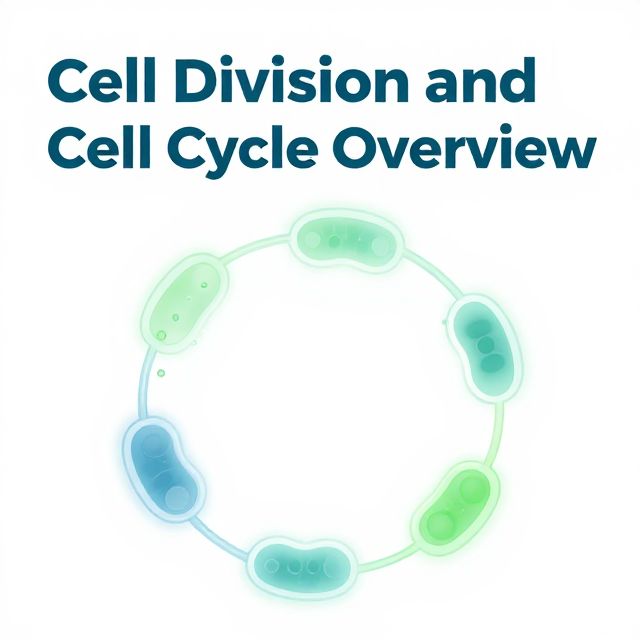
Cell Division and Cell Cycle Overview - kapak
Bilim#cell division#cell cycle#mitosis#binary fission

Cell Division and Cell Cycle Overview

An academic summary detailing prokaryotic and eukaryotic cell division, including binary fission, the eukaryotic cell cycle phases, and the stages of mitosis and cytokinesis.

sevv_s0March 28, 2026 ~23 dk toplam
01

Sesli Özet

7 dakika

Konuyu otobüste, koşarken, yolda dinleyerek öğren.

Sesli Özet

Cell Division and Cell Cycle Overview

0:006:34
02

Flash Kartlar

25 kart

Karta tıklayarak çevir. ← → ile gez, ⎵ ile çevir.

1 / 25
Tüm kartları metin olarak gör
  1. 1. What fundamental processes in living organisms rely on cell division?

    Cell division is crucial for growth, development, tissue regeneration, and reproduction in all living organisms. It enables organisms to produce offspring and transmit hereditary information, ensuring the continuity of life across generations.

  2. 2. Who was Walther Fleming and what was his significant contribution to cell biology?

    Walther Fleming was a German embryologist who, in 1882, made the initial observation of cell division, specifically mitosis. He noted minute, thread-like structures dividing within salamander larvae cells, laying the groundwork for understanding nuclear division.

  3. 3. Describe the process of binary fission in prokaryotic cells.

    Binary fission is a simpler form of cell division in prokaryotes where the cell divides into two approximately equal halves. The single, circular DNA genome replicates, and the two copies attach to the plasma membrane. The cell then grows and new cell wall material is deposited, eventually pinching the cell into two daughter cells, each with one genome.

  4. 4. What is the nature of the genetic information (genome) in prokaryotic cells?

    The prokaryotic genome exists as a single, circular, double-stranded DNA molecule. Unlike eukaryotes, it lacks a nucleus and is typically located in a region called the nucleoid. This simpler organization allows for a more straightforward replication and division process.

  5. 5. What is the 'replication origin' in prokaryotic DNA replication?

    The replication origin is a specific site on the prokaryotic circular DNA molecule where DNA replication begins. It is typically rich in A/T base pairs, which are easier to separate due to fewer hydrogen bonds, facilitating the initial unwinding of the DNA strands by enzymes.

  6. 6. Name two key enzymes involved in the initiation of DNA replication in prokaryotes and their functions.

    Helicase is an enzyme that opens the replication fork by unwinding the DNA double helix. Single-strand binding proteins (SSBPs) then attach to the separated strands to prevent them from re-annealing, keeping the replication fork open for synthesis.

  7. 7. What roles do DNA polymerase III and DNA ligase play in prokaryotic DNA replication?

    DNA polymerase III is the primary enzyme responsible for extending new DNA strands by adding nucleotides in the 5' to 3' direction. DNA ligase, on the other hand, seals any gaps or nicks between DNA fragments, such as those left after RNA primers are replaced by DNA, ensuring a continuous strand.

  8. 8. How do prokaryotic cells ensure each daughter cell receives a complete genome during binary fission?

    After DNA replication, the two identical copies of the genome remain attached to the plasma membrane at different points. As the bacterial cell grows, new plasma membrane and cell wall materials are deposited between these attachment sites, effectively separating the two genomes and ensuring each new cell receives one.

  9. 9. List the five main phases of the eukaryotic cell cycle.

    The eukaryotic cell cycle consists of five main phases: G1 (Gap 1), S (Synthesis), G2 (Gap 2), and M (Mitotic) phase. The G1, S, and G2 phases collectively form interphase, which is the period between cell divisions.

  10. 10. Define interphase and identify its constituent phases.

    Interphase is the period between cell divisions in eukaryotic cells, during which the cell grows, replicates its DNA, and prepares for mitosis. It consists of three distinct phases: G1 (first growth phase), S (DNA synthesis phase), and G2 (second growth phase).

  11. 11. What are the primary activities that occur during the G1 phase of the eukaryotic cell cycle?

    The G1 phase is the primary growth phase where the cell grows in size, synthesizes proteins, and carries out its normal metabolic functions. During this phase, the cell also expresses genes and differentiates, responding to internal and external signals to determine if it should proceed to DNA replication.

  12. 12. What critical event takes place during the S phase of the eukaryotic cell cycle?

    The S phase (Synthesis phase) is dedicated to DNA synthesis. During this phase, the cell replicates its entire genome, ensuring that each chromosome consists of two identical sister chromatids. This replication is essential so that each daughter cell receives a complete set of genetic material.

  13. 13. Describe the main preparations a cell undergoes during the G2 phase.

    The G2 phase is the second growth phase where the cell prepares for genomic separation. Key activities include the replication of mitochondria and other organelles, further cell growth, chromosome condensation beginning, and the assembly of microtubules, which will form the mitotic spindle.

  14. 14. What is the G0 phase, and which types of cells typically enter this state?

    The G0 phase is a quiescent (resting) state that cells may enter if conditions are unsuitable for division or if they are terminally differentiated. Cells like neurons and skeletal muscle cells typically remain in G0 for the organism's lifetime. Other cells, such as damaged liver cells, can re-enter the cell cycle from G0 when needed.

  15. 15. What does the M phase of the eukaryotic cell cycle encompass?

    The M phase encompasses both mitosis and cytokinesis. Mitosis refers to the division of the nucleus, resulting in two identical sets of chromosomes. Cytokinesis is the subsequent division of the cytoplasm, leading to the formation of two separate daughter cells.

  16. 16. What is mitosis, and what are its four traditional stages?

    Mitosis is the process of nuclear division in eukaryotic cells, ensuring that each daughter cell receives an identical set of chromosomes. It is traditionally subdivided into four continuous stages: prophase, metaphase, anaphase, and telophase.

  17. 17. Describe the state of chromosomes and centrosomes during interphase, prior to mitosis.

    During interphase, chromosomes are decondensed and not individually visible under a light microscope; they exist as chromatin. However, they have already replicated during the S phase, meaning each chromosome consists of two sister chromatids. Additionally, the single centrosome has duplicated, resulting in two centrosomes.

  18. 18. Outline the key events that occur during prophase of mitosis.

    Prophase begins with the disappearance of the nucleolus and the formation of the mitotic spindle apparatus. Centrosomes move to opposite poles, and chromatin fibers coil tightly, condensing into discrete chromosomes, each appearing as two identical sister chromatids joined at their centromeres.

  19. 19. What happens during prometaphase that distinguishes it from prophase?

    Prometaphase is characterized by the fragmentation of the nuclear envelope, allowing spindle microtubules to invade the nuclear area. Chromosomes become even more condensed, and each chromatid develops a kinetochore, to which kinetochore microtubules attach, causing chromosomes to move erratically.

  20. 20. What is the defining event of metaphase in mitosis?

    Metaphase is defined by the alignment of all chromosomes at the metaphase plate, an imaginary plane equidistant from the two spindle poles. At this stage, the kinetochores of sister chromatids are attached to kinetochore microtubules originating from opposite poles, ensuring proper segregation.

  21. 21. Explain the process of chromosome separation during anaphase.

    Anaphase begins with the cleavage of cohesin proteins, which held sister chromatids together. This allows the sister chromatids to separate, becoming individual daughter chromosomes. Kinetochore microtubules shorten, pulling these daughter chromosomes towards opposite ends of the cell, while polar microtubules lengthen, elongating the cell.

  22. 22. What are the main events that characterize telophase?

    During telophase, the daughter chromosomes arrive at the poles of the cell and begin to decondense. New nuclear envelopes form around each set of chromosomes from fragments of the parent cell's nuclear envelope and other endomembrane components. The nucleoli reappear, and the remaining spindle microtubules depolymerize.

  23. 23. How does cytokinesis differ in animal cells compared to plant cells?

    In animal cells, cytokinesis involves the formation of a contractile ring made of actin filaments, which creates a cleavage furrow that pinches the cell in two. In plant cells, a cell plate forms in the middle of the cell, growing outwards to eventually develop into a new cell wall, dividing the two daughter cells.

  24. 24. What is the ultimate outcome of mitosis in terms of daughter cells?

    Mitosis ultimately produces two daughter cells that are genetically identical to the mother cell, assuming no rare mutations occurred. Each daughter cell receives a complete and identical set of chromosomes, ensuring genetic continuity and accurate inheritance of genetic material.

  25. 25. Why is mitosis crucial for multicellular organisms?

    Mitosis is crucial for multicellular organisms because it enables their development from a single zygote, facilitates organismal growth by increasing cell number, and is essential for wound repair and tissue regeneration by replacing damaged or old cells with new, identical ones.

03

Bilgini Test Et

15 soru

Çoktan seçmeli sorularla öğrendiklerini ölç. Cevap + açıklama.

Soru 1 / 15Skor: 0

Which of the following fundamental biological processes relies on cell division?

04

Detaylı Özet

6 dk okuma

Tüm konuyu derinlemesine, başlık başlık.

This study material has been compiled from lecture slides (PDF/PowerPoint text) and an audio transcript provided by Prof. Dr. Elif Aylin Özüdoğru, Spring 2026, İstanbul.


Cell Division and Cell Cycle - I 🧬

1. Introduction to Cell Division

All living organisms, from the simplest bacteria to complex multicellular creatures, undergo fundamental processes such as growth, development, tissue regeneration, and reproduction. These processes are critically dependent on cell division ✅. Cell division enables organisms to produce offspring and transmit their hereditary information. The initial observation of cell division, specifically mitosis, was made by German embryologist Walther Fleming in 1882, who observed thread-like structures dividing within salamander larvae cells.

2. Prokaryotic Cell Division: Binary Fission 🦠

Prokaryotic cells, which lack a nucleus, divide through a simpler process called binary fission.

2.1. Process Overview

  • The cell divides into two equal or nearly equal halves.
  • Prokaryotic cells grow by increasing in cell number rather than individual cell size.
  • Bacterial populations increase exponentially, doubling with each generation time.

2.2. Genetic Material and Replication

📚 Genome: The genetic information exists as a single, circular, double-stranded DNA molecule.

  1. Replication Origin: DNA replication begins early in the cell's life at a specific site on the DNA molecule called the replication origin. This region is approximately 245 base pairs long and is rich in A/T base pairs, which are easier to separate due to fewer hydrogen bonds.
  2. Enzymatic Action: A complex of over 22 different proteins initiates the copying process.
    • Helicase: Unwinds and opens the replication fork 🌀.
    • Single-strand binding proteins: Coat the DNA around the replication fork to prevent rewinding.
    • Topoisomerase: Works ahead of the replication fork to prevent supercoiling.
    • Primase: Synthesizes short RNA primers complementary to the DNA strand.
    • DNA Polymerase III: Extends the primers, adding new DNA nucleotides to the 3' end.
    • DNA Polymerase I: Removes RNA primers and replaces them with DNA.
    • DNA Ligase: Seals the gaps between DNA fragments.
  3. Genome Duplication: Once replication is complete, the cell possesses two identical copies of its genome, which are attached side-by-side to the cytoplasmic surface of the plasma membrane.

2.3. Cell Separation

  • The growth of the bacterial cell to about twice its initial size triggers the onset of cell division.
  • New plasma membrane and cell wall materials are laid down in the zone between the attachment sites of the two daughter genomes.
  • This new membrane grows inward, eventually reaching the center of the cell and dividing it in two.
  • A new cell wall forms around the new membrane, leading to the separation of two daughter cells, each assured of retaining one complete genome.

3. Eukaryotic Cell Cycle 🔄

Eukaryotic cells, with their larger size and more complex genomic organization, utilize a more intricate cell division process, described as the cell cycle.

3.1. Phases of the Cell Cycle

The eukaryotic cell cycle consists of five main phases:

  • Interphase: The period of growth and DNA replication, comprising G1, S, and G2 phases.
  • M Phase (Mitosis): The actual division process, including nuclear division (mitosis) and cytoplasmic division (cytokinesis).

📊 Typical Cultured Human Cell Cycle (approx. 24 hours):

  • M phase: ~1 hour
  • Interphase: ~23 hours (S phase: ~10-12 hours)

3.2. Interphase: Preparation for Division

Interphase is the portion of the cell cycle between cell divisions.

  • G1 Phase (Gap 1):
    • Primary growth phase of the cell.
    • Major portion of the cell's lifespan for many organisms.
    • Cell grows, expresses genes, and differentiates.
    • Internal and external conditions are checked.
    • Length varies depending on external conditions and extracellular signals.
  • S Phase (Synthesis):
    • The cell synthesizes a replica of its entire genome (DNA synthesis).
  • G2 Phase (Gap 2):
    • Second growth phase.
    • Preparations for genomic separation are made.
    • Mitochondria and other organelles replicate.
    • Chromosomes begin to condense.
    • Microtubules begin to assemble at a spindle.
    • Quality control checks are performed.

3.3. G0 Phase: Quiescence 😴

  • If conditions are not suitable during G1, cells may enter the G0 phase, a quiescent state.
  • Cells can remain in G0 for days, months, or even years.
  • Examples:
    • Permanent G0: Many cells in our body, such as neurons and skeletal muscle cells, remain in G0 until the organism dies.
    • Temporary G0: Some cells, like damaged liver cells, can re-enter the cell cycle from G0 when needed.
    • Repetitive Cycling: Others, like fibroblasts and lymphocytes, enter the cell cycle repeatedly.

4. Eukaryotic Cell Division: Mitosis and Cytokinesis 🔬

The M phase includes mitosis (nuclear division) and cytokinesis (cytoplasmic division). Mitosis is a continuous process but is traditionally divided into four stages.

4.1. Interphase (Prior to Mitosis)

💡 Preparation Stage:

  • Chromosomes are decondensed and not individually visible, as they have replicated during the S phase but are not yet condensed.
  • The nucleolus is present.
  • Two centrosomes have formed by the duplication of a single centrosome. Each centrosome contains a pair of centrioles.

4.2. Stages of Mitosis (M Phase) 🖼️

Mitosis ensures that each daughter cell receives an identical set of chromosomes.

4.2.1. Prophase 🌟

  • Nucleolus disappears.
  • Mitotic spindle apparatus begins to form: Microtubules extend from the centrosomes. Radial arrays of shorter microtubules around the centrosomes are called asters.
  • Centrosomes move away from each other towards opposite poles of the cell.
  • Chromatin fibers become more tightly coiled, condensing into discrete chromosomes.
  • Each duplicated chromosome appears as two identical sister chromatids joined at their centromere.
  • Spindle Apparatus Components:
    • Aster microtubules: Important for positioning the spindle apparatus.
    • Polar microtubules: Help to "push" the poles away from each other.
    • Kinetochore microtubules: Will attach to the kinetochores on the centromeres of chromosomes.

4.2.2. Prometaphase 💥

  • Nuclear envelope fragments into vesicles.
  • Microtubules invade the nuclear area.
  • Chromosomes become even more condensed.
  • Each of the two sister chromatids of each chromosome develops a protein structure called a kinetochore at its centromere.
  • Kinetochore microtubules attach to the kinetochores, causing the chromosomes to jerk back and forth.
  • Polar (non-kinetochore) microtubules interact with those from the opposite pole of the spindle.

4.2.3. Metaphase 📏

  • Centrosomes are now at opposite poles of the cell.
  • Chromosomes align at the metaphase plate, an imaginary plane equidistant from the two spindle poles.
  • The kinetochores of the sister chromatids are attached to kinetochore microtubules coming from opposite poles, ensuring proper tension and alignment.

4.2.4. Anaphase 🏃‍♀️

  • Cohesin proteins are cleaved, leading to the separation of the two sister chromatids.
  • Once separated, each chromatid is considered a daughter chromosome.
  • Kinetochore microtubules shorten, pulling the newly liberated daughter chromosomes towards opposite ends of the cell.
  • Polar microtubules lengthen, causing the cell to elongate.
  • By the end of anaphase, the two ends of the cell have equivalent and complete collections of chromosomes.

4.2.5. Telophase ✌️

  • Chromosomes reach the poles and begin to decondense.
  • Two daughter nuclei form: Nuclear envelopes arise from fragments of the parent cell's nuclear envelope and other portions of the endomembrane system.
  • The remaining spindle microtubules depolymerize.

4.3. Cytokinesis: Cytoplasmic Division ✂️

  • Cytokinesis typically overlaps with the latter stages of telophase.
  • Animal Cells: A cleavage furrow forms. This is a contracting ring of actin and myosin microfilaments that constricts like a drawstring, pinching the cell in two.
  • Plant Cells: A cell plate forms in the middle of the cell. Vesicles derived from the Golgi apparatus fuse to form a new cell wall between the two daughter nuclei.

5. Key Outcomes and Importance of Mitosis ✅

  • Mitosis ultimately produces two daughter cells that are genetically identical to the mother cell (barring rare mutations).
  • Processes requiring mitotic cell division:
    • Development of multicellularity: From a single zygote to a complex organism.
    • Organismal growth: Increase in size.
    • Wound repair: Replacing damaged cells.
    • Tissue regeneration: Replacing old or lost cells (e.g., skin cells, blood cells).

Thank you for your patience and attention!
Kendi çalışma materyalini oluştur

PDF, YouTube videosu veya herhangi bir konuyu dakikalar içinde podcast, özet, flash kart ve quiz'e dönüştür. 1.000.000+ kullanıcı tercih ediyor.

Sıradaki Konular

Tümünü keşfet
The Cell Cycle Control System Explained

The Cell Cycle Control System Explained

Explore the intricate mechanisms governing cell division, from key proteins like cyclins and Cdks to the checkpoints ensuring proper replication and mitosis.

Özet 25 15
The Reproductive System: Cell Division and Reproduction

The Reproductive System: Cell Division and Reproduction

Explore the fundamental processes of cell division and the diverse strategies of reproduction, including asexual and sexual methods, gametogenesis, fertilization, and the human reproductive systems.

Özet 25 15 Görsel
Cytology: The Study of the Cell and Its Division

Cytology: The Study of the Cell and Its Division

Explore the fundamental principles of cytology, from bacterial binary fission to the intricate eukaryotic cell cycle, chromosome organization, and genetic mechanisms.

17 dk Özet 25 15
Understanding Cellular Division: The Cell Cycle, Mitosis, and Meiosis

Understanding Cellular Division: The Cell Cycle, Mitosis, and Meiosis

This podcast explores the intricate world of cellular division, detailing the cell cycle's phases and control, the process of mitosis for somatic cell reproduction, and meiosis for genetic diversity in gamete formation.

5 dk Özet 25 15
Biochemistry and Cellular Structure: Foundations of Life

Biochemistry and Cellular Structure: Foundations of Life

This summary explores biochemistry as the chemical basis of life, detailing metabolic processes, cellular organization, and the specialized functions of prokaryotic and eukaryotic cell components.

7 dk Özet 25 15
Cell Division and Cell Cycle: Meiosis

Cell Division and Cell Cycle: Meiosis

An academic summary of cell division, focusing on sexual reproduction, the necessity of meiosis, its stages, and unique features like synapsis, homologous recombination, and reduction division.

6 dk Özet 25 15
Introduction to Basic Genetics

Introduction to Basic Genetics

Explore the fundamental principles of genetics, from cell theory and the nature of genetic material to heredity, cell division, and the diverse branches of genetic study.

Özet 25 15
Introduction to Cell and Molecular Biology: History, Methods, and Significance

Introduction to Cell and Molecular Biology: History, Methods, and Significance

Explore the fundamental concepts of cell and molecular biology, tracing its historical development, key scientific discoveries, advanced investigative techniques, and its profound importance in modern medicine.

7 dk Özet 25 15