Earth's Atmospheric and Radiative Balance - kapak
Bilim#earth science#atmospheric science#thermal radiation#planetary energy balance

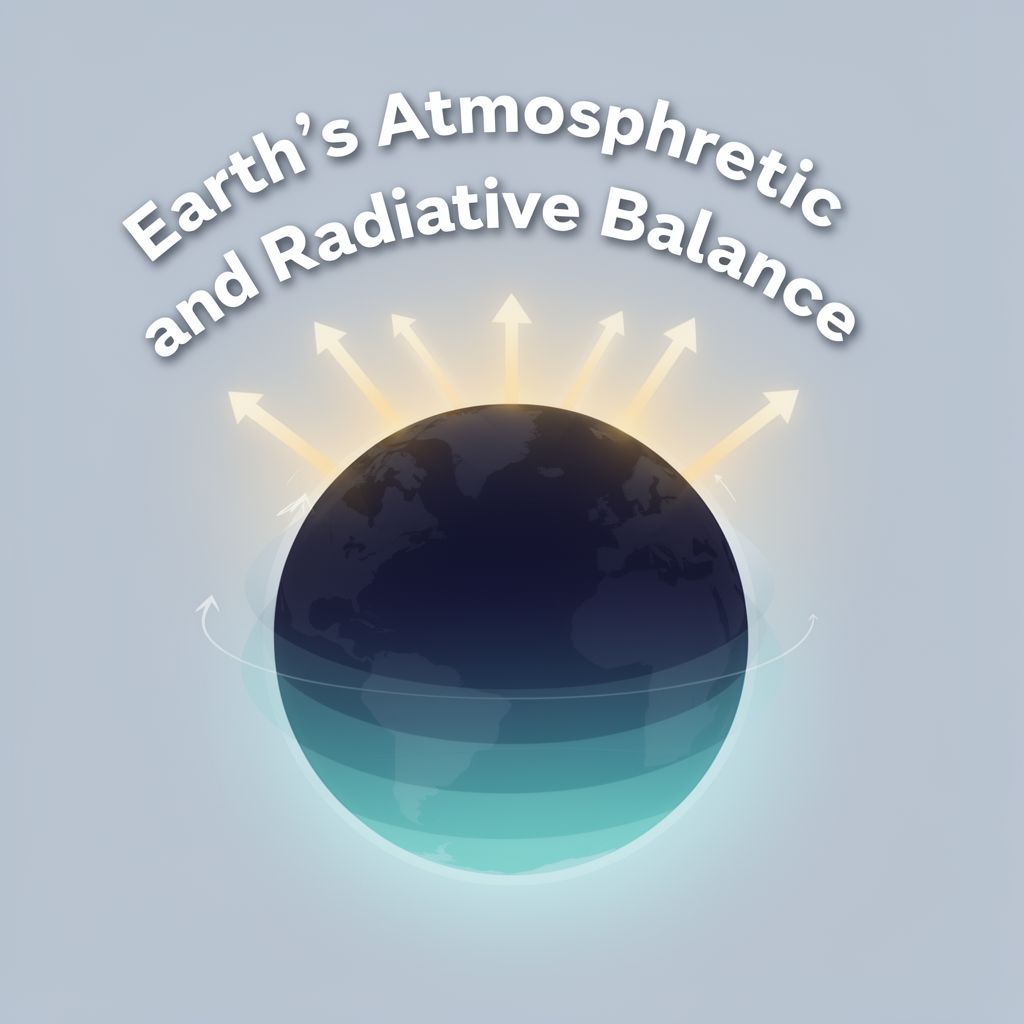
Earth's Atmospheric and Radiative Balance

This summary explores Earth's early formation, atmospheric evolution, and the fundamental principles of thermal radiation and planetary energy balance, including key physical laws and climate parameters.

parsaFebruary 10, 2026 ~21 dk toplam
01

Sesli Özet

6 dakika

Konuyu otobüste, koşarken, yolda dinleyerek öğren.

Sesli Özet

Earth's Atmospheric and Radiative Balance

0:006:03
02

Flash Kartlar

25 kart

Karta tıklayarak çevir. ← → ile gez, ⎵ ile çevir.

1 / 25
Tüm kartları metin olarak gör
  1. 1. When did Earth form and what is its approximate radius?

    Earth formed approximately 4.54 billion years ago. Its radius measures 6,400 kilometers. These fundamental characteristics provide a baseline for understanding the planet's long history and the scale of the processes governing its atmosphere and climate.

  2. 2. What is Earth's average distance from the Sun, and how long does sunlight take to reach it?

    Earth orbits the Sun at an average distance of 150 million kilometers. Light from the Sun takes approximately 8 minutes to reach Earth. This distance and travel time are critical factors in determining the amount of solar radiation received by our planet.

  3. 3. What were the primary components of Earth's first atmosphere, and how was it formed?

    Earth's first atmosphere was primarily composed of water vapor and carbon dioxide. It was formed through outgassing, a process driven by extensive volcanic eruptions during the planet's early geological activity. This initial atmospheric composition set the stage for subsequent atmospheric evolution.

  4. 4. How did Earth's oceans form during the early stages of the planet?

    As early Earth cooled, the abundant water vapor in its atmosphere condensed. This condensation led to the formation of clouds, which then produced rainwater. Over vast periods, this accumulated rainwater filled depressions on the surface, creating Earth's oceans.

  5. 5. What pivotal event occurred approximately 3.5 billion years ago that significantly impacted atmospheric evolution?

    Approximately 3.5 billion years ago, photosynthesizing bacteria emerged. These organisms began to release oxygen into the atmosphere as a byproduct of their metabolic processes. This marked a pivotal moment, initiating the gradual increase in atmospheric oxygen levels over geological time.

  6. 6. How did the increase in atmospheric oxygen lead to the formation of the ozone layer?

    As oxygen concentrations gradually increased in the atmosphere due to photosynthetic life, sufficient amounts accumulated in the upper atmosphere. Around 2.3 billion years ago, these oxygen molecules (O2) began to form ozone (O3) through photochemical reactions. This process led to the development of the ozone layer.

  7. 7. What is the critical role of the ozone layer in protecting life on Earth?

    The ozone layer plays a critical role by absorbing harmful ultraviolet (UV) radiation from the Sun. By filtering out this damaging radiation, it protects life on the surface from its adverse effects. This protection was essential for the diversification and flourishing of life forms on Earth.

  8. 8. What fundamental principles govern Earth's energy balance?

    Earth's energy balance is fundamentally governed by principles of thermal radiation, also known as blackbody radiation. These principles describe how objects emit and absorb electromagnetic waves, which are the carriers of energy. Understanding these laws is crucial for analyzing the planet's climate system.

  9. 9. What does the Planck Function quantify in relation to thermal radiation?

    The Planck Function quantifies the spectral radiance, or intensity, of radiation emitted by a blackbody. It describes this radiation at a given temperature and wavelength. Specifically, it details the radiation power per unit area, per unit solid angle, and per unit wavelength, providing a comprehensive description of emitted energy.

  10. 10. Explain Wien's Displacement Law and provide an example.

    Wien's Displacement Law states that hotter materials emit electromagnetic radiation at shorter wavelengths compared to cooler objects. It directly relates the peak emission wavelength to an object's absolute temperature. For example, the Sun (5780 K) peaks in visible light (0.5 micrometers), while Earth (300 K) peaks in infrared (9.7 micrometers).

  11. 11. What does the Stefan-Boltzmann Law calculate, and what is its relationship to temperature?

    The Stefan-Boltzmann Law calculates the total flux, or power per unit area, emitted by a blackbody across all wavelengths. It demonstrates that this total flux is proportional to the fourth power of the object's absolute temperature. This means a small increase in temperature leads to a significant increase in emitted energy.

  12. 12. Provide an example of the Stefan-Boltzmann Law by comparing the surface flux of the Sun and Earth.

    According to the Stefan-Boltzmann Law, the Sun's surface flux is approximately 63 million watts per square meter due to its high temperature. In contrast, Earth's surface flux is around 390 watts per square meter. This vast difference illustrates how temperature dramatically influences the total energy emitted by a body.

  13. 13. What does Kirchhoff's Law of Thermal Radiation establish regarding absorptivity and emissivity?

    Kirchhoff's Law of Thermal Radiation establishes that for any material, its absorptivity is equal to its emissivity. Absorptivity is the fraction of incident radiation absorbed, while emissivity is the ratio of its emitted intensity to that of a perfect blackbody. This law implies that good absorbers are also good emitters of radiation.

  14. 14. Define absorptivity in the context of thermal radiation.

    Absorptivity, in the context of thermal radiation, is defined as the fraction of incident radiation that is absorbed by a material. It is a dimensionless quantity ranging from 0 (perfect reflector) to 1 (perfect absorber). This property is crucial for understanding how materials interact with electromagnetic energy.

  15. 15. Define emissivity in the context of thermal radiation.

    Emissivity is defined as the ratio of the thermal radiation emitted by a surface to the radiation emitted by a perfect blackbody at the same temperature. Like absorptivity, it is a dimensionless value between 0 and 1. A high emissivity indicates that a surface is an efficient radiator of thermal energy.

  16. 16. What is the Solar Constant, and what is its approximate value?

    The Solar Constant is the flux of solar radiation incident on Earth, measured outside the atmosphere. Its approximate value is 1370 watts per square meter. This constant represents the maximum potential solar energy available to Earth before atmospheric interactions.

  17. 17. What is Earth's average albedo, and what does it signify?

    Earth has an average albedo of 0.3, meaning 30 percent of the incident solar radiation is reflected back into space. Albedo is a measure of the reflectivity of a surface. This reflection reduces the amount of solar energy absorbed by the planet, influencing its overall energy budget.

  18. 18. How is radiative equilibrium achieved in Earth's climate system?

    Radiative equilibrium in Earth's climate system is achieved when the absorbed solar energy equals the emitted terrestrial infrared radiation. This balance ensures that the planet's overall temperature remains relatively stable over time. Any imbalance can lead to warming or cooling trends.

  19. 19. How is Earth's effective radiating temperature derived?

    Earth's effective radiating temperature is derived by balancing the absorbed solar flux over Earth's cross-sectional area with the emitted infrared flux over Earth's entire surface area. This calculation assumes the Earth is a perfect blackbody radiating directly to space without an atmosphere. It provides a theoretical baseline temperature.

  20. 20. What is Earth's calculated effective radiating temperature?

    Earth's calculated effective radiating temperature is 255 Kelvin. This theoretical temperature represents what the Earth's surface temperature would be if it had no atmosphere and radiated energy directly into space as a perfect blackbody. It serves as a crucial reference point for understanding Earth's actual temperature.

  21. 21. What is the average incident solar radiation on Earth's surface?

    When averaged over the Earth's surface, the incident solar radiation is 342 watts per square meter. This value accounts for the spherical shape of the Earth and the distribution of sunlight across its surface. It's a key input for calculating the planet's energy budget.

  22. 22. How much solar radiation is scattered back to space due to Earth's albedo, and what is the remaining solar input to the climate system?

    Due to Earth's albedo, 102 watts per square meter of the incident solar radiation (342 W/m²) are scattered back to space. This leaves 240 watts per square meter as the net solar input to the climate system. This absorbed energy is what drives Earth's atmospheric and oceanic processes.

  23. 23. What is the infrared flux emitted from Earth in radiative equilibrium, and what temperature does it correspond to?

    In radiative equilibrium, the infrared flux emitted from Earth is also 240 watts per square meter. This emitted flux corresponds to the effective radiating temperature of 255 Kelvin. This balance between absorbed solar input and emitted infrared radiation is fundamental to Earth's energy budget.

  24. 24. Why is Earth's average surface temperature (288 K) higher than its effective radiating temperature (255 K)?

    Earth's average surface temperature, approximately 288 Kelvin, is higher than its effective radiating temperature of 255 Kelvin due to the greenhouse effect. The atmosphere, containing greenhouse gases, traps some of the outgoing infrared radiation, re-emitting it back towards the surface. This natural process warms the planet's surface beyond what it would be without an atmosphere.

  25. 25. What were the major events that shaped early Earth, as mentioned in the summary?

    The summary highlights that early Earth was shaped by significant geological activity, including outgassing from extensive volcanic eruptions. These events produced the planet's first atmosphere and, as the planet cooled, led to the condensation of water vapor and the formation of oceans. These geological processes laid the foundation for subsequent atmospheric and biological evolution.

03

Bilgini Test Et

15 soru

Çoktan seçmeli sorularla öğrendiklerini ölç. Cevap + açıklama.

Soru 1 / 15Skor: 0

Approximately how long does it take for light from the Sun to reach Earth?

04

Detaylı Özet

5 dk okuma

Tüm konuyu derinlemesine, başlık başlık.

This study material has been compiled from various sources, including a lecture audio transcript and copy-pasted text which contained lecture slides and interactive poll questions.


📚 Earth's Atmospheric and Radiative Processes: A Study Guide

🌍 Introduction to Earth and Its Systems

This guide explores the fundamental characteristics of Earth, the evolution of its atmosphere and oceans, and the physical laws governing thermal radiation and planetary energy balance. Understanding these concepts is crucial for comprehending Earth's climate system.

✅ Key Earth Facts

  • Age: Approximately 4.54 billion years 🕰️
  • Radius: Approximately 6,400 kilometers
  • Distance to Sun: Average of 150 million kilometers
  • Light Travel Time from Sun: Approximately 8 minutes

🌬️ Formation and Evolution of Earth's Atmosphere and Oceans

The early Earth underwent significant transformations that shaped its current environment.

1️⃣ Early Atmosphere Formation

  • Volcanic Outgassing: Major events leading to early Earth's formation included extensive volcanic eruptions.
  • Composition: These eruptions produced Earth's first atmosphere, primarily consisting of water vapor (H₂O) and carbon dioxide (CO₂).

2️⃣ Ocean Formation

  • Cooling Planet: As Earth cooled, the abundant water vapor in the atmosphere began to condense.
  • Condensation & Rain: This condensation led to the formation of clouds and subsequent rainfall.
  • Accumulation: Over vast periods, this rainwater accumulated, forming the Earth's oceans.

3️⃣ Oxygenation and Ozone Layer Development

  • Photosynthesizing Bacteria: Around 3.5 billion years ago, a pivotal moment occurred with the emergence of photosynthesizing bacteria.
  • Oxygen Release: These organisms began to release oxygen (O₂) into the atmosphere.
  • Gradual Increase: Oxygen levels steadily increased over geological time.
  • Ozone Layer Formation: Eventually, oxygen concentrations became sufficient for the development of the ozone (O₃) layer in the upper atmosphere, with significant amounts recorded around 2.3 billion years ago.
  • Protective Role: The ozone layer is critical for absorbing harmful ultraviolet (UV) radiation, thereby protecting life on the surface and facilitating its diversification.

🔥 Principles of Thermal Radiation

Earth's energy balance is fundamentally governed by the principles of thermal radiation, also known as blackbody radiation. Electromagnetic waves (light) carry this energy.

📚 Key Laws of Thermal Radiation

  1. Planck Function (Spectral Radiance)

    • Definition: Quantifies the intensity of radiation emitted by a blackbody at a given temperature and wavelength. It describes the radiation power per unit area, per unit solid angle, per unit wavelength.
    • Formula: $B(\lambda, T) = \frac{2hc^2}{\lambda^5 (e^{\frac{hc}{k\lambda T}} - 1)}$
      • $h$: Planck's constant ($6.626 \times 10^{-34}$ J s)
      • $c$: Speed of light ($3 \times 10^8$ m/s)
      • $k$: Boltzmann's constant ($1.381 \times 10^{-23}$ J/K)
      • $\lambda$: Wavelength
      • $T$: Absolute temperature
    • Application: Can be inverted to measure temperature from observed intensity.
  2. Wien's Displacement Law (Peak Emission Wavelength)

    • Definition: States that hot materials emit electromagnetic radiation at shorter wavelengths than cooler objects. It relates the peak emission wavelength to the object's temperature.
    • Formula: $\lambda_p = \frac{2898}{T} \text{ μm}$
    • Examples:
      • Sun: Surface temperature $\approx 5780$ K. $\lambda_p = \frac{2898}{5780} \approx 0.5$ μm (visible light).
      • Earth: Average temperature $\approx 300$ K. $\lambda_p = \frac{2898}{300} \approx 9.7$ μm (infrared radiation).
  3. Stefan-Boltzmann Law (Total Emitted Flux)

    • Definition: Calculates the total flux (power per unit area) emitted by a blackbody across all wavelengths. It is proportional to the fourth power of its absolute temperature.
    • Formula: $F = \sigma T^4$
      • $\sigma$: Stefan's constant ($5.67 \times 10^{-8}$ W m⁻² K⁻⁴)
    • Examples:
      • Sun: $F_{sun} \approx 63,284,072$ W/m²
      • Earth: $F_{earth} \approx 390$ W/m²
  4. Kirchhoff's Law (Absorptivity = Emissivity)

    • Definition: For any material, its absorptivity ($a$) is equal to its emissivity ($\epsilon$).
      • Absorptivity ($a$): Fraction of incident radiation absorbed. ($a=1$ for a perfect blackbody).
      • Emissivity ($\epsilon$): Ratio of emitted intensity to that of a perfect blackbody.
    • Formula: $a = \epsilon$
    • Implication: If $a = \epsilon \neq 1$, then $F = \epsilon \times \sigma T^4 = a \times \sigma T^4$.

📊 Planetary Radiation Balance and Effective Temperature

Earth's climate system is maintained by a delicate balance between incoming solar radiation and outgoing terrestrial radiation.

💡 Solar Constant ($F_s$)

  • Definition: The flux of solar radiation incident on Earth, outside the atmosphere.
  • Value: Approximately $1370$ W/m².

☁️ Albedo (A)

  • Definition: The fraction of incident solar radiation that is reflected back into space.
  • Earth's Average Albedo: Approximately $0.3$ (or 30%). This means 30% of incoming solar radiation is reflected.

⚖️ Radiative Equilibrium

For Earth's temperature to remain stable, the absorbed solar energy must equal the emitted terrestrial infrared radiation.

  • Solar Energy Incident on Earth (averaged over surface):

    • Total incident solar energy: $F_s \times \pi R_e^2$ (where $R_e$ is Earth's radius)
    • Averaged over Earth's surface area ($4\pi R_e^2$): $\frac{F_s \times \pi R_e^2}{4\pi R_e^2} = \frac{F_s}{4} = \frac{1370 \text{ W/m}^2}{4} = 342 \text{ W/m}^2$.
  • Solar Radiation Scattered Back to Space:

    • Due to albedo: $\frac{F_s}{4} \times A = 342 \text{ W/m}^2 \times 0.3 = 102 \text{ W/m}^2$.
  • Solar Energy Absorbed by Climate System:

    • $\frac{F_s}{4} \times (1 - A) = 342 \text{ W/m}^2 \times (1 - 0.3) = 240 \text{ W/m}^2$.

🌡️ Effective Radiating Temperature ($T_e$)

This is the temperature Earth would have if it were a perfect blackbody radiating directly to space, without an atmosphere.

  • Balance Equation: Absorbed Solar Energy = Emitted Terrestrial IR $F_s \times \pi R_e^2 \times (1 - A) = \sigma T_e^4 \times 4\pi R_e^2$
  • Solving for $T_e$: $T_e^4 = \frac{F_s \times (1 - A)}{4\sigma}$
  • Calculation: $T_e^4 = \frac{1370 \text{ W/m}^2 \times (1 - 0.3)}{4 \times 5.67 \times 10^{-8} \text{ W m}^{-2} \text{ K}^{-4}}$ $T_e \approx 255 \text{ K}$

⚠️ Important Distinction: Effective vs. Surface Temperature

  • Effective Radiating Temperature ($T_e$): 255 K
  • Average Surface Temperature ($T_g$): Approximately 288 K
  • Reason for Difference: Earth's average surface temperature is significantly higher than its effective radiating temperature due to the greenhouse effect of its atmosphere. Greenhouse gases trap outgoing infrared radiation, warming the surface.

📝 Summary of Key Climate Factoids

  • Incident Solar Radiation (averaged over Earth's surface): 342 W/m²
  • Solar Radiation Scattered Back to Space (Albedo): 102 W/m²
  • Solar Input to Climate System (Absorbed): 240 W/m²
  • IR Flux Emitted from Earth (in radiative equilibrium): 240 W/m²
  • Effective Radiating Temperature ($T_e$): 255 K
  • Average Surface Temperature ($T_g$): 288 K

🎯 Conclusion

Earth's journey from its early formation to its current state is a complex interplay of geological, biological, and physical processes. The evolution of its atmosphere, driven by volcanic outgassing and later by photosynthetic life, was fundamental in shaping a habitable planet. Simultaneously, the planet's temperature and energy budget are meticulously governed by universal laws of thermal radiation. The balance between incoming solar energy, Earth's albedo, and the emission of infrared radiation dictates the planet's effective radiating temperature. Understanding these interconnected physical and atmospheric processes is essential for comprehending Earth's climate and its ongoing changes.

Kendi çalışma materyalini oluştur

PDF, YouTube videosu veya herhangi bir konuyu dakikalar içinde podcast, özet, flash kart ve quiz'e dönüştür. 1.000.000+ kullanıcı tercih ediyor.

Sıradaki Konular

Tümünü keşfet
The Hydrosphere and Anomalous Properties of Water

The Hydrosphere and Anomalous Properties of Water

An academic overview of Earth's hydrosphere, detailing water distribution, the hydrologic cycle, and the unique physical and chemical properties of water, including its density anomaly and differences between fresh and seawater.

9 dk Özet 25 15
Understanding the Borehole Environment

Understanding the Borehole Environment

This summary provides an academic overview of the borehole environment, detailing its characteristics, influencing factors, and significance in subsurface investigations and resource extraction.

6 dk Özet 15
Types of Dissolution and Solution Concentration

Types of Dissolution and Solution Concentration

Explore the different ways substances dissolve, including physical and chemical dissolution, and understand key concentration units like molarity and parts per million (ppm).

Özet 15 Görsel
The Musculoskeletal System: Structure, Function, and Locomotion

The Musculoskeletal System: Structure, Function, and Locomotion

Explore the intricate musculoskeletal system, its components, functions, and the mechanisms of locomotion in various organisms, with a detailed focus on the human body.

Özet 25 15 Görsel
The Nervous and Endocrine Systems: Body's Control Centers

The Nervous and Endocrine Systems: Body's Control Centers

Explore the intricate workings of the nervous and endocrine systems, their structures, functions, and how they maintain the body's homeostasis.

Özet 25 15 Görsel
The Reproductive System: Cell Division and Reproduction

The Reproductive System: Cell Division and Reproduction

Explore the fundamental processes of cell division and the diverse strategies of reproduction, including asexual and sexual methods, gametogenesis, fertilization, and the human reproductive systems.

Özet 25 15 Görsel
Introduction to Radioactivity and Its Applications

Introduction to Radioactivity and Its Applications

This summary provides an academic overview of radioactivity, covering fundamental concepts, types of radiation, decay processes, biological effects, detection methods, and diverse applications in medicine, industry, and dating.

8 dk Özet 25 15
The Haber Process in GCSE Chemistry

The Haber Process in GCSE Chemistry

An academic overview of the Haber Process, covering its industrial significance, chemical principles, reaction conditions, and environmental impact for GCSE Chemistry students.

6 dk Özet 25 15