Sensory Receptors and Gustatory Perception - kapak
Bilim#merkel cells#sensory receptors#mechanoreceptors#taste buds

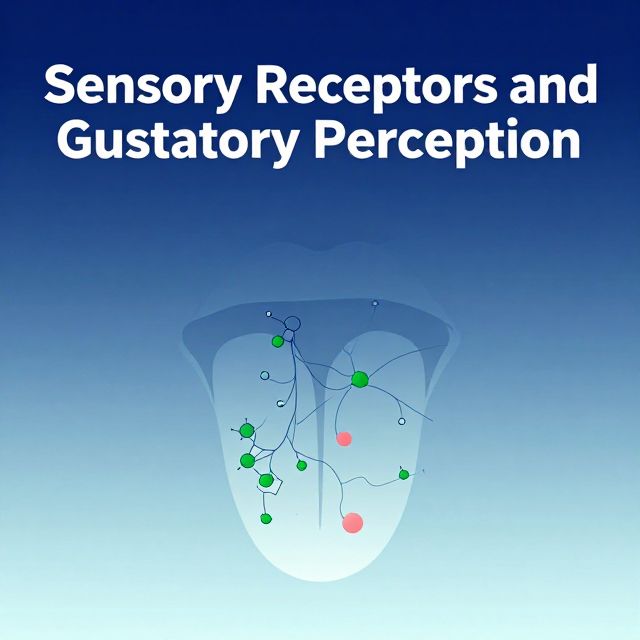
Sensory Receptors and Gustatory Perception

This summary explores the structure, function, and mechanisms of various sensory receptors, including Merkel cells and different nerve endings, alongside the anatomy and molecular processes of taste buds.

tipfakyorduMarch 9, 2026 ~24 dk toplam
01

Sesli Özet

8 dakika

Konuyu otobüste, koşarken, yolda dinleyerek öğren.

Sesli Özet

Sensory Receptors and Gustatory Perception

0:007:37
02

Flash Kartlar

25 kart

Karta tıklayarak çevir. ← → ile gez, ⎵ ile çevir.

1 / 25
Tüm kartları metin olarak gör
  1. 1. What is the primary role of sensory receptors in the human body?

    Sensory receptors are specialized structures that detect various external and internal stimuli. Their primary role is to convert these stimuli into electrical signals that can be interpreted by the nervous system, allowing the body to perceive and interact with its environment.

  2. 2. Which two main areas of sensory perception are covered in this content?

    This content primarily focuses on two main areas of sensory perception: the fundamental characteristics and functions of various mechanoreceptors located within the integumentary system (skin), and the intricate mechanisms governing gustatory perception via taste buds.

  3. 3. Where are Merkel cells located and what is their main function?

    Merkel cells are mechanoreceptors situated within the stratum basale of the epidermis. Their main function is to sense mild-touch and contribute to the detailed perception of object-tissue interactions, especially at the fingertips and hair follicle roots.

  4. 4. How are Merkel cells connected to adjacent keratinocytes and what is their embryonic origin?

    Merkel cells are intricately connected with adjacent keratinocytes via desmosomes. Intriguingly, they originate from the same embryonic source as keratinocytes, highlighting a shared developmental pathway despite their specialized sensory function.

  5. 5. Describe some unique features of Merkel cells that show both epidermal and neural characteristics.

    Merkel cells display a unique combination of both epidermal and neural features. They contain keratin filaments, typical of epidermal cells, but also possess distinct dendritic processes and dense-cored neurosecretory granules containing various peptides, which are characteristic of neural cells.

  6. 6. What is a Merkel's disc and where are these structures predominantly found?

    A Merkel's disc is a crucial sensory structure formed when myelinated afferent nerve fibers lose their Schwann cell sheaths and form a close association with Merkel cells. These discs are predominantly found at the fingertips and at the roots of hair follicles, enabling detailed touch perception.

  7. 7. How are simple nerve endings structurally different from capsulated nerve endings?

    Simple nerve endings are characterized by the absence of both Schwann cells and a collagen fiber sheath surrounding their sensory fibers. In contrast, capsulated nerve endings feature sensory fibers that are enveloped by glial cells and a delicate connective tissue capsule, providing more structural organization.

  8. 8. Name three principal types of somatic sensory receptors.

    Three principal types of somatic sensory receptors include the Merkel Disc, Free Nerve Ending, and Meissner Corpuscle. Other examples mentioned are Hair Root Plexus, Pacinian Corpuscle, Ruffini Corpuscle, and Krause Ending, all contributing to different aspects of touch and sensation.

  9. 9. What is the primary function and location of Free Nerve Endings?

    Free nerve endings are unencapsulated nerve endings located extensively within the papillary dermis and extending towards the basal layer of the epidermis, sometimes reaching the stratum granulosum. They are crucial for the perception of heat, pain, itch, and mild-touch.

  10. 10. Where are Hair Root Plexuses located and what do they detect?

    Hair root plexuses are positioned at the basal parts of hair follicles within the reticular dermis. They are specialized to detect the subtle movements of hairs, acting as mechanoreceptors that respond to displacement of the hair shaft.

  11. 11. Describe the morphology and primary function of Meissner corpuscles.

    Meissner corpuscles are distinct ellipse-shaped mechanoreceptors situated within the papillary dermis, oriented at a right angle to the epidermis. Their primary function is the perception of mild-touch, particularly low-frequency stimuli, through temporary changes in their shape upon stimulation.

  12. 12. In which highly sensitive areas are Meissner corpuscles abundantly found?

    Meissner corpuscles are abundantly found in highly sensitive areas such as the fingertips, lips, and the alar parts of the hands and feet. These locations require fine tactile discrimination, which these corpuscles facilitate, although their density decreases after puberty.

  13. 13. Describe the unique morphology of Pacinian corpuscles.

    Pacinian corpuscles are notable for their large, oval, and onion-like lamellar structure. This complex morphology includes flattened Schwann cells and multiple layers of collagen fibers, with intercellular spaces filled with interstitial fluid and occasional capillaries, contributing to their sensitivity.

  14. 14. Where are Pacinian corpuscles located within the skin and other organs?

    Pacinian corpuscles are located in the deeper regions of the reticular dermis and even extend into the hypodermis. They are also found at the fingertips and in the deep layers of various visceral organs, including the rectum, urinary bladder, joints, and periosteum.

  15. 15. What types of stimuli are Pacinian corpuscles highly sensitive to?

    Pacinian corpuscles are highly sensitive to coarse-touch, pressure, and vibration. Their deep location and lamellar structure allow them to detect changes in pressure resulting from alterations in the shape of the surrounding tissue, making them crucial for proprioception and deep touch.

  16. 16. What is the function of Ruffini corpuscles and what is their characteristic morphology?

    Ruffini corpuscles are fusiform mechanoreceptors that play a role in sensing the stretching and winding of collagen fibers within the skin. Their structure includes a capsule that encloses a liquid-filled space, and their axons terminate in a bulbous fashion, allowing them to detect skin distortion.

  17. 17. Where are Krause endings specifically found and what do they sense?

    Krause endings are ovoid-shaped receptors characterized by a thin capsule composed of collagen fibers. These endings are specifically found in the penis and clitoris, where they are involved in sensing low-frequency vibrations, contributing to tactile sensitivity in these areas.

  18. 18. What is gustatory perception?

    Gustatory perception, also known as the sense of taste, is the ability to detect the flavor of substances such as food and drink. It is primarily mediated by specialized sensory organs called taste buds, which are responsible for identifying different taste qualities.

  19. 19. Where are taste buds predominantly located on the tongue?

    On the tongue, taste buds are predominantly located within the fungiform, foliate, and circumvallate papillae. These papillae are specialized structures that house the taste buds, increasing the surface area for taste detection.

  20. 20. Name two locations where taste buds can be found beyond the tongue.

    Beyond the tongue, taste buds are also identified in other oral and pharyngeal regions. These include the glossopalatine arch, soft palate, epiglottis, and pharynx, indicating a broader distribution of taste sensitivity in the upper digestive tract.

  21. 21. What is the function of the taste pore in a taste bud?

    Each taste bud is characterized by a taste pore at its apex. This taste pore serves as the entry point for tastants (taste-producing molecules) from the oral cavity, allowing them to reach and interact with the sensory cells within the taste bud.

  22. 22. What are the three main cellular components of a taste bud?

    The cellular composition of a taste bud includes neuroepithelial cells (the actual sensory cells), sustentacular cells (support cells), and basal cells. These cell types work together to detect tastes and maintain the structure and function of the taste bud.

  23. 23. How often do neuroepithelial and sustentacular cells regenerate, and which cells are responsible for this renewal?

    Both neuroepithelial and sustentacular cells undergo continuous regeneration approximately every 10 days. Basal cells function as the stem cell population for this renewal process, ensuring a constant supply of new taste receptor cells.

  24. 24. Which type of receptors are involved in the transduction pathway for sweet, umami, and chilly tastes?

    For sweet, umami, and chilly tastes, the transduction pathway involves G-protein-coupled receptors. Specifically, the T1R and T2R families of these receptors are responsible for binding to the respective tastants and initiating the signaling cascade.

  25. 25. Outline the steps of the G-protein-coupled receptor pathway for taste transduction.

    Upon ligand binding to G-protein-coupled receptors, phospholipase C is activated, leading to the production of inositol triphosphate (IP3) as a secondary messenger. This cascade ultimately results in the opening of taste-specific sodium ion channels, initiating depolarization of the taste cell.

03

Bilgini Test Et

15 soru

Çoktan seçmeli sorularla öğrendiklerini ölç. Cevap + açıklama.

Soru 1 / 15Skor: 0

What is the primary function of Merkel cells?

04

Detaylı Özet

6 dk okuma

Tüm konuyu derinlemesine, başlık başlık.

This study material has been compiled from various sources, including copy-pasted text and a lecture audio transcript, to provide a comprehensive overview of Merkel Cells, other Sensory Receptors, and Taste Buds.


📚 Sensory Receptors and Gustatory Perception

🎯 Introduction

The human body is equipped with a sophisticated array of sensory receptors that enable us to perceive and interact with our environment. These specialized structures convert various physical and chemical stimuli into electrical signals that the nervous system can interpret. This study guide will delve into the fascinating world of cutaneous mechanoreceptors, focusing on Merkel cells and other nerve endings, and then explore the intricate mechanisms of gustatory perception through taste buds.

1️⃣ Cutaneous Sensory Receptors: The Skin's Senses

The skin, our largest organ, is rich in sensory receptors that detect touch, pressure, vibration, temperature, and pain. These receptors are broadly categorized into non-capsulated and encapsulated nerve endings based on their structural complexity.

1.1 Merkel Cells and Merkel Discs

📚 Merkel cells are unique mechanoreceptors located in the stratum basale (basal layer) of the epidermis. They are crucial for mild-touch sensation and the perception of object texture.

  • Location: Stratum basale of the epidermis, fingertips, and hair follicle roots. ✅
  • Structure & Features:
    • Connected to adjacent keratinocytes via desmosomes.
    • Originate from the same embryonic source as keratinocytes.
    • Contain a small amount of melanosomes.
    • Display both epidermal (keratin filaments) and neural (dendritic processes) characteristics.
    • Possess a lobated nucleus and dark-stained cytoplasm.
    • Contain dense-cored neurosecretory granules with peptides.
  • Merkel Discs: Formed when Merkel cells are in close contact with enlarged, myelinated afferent nerve endings. At these discs, the nerve fibers lose their Schwann cell sheaths, allowing for direct interaction.
  • Function: Primarily sense mild-touch and object-tissue characteristics. 💡

1.2 Classification of Nerve Endings

Sensory nerve endings in the skin can be classified based on their structural complexity:

  • Simple (Non-Capsulated) Nerve Endings:
    • Lack Schwann cells and a collagen fiber sheath around sensory fibers.
    • Examples: Merkel Discs, Free Nerve Endings, Hair Root Plexuses.
  • Capsulated Nerve Endings:
    • Sensory fibers are enclosed by glial cells and a delicate connective tissue capsule.
    • Examples: Meissner Corpuscles, Pacinian Corpuscles, Ruffini Corpuscles, Krause Endings.

1.3 Non-Capsulated Nerve Endings

These receptors are simpler in structure, lacking a complex connective tissue capsule.

  • Merkel Discs: (As described above) Sense mild-touch and object texture.
  • Free Nerve Endings:
    • Location: Abundant in the papillary dermis, extending towards the basal layer of the epidermis, sometimes reaching the stratum granulosum.
    • Structure: Not enclosed by Schwann cells or connective tissue.
    • Function: Detect a wide range of stimuli including heat, pain, itch, and mild-touch. ⚠️ These are the most common type of nerve ending.
  • Hair Root Plexuses:
    • Location: Basal parts of hair follicles, within the reticular dermis.
    • Function: Specialized to detect the subtle movements of hairs, acting as highly sensitive mechanoreceptors.

1.4 Encapsulated Nerve Endings

These receptors are characterized by a connective tissue capsule that surrounds the nerve ending, often enhancing their sensitivity to specific stimuli.

  • Meissner Corpuscles:
    • Shape: Ellipse-shaped mechanoreceptors.
    • Location: Papillary dermis, positioned at a right angle to the epidermis.
    • Structure: Composed of flattened Schwann cells and winding sensory axons within a capsule.
    • Function: Sense mild-touch, particularly low-frequency stimuli and light pressure. They achieve this by temporarily changing shape upon stimulation.
    • Distribution: Abundant in highly sensitive areas like fingertips, lips, and the alar parts of hands and feet.
    • Note: Their number decreases after puberty. 📈
  • Pacinian Corpuscles:
    • Shape & Size: Large, oval-shaped, with an "onion-like" lamellar structure.
    • Location: Deep in the reticular dermis and even in the hypodermis. Also found in deep layers of visceral organs (rectum, urinary bladder, joints, periosteum).
    • Structure: Multiple layers of flattened Schwann cells and collagen fibers, with intercellular spaces filled with interstitial fluid and rare capillaries.
    • Function: Detect coarse-touch, pressure, and vibration. They respond to rapid changes in pressure or vibration due to their layered structure.
    • Example: Feeling the vibration of a phone or the deep pressure of a massage.
  • Ruffini Corpuscles:
    • Shape: Fusiform (spindle-shaped) mechanoreceptors.
    • Structure: Capsule encloses a liquid-filled space; axons terminate bulbously.
    • Function: Sense stretching and winding of collagen fibers within the skin, providing information about skin distortion and joint position.
  • Krause Endings:
    • Shape: Ovoid-shaped.
    • Structure: Thin capsule made of collagen fibers.
    • Location: Primarily found in specific areas like the penis and clitoris.
    • Function: Sense low-frequency vibrations.

2️⃣ Gustatory Perception: Taste Buds

Taste buds are specialized sensory organs responsible for our sense of taste, or gustation. They allow us to distinguish between different chemical compounds in food.

2.1 Anatomy and Location

  • Primary Locations: Predominantly on the tongue, within specific papillae:
    • Fungiform papillae: Mushroom-shaped, scattered over the tongue surface.
    • Foliate papillae: Leaf-like folds on the lateral margins of the tongue.
    • Circumvallate papillae: Large, dome-shaped structures forming a "V" at the back of the tongue.
  • Secondary Locations: Also found in other oral and pharyngeal regions, including the glossopalatine arch, soft palate, epiglottis, and pharynx.
  • Taste Pore: Each taste bud has a small opening at its apex, called the taste pore, through which tastants (taste-producing molecules) enter to interact with receptor cells.

2.2 Cellular Composition

Taste buds are composed of three main cell types, all of which undergo continuous regeneration:

  • Neuroepithelial Cells (Taste Receptor Cells):
    • Possess microvilli that extend into the taste pore.
    • Are the primary sensory cells that detect tastants.
    • Regenerate approximately every 10 days.
  • Sustentacular Cells (Support Cells):
    • Also have microvilli.
    • Provide structural and metabolic support to the neuroepithelial cells.
    • Regenerate approximately every 10 days.
  • Basal Cells:
    • Located at the base of the taste bud.
    • Act as stem cells, differentiating into new neuroepithelial and sustentacular cells.

2.3 Mechanisms of Taste Transduction

The way taste buds detect different tastes varies depending on the specific taste quality.

2.3.1 G-Protein-Coupled Receptor (GPCR) Pathway

This pathway is used for detecting sweet, umami, and "chilly" (some sources refer to this as fat or other complex tastes).

  1. Tastant Binding: Specific tastants bind to G-protein-coupled receptors (T1R and T2R families) on the microvilli of neuroepithelial cells. 1️⃣
  2. G-Protein Activation: This binding activates an associated G-protein. 2️⃣
  3. Enzyme Activation: The activated G-protein then activates the enzyme Phospholipase C (PLC). 3️⃣
  4. Secondary Messenger Production: PLC produces inositol triphosphate (IP3), which acts as a secondary messenger. 4️⃣
  5. Ion Channel Opening: IP3 leads to the opening of taste-specific Na+ channels. 5️⃣
  6. Depolarization: The influx of Na+ ions causes depolarization of the taste cell membrane. 6️⃣
  7. Neurotransmitter Release: Depolarization triggers the opening of voltage-gated Ca++ channels, leading to an influx of Ca++ and the subsequent release of neurotransmitters, which signal to afferent nerve fibers. 7️⃣

2.3.2 Ion Channel Pathway

This pathway is used for detecting sour and salty tastes, involving direct interaction with ion channels.

  • Sour Taste: Primarily sensed by the presence of H+ ions (protons), which directly or indirectly affect ion channels, leading to depolarization.
  • Salty Taste: Primarily sensed by the influx of Na+ ions (sodium), which directly enter the taste cell through specific ion channels, causing depolarization.

💡 Conclusion

The human body's ability to perceive a vast array of stimuli, from the subtle touch of a feather to the complex flavors of a meal, relies on a diverse and specialized set of sensory receptors. Each receptor type, whether a Merkel cell in the epidermis or a neuroepithelial cell in a taste bud, possesses unique structural features, specific locations, and distinct transduction mechanisms. Together, these receptors provide us with a rich and detailed sensory experience, essential for navigating and understanding our world.
Kendi çalışma materyalini oluştur

PDF, YouTube videosu veya herhangi bir konuyu dakikalar içinde podcast, özet, flash kart ve quiz'e dönüştür. 1.000.000+ kullanıcı tercih ediyor.

Sıradaki Konular

Tümünü keşfet
Sensory and Motor Systems: An Academic Overview

Sensory and Motor Systems: An Academic Overview

This audio summary provides a formal academic overview of the human sensory and motor systems, detailing sensory perception, receptor types, neural pathways, motor control, and reflexes.

7 dk Özet 25 15
The Nervous System: Structure, Tissue, and Communication

The Nervous System: Structure, Tissue, and Communication

An academic overview of the nervous system's anatomical and functional divisions, its cellular components, the role of myelination, and the electrical and chemical mechanisms of neuronal communication.

7 dk Özet 25 15
Understanding the Borehole Environment

Understanding the Borehole Environment

This summary provides an academic overview of the borehole environment, detailing its characteristics, influencing factors, and significance in subsurface investigations and resource extraction.

6 dk Özet 15
Types of Dissolution and Solution Concentration

Types of Dissolution and Solution Concentration

Explore the different ways substances dissolve, including physical and chemical dissolution, and understand key concentration units like molarity and parts per million (ppm).

Özet 15 Görsel
The Musculoskeletal System: Structure, Function, and Locomotion

The Musculoskeletal System: Structure, Function, and Locomotion

Explore the intricate musculoskeletal system, its components, functions, and the mechanisms of locomotion in various organisms, with a detailed focus on the human body.

Özet 25 15 Görsel
The Nervous and Endocrine Systems: Body's Control Centers

The Nervous and Endocrine Systems: Body's Control Centers

Explore the intricate workings of the nervous and endocrine systems, their structures, functions, and how they maintain the body's homeostasis.

Özet 25 15 Görsel
The Reproductive System: Cell Division and Reproduction

The Reproductive System: Cell Division and Reproduction

Explore the fundamental processes of cell division and the diverse strategies of reproduction, including asexual and sexual methods, gametogenesis, fertilization, and the human reproductive systems.

Özet 25 15 Görsel
Introduction to Radioactivity and Its Applications

Introduction to Radioactivity and Its Applications

This summary provides an academic overview of radioactivity, covering fundamental concepts, types of radiation, decay processes, biological effects, detection methods, and diverse applications in medicine, industry, and dating.

8 dk Özet 25 15