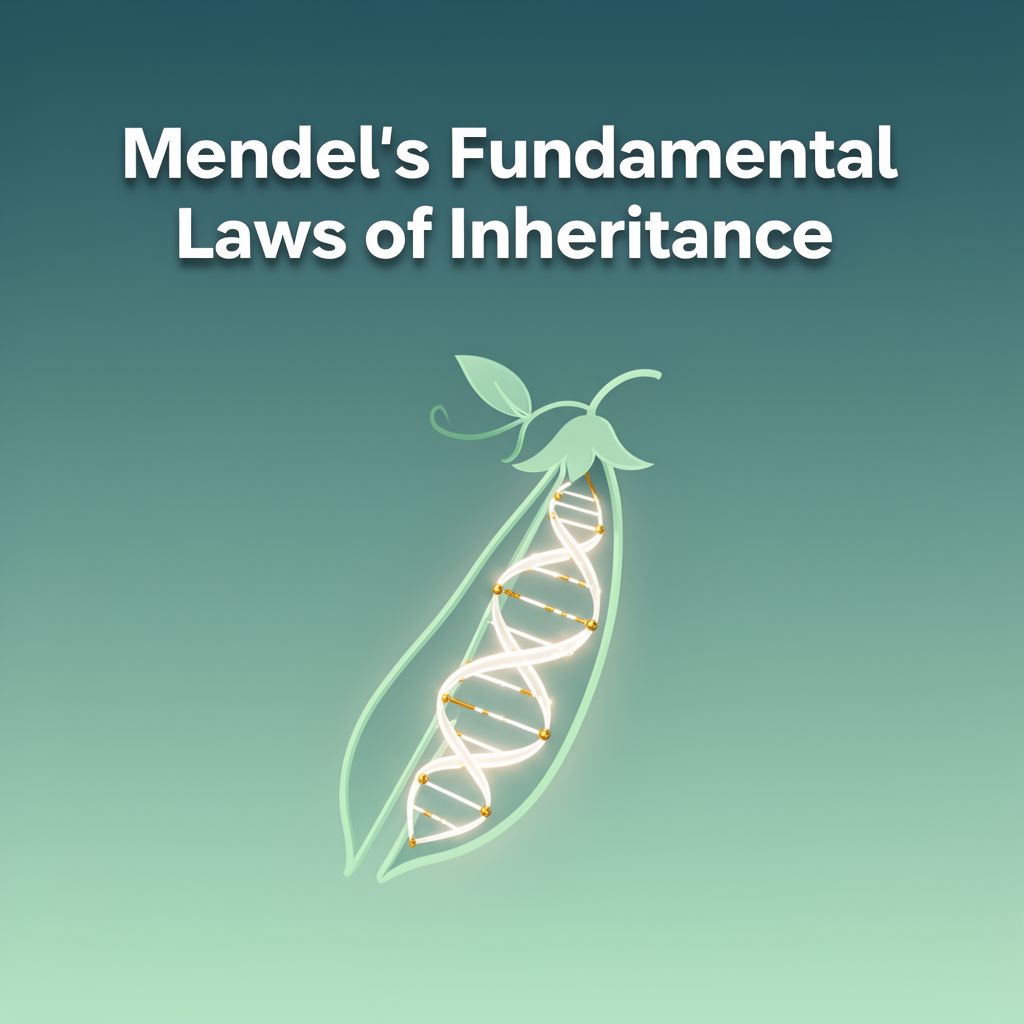
Mendel's Fundamental Laws of Inheritance - kapak
Bilim#mendel#genetics#inheritance#biology

Mendel's Fundamental Laws of Inheritance

Explore Gregor Mendel's groundbreaking work on heredity, including the Law of Segregation, the Law of Independent Assortment, and the Law of Dominance, which form the basis of modern genetics.

banoJanuary 22, 2026 ~18 dk toplam
01

Sesli Özet

5 dakika

Konuyu otobüste, koşarken, yolda dinleyerek öğren.

Sesli Özet

Mendel's Fundamental Laws of Inheritance

0:005:22
02

Flash Kartlar

25 kart

Karta tıklayarak çevir. ← → ile gez, ⎵ ile çevir.

1 / 25
Tüm kartları metin olarak gör
  1. 1. Who is Gregor Mendel often referred to as?

    Gregor Mendel is often referred to as the 'father of modern genetics.' His meticulous experiments, primarily with pea plants, laid the foundational understanding of how traits are passed from one generation to the next, revolutionizing the field of biology.

  2. 2. What was the primary organism Gregor Mendel used for his experiments?

    Gregor Mendel primarily used pea plants (Pisum sativum) for his experiments. These plants were ideal because they have distinct, easily observable traits, a relatively short life cycle, and can be easily cross-pollinated or self-pollinated, allowing for controlled breeding experiments.

  3. 3. What was the prevailing, yet inaccurate, theory of heredity before Mendel's work?

    Before Mendel, the prevailing theory of heredity was 'blending inheritance.' This theory proposed that parental characteristics simply mixed together, much like mixing paints, resulting in an intermediate phenotype in the offspring. Mendel's work disproved this by showing traits are passed as distinct units.

  4. 4. What revolutionary concept did Mendel introduce regarding the inheritance of traits?

    Mendel introduced the revolutionary concept that traits are not simply blended but are passed on as distinct units, which we now call genes or alleles. He demonstrated that the inheritance of these traits follows basic statistical laws, allowing for predictable and quantifiable analysis of heredity.

  5. 5. How did Mendel's approach to studying heredity differ from previous attempts?

    Mendel's approach was unique due to its meticulous experimental design, controlled breeding, and, crucially, its quantitative and statistical analysis of results. He counted and analyzed thousands of offspring, providing a clear, statistically supported framework for heredity, which was a radical departure from qualitative observations.

  6. 6. What is the significance of Mendel's statistical approach to heredity?

    Mendel's statistical approach provided the scientific rigor necessary to unravel the complexities of heredity. By quantifying his results, he demonstrated that trait transmission is predictable and quantifiable, establishing that traits were passed on independently and not simply blended, thus moving genetics into a scientific discipline.

  7. 7. What is the first of Mendel's fundamental laws of inheritance?

    The first fundamental law is the Law of Segregation. This law states that for any given trait, the two factors (alleles) that determine its expression separate from each other during the formation of gametes, so that each gamete receives only one of these factors.

  8. 8. According to the Law of Segregation, what are the 'factors' that determine a trait?

    According to the Law of Segregation, these 'factors' are what we now call alleles. Alleles are distinct forms of a gene that determine a specific characteristic. They exist in pairs within an individual, with one allele inherited from each parent.

  9. 9. How do these 'factors' (alleles) behave during gamete formation according to the Law of Segregation?

    During gamete formation (the production of reproductive cells like sperm or egg), the two factors (alleles) for each trait separate, or segregate, from each other. Consequently, each gamete receives only one of these two factors, ensuring genetic diversity.

  10. 10. What happens to the factors (alleles) during fertilization, based on the Law of Segregation?

    During fertilization, the offspring inherits one factor (allele) from each parent. This process reconstitutes the pair of factors in the new individual, determining the expression of the trait. This random recombination is key to genetic variation.

  11. 11. Why was the Law of Segregation a critical revelation against the blending inheritance theory?

    The Law of Segregation was critical because it showed that traits are passed as distinct, separable units, not blended. It demonstrated that dominant and recessive traits are passed on randomly, explaining why traits can disappear in one generation and reappear unchanged in a later one, which blending inheritance could not explain.

  12. 12. What is the second of Mendel's fundamental laws of inheritance?

    The second fundamental law is the Law of Independent Assortment. This law states that the alleles for different genes assort independently of one another during gamete formation. In simpler terms, the inheritance of one trait does not influence the inheritance of another trait.

  13. 13. What does the Law of Independent Assortment address regarding inheritance?

    The Law of Independent Assortment addresses the inheritance of multiple traits simultaneously. It explains that the segregation of alleles for one gene is independent of the segregation of alleles for another gene, leading to a greater variety of genetic combinations in offspring.

  14. 14. Explain what 'assort independently' means in the context of Mendel's second law.

    'Assort independently' means that the alleles for different genes (located on different chromosomes or far apart on the same chromosome) separate into gametes without influencing each other. For example, the way alleles for seed color segregate is independent of how alleles for plant height segregate.

  15. 15. Provide an example illustrating the Law of Independent Assortment using pea plant traits.

    For example, in pea plants, the inheritance of seed color (yellow or green) is independent of the inheritance of plant height (tall or dwarf). A tall plant is just as likely to produce offspring with green seeds as it is with yellow seeds, assuming the parent carries the respective alleles for both traits.

  16. 16. What is the consequence of independent assortment for genetic variation in offspring?

    Independent assortment significantly increases genetic variation in offspring. By allowing different combinations of alleles from different genes to be passed down, it explains why siblings from the same parents can exhibit such diverse combinations of traits, contributing to the probabilistic nature of inheritance.

  17. 17. What is the third of Mendel's fundamental laws of inheritance?

    The third fundamental law is the Law of Dominance. This law provides insight into how traits are expressed when different factors (alleles) are present. It states that in a pair of contrasting traits, one factor, the dominant allele, will mask or suppress the expression of the other, recessive allele.

  18. 18. According to the Law of Dominance, what happens when an individual inherits both a dominant and a recessive allele for a trait?

    According to the Law of Dominance, if an individual inherits both a dominant and a recessive allele for a particular trait, only the dominant trait will be observable in the phenotype. The dominant allele completely masks the expression of the recessive allele.

  19. 19. Under what condition will a recessive trait be expressed in an organism's phenotype?

    A recessive trait will only be expressed in an organism's phenotype if the individual inherits two copies of the recessive allele, one from each parent. If even one dominant allele is present, the recessive trait will remain hidden or masked.

  20. 20. Give an example of dominance using Mendel's pea plants.

    In Mendel's pea plants, tallness was dominant over dwarfism. This means that a pea plant inheriting one allele for tallness and one allele for dwarfism would still appear tall. The dwarf trait would only manifest if the plant inherited two dwarf alleles.

  21. 21. How did the Law of Dominance help explain why certain traits seemed to disappear and reappear across generations?

    The Law of Dominance provided a clear mechanism for this phenomenon. A recessive trait could seem to disappear in one generation (e.g., F1) if it was masked by a dominant allele, only to reappear in a later generation (e.g., F2) when two recessive alleles were inherited together, allowing its expression.

  22. 22. What was the primary goal of Gregor Mendel's experiments?

    Gregor Mendel's primary goal was to understand the fundamental principles of heredity – how traits are passed from one generation to the next. He aimed to establish a clear, statistically supported framework for inheritance, moving beyond the then-prevailing, inaccurate theories of his time.

  23. 23. How did Mendel's work revolutionize the field of biology?

    Mendel's work revolutionized biology by providing the first clear, statistically supported framework for heredity. His discoveries moved beyond the concept of blending inheritance, establishing that traits are passed as distinct units and follow predictable laws, thereby founding the science of modern genetics.

  24. 24. What does it mean that traits are transmitted in a 'predictable, quantifiable manner'?

    It means that the inheritance of traits can be observed, measured, and analyzed statistically. This allows scientists to predict the likelihood of offspring inheriting specific traits, moving away from random or blended outcomes and providing a scientific basis for understanding heredity.

  25. 25. What are 'gametes' in the context of Mendel's laws?

    In the context of Mendel's laws, 'gametes' are the reproductive cells (e.g., sperm and egg in animals, pollen and ovules in plants). According to the Law of Segregation, each gamete carries only one allele for each trait, which it contributes to the offspring during fertilization.

03

Bilgini Test Et

15 soru

Çoktan seçmeli sorularla öğrendiklerini ölç. Cevap + açıklama.

Soru 1 / 15Skor: 0

What was Gregor Mendel's primary contribution to the field of biology?

04

Detaylı Özet

3 dk okuma

Tüm konuyu derinlemesine, başlık başlık.

Gregor Mendel's Fundamental Laws of Inheritance: A Study Guide

This study material has been compiled from a lecture audio transcript and supplementary copy-pasted text.


📚 Introduction to Gregor Mendel's Legacy

Gregor Mendel, often hailed as the "Father of Modern Genetics," conducted groundbreaking experiments that revolutionized our understanding of heredity. His meticulous work, primarily with pea plants, laid the foundation for how we comprehend the transmission of traits from one generation to the next. Before Mendel, the prevailing theory of "blending inheritance" suggested that parental traits simply mixed, like paints. However, Mendel's insights, supported by statistical analysis, demonstrated that traits are passed on as distinct units, forever changing the field of biology.

💡 Mendel's Core Achievements and the Statistical Nature of Heredity

Mendel's profound contributions stemmed from his extensive and carefully designed experiments. He proposed a revolutionary theory: all living things possess specific traits, and, crucially, the inheritance of these traits follows basic statistical laws. This statistical approach was a radical departure from previous ideas and provided the scientific rigor needed to unravel the complexities of heredity.

Key Achievements:

  • Established that traits are passed on as distinct units, not blended.
  • Demonstrated that heredity follows predictable, quantifiable patterns.
  • Provided the first clear, statistically supported framework for inheritance.
  • Showed that traits could be passed on independently of other traits.

🧬 Mendel's Laws of Inheritance

Mendel formulated three fundamental laws that govern how genetic traits are inherited. These laws explain the patterns observed in offspring and provide the basis for modern genetics.

1️⃣ The Law of Segregation

The Law of Segregation explains how individual traits are passed down. It states that for any given trait, there are distinct factors (now known as alleles) that determine its expression. These factors exist in pairs within an individual.

Core Principle:

  • During the formation of gametes (reproductive cells like sperm or egg), these two factors (alleles) separate or "segregate" from each other.
  • Consequently, each gamete receives only one of these two factors.
  • When fertilization occurs, the offspring inherits one factor from each parent, thereby reconstituting the pair.

This random segregation and subsequent recombination of factors from parents to offspring was a critical revelation. It provided a robust alternative to the blending inheritance theory, clearly showing that there are dominant and recessive traits passed on randomly.

2️⃣ The Law of Independent Assortment

Building upon the Law of Segregation, the Law of Independent Assortment addresses the inheritance of multiple traits simultaneously.

Core Principle:

  • The alleles for different genes assort independently of one another during gamete formation.
  • In simpler terms, the inheritance of one trait does not influence the inheritance of another trait.

Example: Consider pea plant height and seed color. The way alleles for height segregate into gametes is independent of how alleles for seed color segregate. This means a tall plant is just as likely to produce offspring with green seeds as it is with yellow seeds, assuming the parent carries the respective alleles. This independent assortment leads to a greater variety of genetic combinations in offspring, explaining the diversity among siblings from the same parents.

3️⃣ The Law of Dominance

The Law of Dominance provides insight into how traits are expressed when different factors (alleles) are present for a particular gene.

Core Principle:

  • In a pair of contrasting traits, one factor, called the dominant allele, will mask or completely suppress the expression of the other factor, known as the recessive allele, in the organism's observable characteristics (phenotype).
  • The recessive trait will only be expressed if the individual inherits two copies of the recessive allele (one from each parent).

Example: In Mendel's pea plants, tallness was dominant over dwarfism. A plant inheriting one allele for tallness and one for dwarfism would still appear tall. The dwarf trait would only manifest if the plant inherited two dwarf alleles. This concept was crucial for understanding why certain traits seemed to disappear in one generation only to reappear in a later one.


Mendel's meticulous experiments and the laws he formulated provided the foundational framework for understanding genetic inheritance, paving the way for all subsequent discoveries in genetics and molecular biology. His work underscores the probabilistic and distinct nature of trait transmission, moving beyond simplistic blending theories.
Kendi çalışma materyalini oluştur

PDF, YouTube videosu veya herhangi bir konuyu dakikalar içinde podcast, özet, flash kart ve quiz'e dönüştür. 1.000.000+ kullanıcı tercih ediyor.

Sıradaki Konular

Tümünü keşfet
Introduction to Basic Genetics

Introduction to Basic Genetics

Explore the fundamental principles of genetics, from cell theory and the nature of genetic material to heredity, cell division, and the diverse branches of genetic study.

Özet 25 15
Understanding Connective Tissues and Their Cells

Understanding Connective Tissues and Their Cells

Explore the fundamental types, structures, and cellular components of connective tissues, including their crucial roles in the body's support, protection, and immunity.

Özet 25 15
Cellular Respiration and Energy Metabolism

Cellular Respiration and Energy Metabolism

An academic summary detailing cellular respiration, its stages, types, and the broader context of energy metabolism, including nutrient processing and energy balance.

6 dk Özet 25 15
Biology, Behavior, and the Nature-Nurture Interplay

Biology, Behavior, and the Nature-Nurture Interplay

Explore the intricate relationship between genetics, environment, and behavior, delving into the Minnesota Study of Twins, gene expression, epigenetics, and methods to disentangle nature vs. nurture.

Özet 25 15
Cell Division and Cell Cycle: Meiosis

Cell Division and Cell Cycle: Meiosis

An academic summary of cell division, focusing on sexual reproduction, the necessity of meiosis, its stages, and unique features like synapsis, homologous recombination, and reduction division.

6 dk Özet 25 15
Cell Division and Cell Cycle Overview

Cell Division and Cell Cycle Overview

An academic summary detailing prokaryotic and eukaryotic cell division, including binary fission, the eukaryotic cell cycle phases, and the stages of mitosis and cytokinesis.

6 dk Özet 25 15
Biological Compounds: Inorganic and Organic Molecules

Biological Compounds: Inorganic and Organic Molecules

This audio summary explores the fundamental inorganic and organic compounds essential for life, detailing their structures, properties, and critical biological functions.

8 dk Özet 25 15
Common Characteristics of Living Organisms

Common Characteristics of Living Organisms

An academic summary detailing the fundamental characteristics shared by all living organisms, including cellular organization, metabolism, homeostasis, reproduction, growth, response to stimuli, and adaptation.

5 dk Özet 25 15