Biological Compounds: Inorganic and Organic Molecules - kapak
Bilim#biology#biological compounds#inorganic compounds#organic compounds

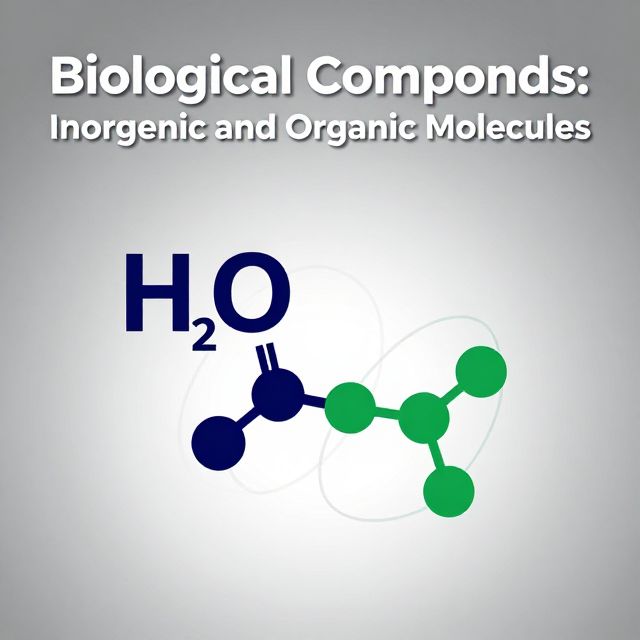
Biological Compounds: Inorganic and Organic Molecules

This audio summary explores the fundamental inorganic and organic compounds essential for life, detailing their structures, properties, and critical biological functions.

pancucumMarch 19, 2026 ~26 dk toplam
01

Sesli Özet

9 dakika

Konuyu otobüste, koşarken, yolda dinleyerek öğren.

Sesli Özet

Biological Compounds: Inorganic and Organic Molecules

0:008:53
02

Flash Kartlar

25 kart

Karta tıklayarak çevir. ← → ile gez, ⎵ ile çevir.

1 / 25
Tüm kartları metin olarak gör
  1. 1. What are the four fundamental organic molecules that constitute living organisms?

    The four fundamental organic molecules are carbohydrates, lipids, proteins, and nucleic acids. These molecules are essential for various biological processes, serving roles such as energy storage, structural support, metabolic regulation, and genetic information transmission. They are the building blocks of all living cells.

  2. 2. Which six primary elements constitute approximately 98% of the weight of most living organisms?

    The six primary elements are carbon (C), hydrogen (H), oxygen (O), nitrogen (N), phosphorus (P), and sulfur (S). These elements form the backbone of biological compounds, and their unique arrangements give distinct properties to each molecule. Their abundance highlights their critical role in life's chemistry.

  3. 3. How are chemical compounds broadly classified in biology?

    Chemical compounds are broadly classified into two categories: inorganic compounds and organic compounds. This classification is primarily based on the presence or absence of carbon atoms and the complexity of their structures. Both types of compounds are vital for cellular functions and the maintenance of life.

  4. 4. Name the fundamental organic molecules of cells and briefly state their primary roles.

    Nucleic acids are responsible for genetic information transmission. Proteins are crucial for metabolic continuity and structural support. Lipids are significant for energy storage and membrane formation. Carbohydrates are effective in rapid energy transformations and structural roles. These molecules collectively ensure the proper functioning and survival of cells.

  5. 5. What are the general characteristics of inorganic compounds?

    Inorganic compounds generally lack carbon atoms, or if they contain carbon, it is not bonded to hydrogen (e.g., CO2). They typically possess simpler structures compared to organic molecules. Despite their simplicity, they perform highly important roles in cellular functions, such as water and minerals.

  6. 6. Why is water considered the most critical inorganic molecule for life?

    Water is the most critical inorganic molecule because it is the most abundant substance in nature and within organisms, constituting a large part of cell structure. It is essential for numerous biological processes, including nutrient transport, metabolic waste removal, and maintaining cellular integrity. The continuity of life is heavily dependent on water's unique properties.

  7. 7. Explain water's solvent property and its importance in biological systems.

    Water's solvent property means it can dissolve many substances due to its polarity. This property is crucial in biological systems as it facilitates nutrient transport throughout the body, allowing essential molecules to reach cells. It also aids in the removal of metabolic waste products, ensuring cellular health and function. This makes water the 'universal solvent'.

  8. 8. Describe the structure of a water molecule and how it leads to its polarity.

    A water molecule consists of two positively charged hydrogen atoms bonded with one negatively charged oxygen atom. This forms an asymmetrical, bent shape. The oxygen atom is more electronegative than hydrogen, pulling electrons closer to itself, which creates a partial negative charge on the oxygen and partial positive charges on the hydrogen atoms. This uneven distribution of charge makes water a polar molecule.

  9. 9. Define adhesion in the context of water's properties.

    Adhesion is the attractive force between water molecules and molecules of a different type. This property allows water to stick to other surfaces, such as the walls of plant vessels, aiding in phenomena like capillary action. It is distinct from cohesion, which involves attraction between like molecules.

  10. 10. Define cohesion in the context of water's properties.

    Cohesion is the attractive force between molecules of the same type, specifically between water molecules. This property is responsible for water's surface tension, allowing small organisms to walk on water, and plays a vital role in water transport in plants by creating a continuous column of water. It is a result of hydrogen bonding between water molecules.

  11. 11. Why is water often called the 'universal solvent'?

    Water is often called the 'universal solvent' because its polarity allows it to dissolve a wide variety of substances, particularly other polar molecules and ionic compounds. This ability is fundamental for life, as it facilitates countless chemical reactions, enables the transport of nutrients, and helps maintain cellular processes. Without this property, many biological functions would not be possible.

  12. 12. Differentiate between hydrophilic and hydrophobic compounds.

    Hydrophilic compounds are 'water-loving' substances that readily dissolve in water due to their polar nature, such as sugar. Conversely, hydrophobic compounds are 'water-fearing' substances that do not dissolve well in water, typically because they are nonpolar, like lipids. This distinction is crucial for understanding how different molecules interact within biological systems.

  13. 13. How does water's high specific heat capacity benefit living organisms?

    Water's high specific heat capacity means it can absorb or release a large amount of heat with only a slight change in its own temperature. This property is highly beneficial for organisms as it helps them resist drastic temperature fluctuations, maintaining a stable internal environment (homeostasis). This thermal stability is crucial for enzyme function and overall metabolic processes.

  14. 14. Explain the role of water in dehydration (condensation) reactions.

    In dehydration, also known as condensation reactions, water is released as a byproduct when two smaller molecules (monomers) are joined together to form a larger molecule (polymer). This process involves the removal of a hydroxyl group from one monomer and a hydrogen atom from another, forming a new covalent bond and a molecule of water. It's a common mechanism for synthesizing macromolecules.

  15. 15. Explain the role of water in hydrolysis reactions.

    In hydrolysis reactions, water is used to break down larger molecules (polymers) into smaller units (monomers). A water molecule is added across a bond, breaking it and releasing the individual monomers. This process is essential for digestion, where complex food molecules are broken down into absorbable units, and for recycling cellular components. It is the reverse of dehydration.

  16. 16. What are minerals, and why are they crucial for life?

    Minerals are inorganic substances that organisms require but cannot synthesize themselves. They are crucial for healthy growth, development, and the proper functioning of various body systems. Minerals strengthen bones, enable muscular and nervous system function, regulate water balance, and support hormones, enzymes, and the immune system, making them indispensable for life maintenance.

  17. 17. How do organisms obtain the minerals they need?

    Organisms obtain minerals from their environment. Plants acquire minerals from the soil through their roots. Animals, in turn, obtain minerals by consuming plants or other animals that have consumed plants, as well as directly from water. Since living organisms cannot produce minerals, external acquisition is essential for their survival and health.

  18. 18. Do minerals provide energy? Explain their primary metabolic role.

    No, minerals do not provide energy to organisms. Instead, their primary metabolic role is to act as regulatory molecules. They are essential cofactors for many enzymes, participate in nerve impulse transmission, muscle contraction, and maintain osmotic pressure. They are vital for metabolism but do not contribute caloric energy.

  19. 19. What are the general characteristics of organic molecules?

    Organic molecules are compounds formed by the bonding of various elements and functional groups to carbon atoms. They are generally larger and more complex than inorganic molecules. They often include hydrogen, oxygen, nitrogen, and sulfur, along with functional groups that determine their biochemical properties and biological functions. They are fundamental components of living systems.

  20. 20. Define monomer and polymer in the context of organic molecules.

    A monomer is a small, repeating unit that serves as a building block for larger molecules. A polymer is a large molecule (macromolecule) made up of many repeating monomer subunits linked together. For example, amino acids are monomers that link to form protein polymers, and monosaccharides are monomers that form carbohydrate polymers.

  21. 21. What are carbohydrates composed of, and what is their main function?

    Carbohydrates are organic molecules composed primarily of carbon, hydrogen, and oxygen atoms, often in a 1:2:1 ratio (CH₂O)n. Their main function is to serve as the primary energy-providing nutrient for living organisms, essential for daily activities and cellular processes. They also play structural roles in some organisms.

  22. 22. Name the three main categories of carbohydrates.

    The three main categories of carbohydrates are monosaccharides, disaccharides, and polysaccharides. These categories are distinguished by the number of sugar units they contain. Monosaccharides are single sugar units, disaccharides are two units, and polysaccharides are long chains of many sugar units.

  23. 23. What are monosaccharides, and give examples of hexoses.

    Monosaccharides are simple sugars, the most basic units of carbohydrates, typically having molecular formulas expressed as CH₂Oₙ. Hexoses are monosaccharides with six carbon atoms. Common examples of hexoses include glucose (blood sugar), fructose (fruit sugar), and galactose (milk sugar), all of which are structural isomers.

  24. 24. Describe the importance and primary role of glucose in living organisms.

    Glucose, also known as blood sugar, is a primary energy source for cells, including nerve cells, in most living organisms. It is synthesized by plants through photosynthesis and stored as glycogen in animals or starch in plants. Its breakdown provides immediate energy for metabolic activities, making it a central molecule in energy metabolism.

  25. 25. How are disaccharides formed, and give two examples with their monosaccharide components.

    Disaccharides are formed by the linkage of two monosaccharides through a glycosidic bond, typically via a dehydration reaction. Two common examples are sucrose, which is composed of glucose and fructose, and lactose, which consists of glucose and galactose. These larger sugars are broken down into monosaccharides by digestive enzymes.

03

Bilgini Test Et

15 soru

Çoktan seçmeli sorularla öğrendiklerini ölç. Cevap + açıklama.

Soru 1 / 15Skor: 0

Which six primary elements constitute approximately 98% of the weight of most living organisms?

04

Detaylı Özet

7 dk okuma

Tüm konuyu derinlemesine, başlık başlık.

Study Material: Basic Components of Life

Source Information: This study material has been compiled and organized from a copy-pasted text and a lecture audio transcript.


📚 Introduction to Biological Compounds

All living organisms are fundamentally composed of various chemical compounds. These compounds are built primarily from six key elements: carbon (C), hydrogen (H), oxygen (O), nitrogen (N), phosphorus (P), and sulfur (S), which together make up approximately 98% of the weight of most living things. The specific arrangement of atoms from these elements gives each compound its unique properties. Additionally, about 25 other elements are essential for life, even in trace amounts, as their absence can significantly impact bodily functions.

Chemical compounds are broadly classified into two main categories:

  1. Inorganic Compounds
  2. Organic Compounds

Organic compounds, such as nucleic acids (for genetic information), proteins (for metabolism), lipids (for energy storage), and carbohydrates (for rapid energy transformations), are considered the fundamental molecules of cells. Alongside these, inorganic molecules like water, minerals, and salts are also crucial components found in cells.


💧 Inorganic Compounds: Water and Minerals

Inorganic compounds generally lack carbon (with some exceptions like CO2) and typically have simpler structures compared to organic molecules. Despite their apparent simplicity, they play vital roles in cellular functions.

1. Water (H₂O)

Water is the most critical inorganic molecule and the most abundant substance in nature and within organisms. It is indispensable for life due to its unique properties.

Key Characteristics & Functions of Water:

  • Abundance: Constitutes a large part of cell structure.
  • Solvent Property: Often called the "universal solvent" 🌍. Its polarity allows it to dissolve many substances, facilitating:
    • Transport of nutrients.
    • Removal of metabolic wastes.
    • Chemical reactions within organisms.
  • Metabolic Role: Essential for metabolic reactions and proper enzyme function.
  • Temperature Regulation: Plays a significant role in regulating body temperature due to its high specific heat capacity and high latent heat of vaporization.
  • Structural Integrity: Helps maintain the structural integrity of cells.
  • Digestion: Aids in the digestion process.

📚 Water Molecule Structure: A water molecule consists of one oxygen atom bonded with two hydrogen atoms.

  • The oxygen atom is more electronegative, attracting electrons and becoming slightly negatively charged (δ-).
  • The hydrogen atoms become slightly positively charged (δ+).
  • This creates an asymmetrical, polar molecule, meaning it has distinct positive and negative regions.

💡 Properties Arising from Polarity:

  • Adhesion: Attraction between water molecules and different types of molecules (e.g., water sticking to glass).
  • Cohesion: Attraction between water molecules and other water molecules (e.g., water droplets forming).
    • In plants, adhesion and cohesion enable the upward transport of water from roots.
  • Surface Tension: High cohesive forces create an invisible film on water's surface, allowing some small organisms to walk on it.
  • Hydrophilic vs. Hydrophobic:
    • Hydrophilic ("water-loving") substances dissolve well in water (e.g., sugar, salts).
    • Hydrophobic ("water-fearing") substances do not dissolve well in water (e.g., lipids, oils).
  • High Specific Heat Capacity: Water can absorb or release large amounts of heat with only a slight change in its own temperature, protecting organisms from sudden temperature fluctuations.
  • High Latent Heat of Vaporization: A large amount of energy is required to evaporate water, providing an effective cooling mechanism (e.g., sweating).
  • Density Anomaly: Ice is less dense than liquid water, causing it to float and insulate aquatic ecosystems below.

🔄 Role of Water in Chemical Reactions: Water is involved in two crucial types of reactions:

  1. Dehydration (Condensation) Reaction: 💧
    • Monomers are joined together to form polymers.
    • A molecule of water is released as a byproduct.
    • Example: Glucose + Glucose → Maltose + H₂O
  2. Hydrolysis Reaction: 💦
    • Polymers are broken down into monomers.
    • A molecule of water is consumed (added) to break the bonds.
    • Example: Maltose + H₂O → Glucose + Glucose

2. Minerals

Minerals are inorganic substances that organisms require for various functions but cannot synthesize within their own bodies. They must be obtained from external sources.

Key Characteristics & Functions of Minerals:

  • Essential Nutrients: Crucial for healthy growth, development, proper functioning of body systems, and overall life maintenance.
  • Sources: Plants obtain minerals from the soil; animals acquire them by consuming plants and drinking water.
  • No Energy Source: Minerals do not provide energy.
  • Regulatory Role: Act as regulatory molecules for metabolism.
  • Structural Support: Strengthen bones (e.g., Calcium), support hormones, enzymes, and other biological components.
  • System Function: Enable proper functioning of muscular and nervous systems.
  • Homeostasis: Regulate water balance and osmotic pressure of the blood.
  • Immune System: Some minerals are essential for immune system function.
  • Deficiency Impact: Insufficient intake can disrupt normal body functions and lead to various health problems.

🌿 Organic Compounds: The Macromolecules of Life

Organic molecules are characterized by their carbon backbone, to which various elements (like H, O, N, S) and functional groups (e.g., alcohol, hydroxyl, carboxyl) are bonded. These functional groups determine the biochemical properties and biological functions of the molecules. Organic molecules are generally larger and more complex than inorganic molecules.

📚 Macromolecules: Monomers and Polymers Many organic molecules are macromolecules (large molecules).

  • Monomer: A small molecule that serves as a building block.
  • Polymer: A large molecule formed by the covalent bonding of many repeating monomer units.

The formation and breakdown of these macromolecules involve the same water-related reactions discussed earlier:

  • Dehydration (Condensation): Joins monomers to form polymers, releasing water.
  • Hydrolysis: Breaks down polymers into monomers, consuming water. These processes are typically enzyme-mediated and require energy.

Organic molecules are synthesized naturally by living organisms (plants, animals, microorganisms) and can also be produced synthetically. The main types of natural organic macromolecules include carbohydrates, proteins, lipids, and nucleic acids, along with vitamins. They serve as fundamental cellular components and regulate metabolic activities.

📊 Functions of Organic Compounds in Living Things:

  • Energy Producers: Carbohydrates, Lipids, Proteins
  • Structural Molecules: Proteins, Lipids, Carbohydrates
  • Master Molecules (Genetic Information): Nucleic acids
  • Regulatory Molecules: Hormones, vitamins, enzymes, proteins, lipids

1. Carbohydrates

Carbohydrates are organic molecules primarily composed of carbon, hydrogen, and oxygen atoms, though some may contain nitrogen. They are a main energy-providing nutrient, crucial for daily activities.

Carbohydrates are categorized based on their size and complexity:

A. Monosaccharides (Simple Sugars)

Monosaccharides are the simplest carbohydrates, typically with a molecular formula of (CH₂O)ₙ.

  • Pentoses (5-carbon sugars):
    • Ribose: A fundamental component of RNA (ribonucleic acid).
    • Deoxyribose: A fundamental component of DNA (deoxyribonucleic acid).
    • 💡 Key Difference: Deoxyribose lacks one oxygen atom compared to ribose.
  • Hexoses (6-carbon sugars): These share the same molecular formula (C₆H₁₂O₆) but have different structural arrangements (structural isomers).
    • Glucose: 🩸 Known as "blood sugar" or "grape sugar."
      • Primary energy source for cells, especially nerve cells.
      • Synthesized by plants through photosynthesis.
      • Stored as glycogen in animals and starch in plants.
    • Fructose: 🍎 Known as "fruit sugar."
      • Found in fruits, honey, and some vegetables.
      • Sweeter than glucose, widely used in the food industry.
      • ⚠️ Excessive consumption can lead to health issues like fatty liver, obesity, and diabetes.
    • Galactose: 🥛 Known as "milk sugar."
      • Found in milk and dairy products.
      • Converted into glucose in cells for energy.
      • A component of lactose.
B. Disaccharides (Double Sugars)

Disaccharides are formed when two monosaccharides link together via a glycosidic bond through a dehydration reaction. They are generally less soluble in water and less sweet than monosaccharides.

  • Maltose (Malt Sugar): Glucose + Glucose
    • Produced in plants.
  • Sucrose (Table Sugar): Glucose + Fructose
    • Mainly obtained from sugar cane and sugar beet.
  • Lactose (Milk Sugar): Glucose + Galactose
    • Found in mammalian milk.
    • 💡 Lactose Intolerance: Occurs when individuals lack sufficient enzymes to break down lactose, leading to digestive problems.

⚠️ Important Note: Excessive consumption of carbohydrates can lead to weight gain, as excess carbohydrates are converted into fats and stored in the body.

C. Polysaccharides (Multiple Sugars)

Polysaccharides are long-chain organic molecules formed by the joining of many monosaccharides (usually glucose) through dehydration reactions. They serve two main functions: storage and structural support.

  1. Storage Polysaccharides:

    • Glycogen:
      • Storage form of glucose in animals and some fungi.
      • Stored primarily in the liver (regulates blood glucose) and muscle cells (energy source during exercise).
    • Starch:
      • Storage form of glucose in plants.
      • Stored in roots, tubers, and seeds.
      • Structurally similar to glycogen.
  2. Structural Polysaccharides:

    • Cellulose: 🌳
      • The basic structural material of plant cell walls.
      • Provides mechanical support and high tensile strength, preventing plant cells from bursting.
      • Indigestible by most organisms, including humans, due to the specific type of bond between glucose units.
      • 💡 Dietary Fiber: In humans, cellulose acts as dietary fiber, accelerating intestinal movements and aiding digestion.
      • Ruminant animals (e.g., cows) and termites have microorganisms that can digest cellulose.
    • Chitin: 🐞
      • Composed of nitrogen-containing glucose derivative monomers.
      • Forms the exoskeletons of insects and the cell walls of fungi.
      • More flexible and elastic than cellulose.
      • Used in medical fields for biocompatible surgical sutures due to its ability to dissolve and shorten wound healing.

✅ Conclusion: The Interdependence of Life's Components

The intricate balance and interaction between inorganic and organic compounds are fundamental to all life processes. From the essential solvent properties of water and the regulatory roles of minerals to the diverse energy storage and structural functions of carbohydrates, each class of biological molecule plays a critical and indispensable role. Understanding these basic components is paramount to comprehending the complexity and continuity of life.
Kendi çalışma materyalini oluştur

PDF, YouTube videosu veya herhangi bir konuyu dakikalar içinde podcast, özet, flash kart ve quiz'e dönüştür. 1.000.000+ kullanıcı tercih ediyor.

Sıradaki Konular

Tümünü keşfet
Animal Nutrition and Digestive Systems

Animal Nutrition and Digestive Systems

Explore the fundamentals of animal nutrition, diverse digestive systems, and the detailed functions of the vertebrate digestive tract and its accessory organs.

Özet 25 15
Unlocking Life's Chemistry: An Intro to Biochemistry

Unlocking Life's Chemistry: An Intro to Biochemistry

Explore the fascinating world of biochemistry, understanding the chemical processes and molecules that make life possible, from DNA to energy production.

Özet 25 15
Cellular Organization and Molecular Foundations

Cellular Organization and Molecular Foundations

Explore the intricate world of eukaryotic cells, from their diverse numbers, shapes, and sizes to the fundamental chemical elements and organic molecules that form the basis of life.

10 dk Özet 25 15
Understanding Connective Tissues and Their Cells

Understanding Connective Tissues and Their Cells

Explore the fundamental types, structures, and cellular components of connective tissues, including their crucial roles in the body's support, protection, and immunity.

Özet 25 15
Cellular Respiration and Energy Metabolism

Cellular Respiration and Energy Metabolism

An academic summary detailing cellular respiration, its stages, types, and the broader context of energy metabolism, including nutrient processing and energy balance.

6 dk Özet 25 15
Cell Division and Cell Cycle Overview

Cell Division and Cell Cycle Overview

An academic summary detailing prokaryotic and eukaryotic cell division, including binary fission, the eukaryotic cell cycle phases, and the stages of mitosis and cytokinesis.

6 dk Özet 25 15
Common Characteristics of Living Organisms

Common Characteristics of Living Organisms

An academic summary detailing the fundamental characteristics shared by all living organisms, including cellular organization, metabolism, homeostasis, reproduction, growth, response to stimuli, and adaptation.

5 dk Özet 25 15
Common Characteristics of Living Organisms

Common Characteristics of Living Organisms

An academic summary detailing the fundamental properties that define living organisms, including cellular organization, metabolism, reproduction, growth, and adaptation, for foundational biological understanding.

6 dk Özet 25 15