Podit
Podit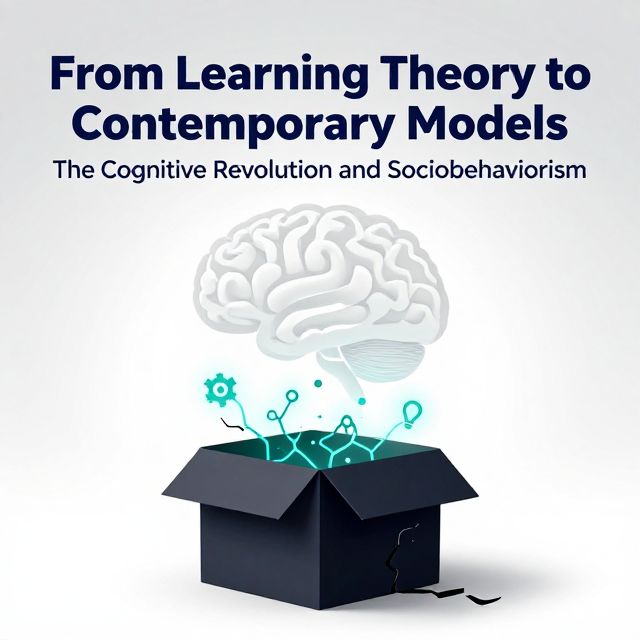
📚 From Learning Theory to Contemporary Models: The Cognitive Revolution and Sociobehaviorism
Source Information: This study material has been compiled from a copy-pasted text and a lecture audio transcript.
🚀 Introduction: The Evolution of Psychological Thought
Psychology's understanding of learning and behavior has undergone significant transformations. Initially dominated by behaviorism, which focused solely on observable actions, the field evolved dramatically with the Cognitive Revolution. This shift opened the "black box" of the mind, leading to contemporary models that integrate internal mental processes with environmental influences. This material explores this journey, highlighting the limitations of early behaviorism, the rise of cognitive psychology, and the emergence of sociobehaviorism through key figures like Albert Bandura and Julian Rotter.
1. 🧠 Early Behaviorism: Focus on Observable Behavior
Early behaviorism, a foundational perspective, asserted that psychology should only study observable behavior.
✅ Core Tenets:
- Observable Behavior Only: Rejected the study of internal mental states.
- Stimulus-Response (S-R) Connections: Learning occurred through simple associations between stimuli and responses.
- Reinforcement and Conditioning: Primary mechanisms for learning.
- "Black Box" Concept: The mind was considered inaccessible and irrelevant to scientific study.
- Environmental Control: Behavior was believed to be solely determined by external environmental factors.
⚠️ Limitations:
- Inability to Explain Complex Behavior: Struggled with phenomena like thinking, planning, and expectations.
- Ignored Internal Processes: Overlooked meaning, interpretation, and cognition.
- Passive Organism View: Treated humans as passive responders rather than active, interpreting individuals.
- Stage 1: Classical Behaviorism (Watson): Behavior = simple stimulus → automatic response, conditioning through associations.
- Stage 2: Neobehaviorism (Skinner): Behavior = response shaped by consequences → future behavior, focus on reinforcement.
2. 💡 The Cognitive Revolution: Opening the Black Box
The Cognitive Revolution marked a pivotal shift, challenging behaviorism's limitations and reintroducing mental processes into psychological study.
✅ Influences & Drivers:
- Dissatisfaction with Behaviorism: Its inability to explain complex mental processes.
- Computer Metaphor: Conceptualized the mind as an information processor (input → processing → output).
- Integration of Cognitive Variables: Figures like Bandura and Rotter began incorporating cognitive elements within behavioral frameworks.
- Advances in Research: Significant progress in understanding language and memory.
- Neuroscience Breakthroughs: Brain imaging and lesion studies demonstrated localized mental functions, proving the existence and importance of internal processes.
📊 Conceptual Changes:
The "black box" was opened, shifting focus from a direct S-R model to internal mental processes:
- Perception: "What is happening?"
- Interpretation: "What does this mean?"
- Memory: "What does this remind me of?"
- Expectations: "What will happen next?"
- Decision-making: "What should I do?"
This led to a fundamental change in perspective:
- Old View: Behavior only, external control, passive organism, S-R model.
- New View: Behavior + cognition, interaction of mind + environment, active interpreting individual, mediational processes (thinking, expectations).
3. 🤝 Sociobehaviorism: The Cognitive Challenge
Sociobehaviorism represents the transition from strict behaviorism to cognitive-behavioral approaches, recognizing the crucial role of cognition and social learning. This stage, roughly 1960-1990, saw behaviorism evolve and merge with cognitive ideas.
✅ Core Idea:
- Behavior = f(environment + cognition): Learning is more than just reinforcement; it involves thinking and expectations.
- Social and Observational Learning: Emphasizes how people learn from others.
- Internal Processes Mediate Behavior: Rejects the strict S-R model, highlighting that interpretation of situations matters as much as the stimuli themselves.
4. 👤 Albert Bandura: Social Cognitive Theory
Albert Bandura (1925-2021) was a key figure in sociobehaviorism, developing Social Cognitive Theory.
1️⃣ Modeling (Observational Learning):
- People can learn without direct reinforcement simply by observing others.
- Example: Bandura's Bobo doll experiment demonstrated how children imitate aggressive behaviors observed in adults.
- Vicarious Reinforcement: Learning occurs by observing others' behaviors and their consequences, even without personal experience. This allows for conscious decisions about behavior.
2️⃣ Reciprocal Determinism:
- A dynamic interaction model where Behavior ↔ Environment ↔ Cognition all mutually influence each other.
- Replaces the direct S-R or reinforcement-behavior link.
- A person's cognitive processes act as mediating mechanisms.
3️⃣ Factors Influencing Modeling:
We are more likely to model individuals who are:
- Of the same sex and age.
- Our peers.
- Those who have solved problems similar to ours.
- High in status and prestige.
- Simple behaviors are also more readily imitated.
4️⃣ Self-Efficacy:
- 📚 Definition: Belief in one's capability; a sense of adequacy, efficiency, and competence in dealing with problems.
- Impact:
- Affects motivation and persistence.
- Low self-efficacy leads to giving up easily, helplessness, hopelessness, and a belief that nothing will make a difference.
- High self-efficacy is a key predictor of success (better grades, career possibilities, job success, higher goals, better physical/mental health).
- Individuals with high self-efficacy are less bothered by stress and recover more quickly.
- Insight: "Believing that you can accomplish what you want to accomplish is one of the most important ingredients in the recipe for success."
5️⃣ Behavior Modification:
- If behaviors are learned by observing, undesired behaviors can be relearned through modeling.
- Example: Children's fear of dogs can be reduced by observing other children approach and touch them.
5. 🧑⚖️ Julian Rotter: Social Learning Theory
Julian Rotter (1916-2014) founded Social Learning Theory, emphasizing expectations and values. His work was more cognitive than Bandura's, focusing on subjective interpretation.
✅ Cognitive Processes:
- Behavior is determined by external stimuli and reinforcement, but these influences are mediated by cognitive processes.
📊 Rotter's Four Principles:
- We form subjective expectations of the outcomes or results of our behavior (amount and kind of reinforcement).
- We estimate the likelihood that a certain behavior leads to specific reinforcement and adjust our actions accordingly.
- We place different values on different reinforcers, assessing their relative worth in various situations.
- Because each individual's psychological environment is unique, the same reinforcement can have different values for different people.
🧭 Locus of Control:
- 📚 Definition: The perceived source of reinforcement.
- Internal Locus: Belief that outcomes depend on one's own behavior.
- Cognitive Result: "I am the captain of my ship."
- Impact: Proactive, healthy, successful.
- External Locus: Belief that outcomes depend on outside forces.
- Cognitive Result: "Life happens to me; I don't make it happen."
- Impact: Passive, anxious, less control.
- Development: Formed in childhood, influenced by parenting style.
- Supportive Parenting: Fosters an internal locus ("Your actions have reliable consequences").
- Inconsistent Parenting: Fosters an external locus ("Outcomes are random or based on others").
6. 🔄 Comparison and Legacy
✅ Bandura vs. Rotter:
- Bandura: Focused on modeling, observational learning, and self-efficacy.
- Rotter: Emphasized expectations, values, and locus of control.
- Shared Ground: Both integrated cognition into learning theories and moved beyond strict behaviorism.
📈 Fate of Behaviorism:
- Behaviorism did not disappear but evolved and merged with cognitive approaches.
- It continues to be used in therapy and research, particularly within cognitive-behavioral frameworks.
🌐 The Cognitive Challenge:
- Successfully reintroduced mental processes into psychology.
- Challenged core behaviorist assumptions.
- Paved the way for the development of modern cognitive psychology, leading to a broader and more comprehensive model of human behavior.