Podit
Podit
Psychology of Learning: Classical and Operant Conditioning
Source Information: This study material has been compiled from a lecture audio transcript and supplementary copy-pasted text.
📚 Introduction to Learning
Learning is a fundamental process that underpins human civilization, enabling advancements in fields like agriculture, architecture, and medicine. Without the capacity to learn, societies would not progress.
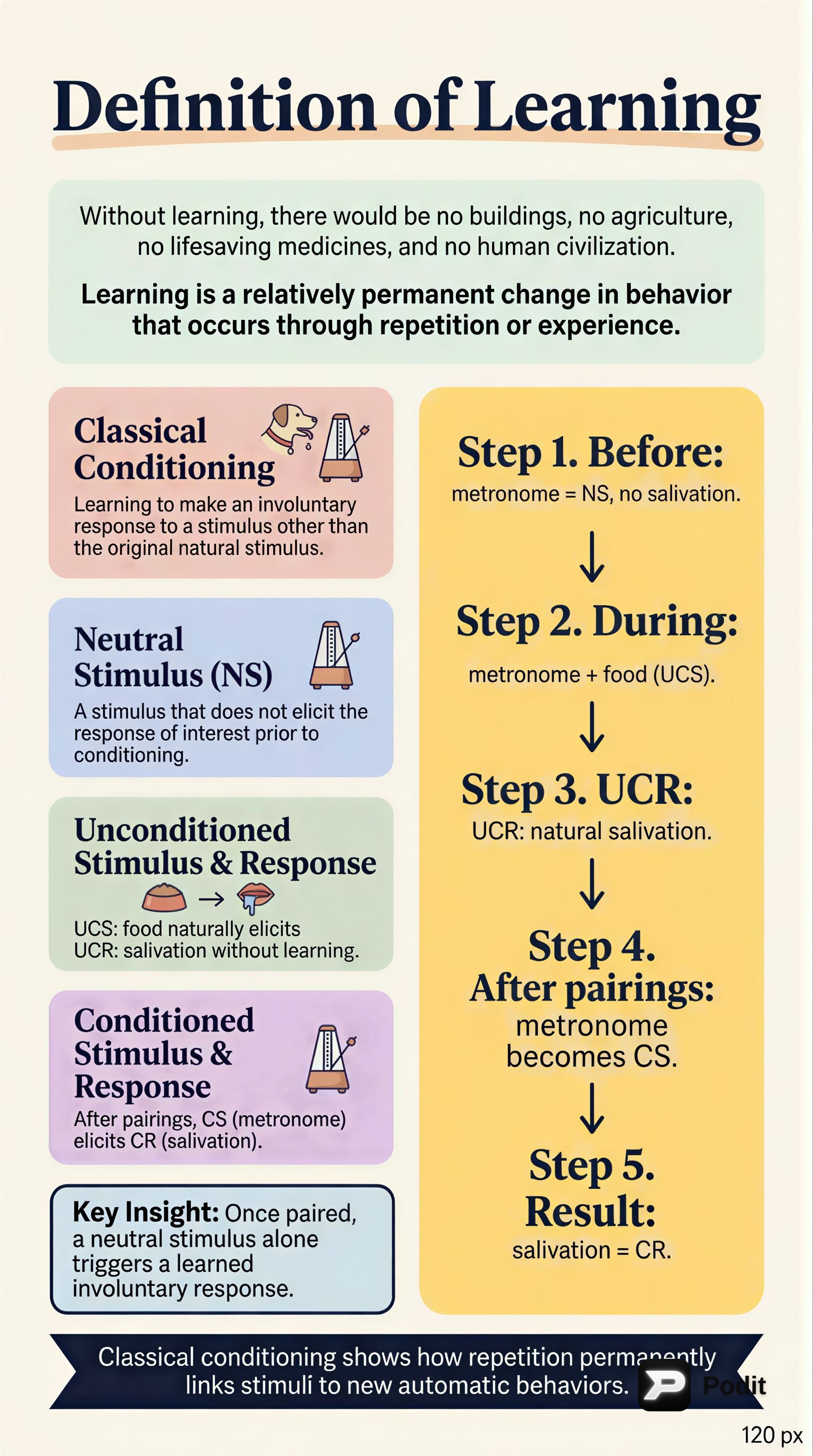
📚 Definition of Learning: Learning is defined as a relatively permanent change in behavior that occurs through repetition or experience.
- This change is not always immediate but is enduring.
- It can manifest as decreased behavior after a painful experience or increased behavior after a pleasurable one.
- ⚠️ Important Note: Not all behavioral changes are due to learning. Changes controlled by genetic code or maturation (e.g., learning to walk, changes in height or weight) are distinct from learned behaviors.
- 💡 Research suggests that once something is learned, it may be stored in memory in a physical form.
This study guide will explore two primary forms of learning: Classical Conditioning and Operant Conditioning.
🐶 Classical Conditioning
Classical conditioning is a type of learning where an organism learns to make an involuntary response to a stimulus that previously did not elicit that response. This occurs by associating the new stimulus with an original, natural stimulus that does produce the response.
Pavlov's Experiment: The Foundation 🧪
Ivan Pavlov's famous experiments with dogs illustrate the core principles of classical conditioning:
-
Before Conditioning:
- A Neutral Stimulus (NS), such as the sound of a metronome, does not naturally cause salivation.
- An Unconditioned Stimulus (UCS), like food, naturally and automatically causes salivation.
- An Unconditioned Response (UCR) is the natural, unlearned reaction to the UCS, such as salivation in response to food.
-
During Conditioning:
- The NS (metronome sound) is repeatedly presented just before the UCS (food).
- The UCS (food) continues to elicit the UCR (salivation).
-
After Conditioning:
- After several pairings, the NS (metronome sound) alone begins to elicit salivation.
- The metronome sound has now become a Conditioned Stimulus (CS).
- The salivation in response to the metronome sound is now a Conditioned Response (CR). This is the learned behavior.
Elements of Classical Conditioning 📝
- Neutral Stimulus (NS): A stimulus that does not elicit the response of interest prior to conditioning (e.g., metronome sound before pairing with food).
- Unconditioned Stimulus (UCS): A stimulus that naturally and automatically elicits a particular response without any prior learning (e.g., food).
- Unconditioned Response (UCR): The natural, unlearned response to the UCS (e.g., salivation to food).
- Conditioned Stimulus (CS): A previously neutral stimulus that, after being paired with the UCS, becomes able to produce a conditioned response (e.g., metronome sound after conditioning).
- Conditioned Response (CR): The learned response to the CS (e.g., salivation to the metronome sound).
- Acquisition: The process of learning to associate the neutral stimulus with the unconditioned response, leading to the formation of the CR.
Basic Principles for Effective Acquisition ✅
For classical conditioning to occur effectively, certain conditions are ideal:
- CS before UCS: The CS must come before the UCS.
- Close Proximity: The CS and UCS must be presented very close together in time, ideally no more than 5 seconds apart.
- Multiple Pairings: The neutral stimulus must be paired with the UCS several times before conditioning takes place.
- Distinctive CS: The CS should be a stimulus that is distinctive or stands out from other competing stimuli.
Real-World Examples 💡
- Dentist Visit:
- UCS: Painful dental treatment
- UCR: Anxiety/Fear
- NS: Dentist drill sound
- After Conditioning: CS (dentist drill sound) leads to CR (anxiety/fear).
- Brand Association: A specific sound or jingle (NS) paired with a desirable product (UCS) can lead to a craving (CR) for that product when the sound is heard (CS).
Key Phenomena in Classical Conditioning 🔄
- Stimulus Generalization: The tendency to respond to a stimulus that is only similar to the original CS with the CR.
- Example: Having an anxiety response to an electric coffee grinder sound because it's similar to a dentist drill.
- Stimulus Discrimination: The tendency to stop making a generalized response to a stimulus that is similar to the original CS, but not identical. The organism learns to distinguish between similar stimuli.
- Example: Anxiety no longer arises from a coffee machine sound after repeated exposure without a painful outcome, while the dentist drill still causes anxiety.
- Extinction: The disappearance or weakening of a learned response following the removal or absence of the UCS.
- Example: If Pavlov's dogs hear the metronome repeatedly without receiving food, they will eventually stop salivating to the metronome.
- Spontaneous Recovery: The reappearance of a learned response after extinction has occurred and a period of rest.
- Example: An extinguished fear might briefly return after some time has passed. This is often seen in substance addiction recovery.
- Higher-Order Conditioning: Occurs when a strong CS is paired with a new neutral stimulus. The strong CS acts like a UCS, causing the previously neutral stimulus to become a second CS.
Applications to Human Behavior and Therapy 🧠
Classical conditioning explains many human behaviors and is used in therapeutic interventions:
- Conditioned Emotional Responses (CER): Emotional responses that become classically conditioned to learned stimuli.
- Examples: Phobias (e.g., fear of dogs), positive emotions evoked by advertisements (e.g., cute babies, attractive models).
- Little Albert Experiment: John B. Watson demonstrated that fears could be classically conditioned in humans (e.g., conditioning a fear of white rats in a baby).
- Vicarious Conditioning: Learning an involuntary response or emotion by observing the reaction of another person.
- Example: A child developing a fear of dogs after seeing another child get bitten.
Therapeutic Applications 🩺
- Systematic Desensitization: A technique where relaxation techniques are learned and then gradually paired with increasing exposure to a feared stimulus, aiming to replace fear with relaxation.
- Counterconditioning: Pairing the presence of a feared stimulus with something pleasant to create a new, positive association.
- Exposure Therapy: Repeated safe exposure to a feared object or situation without any negative outcome, leading to a reduction in the fear response.
Biological Preparedness 🧬
Classical conditioning sometimes happens very quickly due to biological preparedness. Animals and humans are predisposed to associate certain stimuli with certain responses more easily than others.
- Example 1: Birds are predisposed to link visual features with food. They quickly learn to avoid moths that resemble poisonous monarch butterflies.
- Example 2: Mammals are predisposed to connect taste with illness. A strong aversion to a food can develop very quickly if it causes nausea.
🐀 Operant Conditioning
Operant conditioning focuses on the learning of voluntary behavior through the effects of pleasant and unpleasant consequences. It answers the question: "If I do this, what's in it for me?"
Thorndike's Law of Effect 📊
Edward Thorndike's work with "puzzle boxes" and cats led to the Law of Effect:
- If an action is followed by a pleasurable consequence, it will tend to be repeated.
- If an action is followed by an unpleasant consequence, it will tend not to be repeated.
- Example: A cat learning to escape a puzzle box by pressing a lever because it leads to food. The time to escape decreases with trials.
B.F. Skinner's Contributions 🔬
B.F. Skinner further developed operant conditioning, emphasizing that learning depends on what happens after the response—the consequence.
- He used the "Skinner Box" (operant conditioning chamber) to study how consequences affect voluntary behaviors in animals (e.g., a rat learning to press a bar for food pellets).
- In operant conditioning, the organism actively reacts to produce a certain desired outcome, unlike classical conditioning which involves involuntary biological responses.
Reinforcement: Increasing Behavior 📈
Reinforcement is any event or stimulus that, when following a response, increases the probability that the response will occur again.
Types of Reinforcers:
- Primary Reinforcer: Naturally reinforcing by meeting a basic biological need (e.g., food, water, touch).
- Secondary Reinforcer: Becomes reinforcing after being paired with a primary reinforcer (e.g., praise, tokens, money). Money, for instance, is a secondary reinforcer because it can be exchanged for primary reinforcers.
Methods of Reinforcement:
- Positive Reinforcement: The reinforcement of a response by the addition or experiencing of a pleasurable stimulus. This adds something good.
- Example: Giving a child a toy (pleasurable stimulus) for cleaning their room.
- Negative Reinforcement: The reinforcement of a response by the removal, escape from, or avoidance of an unpleasant stimulus. This takes away something bad.
- Example 1: Stopping at a red light to avoid an accident (avoiding an unpleasant stimulus).
- Example 2: Taking an aspirin to remove a headache.
- Example 3: Timely payment of taxes to avoid penalties.
Schedules of Reinforcement ⏱️
Schedules of reinforcement dictate the frequency and timing of when a desired behavior is reinforced.
-
Continuous Reinforcement: Every correct response is reinforced.
- ✅ Leads to very fast learning.
- ⚠️ Leads to very quick extinction once reinforcement stops.
- Example: A child gets money every time they tidy their room.
-
Partial Reinforcement: Responses are reinforced only some of the time, not after every occurrence.
- ✅ Leads to slower learning but much greater resistance to extinction.
- Example: A child gets money only at the end of the week for tidying their room.
Types of Partial Reinforcement Schedules:
- Interval Schedules (Time-based): Reinforcement depends on the passage of time.
- Fixed Interval (FI): Reinforcement after a set period of time.
- Example: A paycheck every two weeks. Response rate is not fast; people tend to increase behavior closer to the reinforcement time (e.g., factory workers speeding up before payday).
- Variable Interval (VI): Reinforcement after varying periods of time.
- Example: Checking email for a response, pop quizzes. Produces a slow, steady rate of response.
- Fixed Interval (FI): Reinforcement after a set period of time.
- Ratio Schedules (Response-based): Reinforcement depends on the number of responses.
- Fixed Ratio (FR): Reinforcement after a set number of responses.
- Example: Getting a free coffee after buying 10. Produces a high rate of response with a brief pause after reinforcement.
- Variable Ratio (VR): Reinforcement after a varying number of responses.
- Example: Slot machines, lottery tickets. Produces a very high and steady rate of response, and is the most resistant to extinction. This is why gambling can be so addictive.
- Fixed Ratio (FR): Reinforcement after a set number of responses.
Punishment: Decreasing Behavior 📉
Punishment is any event or object that, when following a response, makes that response less likely to happen again. Punishment weakens behavior, while reinforcement strengthens it.
Types of Punishment:
- Punishment by Application (Positive Punishment): The punishment of a response by the addition or experiencing of an unpleasant stimulus. This adds something bad.
- Example: A child is yelled at for misbehaving.
- Punishment by Removal (Negative Punishment): The punishment of a response by the removal of a pleasurable stimulus. This takes away something good.
- Example 1: A child is forbidden to go out (removal of a pleasurable activity) for not doing their chores.
- Example 2: Fining someone for breaking the law (removing money).
⚠️ Negative Reinforcement vs. Negative Punishment:
- Negative Reinforcement: Removes an unpleasant stimulus to increase a desired behavior (e.g., cleaning your room to stop nagging).
- Negative Punishment: Removes a pleasant stimulus to decrease an undesired behavior (e.g., taking away TV privileges for aggressive behavior).
Effective Punishment Strategies ✅
While punishment can be controversial, it can be effective under specific conditions:
- Immediacy: Administered immediately after the undesirable behavior.
- Consistency: Applied consistently every time the behavior occurs.
- Paired with Reinforcement: Ideally, punishment for misbehavior should be paired with reinforcement of positive alternative behaviors.
- If behavior needs to stop immediately: In rare, critical cases (e.g., a child running into traffic).
Limitations and Side Effects of Punishment 🚫
Punishment, especially severe or inconsistent punishment, has several drawbacks:
- Suppresses, Doesn't Eliminate: It often only suppresses the undesirable behavior temporarily, rather than eliminating it.
- Avoidance: May cause the individual to avoid the punisher rather than changing the behavior.
- Lying: Can lead to lying to avoid punishment.
- Fear and Anxiety: Can cause fear and anxiety, which are not conducive to learning.
- Modeling Aggression: Violent punishment can model aggressive behavior.
- Doesn't Teach What To Do: Punishment teaches what not to do, but not what to do instead.
Conclusion: The Impact of Learning Theories 💡
Both classical and operant conditioning provide crucial frameworks for understanding how behaviors are acquired, maintained, and modified. Classical conditioning explains involuntary responses and emotional associations, while operant conditioning elucidates how voluntary actions are shaped by their consequences. These theories are not only fundamental to psychology but also have profound implications for education, therapy, and everyday life, offering insights into habit formation, behavior modification, and the treatment of psychological disorders.