Self and Personality: Psychological Perspectives - kapak
Psikoloji#self#personality#psychology#psychodynamic theory

Self and Personality: Psychological Perspectives

This audio summary explores the psychological concepts of self and personality, examining how individuals understand themselves, various theoretical approaches to personality, biological influences, and assessment methods.

c9vzlzrxApril 23, 2026 ~26 dk toplam
01

Sesli Özet

9 dakika

Konuyu otobüste, koşarken, yolda dinleyerek öğren.

Sesli Özet

Self and Personality: Psychological Perspectives

0:008:58
02

Görsel Özet

İnfografik

Konunun tüm parçalarını tek bakışta gör.

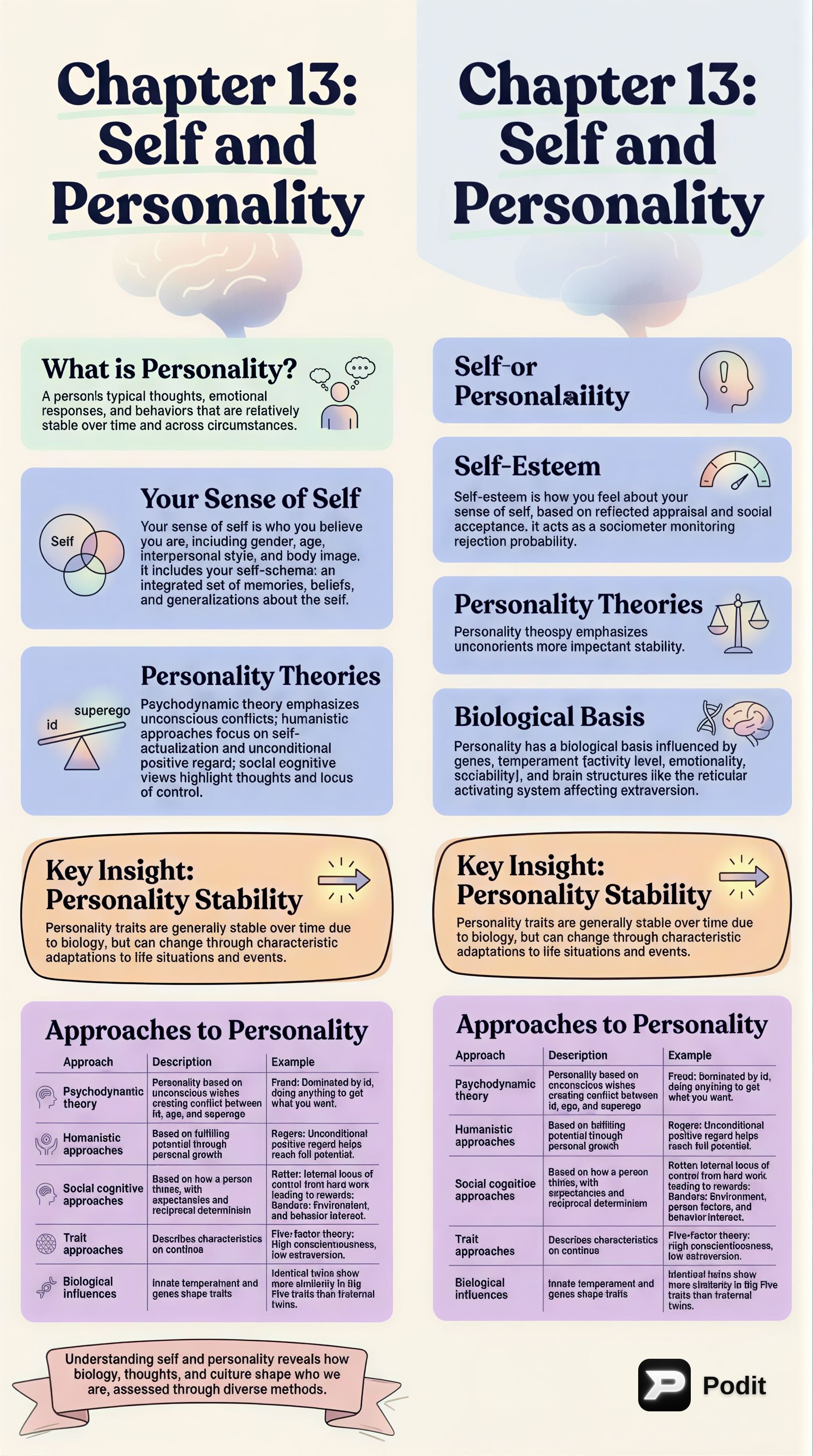
Self and Personality: Psychological Perspectives - görsel özet infografik
Tam boyutta görüntüle →
03

Flash Kartlar

25 kart

Karta tıklayarak çevir. ← → ile gez, ⎵ ile çevir.

1 / 25
Tüm kartları metin olarak gör
  1. 1. What is the definition of personality according to the text?

    Personality is defined as a person's typical thoughts, emotional responses, and behaviors that exhibit relative stability across time and circumstances. It encompasses the consistent patterns that make each individual unique. These patterns are generally stable, meaning they tend to persist despite changes in external situations.

  2. 2. What aspects does the concept of the 'self' typically include?

    The concept of the self, while difficult to define precisely, typically includes various aspects such as gender, age, social status, interpersonal style, personal characteristics, and body image. It represents an individual's overall understanding and perception of who they are. This comprehensive view helps shape how individuals interact with the world and process information about themselves.

  3. 3. Define self-schema.

    A self-schema is an integrated set of memories, beliefs, and generalizations about oneself. It acts as a cognitive framework that organizes and guides the processing of self-relevant information. This schema helps individuals make sense of their experiences and maintain a consistent self-concept, influencing how they perceive and interpret events.

  4. 4. Explain the working self-concept with an example.

    The working self-concept illustrates that one's immediate experience of the self can vary based on the most relevant aspect at a given moment. It means that different facets of our identity become salient depending on the context. For instance, an individual's awareness of their ethnicity or gender may become more prominent when they are in a group where they are a minority in that specific respect, highlighting that particular aspect of their self-concept.

  5. 5. What is self-esteem?

    Self-esteem refers to how one feels about their self-perception. It is a subjective evaluation of one's own worth. Distinct from the broader sense of self, self-esteem reflects the emotional component of self-concept, indicating whether an individual views themselves positively or negatively. It plays a crucial role in mental well-being and behavior.

  6. 6. What is reflected appraisal in the context of self-esteem?

    Reflected appraisal is a concept suggesting that self-esteem is influenced by how individuals believe others perceive them. Essentially, we tend to see ourselves as we believe others see us. If we perceive others as having a positive view of us, our self-esteem is likely to be higher, and vice versa. This highlights the social construction of self-worth.

  7. 7. Explain the sociometer theory of self-esteem.

    The sociometer theory proposes that self-esteem functions as an internal monitor of social acceptance or rejection. It acts like a gauge, indicating how well we are doing in terms of social inclusion. High self-esteem tends to correlate with a low perceived probability of rejection, while low self-esteem is associated with a perceived high possibility of rejection, motivating individuals to maintain social connections.

  8. 8. What is the core idea of Freud's psychodynamic theory?

    Freud's psychodynamic theory posits that personality is primarily shaped by unconscious wishes that generate conflict among three distinct mental structures: the id, ego, and superego. This theory emphasizes the influence of early childhood experiences and unresolved conflicts on adult personality. It suggests that much of our behavior is driven by forces outside of our conscious awareness, leading to internal struggles.

  9. 9. Briefly describe the roles of the Id, Ego, and Superego.

    The Id operates on the pleasure principle, seeking immediate gratification of desires and is entirely unconscious. The Superego reflects internalized societal and parental standards, forming a rigid moral structure that strives for perfection. The Ego, functioning on the reality principle, mediates between the Id's impulsive desires and the Superego's moral constraints through rational thought, aiming to satisfy desires realistically and appropriately.

  10. 10. What are defense mechanisms, and what is their purpose?

    Defense mechanisms are unconscious strategies employed by the ego to manage anxiety arising from conflicts between the id's desires and the superego's constraints. Their purpose is to protect the individual from distressing thoughts and feelings. Examples include denial, repression, projection, and rationalization, all serving to reduce psychological discomfort by distorting reality in some way.

  11. 11. What is the significance of Freud's psychosexual stages?

    Freud's psychosexual stages (oral, anal, phallic, latency, and genital) propose that libido, or sexual energy, is channeled to different erogenous zones at various developmental periods. The significance lies in the idea that fixation at any particular stage due to unresolved conflicts can profoundly affect adult personality. These fixations are believed to manifest as specific personality traits or psychological issues later in life.

  12. 12. What is the main focus of Carl Rogers's humanistic approach to personality?

    Carl Rogers's humanistic approach, known as the person-centered approach, primarily focuses on self-actualization and the fulfillment of an individual's potential through self-understanding. It emphasizes the inherent goodness of people and their innate drive to grow and achieve their highest capabilities. This perspective highlights the importance of conscious experience and personal responsibility in shaping personality.

  13. 13. Define self-actualization.

    Self-actualization is the process of fulfilling one's potential and achieving personal growth. It represents the highest level of psychological development, where an individual strives to become the best version of themselves. According to humanistic theories, particularly Carl Rogers's, self-actualization is an innate human tendency that drives individuals towards personal fulfillment and meaning in life.

  14. 14. Differentiate between conditions of worth and unconditional positive regard.

    Conditions of worth are external standards or expectations that individuals feel they must meet to be considered worthy of love and acceptance, often leading to incongruence between the real and ideal self. Unconditional positive regard, conversely, is the acceptance and love of a person regardless of their behavior or perceived flaws. It fosters self-acceptance and allows individuals to grow towards self-actualization without fear of judgment.

  15. 15. What is the primary focus of social cognitive approaches to personality?

    Social cognitive approaches to personality primarily focus on how thoughts, beliefs, expectations, and observations shape an individual's personality. These theories emphasize the role of cognitive processes in learning and behavior, highlighting how people interpret their social world and how these interpretations influence their actions. They view personality as a dynamic interaction between cognitive factors, behavior, and environmental influences.

  16. 16. Explain Rotter's expectancy theory.

    Rotter's expectancy theory suggests that behaviors are part of personality and result from two main factors: expectancies for reinforcement and the value ascribed to those reinforcers. Individuals are more likely to engage in behaviors they expect to lead to positive outcomes and that they value highly. This theory highlights the cognitive aspect of learning, where our beliefs about future consequences drive our actions.

  17. 17. Distinguish between internal and external locus of control.

    Locus of control refers to an individual's belief about the extent to which they control events in their lives. An internal locus of control means perceiving personal control over outcomes, believing that one's own actions and efforts determine results. Conversely, an external locus of control involves perceiving external forces, such as luck, fate, or powerful others, as controlling outcomes, leading to a belief that one has little personal agency.

  18. 18. Describe Bandura's concept of reciprocal determinism.

    Bandura's reciprocal determinism highlights the dynamic interaction among three factors in shaping personality: environment, person factors (like self-confidence and beliefs), and behavior. It suggests that these three elements continuously influence each other in a reciprocal fashion, rather than one factor solely determining the others. For example, a person's beliefs can influence their behavior, which in turn can alter their environment, and so on.

  19. 19. What is the fundamental idea behind trait approaches to personality?

    The fundamental idea behind trait approaches to personality is that personality can be described and understood through stable characteristics or tendencies, known as traits. These traits are considered relatively consistent across different situations and over time, providing a framework for categorizing and predicting individual differences in behavior. Trait theories aim to identify and measure these enduring dispositions.

  20. 20. Name the initial dimensions identified by Eysenck's biological trait theory.

    Eysenck's biological trait theory initially identified two primary dimensions of personality: introversion/extraversion and stable/unstable emotions (neuroticism). He later added a third dimension, psychoticism, which is now often termed constraint. These dimensions were believed to have a strong biological basis, influencing an individual's typical patterns of thought, emotion, and behavior.

  21. 21. What is the significance of the Five-Factor Theory (Big Five)?

    The Five-Factor Theory, also known as the Big Five, is significant because it identifies five basic personality traits that are widely supported by cross-cultural evidence and consistent across different assessment methods. These traits are Openness to Experience, Conscientiousness, Extraversion, Agreeableness, and Neuroticism (OCEAN). It provides a robust and widely accepted framework for understanding the fundamental dimensions of human personality.

  22. 22. How do neurobiological factors relate to extraversion and introversion?

    Neurobiological research suggests that extraversion and introversion are linked to differences in the reticular activating system (RAS) in the brain. Extraverts are believed to have a lower baseline level of arousal, leading them to seek out stimulating activities to reach an optimal level of excitement. Conversely, introverts are thought to have a higher baseline arousal, causing them to prefer calmer environments to avoid overstimulation. This biological difference influences their preferred social and environmental settings.

  23. 23. How do studies demonstrate genetic influences on personality?

    Genetic influences on personality are demonstrated through studies showing greater personality trait similarity in identical twins compared to fraternal twins, even when raised apart. Additionally, adoption studies compare adopted children to both their biological and adoptive parents, revealing that adopted children tend to show more personality similarities with their biological parents. These findings suggest a significant heritable component to personality traits, indicating that genes play a role in shaping who we are.

  24. 24. Define temperament and list its three key aspects.

    Temperament is defined as a biologically based tendency to feel or act in certain ways, representing the innate biological structure of personality. It is considered the foundational, inborn aspect of personality. The three key aspects of temperament identified are activity level (overall amount of energy and behavior), emotionality (intensity of emotional reactions), and sociability (tendency to affiliate with others).

  25. 25. Differentiate between basic tendencies and characteristic adaptations according to McCrae and Costa.

    According to McCrae and Costa's model, basic tendencies are the underlying personality traits that are largely determined by biology and remain stable over time, such as the Big Five traits. Characteristic adaptations, on the other hand, are the behavioral expressions of these basic tendencies, which are modified and shaped by situational demands, cultural influences, and personal experiences. While basic tendencies are stable, characteristic adaptations can change in response to life events, showing how personality interacts with the environment.

04

Bilgini Test Et

15 soru

Çoktan seçmeli sorularla öğrendiklerini ölç. Cevap + açıklama.

Soru 1 / 15Skor: 0

According to the text, how is personality defined?

05

Detaylı Özet

7 dk okuma

Tüm konuyu derinlemesine, başlık başlık.

This study material has been compiled and organized from lecture slides and an audio transcript on the topic of Self and Personality.


🧠 Self and Personality: A Comprehensive Study Guide

This chapter explores the fundamental aspects of human individuality, covering how individuals perceive themselves, the theoretical frameworks for understanding personality, its biological underpinnings, and methods for assessment.

1. How Do You Know Yourself? 🧐

Understanding the self begins with defining personality and exploring how individuals construct their self-perception and self-esteem.

1.1 Your Sense of Self Is Who You Believe You Are

📚 Personality: A person's typical thoughts, emotional responses, and behaviors that are relatively stable over time and across circumstances. ✅ The "self" is a complex concept, typically encompassing:

  • Gender, Age, Student status
  • Interpersonal style (e.g., shy, friendly)
  • Personal characteristics (e.g., moody, optimistic)
  • Body image (e.g., positive, negative)

📚 Self-schema: An integrated set of memories, beliefs, and generalizations about the self.

  • 💡 Research shows activity in the frontal lobes when processing self-related information.
  • Example: A self-schema might include "student," "daughter," and "ambitious," with varying degrees of connection.

📚 Working self-concept: The immediate experience of the self in the here and now, which can vary based on the most relevant aspect at that moment.

  • Example: A Black man working with a group of women might focus on his identity as a man. If he's with a group of White people, his awareness might shift to his identity as a Black man.

1.2 Self-Esteem Is How You Feel About Your Sense of Self

📚 Self-esteem: How you feel about your sense of self. ✅ Many theories suggest self-esteem is based on how we believe others perceive us, known as 📚 reflected appraisal. ✅ Self-esteem functions as a 📚 sociometer, an internal monitor of social acceptance or rejection.

  • 📈 High probability of rejection leads to low self-esteem.
  • 📉 Low probability of rejection leads to high self-esteem.

1.3 You Try to Create a Positive Sense of Self

This unit suggests that individuals actively strive to maintain a positive self-image.

1.4 Your Sense of Self Is Influenced by Cultural Factors

Cultural and historical influences, alongside biological factors, play a significant role in shaping individual differences and one's sense of self.

2. How Can You Understand Personality? 💡

Various theoretical approaches attempt to explain the origins and manifestations of personality.

2.1 Psychodynamic Theory Emphasizes Unconscious Conflicts

Proposed by Freud, this theory suggests personality is based on unconscious wishes creating conflict between three structures:

  • Levels of Mental Activity:
    • 📚 Conscious: Thoughts we are aware of.
    • 📚 Preconscious: Content not currently aware of, but retrievable.
    • 📚 Unconscious: Material the mind cannot easily retrieve.
  • Personality Structures:
    • 📚 Id: Operates on the pleasure principle (driven by libido), completely submerged in the unconscious.
    • 📚 Superego: Reflects internalized societal and parental standards of conduct; a rigid structure of morality.
    • 📚 Ego: Operates on the reality principle, mediating between the id's desires and the superego's constraints through rational thought and problem-solving.
  • Defense Mechanisms: Unconscious mental strategies the ego uses to protect itself from anxiety caused by id-superego conflicts.
    • Denial: Refusing to acknowledge anxiety source (e.g., refusing cancer treatment).
    • Repression: Excluding anxiety source from awareness (e.g., forgetting a traumatic event).
    • Projection: Attributing unacceptable qualities of self to others (e.g., a competitive person calling others competitive).
    • Reaction Formation: Warding off uncomfortable thoughts by overemphasizing the opposite (e.g., bullying someone you're attracted to).
    • Rationalization: Creating logical excuses for shameful behavior (e.g., driving after drinking because "everyone does it").
    • Displacement: Shifting emotion to an easier target (e.g., yelling at children after a bad day at work).
    • Sublimation: Channeling unacceptable impulses into constructive behavior (e.g., someone with an eating disorder becoming a nutritionist).
  • Psychosexual Stages: Freud proposed stages (oral, anal, phallic, latency, genital) where libido is focused on erogenous zones. Fixation at a stage can profoundly affect personality (e.g., oral or anal personalities).
  • ⚠️ Contemporary View: Neo-Freudians (e.g., object relations theory) focus on social interactions, but psychodynamic theories are largely abandoned by psychologists due to their untestability.

2.2 Humanistic Approaches Emphasize Goodness in People

These approaches emphasize self-actualization and fulfilling potential through greater self-understanding.

  • Carl Rogers's 📚 Person-centered approach: Personality is shaped by self-understanding and others' evaluations.
  • Conditions of worth: Imposed by others, leading to conditional positive regard.
  • Unconditional positive regard: Expressing love and acceptance regardless of behavior, helping individuals reach their full potential.
    • Example: Always telling children you love them, even if you disapprove of their actions.

2.3 Social Cognitive Approaches Focus on How Thoughts Shape Personality

These approaches recognize the influence of how people think on personality.

  • Rotter's 📚 Expectancy theory: Behaviors are part of personality, resulting from expectancies for reinforcement and the value ascribed to particular reinforcers.
  • 📚 Locus of control: People's perception of whether they control rewards/punishments.
    • Internal locus of control: Belief in personal control over outcomes (e.g., working hard for good grades).
    • External locus of control: Belief that external forces control outcomes.
  • Bandura's 📚 Reciprocal determinism: Personality is explained by the interaction of three factors:
    • 1️⃣ Environment (e.g., supportive workplace)
    • 2️⃣ Person factors (e.g., self-confidence)
    • 3️⃣ Behavior (e.g., working late)

2.4 Trait Approaches Describe Characteristics

These approaches describe personality based on stable characteristics or tendencies to act in a certain way over time and across situations.

  • Traits exist on a continuum, with most people falling in the middle.
  • Eysenck's biological trait theory: Initially proposed two major dimensions:
    • Introversion/Extraversion: How shy/reserved vs. sociable/outgoing a person is.
    • Stable/Unstable emotions: Emotional consistency.
    • Later added a third dimension: 📚 Psychoticism (now called Constraint), reflecting aggression, poor impulse control, self-centeredness, or lack of empathy.
  • Five-factor theory (Big Five): Identifies five basic personality traits. This theory is widely supported by cross-cultural evidence and consistent across different assessment methods.

3. How Does Biology Affect Personality? 🧬

Personality has a significant biological basis, influenced by neurobiology, genetics, and innate temperaments.

3.1 Personality Has a Biological Basis

  • Neurobiological research links extraversion/introversion to the 📚 Reticular Activating System (RAS) in the brain stem.
    • Extraverts: Lower baseline arousal, seek exciting activities for optimal functioning.
    • Introverts: Higher baseline arousal, seek calming activities for optimal functioning.

3.2 Personality Is Influenced by Genes

  • Research shows links between certain genes and personality traits.
  • Twin studies: Identical twins are more similar in Five-Factor personality traits than fraternal twins.
  • Adoption studies further support the genetic basis of personality.

3.3 Temperament Is Innate

📚 Temperament: A biologically based tendency to feel or act in certain ways, representing the innate biological structures of personality.

  • Three key aspects:
    • 1️⃣ Activity level
    • 2️⃣ Emotionality
    • 3️⃣ Sociability
  • Long-term effects: Early childhood temperament significantly influences later behavior and personality (e.g., undercontrolled children at age 3 are more likely to be antisocial or have alcohol problems later).

3.4 Personality Stability Is Influenced by Biology and Situation

  • Genetic makeup predisposes individuals to certain traits.
  • Personality traits generally remain stable after childhood, with cross-cultural evidence suggesting a biological basis for age-related changes.
  • However, certain aspects of personality can change in response to life events.
  • McCrae and Costa's Model of Personality:
    • 📚 Basic tendencies: Personality traits largely determined by biology and stable over time.
    • 📚 Characteristic adaptations: Changes in behavioral expression of basic tendencies based on situational demands.
    • Example: Conscientiousness tends to increase with age across cultures. Caregiving roles can lead to increases in positive personality traits like agreeableness.

4. How Can Personality Be Assessed? 📊

Various methods are used to measure and understand personality, each with its strengths and limitations.

4.1 Several Methods Are Used to Assess Personality

  • 📚 Projective measures: Personality tests that examine unconscious processes by having people interpret ambiguous stimuli.
    • Rorschach inkblot test
    • Thematic Apperception Test (TAT)
  • 📚 Self-report measures: Questionnaires where people respond to items revealing traits and behaviors.
    • NEO Personality Inventory
  • Electronically recording information:
    • 📚 Electronically Activated Record (EAR): A device that unobtrusively tracks real-world interactions.
    • 💡 EAR studies show Five-Factor traits predict actual behavior (e.g., extraverts talk more, conscientious students attend class more).
  • Observational methods: Personality judgments made by others.
    • 💡 Close acquaintances may predict behavior more accurately than individuals predict their own, due to self-perception biases.

4.2 Behavior Is Influenced by Personality and Situation

  • 📚 Person/situation debate: Discusses whether behavior is determined more by situations or personality traits.
  • 📚 Situationism: Mischel's theory that behavior is determined more by situations than by personality traits.
  • Interaction of personality and situation:
    • Strong situations: Mask personality differences due to powerful social environments (e.g., religious services, job interviews).
    • Weak situations: Reveal personality differences (e.g., parks, bars, one's home).
  • 📚 Interactionism: The idea that behavior is determined jointly by situations and underlying traits.

4.3 Assessment Can Reveal Cultural and Gender Differences in Personality

Personality assessment can highlight how cultural backgrounds and gender roles influence the expression and perception of personality traits.


Conclusion ✅

The study of self and personality is a dynamic field that integrates diverse perspectives. It encompasses the intricate construction of the self, the influence of unconscious conflicts, the drive for self-actualization, the impact of cognitive processes, and the description of stable traits. Furthermore, biological factors like genetics and temperament play a crucial role, interacting with situational demands to shape behavior. Understanding personality requires a multifaceted approach, utilizing various assessment methods to capture the complexity of human individuality.
Kendi çalışma materyalini oluştur

PDF, YouTube videosu veya herhangi bir konuyu dakikalar içinde podcast, özet, flash kart ve quiz'e dönüştür. 1.000.000+ kullanıcı tercih ediyor.

Sıradaki Konular

Tümünü keşfet
Unpacking Personality: A Deep Dive into Key Theories

Unpacking Personality: A Deep Dive into Key Theories

Join me as we explore the fascinating world of personality psychology, from existential meaning to biological roots. You'll discover how different theories help us understand ourselves and others.

20 dk Özet 25 15
From Learning Theory to Contemporary Models in Psychology

From Learning Theory to Contemporary Models in Psychology

Explore the evolution of psychological thought from early behaviorism to the cognitive revolution and sociobehaviorism, focusing on key figures like Bandura and Rotter.

Özet 15
Exploring Human Psychology: Development, Emotion, Motivation, Personality, and Health

Exploring Human Psychology: Development, Emotion, Motivation, Personality, and Health

This podcast offers an in-depth look into human development, the intricacies of emotion and motivation, various personality theories, social behavior, and the psychological aspects of health and stress management.

23 dk 25 15
Adolescents and Social Media: Engagement, Theories, and Well-being

Adolescents and Social Media: Engagement, Theories, and Well-being

Explore how adolescents and young adults engage with social media, examining key theories, the screen time debate, and the nuanced impact of online interactions on well-being.

Özet Görsel
Cognitive Biases and Heuristics in Behavioral Economics

Cognitive Biases and Heuristics in Behavioral Economics

An academic summary exploring key cognitive biases and heuristics, their impact on human decision-making, and their role in behavioral economics, contrasting with traditional economic theory.

5 dk Özet 25 15
Social Psychology: Core Concepts and Influences

Social Psychology: Core Concepts and Influences

An academic overview of social psychology, covering its definition, historical development, foundational principles, cultural influences, and key concepts like affect, behavior, and cognition.

5 dk Özet 25 15
Test and Measurement II for Psychology Students

Test and Measurement II for Psychology Students

An academic overview of advanced psychometric principles, test development, adaptation, and their application in psychological assessment for psychology students.

4 dk Özet 15
Prenatal Development: Stages and Processes

Prenatal Development: Stages and Processes

Explore the fascinating journey of prenatal development, from conception through the germinal, embryonic, and fetal stages, including key cellular processes and support systems.

Özet 25 15