1. What is the primary focus of the content discussed in Podit?
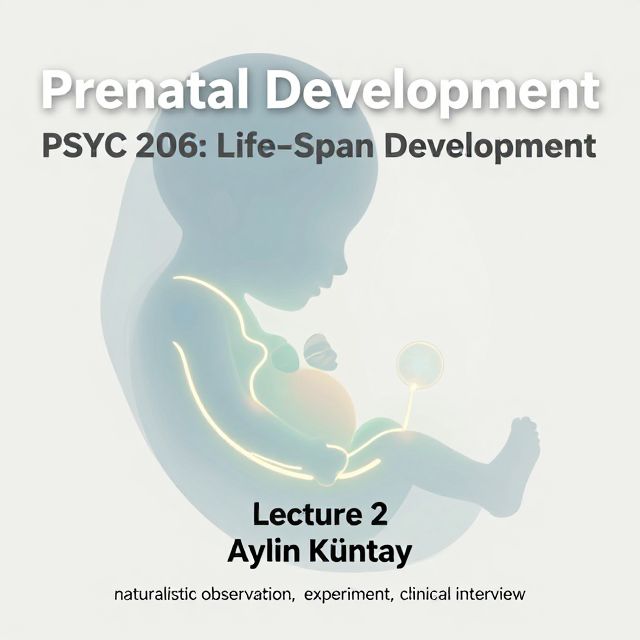
The primary focus of the content is prenatal development. It delves into the intricate processes of life-span development, specifically exploring the stages from conception to birth, the fundamental cellular processes involved, and the crucial support systems that facilitate this remarkable journey.
2. Describe naturalistic observation as a data collection method in developmental science.
Naturalistic observation involves observing and recording people's behavior in their everyday lives. Its main advantage is directly gathering objective information and revealing the full complexity of behavior. However, people might behave differently under observation, and analyzing the information can be time-consuming.
3. What is the main advantage of using an experiment in developmental science?
The main advantage of an experiment is its ability to test causal hypotheses. By introducing a change in a group's experience and measuring its effects, researchers can determine cause-and-effect relationships, making it a powerful tool for understanding developmental processes.
4. What is a significant limitation of the clinical interview method in developmental science?
A significant limitation of the clinical interview method is its reliance on verbal expression. This makes it inappropriate for very young children who have not yet developed sufficient language skills to articulate their thoughts and feelings effectively, thus restricting its applicability across all age groups.
5. According to developmental science, when does life begin?
According to developmental science, life begins at the moment of conception. This is the point when an egg and sperm combine to form a zygote, initiating the complex processes of prenatal development that lead to a new organism.
6. Name the three main stages of prenatal development and their approximate durations.
The three main stages of prenatal development are the germinal period (conception to implantation, approximately two weeks), the embryonic period (implantation to organogenesis, about six weeks), and the fetal period (organogenesis to birth, roughly thirty weeks). Each stage involves distinct developmental milestones.
7. What happens during conception, and what are the resulting cells called?
Conception occurs when an egg and sperm, known as germ cells or gametes, combine. Each germ cell carries half of the genetic material (23 chromosomes). Upon combination, a full set of 46 chromosomes is formed, and the fertilized egg is called a zygote.
8. How are germ cells (gametes) formed, and how many chromosomes do they contain?
Germ cells, or gametes (egg and sperm), are formed through meiosis. Meiosis is a specialized cell division process that ensures each germ cell contains exactly half the genetic material, specifically 23 chromosomes, preparing them for combination during conception.
9. What is a zygote, and what does it represent in terms of genetic material?
A zygote is the fertilized egg formed when an egg and sperm combine. It represents the first stage of a new life with a complete set of human genetic material, containing 46 chromosomes (23 from each parent), which dictates the individual's genetic blueprint.
10. How is sex determined genetically in humans?
Sex determination in humans is genetically determined by the sex chromosomes. Females typically have two X chromosomes (XX), while males have one X and one Y chromosome (XY). The sperm carries either an X or a Y chromosome, determining the sex of the offspring.
11. What genetic condition is caused by an extra copy of chromosome 21?
Down syndrome is a genetic condition caused by the presence of an extra copy of chromosome 21. This results in individuals having 47 chromosomes instead of the usual 46, leading to a range of physical and developmental characteristics associated with the syndrome.
12. What is cell division, also known as mitosis, in the context of prenatal development?
Cell division, or mitosis, is a fundamental developmental process that begins right after conception. The zygote repeatedly splits into two, then four, then eight cells, and so on, leading to a rapid increase in cell number and forming the basis for growth and development.
13. Explain the process of cell migration during prenatal development.
Cell migration is the movement of newly formed cells away from their point of origin. This process is crucial for forming complex structures and organs, as cells need to relocate to specific positions within the developing organism to fulfill their specialized functions.
14. What is cell differentiation, and when does it occur?
Cell differentiation occurs after several cell divisions, where cells begin to specialize. Based on their location in the body and signals from nearby cells, they develop distinct structures and functions, transforming from general cells into specific types like muscle, nerve, or skin cells.
15. Provide an example of cell death, or apoptosis, being essential for development.
Cell death, or apoptosis, is a programmed process essential for normal development. A key example is when cells between developing fingers die to separate them, allowing the formation of distinct digits rather than webbed hands or feet. This controlled process is vital for shaping body structures.
16. What is the genetic difference between identical (monozygotic) and fraternal (dizygotic) twins?
Identical (monozygotic) twins originate from a single fertilized egg that splits, resulting in individuals with exactly the same genetic makeup. Fraternal (dizygotic) twins, however, result from two separate eggs fertilized by two separate sperm, sharing only half their genes, similar to any other siblings.
17. When and where does the zygote embed itself after conception?
By the end of the first week post-conception, the zygote embeds itself in the uterine lining. This crucial process, known as implantation, marks the beginning of the embryonic period and is necessary for the continued development of the embryo.
18. After implantation, how does the embedded ball of cells differentiate to form the embryo and its support system?
After implantation, the embedded ball of cells differentiates into two main parts. The inner cell mass becomes the embryo itself, while the remaining cells form the crucial support system, which includes structures like the amniotic sac and the placenta, vital for the embryo's survival and growth.
19. What is the function of the amniotic sac during prenatal development?
The amniotic sac is a fluid-filled membrane that acts as a protective buffer for the fetus. It cushions the developing organism from physical shocks, helps maintain a constant temperature, and allows for fetal movement, all contributing to a safe and stable environment for growth.
20. Describe the role of the placenta in prenatal development.
The placenta is a vital support organ that keeps the mother's and fetus's circulatory systems separate while allowing the exchange of materials. It facilitates the transfer of oxygen and nutrients from the mother to the fetus and waste products from the fetus to the mother, acting through a semi-permeable membrane.
21. Is the placental membrane a perfect defensive barrier against harmful elements? Explain.
No, the placental membrane is not a perfect defensive barrier. While it serves as a protective layer, it is semi-permeable, meaning that harmful elements such as certain drugs, toxins, or viruses can still cross it. This highlights the importance of maternal health and environmental factors during pregnancy.
22. What is the developing organism called from the third to the eighth week of prenatal development?
From the third to the eighth week of prenatal development, the developing organism is termed an embryo. This period is characterized by rapid cell differentiation and the formation of major organs and body structures, making it a critical stage for development.
23. When does the developing organism transition from an embryo to a fetus?
The developing organism transitions from an embryo to a fetus after the eighth week of prenatal development. From the ninth week until birth, it is referred to as a fetus, a stage primarily focused on growth, maturation of organs, and refinement of body systems.
24. What significant developmental milestone occurs at four weeks of embryonic development?
At four weeks of embryonic development, the embryo is curved, and a primitive heart becomes visible. Remarkably, this primitive heart is already beating and circulating blood, marking a crucial step in the establishment of the circulatory system and overall organ function.
25. By what week does the organism begin to show more recognizable human features and is considered a fetus?
By 11 weeks of prenatal development, the organism begins to show more recognizable human features and is considered a fetus. This marks the end of the embryonic period and the beginning of the fetal period, where growth and maturation become the primary focus.
 Podit
Podit