 Podit
Podit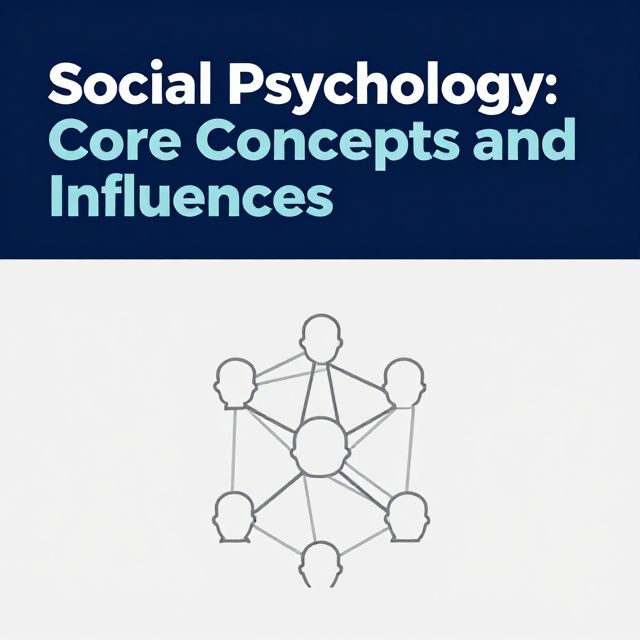
This study material has been compiled from a combination of copy-pasted text and a lecture audio transcript.
📚 Introduction to Social Psychology
Social psychology is the scientific study of how individuals perceive, think about, and behave toward others, and how these internal states and actions are reciprocally influenced by the social environment. It explores the intricate dynamics between individuals and their social worlds, providing a scientific framework for understanding human behavior, social influence, and the profound impact of cultural variations on our thoughts, feelings, and actions.
🕰️ A Brief History of Social Psychology
The field of social psychology has evolved significantly over time:
- 19th Century: Initial foundational studies began.
- 1908: The first dedicated social psychology books were published.
- 1940s: Significant advancements were made by researchers like Kurt Lewin and Leon Festinger, partly driven by the need to understand mass behavior during World War II.
- 1970s: The concept of Social Cognition emerged, focusing on how people process social information.
- 21st Century: The field expanded to include Social Neuroscience, examining the neural bases of social processes.
⚠️ Criticisms of Social Psychology
Despite its scientific rigor, social psychology has faced two main criticisms:
- "Social psychology tells us what we already know." This criticism suggests that the field merely confirms common sense or intuitive understandings of human behavior.
- "Social psychology is dangerous." This concern often relates to the potential misuse of knowledge about social influence and behavior.
🤝 Foundational Principles
1. The Person and the Social Situation
Social psychology largely focuses on the social situation. Our social situations create social influence—the process through which other people change our thoughts, feelings, and behaviors, and through which we change theirs.
✅ Kurt Lewin's Formula: A cornerstone of social psychology, formalized by Kurt Lewin, highlights the joint influence of individual characteristics and environmental factors on behavior:
Behavior = f (person, social situation)
This means that behavior is a function of both the individual's traits and the social context they are in.
2. Evolutionary Adaptation and Human Characteristics
The assumption that human nature, including much of our social behavior, is largely determined by our evolutionary past is known as evolutionary adaptation. This perspective suggests that many of our social behaviors are rooted in survival and reproductive advantages from our ancestral past.
💡 Core Human Concerns: Two fundamental drives shaped by evolutionary adaptation are:
- Self-concern: The motivation to protect and enhance one's own welfare and the welfare of one's immediate family.
- Other-concern: The motivation to affiliate with, accept, and be accepted by others.
3. Social Norms
A key outcome of social influence is the development of social norms. 📚 Definition: Social norms are the ways of thinking, feeling, or behaving that are shared by group members and perceived by them as appropriate. These include customs, traditions, standards, rules, and the general values of a group.
4. Cultural Influence on Norms
Social norms are heavily influenced by culture. 📚 Definition: A culture represents a group of people, normally living within a given geographical region, who share a common set of social norms, including religious and family values and moral beliefs.
Different cultures often have distinct normative orientations:
- Individualism (Western Cultures): Norms primarily oriented toward self-enhancement and independence. Focus is on the individual's achievements and autonomy.
- Collectivism (East Asian Cultures): Norms more focused on other-concern, promoting interdependence and a deeper connection among individuals. Emphasis is on group harmony and collective well-being.
🧠 The ABCs of Social Psychology
Social psychology is fundamentally structured around three basic and interrelated human capacities, known as the ABCs:
- Affect (Feelings) 💖: Our emotions and moods.
- Behavior (Interactions) 🚶♀️: Our actions and observable responses.
- Cognition (Thought) 🤔: Our mental processes, beliefs, and perceptions.
These three elements are crucial for successful social interaction and for maintaining and enhancing our lives.
1. Social Cognition: Thinking and Learning about Others
📚 Definition: Social cognition refers to the cognitive activities related to social contexts, enabling individuals to understand and predict their own behavior and that of others.
Key concepts in social cognition include:
- Schema: A knowledge representation that includes information about a person or group. Schemas help us organize and interpret social information quickly.
- Attitude: A knowledge representation that primarily reflects our liking or disliking of a person, thing, or group. Attitudes guide our evaluations and actions.
2. Social Affect: Feelings about Ourselves and Others
📚 Definition: Affect refers to the feelings we experience as part of our everyday lives. It manifests in two primary forms:
- Mood: Refers to the positive or negative feelings that are in the background of our everyday experiences. Moods are generally longer-lasting and less intense than emotions.
- Emotions: Brief, but often intense, mental and physiological feeling states. Compared to moods, emotions are shorter-lived, stronger, and more specific (e.g., joy, anger, fear).
🤯 Challenging Intuition: Does Social Psychology Just Tell Us What We Already Know?
Social psychology often reveals findings that contradict common sense, directly addressing the criticism that it merely states the obvious. Here are some examples:
-
Opposites attract.
- Intuition: Often believed.
- Social Psychology Finding: ❌ False. The opposite is generally true. Similarity, particularly in values and beliefs, is a significant determinant of liking and attraction.
-
An athlete who wins the bronze medal (third place) is happier than the athlete who wins the silver medal (second place).
- Intuition: Seems counter-intuitive.
- Social Psychology Finding: ✅ True. This is due to counterfactual thinking. The silver medalist often compares their outcome to "what might have been" (winning gold), leading to regret. The bronze medalist compares their outcome to "what might have been" (winning no medal at all), leading to relief and happiness.
-
Having good friends you can count on can keep you from catching colds.
- Intuition: Might seem like a stretch.
- Social Psychology Finding: ✅ True. Social support—the perception that we have people we can count on and talk to—provides many positive benefits to our mental and physical health, including a stronger immune system.
-
Subliminal advertising (persuasive messages displayed out of our awareness) is very effective in getting us to buy products.
- Intuition: Often portrayed in media as powerful.
- Social Psychology Finding: ❌ False. While unconscious stimuli can influence behavior, there is little scientific evidence that subliminal advertising is effective in significantly influencing purchasing decisions.
-
The greater the reward promised for an activity, the more one will come to enjoy engaging in that activity.
- Intuition: More reward equals more enjoyment.
- Social Psychology Finding: ❌ False. Providing an external reward for an activity that is already intrinsically enjoyed can actually undermine a person's enjoyment of that activity (e.g., paying a child for good grades might make them enjoy learning less).
-
Physically attractive people are seen as less intelligent than less attractive people.
- Intuition: Sometimes a stereotype.
- Social Psychology Finding: ❌ False. Research consistently shows that physically attractive people are often perceived as more intelligent, competent, and socially skilled—a phenomenon known as the "halo effect."
-
Punching a pillow or screaming out loud is a good way to reduce frustration and aggressive tendencies.
- Intuition: Common belief in "venting."
- Social Psychology Finding: ❌ False. There is no evidence that engaging in violent behavior reduces the desire to be aggressive. In fact, engaging in aggression often leads to more aggression, reinforcing the behavior.
-
People pull harder in a tug-of-war when they’re pulling alone than when pulling in a group.
- Intuition: People might try harder in a group.
- Social Psychology Finding: ✅ True. This is an example of social loafing, where individuals exert less effort when working in a group because they believe others will compensate for their reduced effort.
🎯 Conclusion
Social psychology offers a systematic and empirical approach to understanding the complex interplay between individuals and their social environments. By investigating phenomena like social influence, cultural norms, and cognitive processes, it provides valuable insights that often challenge intuitive assumptions, leading to a deeper, evidence-based understanding of human experience.