 Podit
Podit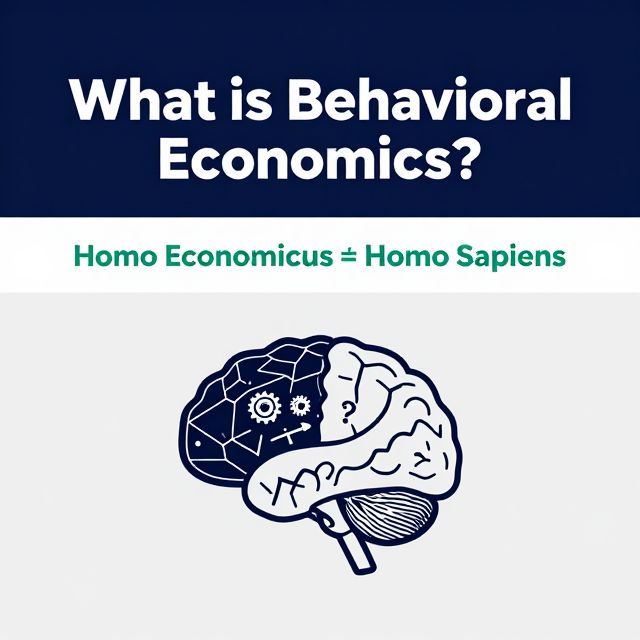
Behavioral Economics: Understanding Human Decision-Making 🧠
Source Information: This study material has been compiled from a lecture audio transcript and copy-pasted text, likely from a PDF or PowerPoint presentation.
1. Introduction to Behavioral Economics: Beyond Rationality 💡
Traditional economic theory often models human behavior through the lens of "Homo Economicus" – a perfectly rational, self-interested agent. This idealized individual is assumed to:
- ✅ Possess no cognitive limitations in acquiring or processing information (no bounded rationality).
- ✅ Maximize expected utility consistently.
- ✅ Skillfully handle probabilities.
- ✅ Exhibit consistent time preferences.
- ✅ Act purely selfishly, caring only about personal payoff.
Examples of Homo Economicus Assumptions:
- Objective outcomes are the sole determinants of decisions, framing has no impact.
- Plans are always followed without irrational procrastination.
- Social norms are irrelevant.
- Any "kind" behavior is purely strategic.
However, real human beings, or "Homo Sapiens," frequently deviate from these assumptions. Behavioral Economics enriches traditional economic models by integrating crucial insights from psychology to provide a more realistic understanding of decision-making. The primary challenge lies in balancing this improved realism with the tractability of economic models.
Related and Overlapping Fields:
- Economic psychology
- Experimental economics
- Decision theory
2. Goals and Foundational Concepts 🎯
The core objectives of behavioral economics are to:
- Understand human behavior.
- Predict behavior more accurately.
- Potentially influence behavior for better outcomes.
2.1 Normative vs. Descriptive Models 📚
A key distinction in behavioral economics is between:
- Normative Models: These dictate how people should make decisions (e.g., rational choice theory).
- Descriptive Models: These describe how people actually make decisions, often revealing deviations from normative ideals.
While neo-classical economics often assumes its models are both descriptively and normatively valid, behavioral economics explicitly separates these two perspectives.
2.2 Correlation vs. Causality ⚠️
Understanding behavior requires distinguishing between correlation and causality.
- Correlation: Indicates a relationship between two variables (e.g., people with gym subscriptions visit the gym more often).
- Causality: Means one variable directly influences another (e.g., buying a gym subscription doesn't automatically cause you to go more often).
Experiments are vital tools for establishing causality.
3. Research Methods: Experimental Economics 📊
Experiments are crucial for isolating causal effects in behavioral economics. They typically involve:
- Control Group: A group that does not receive the treatment, serving as a baseline.
- Treatment Group(s): Group(s) that receive the intervention being studied.
3.1 Types of Experiments
- Lab Experiments: Conducted in a controlled environment, allowing for precise manipulation of variables.
- Field Experiments: Conducted in a natural environment, offering higher external validity.
3.2 Experimental Designs
- Between-Subjects Design: Each participant is exposed to only one treatment condition.
- Within-Subjects Design: Each participant is exposed to multiple (or all) treatment conditions.
3.3 Incentives and Ethics
- Real Incentives: Participants are paid according to their decisions, aligning their motivations with the experimental task.
- Flat Fee: A fixed payment for participation, regardless of decisions.
- No Deception: A core principle in economic experiments, unlike some psychological experiments (e.g., Milgram experiment). This ensures trust and valid results.
4. Preferences and Utility: The Foundation of Choice ⚖️
When analyzing choices, economists delve into preferences and utility.
4.1 Preference Relations
Preferences describe an individual's ranking of options:
- Weak Preference (≽): "is (weakly) preferred to" (e.g., x ≽ y means x is at least as good as y).
- Strict Preference (≻): "is strictly preferred to" (e.g., x ≻ y means x is definitively better than y).
- Indifference (~): "is indifferent to" (e.g., x ~ y means x and y are equally preferred).
4.2 Preference Conditions for Rationality
For preferences to be considered "rational" and representable by a utility function, they must satisfy certain conditions:
- Completeness: For any two options x and y, an individual can always state either x ≽ y, or y ≽ x (or both, implying indifference). There are no "I don't know" answers.
- Transitivity: If x ≽ y and y ≽ z, then it must be that x ≽ z. This ensures consistency in rankings.
- Reflexivity: For any option x, x ≽ x (an option is at least as good as itself).
- Symmetry (~): If x ~ y, then y ~ x.
- Anti-symmetry (≻): If x ≻ y, then it cannot be that y ≻ x.
When preferences satisfy completeness and transitivity, they form a weak order, which is a prerequisite for representing preferences with a utility function.
4.3 Utility Functions
A utility function (u) assigns numerical values to options such that:
- x ≽ y if and only if u(x) ≥ u(y).
- Higher utility values correspond to more preferred options.
There are two main types of utility:
- Ordinal Utility:
- Only the ranking of options matters; utility differences have no inherent meaning.
- A utility function
ucan be replaced byv(x) = f(u(x))wherefis any increasing function (e.g.,f(u) = 4u + 10,f(u) = e^u). - Example: If u(A)=10 and u(B)=5, A is preferred to B. We cannot say A is "twice as good" as B.
- Cardinal Utility:
- Both the ranking and the magnitude of utility differences are meaningful.
- A utility function
ucan only be replaced byv(x) = f(u(x))wherefis a linear increasing function (e.g.,f(u) = 4u + 10, but notf(u) = e^u). - Example: If u(A)=10, u(B)=5, u(C)=0, then the preference for A over B is stronger than for B over C if the differences (5 vs 5) are meaningful.
- Cardinal utility is often assumed for welfare analysis (e.g., Utilitarianism: W = ΣU_i), which also assumes that one unit of utility means the same across individuals.
5. Challenges to Rationality: Behavioral Biases 🤯
While revealed preference suggests we can infer preferences by observing choices, behavioral economics highlights several biases that complicate this, showing that choices don't always perfectly reflect underlying, stable preferences.
5.1 Projection Bias
📚 Definition: The tendency to project current preferences, feelings, or states onto future selves, leading to choices that are overly influenced by the present.
- Impact: Choices for the future depend too little on what future preferences will be and too much on current preferences.
- Example: Buying groceries on an empty stomach often leads to purchasing more food, especially unhealthy items, than needed or desired when satiated.
- Study (Read and van Leeuwen, 1998): Participants chose between healthy/unhealthy snacks for a week later.
- Those hungry now chose more unhealthy snacks, even if they expected to be satiated later. This showed current hunger projected onto future choices.
5.2 Duration Neglect & Peak-End Rule
📚 Definition:
- Duration Neglect: Retrospective evaluations of past experiences are relatively insensitive to their actual duration.
- Peak-End Rule: People tend to judge past experiences based primarily on their most intense moment (the "peak") and how they ended (the "end"), rather than the sum or average of the experience.
- Example: A painful medical procedure.
- Study (Redelmeier, Katz, and Kahneman, 2003): Patients undergoing colonoscopy.
- One group had a standard colonoscopy.
- Another group had an extended colonoscopy where the scope remained in the rectum slightly longer, but at a lower, less painful intensity.
- Finding: The extended group reported less "total pain" retrospectively because the end of their experience was less painful, despite the longer duration.
5.3 Diversification Bias
📚 Definition: The tendency to overestimate the degree to which one will desire variety in the future. This often leads to choosing more variety in a single, simultaneous choice than would be chosen sequentially over time.
- Impact: People might choose a wider range of items for future consumption than they would if they made those choices closer to the consumption time.
- Example: Choosing multiple snacks for the next few weeks.
- Study (Simonson, 1990): Students chose snacks for the next three weeks.
- Sequential Choice: Students chose one snack each week for three weeks.
- Simultaneous Choice: Students chose three snacks at once for the next three weeks.
- Finding: The simultaneous choice group selected significantly more variety, suggesting they over-diversified compared to their actual week-by-week preferences.
This study material provides a comprehensive overview of behavioral economics, contrasting it with traditional economic models, outlining its research methods, and detailing key biases that challenge assumptions of perfect rationality.