Podit
Podit
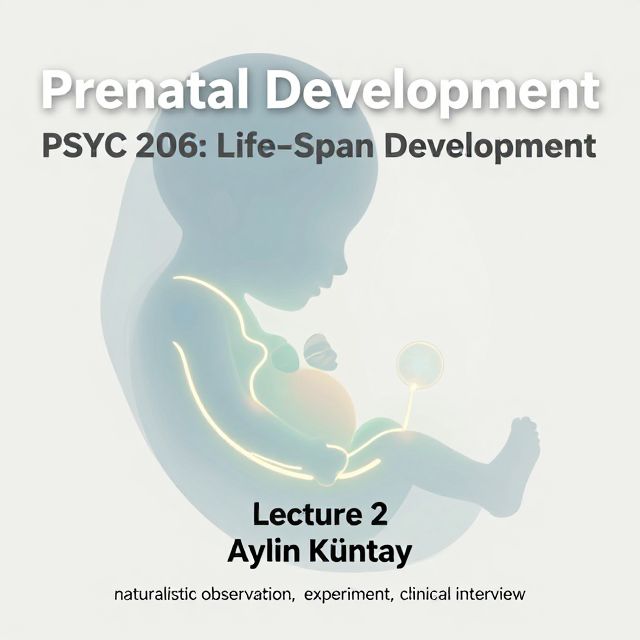
📚 Study Material: Prenatal Development and Newborn Experience
Course: PSYC 206: Life-Span Development Lecture: 4 - Diversity of Experience Instructor: Aylin Küntay
Source Information: This study material has been compiled from lecture slides (copy-pasted text) and an audio transcript of the lecture.
Introduction to Prenatal and Newborn Development
This study material explores the remarkable journey of human development from conception through the earliest stages of newborn life. We will delve into the dynamic environment of the womb, examining how a fetus perceives, learns, and responds to various stimuli. Understanding this foundational period is crucial for appreciating the complexities of life-span development, highlighting both the incredible capabilities of the developing organism and the potential challenges it may face. We will also cover the transition of childbirth and the initial experiences and health considerations of a newborn.
1. Fetal Experience and Sensory Development
The womb is a dynamic and stimulating environment, far from being entirely peaceful and quiet. Fetuses actively engage with their surroundings through various sensory experiences.
1.1. Movement
✅ Fetal movement begins early, around 5-6 weeks after conception.
- Hiccups: One of the earliest movements, potentially a burping reflex (Howes, 2012).
- Swallowing: An important reflex that prepares the fetus for survival outside the womb.
- Fetal Breathing: Around 10 weeks, the fetus moves its chest walls in and out infrequently, circulating amniotic fluid rather than air.
1.2. Touch/Tactile Stimulation
✅ Fetuses experience touch through their own activity.
- They rub their faces and suck their thumbs.
- 💡 Prediction of Handedness: A fetus's choice of thumb to suck (right or left) can predict later handedness (Myowa-Yamakoshi & Takeshita, 2006).
1.3. Sight
✅ Visual experience for fetuses is minimal.
- Only by the third trimester (around 7 months) do they begin processing some visual information, though the womb is largely dark.
1.4. Taste and Smell
✅ Fetuses can detect flavors and scents from the mother's diet around 8 months.
- Mechanism: Amniotic fluid takes on odors from what the mother has eaten, transmitting smells through the liquid.
1.5. Hearing
✅ The prenatal environment is surprisingly noisy.
- Sources: Mother's heartbeat, blood flow, and breathing.
- Noise Level: The uterus can reach 70-95 decibels, comparable to a vacuum cleaner.
2. Prenatal Learning
Despite the filtering effects of the liquid environment, fetuses are capable of learning and remembering.
2.1. Auditory Learning
- Mother's Voice Recognition: A study by Kisilevsky et al. (2003) showed that fetuses' heart rates increased in response to their mother's voice reading a poem, but not to a stranger's voice reading the same poem. This indicates learning and memory of the mother's voice.
- Limitations: The liquid environment filters out detailed speech and music sounds, leaving only pitch contours and rhythmic patterns. Fetuses learn general sound patterns rather than specific content.
2.2. Taste and Smell Learning
- Carrot Juice Study: Mennalla et al. (2001) found that babies whose mothers drank carrot juice daily during the end of pregnancy showed a preference for carrot-flavored food at 5 months, compared to babies whose mothers did not drink carrot juice. This demonstrates early associative learning related to taste.
3. Hazards to Prenatal Development: Teratogens
Prenatal development does not always proceed as planned, facing potential hazards from spontaneous abortion (miscarriage) and environmental factors known as teratogens.
3.1. Definition of Teratogen
📚 A teratogen is an external agent that can cause damage or death during prenatal development.
3.2. Factors Influencing Teratogenic Effects
The severity of teratogenic effects is influenced by several critical factors:
- Timing (Sensitive Periods): Many teratogens cause damage only if present during a specific sensitive period in prenatal development. Since different body systems develop at different rates, their sensitive periods vary (e.g., limb formation is sensitive between 4-6 weeks post-conception).
- Amount and Duration of Exposure (Dose-Response Relation): Most teratogens show a dose-response relationship, meaning the greater the exposure, the more likely and severe the damage.
- Individual Differences in Genetic Susceptibility: Both the mother's and the fetus's genetic makeup can influence how susceptible they are to a teratogen. What might be harmless for one individual could be damaging for another.
3.3. Common Teratogens
3.3.1. Drugs (Legal and Illegal)
- Not all over-the-counter drugs are safe for pregnant women.
- Antidepressants: While some studies suggest potential harm, conclusive evidence is lacking. This presents a dilemma for mothers experiencing depression (10-30% of new mothers), who must weigh the risks of medication against the risks of untreated depression.
- Marijuana: Prenatal exposure may be associated with problems in attention, impulsivity, and memory later in childhood, though more research is needed (Behnke et al., 2013).
3.3.2. Cigarette Smoking
⚠️ Smoking is highly detrimental to fetal development.
- Oxygen Deprivation: Both mother and fetus receive less oxygen.
- Outcomes: Associated with slow fetal growth, low birth weight, and an increased risk of Sudden Infant Death Syndrome (SIDS).
- Long-term Effects: Linked to hearing deficits, ADHD, and cancer later in life for affected children.
- Dose-Response: Greater smoking intensity predicts worse outcomes, including stillbirths.
- Timing: Effects are worst early in pregnancy.
3.3.3. Alcohol
⚠️ Alcohol is the leading cause of fetal brain injury.
- Mechanism: Alcohol in the mother's blood crosses the placenta, entering the fetus's amniotic fluid and bloodstream.
- Fetal Alcohol Spectrum Disorder (FASD): A continuum of alcohol-related birth defects, ranging from subtle cognitive impairments to severe physical and neurological abnormalities.
3.3.4. Environmental Pollutants
- Pollution from sources like coal burning, water contamination, and pesticide use can lead to birth defects (Ren et al., 2011).
3.4. Maternal Factors
3.4.1. Age
- Younger Mothers (≤15 years): Infants are 3-4 times more likely to die before their first birthday.
- Older Mothers: Children are at a greater risk for certain developmental disorders.
3.4.2. Nutrition
- Inadequate supply of specific nutrients can have severe consequences.
- Folic Acid: Too little folic acid is associated with neural-tube defects like spina bifida.
3.4.3. Disease
- While most maternal diseases have no impact, some can be very harmful.
- Zika Virus: A mosquito-borne viral infection that, while mild for the mother, can cause severe birth defects like microcephaly (abnormally small head), leading to hearing/vision loss, seizures, and intellectual disability. Higher rates of microcephaly are observed when infection occurs early in pregnancy.
3.4.4. Maternal Emotional State
- Maternal prenatal stress and depression are associated with changes in children's brain structure (Lebel et al., 2016).
- 💡 Research Insight: The Rice et al. (2010) study attempted to differentiate the effects of maternal stress from shared genetics by studying two groups of mothers (one genetically related to their fetuses, one not). It suggested that prenatal and postnatal environment, rather than shared genetics, was a stronger predictor of later outcomes like birth weight and antisocial behavior.
4. Childbirth
The process of childbirth is a significant transition for both mother and baby.
4.1. The Baby's Experience
- While painful for the mother, the baby experiences a squeezing sensation.
- This squeezing temporarily reduces the size of the fetus's large head, allowing it to pass safely through the mother's pelvic bones.
- This is possible because the skull is composed of separate, overlapping plates during birth.
4.2. Diversity in Childbirth Practices
- Childbirth practices vary widely across cultures, reflecting diverse social and spiritual views.
- Examples: In Bali, birth can be a festive activity with family present. In rural Botswana and Namibia, mothers may give birth outdoors, viewing it as a key event in maturation deeply connected to spiritual beliefs.
5. Newborn Infant Development
Newborn infants begin interacting with their environment immediately, with their exploration influenced by their state of arousal.
5.1. State of Arousal
📚 State: A continuum of arousal, ranging from deep sleep to intense activity.
5.2. Sleep
- Newborns sleep twice as much as young adults.
- They exhibit two main sleep patterns:
- REM Sleep (Rapid Eye Movement): Characterized by quick, jerky eye movements, body movements, distinctive brain activity, and irregular heart rate/breathing. Constitutes 50% of a newborn's sleep, declining to 20% by age 3-4.
- Non-REM Sleep: Absence of motor activity or eye movements, more regular, slow brain waves, breathing, and heart rate.
- Functions of Sleep: Sleep is crucial for development, aiding in the maturation of the visual system (retinal activity during REM) and sensorimotor development. Neonates' brains remain somewhat connected to external stimulation during sleep, allowing for continued learning.
5.3. Crying
- Crying is a normal behavior in neonates, peaking around 6-8 weeks of age.
- It typically decreases in frequency around 3-4 months as infants gain more control over their environment.
- Colic: Some infants experience excessive, unexplained crying for the first few months. Causes are unknown but may include allergic responses, formula intolerance, or immature gut development. Colic usually ends around 3 months and has no long-term effects.
5.4. Newborn Health Assessment
- 1️⃣ Apgar Score: Neonatal caregivers use this quick assessment immediately after birth to evaluate a newborn's health based on skin tone, pulse rate, facial response, arm and leg activity, and breathing.
- 2️⃣ Infant Mortality: Death during the first year after birth. Relatively rare in industrialized nations but remains high in some developing countries.
- 3️⃣ Low Birth Weight (LBW): Infants weighing less than 2500 grams at birth. Most preterm newborns (born at 37 weeks or earlier) are underweight. LBW can lead to medical complications, neurosensory deficits, and lower educational achievement.
6. Cumulative Risk Factors
⚠️ It is important to recognize that risk factors often occur together. For example, a pregnant woman engaging in substance abuse may also experience high stress, poor nutrition, and lack social support.
- Cumulative Effects: The more risk factors present, the worse the potential outcomes for the child.
- These cumulative risks can impact various aspects of child functioning, from attachment and language development to overall well-being.
Wrap-Up: Key Concepts for Review
- Fetal Experience: Movement, touch, sight, smell & taste, hearing.
- Prenatal Learning: Mother's voice recognition, taste preferences (carrot juice example).
- Hazards to Prenatal Development: Miscarriage, environmental factors (teratogens).
- Teratogen Influences: Timing (sensitive periods), amount/duration of exposure (dose-response), genetic susceptibility.
- Common Teratogens: Drugs (antidepressants, marijuana), cigarette smoking (SIDS, LBW), alcohol (FASD), environmental pollutants.
- Maternal Factors: Age, nutrition (folic acid/spina bifida), disease (Zika/microcephaly), emotional state (stress/depression).
- Childbirth: Baby's experience, cultural diversity.
- Newborn Period: States of arousal, sleep (REM vs. non-REM, developmental functions), crying (colic).
- Newborn Health: Apgar score, infant mortality, low birth weight (LBW).
- Cumulative Risk Models: Understanding how multiple risk factors interact and worsen outcomes.