 Podit
Podit
Study Material: Expressing Opinions and Beliefs with Sync Belief
This study material explores the fundamental aspects of expressing personal opinions and deeply held beliefs, focusing on various communication strategies and the advanced concept of 'sync belief'. It draws upon insights from a lecture transcript to provide a comprehensive understanding of effective communication in diverse social and professional contexts.
1. Introduction: The Art of Expressing Oneself 🗣️
The ability to articulate personal opinions and beliefs is a cornerstone of human communication and social interaction. It's not just about sharing information; it's about shaping perceptions, influencing others, and defining one's identity. This guide will delve into the nature of opinions and beliefs, explore different expression strategies, and introduce 'sync belief' – a sophisticated approach to aligning one's views with an audience for greater understanding and impact.
2. The Nature of Opinions and Beliefs 📚
While often used interchangeably, opinions and beliefs possess distinct characteristics:
- Opinions:
- Represent a judgment, viewpoint, or statement about something.
- Often based on personal interpretation, preference, or limited information.
- Generally more fluid and subject to change.
- Example: "I think classical music is the most relaxing genre."
- Beliefs:
- More deeply ingrained convictions or acceptances that something is true or exists.
- Often held without empirical proof.
- Foundational to an individual's worldview, values, and identity.
- Influence attitudes and behaviors.
- Example: "I believe in the importance of environmental sustainability for future generations."
Formation: Both opinions and beliefs are complex constructs, influenced by: ✅ Personal experiences ✅ Cultural background ✅ Education ✅ Social groups ✅ Cognitive biases
Understanding this distinction and their formation is crucial for effective communication, especially when expressing or challenging them.
3. Strategies for Expressing Opinions 💬
The way opinions and beliefs are expressed significantly impacts their reception. Here are common communication styles:
-
1️⃣ Assertive Communication:
- Description: Expressing thoughts, feelings, and beliefs clearly and directly, while respecting others' rights and opinions. Aims for mutual understanding and open dialogue.
- Characteristics: Uses "I" statements, maintains appropriate eye contact, confident yet respectful tone.
- Outcome: Fosters understanding, reduces conflict, builds trust.
- Example: "I understand your perspective on this project, but I believe my approach offers a more efficient solution because..."
-
2️⃣ Passive Communication:
- Description: Suppressing one's own opinions or expressing them indirectly, often due to fear of conflict, rejection, or disapproval.
- Characteristics: Avoids direct confrontation, often apologetic, unclear statements.
- Outcome: Misunderstandings, unaddressed issues, resentment, lack of personal agency.
- Example: (When asked for an opinion) "Whatever you think is best, I guess."
-
3️⃣ Aggressive Communication:
- Description: Expressing opinions in a forceful, demanding, or hostile manner, disregarding others' feelings or rights.
- Characteristics: Loud voice, interrupting, accusatory language, dismissive of others.
- Outcome: Escalates conflict, damages relationships, creates fear or defensiveness.
- Example: "Your idea is completely wrong; we're doing it my way, end of discussion."
-
4️⃣ Passive-Aggressive Communication:
- Description: Combines elements of both passive and aggressive styles, where hostility is expressed indirectly.
- Characteristics: Sarcasm, backhanded compliments, procrastination, subtle sabotage.
- Outcome: Confusion, resentment, unresolved issues, breakdown of trust.
- Example: (After agreeing to a task they didn't want to do) "Oh, I'll get to it eventually, if I have time after fixing everyone else's mistakes."
💡 Insight: Effective expression requires a nuanced approach, adapting the strategy to the specific context, audience, and desired outcome. It involves clarity, awareness of non-verbal cues, and understanding the emotional landscape of the interaction.
4. The Role of Sync Belief in Communication 🤝
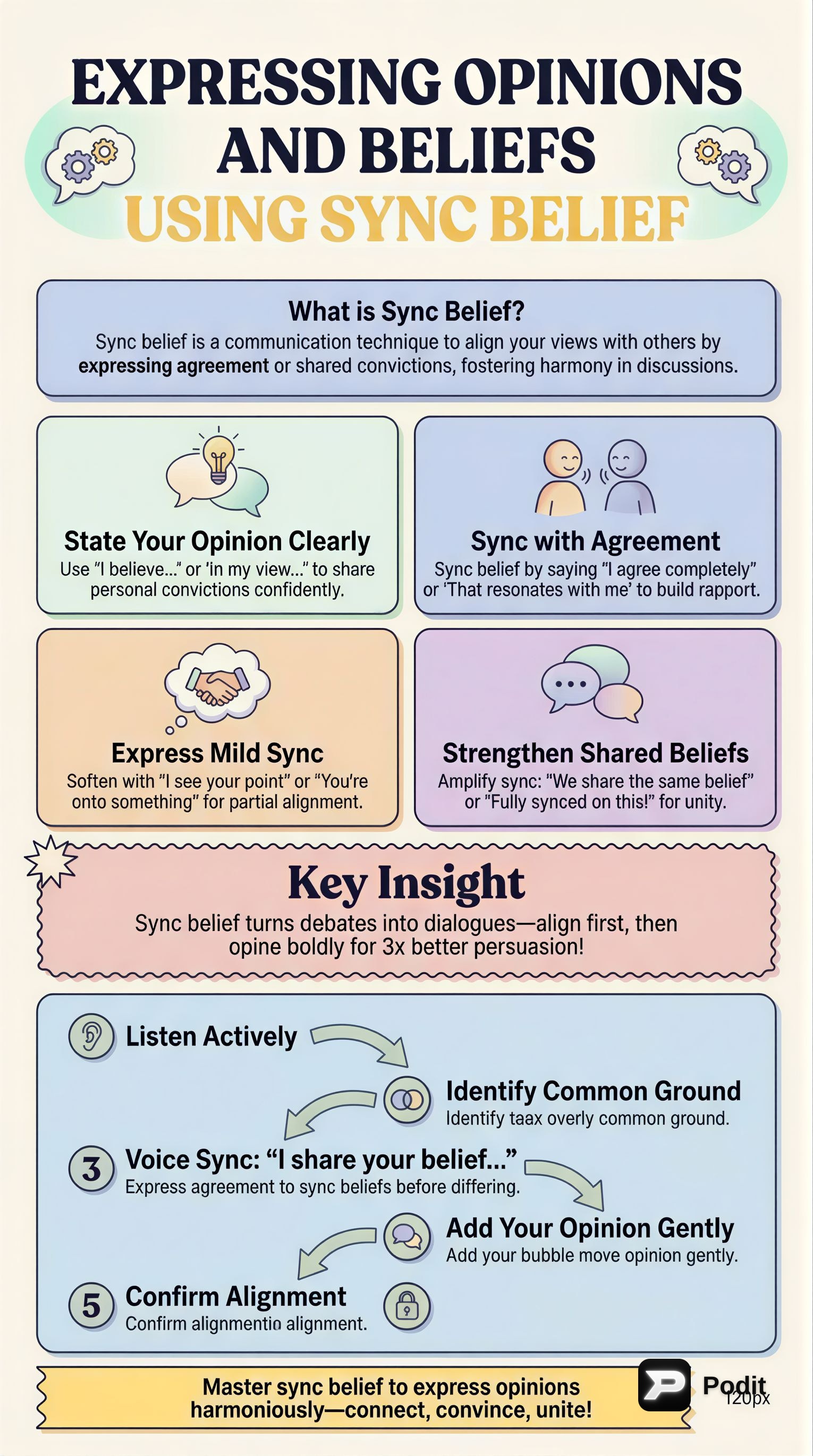
'Sync belief' is a sophisticated communication strategy that prioritizes alignment, commonality, and mutual understanding when expressing opinions and beliefs. It moves beyond simple assertion to foster collaborative discourse.
Key Components of Sync Belief:
-
Active Listening & Empathetic Understanding (Diagnostic Phase) 👂:
- Process: Accurately discern the audience's existing beliefs, values, and perspectives. This involves deep listening and empathy.
- Purpose: Identify potential areas of agreement, shared concerns, or subtle divergences. Without this foundational understanding, attempts at alignment may appear disingenuous.
-
Framing Opinions to Resonate with Common Ground 🖼️:
- Process: Present your own opinions and beliefs in a manner that resonates with or builds upon the identified common ground.
- Principle: This doesn't mean abandoning your core convictions, but selecting language, analogies, and arguments that are more likely to be understood and accepted by the audience.
- Goal: Connect your message to the audience's existing cognitive frameworks.
- Example: When advocating for environmental protection to an audience primarily valuing financial stability, emphasize the economic benefits of green technologies (e.g., job creation, reduced energy costs) rather than solely focusing on ecological preservation.
-
Acknowledging and Validating Differing Viewpoints ✅:
- Process: Demonstrate respect, intellectual humility, and openness by acknowledging and validating perspectives that differ from your own, even while presenting your argument.
- Impact: Disarms defensiveness and creates a more receptive environment for constructive dialogue.
- Phrases to use: "I understand your concern about X, and I believe Y addresses that by..." or "While we may differ on Z, we both agree on A."
Benefits of Employing a Sync Belief Strategy:
- Reduced Communication Barriers: Makes your message more accessible.
- Fostered Trust and Rapport: Builds stronger relationships.
- Facilitated Persuasion: Arguments become more palatable and relevant.
- Constructive Outcomes: Leads to more collaborative solutions in personal and professional contexts.
- Consensus-Building: Transforms potential confrontation into a shared exploration of ideas.
5. Conclusion: Cultivating Harmonious Discourse 🌟
The expression of opinions and beliefs is a complex communicative act. While various strategies exist, the deliberate application of 'sync belief' offers a particularly effective method for navigating diverse perspectives. By understanding the fundamental nature of opinions and beliefs, and by strategically identifying and leveraging common ground, individuals can enhance the clarity, persuasiveness, and overall positive impact of their communication. This approach moves beyond mere assertion to cultivate genuine understanding and constructive engagement, ultimately strengthening social bonds and facilitating more harmonious discourse.