Podit
Podit
Sesli Özet
7 dakikaKonuyu otobüste, koşarken, yolda dinleyerek öğren.
Sesli Özet
Functionalism in Psychology: Origins and Impact
Görsel Özet
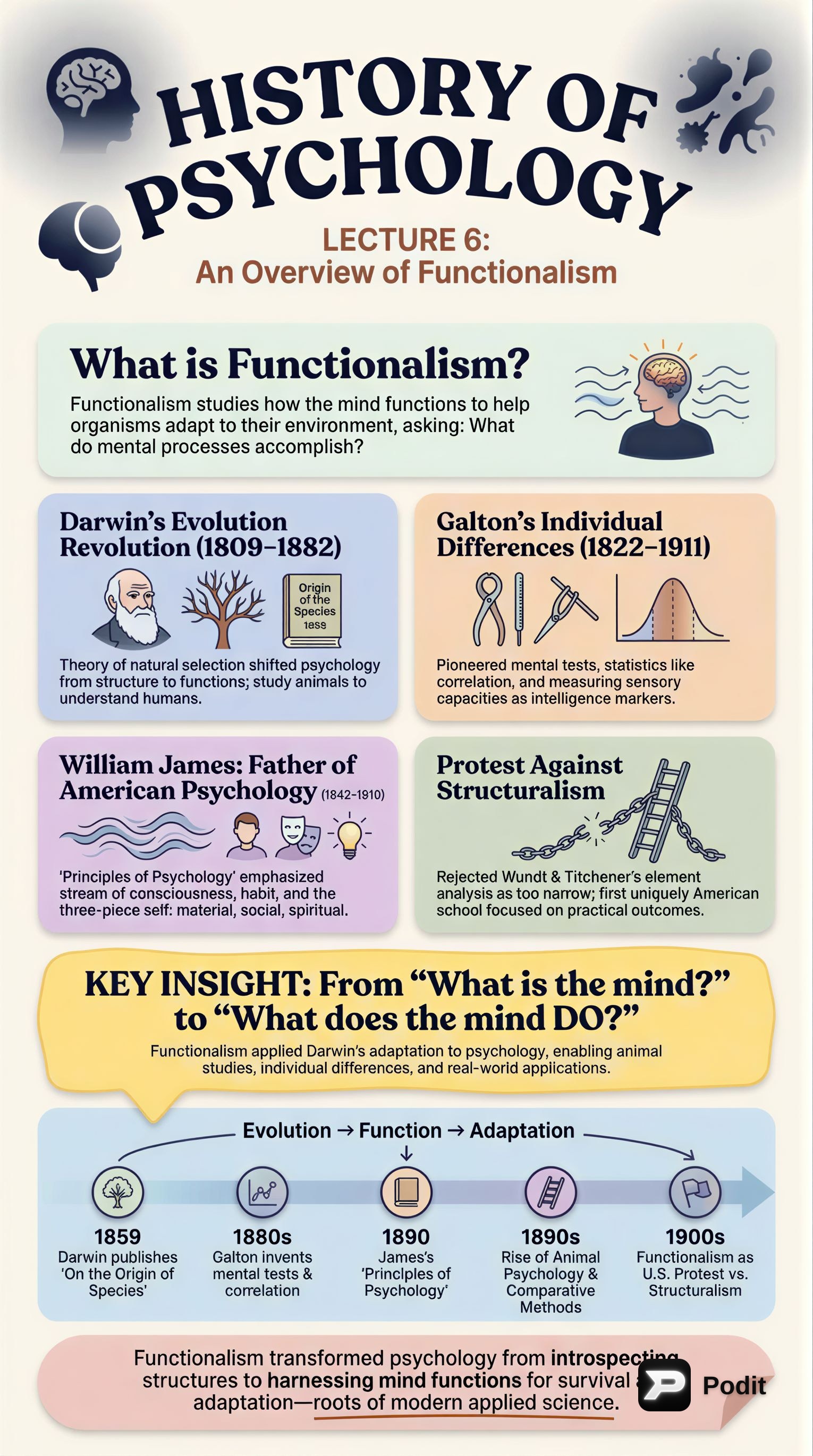
İnfografikKonunun tüm parçalarını tek bakışta gör.
Flash Kartlar
25 kartKarta tıklayarak çevir. ← → ile gez, ⎵ ile çevir.
Tüm kartları metin olarak gör
1. What was the primary shift in focus that functionalism brought to psychology?
Functionalism shifted the focus of psychology from analyzing the structure or composition of consciousness to understanding its adaptive functions. It sought to explore what mental processes accomplish and how the mind aids organisms in adapting to their environment, moving beyond the static analysis favored by structuralists.
2. Against which school of thought did functionalism emerge as a deliberate protest?
Functionalism emerged as a deliberate protest against the more restrictive structural psychology, primarily associated with Wundt and Titchener. Structuralism focused on dissecting consciousness into its basic elements through introspection, while functionalism emphasized the practical consequences and utility of mental processes.
3. Who were some of the key early influences on the development of functionalism?
Key early influences on functionalism included Charles Darwin, whose theory of natural selection provided an evolutionary framework, and Francis Galton, who pioneered the study of individual differences. Early studies of animal behavior also played a crucial role, laying the groundwork for understanding adaptive mental processes.
4. Which of Charles Darwin's publications profoundly influenced the functionalist school of thought?
Charles Darwin's 1859 publication, 'On the Origin of Species,' profoundly influenced functionalism. This work introduced the theory of natural selection, explaining how physical characteristics evolve due to their utility, a principle functionalists extended to psychological characteristics.
5. How did Darwin's theory of natural selection influence functionalists' view of psychological characteristics?
Functionalists extended Darwin's principle of natural selection to psychological characteristics, suggesting that the human brain and mental processes, like physical traits, adapted to serve specific functions in human experience. This implied that mental functions evolved because they were useful for survival and adaptation.
6. Name two key areas in which Darwin's influence manifested in psychology.
Darwin's influence manifested in several key areas, including a new focus on animal psychology, which became foundational for comparative psychology, and an emphasis on the functions of consciousness over its structure. His work also encouraged the acceptance of diverse methodologies and data, and a growing focus on individual differences.
7. How did Darwin's theory legitimize the study of animal behavior in psychology?
Darwin's theory suggested a continuity of mental functioning between humans and animals. This continuity legitimized the study of animal behavior as crucial for understanding human behavior, thereby broadening the scope of psychological research beyond human introspection and into comparative studies.
8. What new research topics did Darwin's influence introduce into the psychological laboratory?
Darwin's influence introduced new research topics into the psychological laboratory by inspiring an examination of the practical functions consciousness serves. This broadened psychology's scope beyond structuralist analysis, encouraging the study of how mental processes aid adaptation and survival in various species.
9. What was Francis Galton's significant contribution to the functionalist perspective?
Francis Galton significantly contributed to the functionalist perspective through his pioneering work on individual differences. He explored mental inheritance and variations in human capacities, bringing an evolutionary spirit to psychology by suggesting that traits could be improved through selective breeding.
10. What was the title of Francis Galton's influential book that explored mental inheritance?
Francis Galton's influential book was titled 'Hereditary Genius.' In this work, he explored the concept of mental inheritance and variations in human capacities, arguing that both physical and mental development are constrained by heredity, aligning with the evolutionary perspective of functionalism.
11. How did Galton apply the spirit of evolution to human traits?
Galton applied the spirit of evolution to human traits by positing that both physical and mental development are constrained by heredity. He argued that human traits could be improved through selective breeding, similar to how desirable traits are enhanced in farm animals, emphasizing the role of genetics in human capacities.
12. What statistical concept, first reported in 1888, did Francis Galton introduce?
Francis Galton introduced the statistical concept of correlation, first reported in 1888. This provided a means to measure the relationship between variables, becoming a foundational tool for quantifying psychological data and understanding the interplay of inherited characteristics.
13. What modern statistical techniques are direct outgrowths of Galton's work on correlation?
Modern statistical techniques for test validity and reliability are direct outgrowths of Galton's work on correlation. His methods for quantifying relationships between variables laid the groundwork for assessing how well psychological tests measure what they intend to measure and how consistent their results are.
14. What concept did Galton originate for measuring intelligence, based on sensory capacities?
Galton originated the concept of mental tests, assuming that intelligence could be measured by sensory capacities. He believed that sharper senses correlated with higher intelligence, leading him to develop apparatuses for rapid and accurate sensory measurements on large populations.
15. What apparatus did Galton invent to conduct rapid sensory measurements?
Galton invented apparatuses, such as a whistle for detecting high-frequency sounds, to conduct rapid and accurate sensory measurements. These tools allowed him to collect quantifiable data on sensory thresholds across large populations, supporting his interest in individual differences and mental testing.
16. Who is widely recognized as the 'Father of American Psychology'?
William James is widely recognized as the 'Father of American Psychology.' His seminal work and influential ideas on the adaptive nature of the mind and consciousness played a pivotal role in shaping the functionalist movement and the direction of psychology in the United States.
17. What was the title of William James's seminal work that advocated for understanding the adaptive mind?
William James's seminal work was titled 'The Principles of Psychology.' In this book, he advocated for understanding how the conscious mind facilitates adaptation to a changing environment, focusing on an individual's interaction with the external world rather than dissecting consciousness into static elements.
18. How did William James describe consciousness, contrasting with the structuralist view?
William James proposed the concept of the 'Stream of Consciousness,' arguing that the brain and mind are in constant flux, making the search for static building blocks futile. He viewed consciousness as a continuous, ever-changing personal flow, unlike the structuralist attempt to break it down into discrete elements.
19. What was James's argument regarding the experience of the same event twice?
James argued that it is impossible to experience the same thing twice. He believed that every new experience is colored by past ones, meaning that even if an external event is identical, the internal state of the individual has changed, making the subjective experience unique each time.
20. What famous statement by William James encapsulates his view on thinking and behavior?
William James's famous statement encapsulating his view on thinking and behavior is: 'My thinking is first and last and always for the sake of my doing.' This highlights his functionalist perspective that thought processes serve a practical purpose, guiding and facilitating an individual's actions and adaptation to the environment.
21. What was William James's stance on introspection as a psychological methodology?
William James acknowledged the difficulties and limitations of introspection but accepted it as a verifiable form of observation. While he recognized its subjective nature, he believed it could still provide valuable insights into mental life, especially when combined with other methods.
22. Besides introspection, what other methodologies did William James value in psychology?
Besides introspection, William James recognized the value of the experimental method, particularly for psychophysics and memory research. Crucially, he also advocated for the comparative method, suggesting that studying diverse populations could reveal significant variations in mental life.
23. What populations did James suggest studying using the comparative method?
James suggested studying diverse populations such as animals, infants, or individuals with emotional disturbances using the comparative method. He believed that examining these groups could reveal significant variations in mental life and provide a broader understanding of psychological functions.
24. Describe William James's concept of the 'Three-Piece Self'.
William James proposed a 'Three-Piece Self' comprising the material self, which includes one's body, family, and possessions; the social self, which is the recognition one gets from others; and the spiritual self, representing one's inner subjective being, including consciousness and moral sensibility. These components collectively form an individual's sense of self.
25. What was a primary criticism of functionalism, particularly from structuralists like Titchener?
A primary criticism of functionalism, particularly from structuralists like Titchener, was the lack of a clear, universally accepted definition for the term 'function' itself. Structuralists argued that functionalism, by deviating from their introspective analysis of mental elements, was not true psychology.