Learning: Operant, Cognitive, and Observational Theories - kapak
Psikoloji#operant conditioning#shaping#behavior modification#cognitive learning

Learning: Operant, Cognitive, and Observational Theories

This summary explores operant conditioning applications like shaping and behavior modification, cognitive learning theories including latent learning, insight, and learned helplessness, and Bandura's observational learning.

nebahatyJune 6, 2026 ~24 dk toplam
01

Sesli Özet

7 dakika

Konuyu otobüste, koşarken, yolda dinleyerek öğren.

Sesli Özet

Learning: Operant, Cognitive, and Observational Theories

0:007:29
02

Görsel Özet

İnfografik

Konunun tüm parçalarını tek bakışta gör.

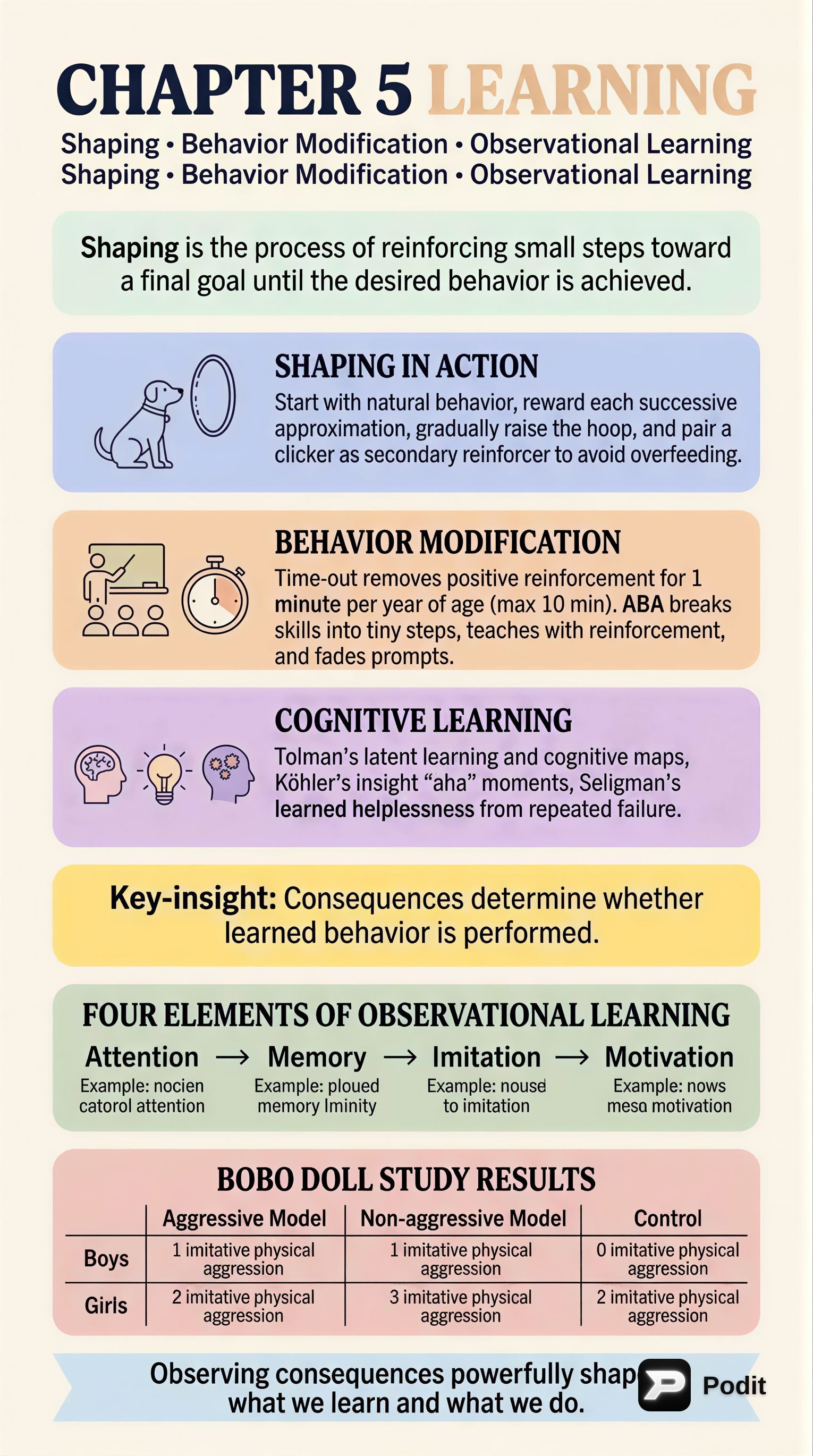
Learning: Operant, Cognitive, and Observational Theories - görsel özet infografik
Tam boyutta görüntüle →
03

Flash Kartlar

25 kart

Karta tıklayarak çevir. ← → ile gez, ⎵ ile çevir.

1 / 25
Tüm kartları metin olarak gör
  1. 1. What is "shaping" in the context of operant conditioning?

    Shaping is a process used in operant conditioning to teach new behaviors. It involves reinforcing successive approximations of a desired behavior, meaning small steps that progressively get closer to the ultimate goal. For example, training a dog to jump through a hoop would involve rewarding initial movements towards the hoop, then stepping through, and finally jumping.

  2. 2. Explain the concept of "successive approximations" in behavior modification.

    Successive approximations refer to the small, incremental steps that gradually lead to a desired complex behavior. In operant conditioning, these steps are reinforced individually, guiding the learner closer to the final target behavior. This method breaks down a difficult task into manageable parts, making learning more efficient and less overwhelming.

  3. 3. How can a sound, like a whistle or clicker, become a secondary reinforcer in animal training?

    A sound becomes a secondary reinforcer by being consistently paired with a primary reinforcer, such as food. Initially, the sound itself has no inherent value, but through repeated association with a reward, it acquires the ability to reinforce behavior. This allows trainers to provide immediate feedback without constantly giving treats, preventing issues like overfeeding.

  4. 4. What role do biological constraints play in operant conditioning?

    Biological constraints refer to the inherent limitations or predispositions that an organism has, which can affect its ability to learn certain behaviors through operant conditioning. Animals are more likely to learn behaviors that are naturally aligned with their instincts or physical capabilities. For instance, it's easier to train a bird to peck for food than to train it to perform a complex dance.

  5. 5. Define behavior modification and its primary principles.

    Behavior modification is an approach that uses operant conditioning (and sometimes classical conditioning) to alter undesirable behaviors and encourage desirable responses. Its primary principles are reinforcement and shaping. This method is widely applied to both animals and humans, including schoolchildren, to improve behavior and teach new skills.

  6. 6. Describe the "time-out" technique used in behavior modification, including its recommended duration.

    Time-out is a mild punishment technique used in behavior modification where an individual is temporarily removed from a reinforcing environment or attention. The goal is to eliminate positive reinforcement for an undesirable behavior. The recommended duration for a time-out is typically one minute per year of the child's age, with a maximum limit of ten minutes.

  7. 7. What is Applied Behavior Analysis (ABA) and where is it commonly applied?

    Applied Behavior Analysis (ABA) is a modern form of behavior modification that integrates analytical and behavioral techniques. It involves breaking skills into small steps, teaching with reinforcement, and gradually removing prompts. ABA is commonly applied in educational settings, private practices, and institutions, particularly for treating children with disorders, training animals, and developing teaching methods for individuals with varied mental abilities.

  8. 8. Explain what biofeedback is and provide examples of its application.

    Biofeedback is an application of learning theories that uses biological information, such as heart rate or muscle tension, to help individuals gain conscious control over involuntary physiological responses. By monitoring these bodily functions, people can learn to regulate them. It is used to manage conditions like stress, hyperactivity, or high blood pressure, empowering individuals to improve their health through self-regulation.

  9. 9. What is the primary focus of cognitive learning theory?

    Cognitive learning theory focuses on understanding learning by examining the mental processes involved. Unlike behavioral theories that emphasize observable actions, cognitive theory delves into internal processes such as perception, memory, problem-solving, and information processing. It seeks to explain how individuals acquire, organize, and use knowledge.

  10. 10. Define latent learning and provide an example from Tolman's experiments.

    Latent learning refers to learning that occurs but is not immediately expressed or observable until there is a reason or incentive to demonstrate it. E. C. Tolman's experiments with rats in mazes demonstrated this; rats developed a "cognitive map" of the maze even without immediate rewards. They only exhibited this learning and navigated the maze efficiently once reinforcement was introduced later.

  11. 11. What is insight learning, and how did Köhler's chimpanzee, Sultan, demonstrate it?

    Insight learning is the sudden perception of relationships among various parts of a problem, leading to a rapid and often complete solution. It's characterized by an "aha!" moment where all elements suddenly come together. Köhler's chimpanzee, Sultan, demonstrated insight learning by successfully combining two short sticks to reach a banana, showing an understanding of the tools' potential relationships.

  12. 12. Explain learned helplessness and how Seligman's experiments illustrated this concept.

    Learned helplessness is the tendency to fail to act to escape from a situation or to avoid an unpleasant stimulus, due to a history of repeated failures in the past. Seligman's experiments with dogs initially subjected to inescapable electric shocks showed that these dogs later failed to escape even when escape was possible. This indicated that they had learned that their actions were futile, leading to a state of passivity and increased fear.

  13. 13. Define observational learning.

    Observational learning is a type of learning that occurs by observing the behavior of another person or model. Instead of direct experience or reinforcement, individuals acquire new behaviors, attitudes, and emotional reactions by watching others. A common example is learning how to drive a car by observing an instructor or parent.

  14. 14. What is the significance of Albert Bandura's Social Cognition Theory in observational learning?

    Albert Bandura's Social Cognition Theory is central to the concept of observational learning because it emphasizes the importance of social models and cognitive processes in learning. Bandura proposed that learning is not purely behavioral but involves cognitive factors like attention, memory, and motivation. His theory highlights that individuals can learn by observing others' actions and the consequences that follow.

  15. 15. Describe the setup of Bandura's 1961 Bobo Doll Study.

    The 1961 Bobo Doll Study by Bandura, Ross, and Ross involved 72 preschool children, aged three to six years. They were divided into three groups: one group observed an aggressive adult model hitting a Bobo doll, another observed a non-aggressive model playing quietly, and a control group had no model. Each child observed their respective model for ten minutes.

  16. 16. What were the key findings of Bandura's 1961 Bobo Doll Study regarding imitative aggression?

    The study found significant imitative physical aggression, particularly among children who had been exposed to the aggressive model. These children were more likely to imitate the specific aggressive behaviors they had observed. The results also indicated that boys generally exhibited more aggression than girls, suggesting potential gender differences in the expression of learned aggression.

  17. 17. How did Bandura's further research on observational learning investigate the impact of observed consequences?

    Bandura's further research involved showing children a film of a model attacking a Bobo doll, with varying consequences for the model. In one condition, the model was rewarded for the aggression, while in another, the model was punished. This setup allowed researchers to observe how the perceived consequences for the model influenced the children's subsequent performance of the aggressive behavior.

  18. 18. What did Bandura's research on rewarded vs. punished models reveal about the distinction between learning and performance?

    This research demonstrated that children who observed the rewarded model imitated the aggression, while those who saw the punished model did not, unless promised a reward for copying. This key finding highlighted that both groups had learned the behavior through observation, but the performance of that learned behavior was strongly influenced by the observed consequences. It showed that learning can occur without immediate performance.

  19. 19. What is the role of "attention" as an essential element of observational learning?

    Attention is the first crucial element in observational learning, requiring the learner to actively focus on the model's behavior. Without paying attention, the learner cannot acquire the information needed to imitate the behavior. Learners are often more likely to pay attention to models they find similar to themselves, attractive, or perceived as competent.

  20. 20. Explain the importance of "memory" in observational learning.

    Memory is the second essential element, requiring the learner to retain what they have observed from the model. This involves encoding the observed behavior into long-term memory so it can be retrieved later. For example, remembering the steps of a cooking show or a dance routine is crucial for later reproduction.

  21. 21. How does "imitation" function as an essential element of observational learning?

    Imitation, also known as reproduction, is the third element, where the learner must be physically and cognitively capable of reproducing the observed behavior. This means having the necessary motor skills and understanding to perform the action. A toddler, for instance, might remember the steps to tie shoelaces but lack the fine motor dexterity to actually perform the task.

  22. 22. What is the role of "desire or motivation" in observational learning?

    Desire or motivation is the fourth essential element, meaning the learner must want to perform the observed behavior. Even if attention, memory, and imitation capabilities are present, the behavior won't be performed without motivation. Motivation increases if rewards are expected or observed, and people are less likely to imitate models who fail or are punished.

  23. 23. What did the study by Joy et al. (1986) investigate regarding media influence on aggressive behavior?

    The study by Joy et al. (1986) investigated the impact of television introduction on aggressive behavior in students. Researchers examined aggressive behavior in communities both before and after television became available. This longitudinal approach allowed them to observe changes in behavior correlated with increased media exposure, providing insights into the potential effects of television on aggression.

  24. 24. How did Centerwall's (1992) study contribute to understanding media influence on aggression?

    Centerwall's (1992) study compared towns with and without television access to assess the influence of media on aggressive behavior. By comparing communities with differing levels of media exposure, the research aimed to identify correlations between television availability and rates of aggression. This comparative approach provided further evidence for the potential link between media consumption and aggressive tendencies.

  25. 25. What do contemporary data indicate about young people's daily media usage compared to other activities?

    Contemporary data indicate that young people spend a significant amount of time daily on media, averaging about six and a half hours. This is considerably more than the time they spend with parents, which is approximately two hours and fifteen minutes, or the fifty minutes dedicated to homework. These statistics highlight the pervasive influence of media in the daily lives of individual youths.

04

Bilgini Test Et

15 soru

Çoktan seçmeli sorularla öğrendiklerini ölç. Cevap + açıklama.

Soru 1 / 15Skor: 0

Which of the following best defines 'shaping' in the context of operant conditioning?

05

Detaylı Özet

7 dk okuma

Tüm konuyu derinlemesine, başlık başlık.

📚 Chapter 5: Understanding Learning Theories

Source Information: This study material has been compiled from a lecture audio transcript and copy-pasted text provided by the user.


💡 Introduction to Learning Theories

Learning is a fundamental process through which individuals acquire new knowledge, skills, behaviors, or attitudes. This chapter explores various theories that explain how learning occurs, focusing on the applications of operant conditioning, cognitive learning processes, and the impact of observational learning. These frameworks offer a comprehensive understanding of how behaviors are acquired, modified, and retained through direct reinforcement, mental processes, and social observation.


1️⃣ Applications of Operant Conditioning

Operant conditioning, a type of learning where behavior is strengthened if followed by a reinforcer or diminished if followed by a punisher, has wide-ranging applications.

1.1. Shaping

📚 Shaping is the process of reinforcing successive approximations of a desired behavior until the target behavior is fully achieved. It involves breaking down a complex behavior into smaller, manageable steps.

  • Successive Approximations: These are small steps that progressively get closer to the ultimate behavioral goal.
  • Example: Training a dog to jump through a hoop.
    1. Start by rewarding the dog for simply looking at the hoop.
    2. Reward for stepping near the hoop.
    3. Reward for stepping through the hoop on the ground.
    4. Gradually raise the hoop, rewarding each successful attempt.
  • 💡 Secondary Reinforcers: Trainers often pair a sound (like a whistle or clicker) with food. The sound then becomes a secondary reinforcer, allowing for reinforcement without constant food delivery, preventing overfeeding.
  • ⚠️ Biological Constraints: While powerful, operant conditioning is limited by an animal's biological predispositions. Not all behaviors can be taught to all species.

1.2. Behavior Modification

📚 Behavior modification uses operant conditioning principles (and sometimes classical conditioning) to change undesirable behaviors and encourage desirable ones. It's widely applied to both animals and humans, especially schoolchildren.

  • Core Principles: Reinforcement and shaping are the main drivers.
  • Example: Time-out
    • A mild form of punishment by removal.
    • A misbehaving individual is temporarily removed from a reinforcing environment (e.g., social attention, toys).
    • This removes positive reinforcement, reducing the likelihood of the undesirable behavior.
    • Recommended Duration: Typically 1 minute per year of age, with a maximum of 10 minutes.

1.3. Applied Behavior Analysis (ABA)

📚 Applied Behavior Analysis (ABA) is a modern, systematic form of behavior modification that combines analytical and behavioral techniques.

  • Methodology: Breaks skills into small, teachable steps, uses reinforcement to teach, and gradually removes prompts as the learner becomes proficient.
  • Applications:
    • Used in schools, private practices, and institutions.
    • Common for treating children with developmental disorders (e.g., autism).
    • Effective in animal training and developing teaching methods for individuals with varied mental abilities.

1.4. Biofeedback

📚 Biofeedback is an application that uses biological information (e.g., heart rate, muscle tension, brain waves) to help individuals gain conscious control over involuntary physiological responses.

  • Purpose: Helps individuals learn to regulate their own bodily functions.
  • Benefits: Can aid in relieving or controlling problems such as stress, hyperactivity, or high blood pressure.

2️⃣ Cognitive Learning Theory

Cognitive learning theory focuses on understanding learning by examining the mental processes involved, rather than just observable behaviors.

2.1. Latent Learning (E. C. Tolman)

📚 Latent learning refers to learning that occurs but is not immediately expressed or observable until there is an incentive to demonstrate it.

  • Tolman's Maze-Running Rats:
    • Experiment: Rats were placed in a maze under three conditions:
      • Group 1: Rewarded with food every day.
      • Group 2: Not rewarded for the first 9 days, then rewarded from day 10 onwards.
      • Group 3: Never rewarded.
    • Results: Group 2 showed a sudden drop in errors once rewards were introduced, performing as well as Group 1. This suggested they had learned the maze layout (formed a cognitive map) during the unrewarded days, but only demonstrated this learning when a reward was present.
    • Cognitive Map: A mental representation of the layout of one's environment.

2.2. Insight Learning (Wolfgang Köhler)

📚 Insight learning is the sudden perception of relationships among various parts of a problem, allowing for a rapid and often "aha!" moment solution.

  • Köhler's Smart Chimp (Sultan):
    • Experiment: Sultan, a chimpanzee, was faced with the problem of reaching a banana hanging from the ceiling, with boxes and sticks scattered around.
    • Solution: After initial failed attempts, Sultan suddenly grasped the relationship between the objects, stacked the boxes, and used a stick to knock down the banana.
    • ✅ This demonstrated a sudden "coming together" of all problem elements, not a gradual trial-and-error process.

2.3. Learned Helplessness (Martin Seligman)

📚 Learned helplessness is the tendency to fail to act to escape from a situation because of a history of repeated failures in the past, leading to a belief that one has no control over the outcome.

  • Seligman's Depressed Dogs:
    • Experiment: Dogs were subjected to inescapable electric shocks. Later, when placed in a situation where escape was possible, these dogs often made no attempt to escape, even when the shocks were avoidable.
    • Conclusion: The dogs had learned that their actions were futile in preventing the shocks, leading to a state of helplessness and increased fear/anxiety, even when circumstances changed.

3️⃣ Observational Learning

📚 Observational learning, also known as social learning, is learning by observing the behavior of a person or model. Albert Bandura's Social Cognitive Theory is central to this concept.

  • Example: Learning how to drive a car by watching others, or a child learning manners by observing parents.

3.1. The Bobo Doll Study (Bandura, Ross, & Ross, 1961)

This seminal study demonstrated the power of observational learning, particularly concerning aggression.

  • Participants: 72 preschool children (3-6 years old).
  • Groups:
    • Aggressive Model Group: Children observed an adult model aggressively interacting with a Bobo doll (e.g., hitting it with a hammer).
    • Non-aggressive Model Group: Children observed an adult model playing quietly with other toys.
    • Control Group: Children had no model.
  • Results (📊):
    • Children in the aggressive model group showed significantly more imitative physical aggression towards the Bobo doll.
    • Boys generally exhibited more aggression than girls.
    • Further experiments showed that children who saw a model rewarded for aggression imitated the behavior more readily than those who saw a model punished. However, even those who saw punishment had learned the behavior and would perform it if promised a reward.
    • Conclusion: Consequences (reward or punishment) strongly influence whether a learned behavior is performed, even if the behavior has been learned through observation.

3.2. Four Elements of Observational Learning (Bandura)

For observational learning to occur effectively, four key elements are necessary:

  1. Attention: The learner must pay attention to the model's behavior.
    • 💡 People are more likely to attend to models they find similar, attractive, or competent.
  2. Memory (Retention): The learner must be able to retain or remember what they observed.
    • ✅ This involves encoding the observed behavior into memory for later retrieval.
    • Example: Remembering the steps from a cooking show.
  3. Imitation (Reproduction): The learner must be physically and cognitively capable of reproducing the observed behavior.
    • ⚠️ There's a difference between knowing how to do something and being able to do it.
    • Example: A toddler might remember the steps for tying shoelaces but lack the fine motor skills (dexterity) to perform them.
  4. Desire (Motivation): The learner must have the motivation or desire to perform the behavior.
    • 📈 Motivation increases if rewards are expected or observed for the behavior.
    • ❌ People rarely imitate models who fail or are punished.

3.3. Media Influence on Behavior

The principles of observational learning extend to media consumption.

  • Aggression and Media: Studies (e.g., Joy et al., 1986; Centerwall, 1992) have investigated the link between exposure to television/video games and aggressive behavior, comparing groups with varying media access.
  • Media Usage Statistics:
    • 📊 Young people spend an average of 6.5 hours a day (44.5 hours/week) on media.
    • In contrast, they spend only 2 hours and 15 minutes a day with parents and 50 minutes a day on homework.
    • Similar trends in media usage are observed in Türkiye (as indicated by provided source links).

🏁 Conclusion

Learning is a multifaceted process explained by various theories. Operant conditioning highlights the role of consequences in shaping behavior, while cognitive learning theory emphasizes internal mental processes like latent learning, insight, and learned helplessness. Observational learning, as demonstrated by Bandura, underscores the profound impact of social models and media on how we acquire and perform behaviors. Together, these theories provide a comprehensive understanding of how both humans and animals learn and adapt.
Kendi çalışma materyalini oluştur

PDF, YouTube videosu veya herhangi bir konuyu dakikalar içinde podcast, özet, flash kart ve quiz'e dönüştür. 1.000.000+ kullanıcı tercih ediyor.

Sıradaki Konular

Tümünü keşfet
From Learning Theory to Contemporary Models in Psychology

From Learning Theory to Contemporary Models in Psychology

Explore the evolution of psychological thought from early behaviorism to the cognitive revolution and sociobehaviorism, focusing on key figures like Bandura and Rotter.

Özet 15
Learning Theories: Classical and Operant Conditioning

Learning Theories: Classical and Operant Conditioning

This summary explores fundamental learning theories, defining learning as a behavioral change through experience. It details classical conditioning, including its elements and applications, and operant conditioning, focusing on reinforcement and punishment.

7 dk Özet 25 15 Görsel
Development, Learning, Memory, and Intelligence in Psychology

Development, Learning, Memory, and Intelligence in Psychology

This podcast explores core concepts in developmental psychology, learning theories, memory processes, and the multifaceted nature of intelligence.

15 dk 25 10
Understanding Human Development, Learning, Memory, and Intelligence

Understanding Human Development, Learning, Memory, and Intelligence

This podcast provides a comprehensive educational overview of key psychological concepts: human development, learning processes, memory functions, and the multifaceted nature of intelligence, based on detailed scientific principles.

13 dk 25 10
Research Methods in Psychology: Descriptive, Qualitative, Correlational, and Experimental Approaches

Research Methods in Psychology: Descriptive, Qualitative, Correlational, and Experimental Approaches

Explore fundamental research methods in psychology, including descriptive, qualitative, correlational, and experimental designs, and the critical conditions for establishing causality.

25 15
Functionalism in Psychology: Origins and Impact

Functionalism in Psychology: Origins and Impact

This summary explores the historical development of functionalism in psychology, examining its roots in Darwinian evolution, Galton's individual differences, and William James's contributions, along with its criticisms and lasting impact.

6 dk 25 Görsel
Adolescents and Social Media: Engagement, Theories, and Well-being

Adolescents and Social Media: Engagement, Theories, and Well-being

Explore how adolescents and young adults engage with social media, examining key theories, the screen time debate, and the nuanced impact of online interactions on well-being.

Özet Görsel
Expressing Opinions and Beliefs Using Sync Belief

Expressing Opinions and Beliefs Using Sync Belief

This summary explores the articulation of opinions and beliefs, differentiating between them, examining communication strategies, and detailing the 'sync belief' approach for effective, aligned discourse.

6 dk Özet 25 15 Görsel