 Podit
Podit
Understanding Abnormality and Psychopathology: A Comprehensive Study Guide
Source Information: This study material is compiled from a lecture audio transcript and copy-pasted text provided by the user.
1. Introduction: Defining "Normal" and "Abnormal" 🤔
The concepts of "normal" and "abnormal" behavior are complex and multifaceted, lacking a single, universally accepted definition. What one society or individual considers typical, another might view as unusual or even pathological. This guide explores how abnormality is defined in clinical psychology, its historical evolution, cultural influences, and contemporary perspectives that extend beyond mere pathology.
1.1 The Elusive Nature of "Normal" 🌍
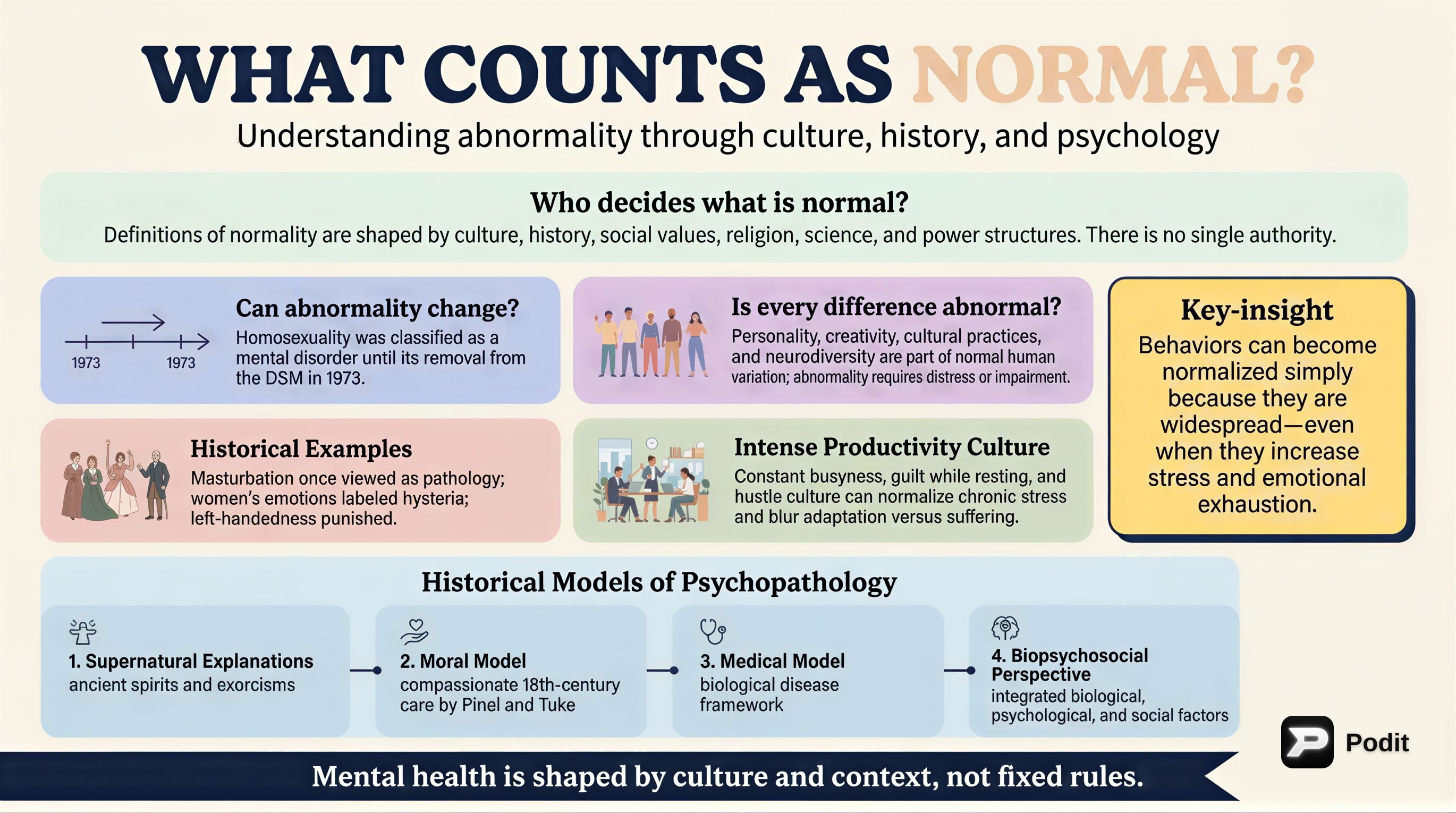
There is no single authority or institution that dictates what is "normal." Instead, definitions are shaped by a confluence of factors:
- Cultural Context: Societal norms, values, and beliefs.
- Historical Period: Definitions evolve over time.
- Social Values: Prevailing moral and ethical standards.
- Religion: Spiritual beliefs and practices.
- Science: Empirical research and clinical understanding.
- Power Structures: Influence of dominant groups.
Psychologists and psychiatrists contribute to these definitions, but societal influences are equally significant.
1.2 Is Every Difference Abnormal? 💡
No. Being different does not automatically equate to being abnormal or disordered. Human variation encompasses a wide range of individual differences, including:
- Personality traits
- Creativity
- Cultural practices
- Neurodiversity
Abnormality typically involves significant distress, dysfunction, or impairment, not simply being unique.
1.3 The Dynamic Nature of Abnormality ⏳
The concept of "abnormality" is not static; it changes over time. Behaviors or identities once considered abnormal may later become accepted, and vice versa.
Historical Examples:
- Homosexuality: Classified as a mental disorder in the DSM until 1973.
- Masturbation: Once viewed as a medical and moral pathology.
- "Hysteria": A diagnosis often given to women expressing strong emotions.
- Left-handedness: Historically punished in some cultures.
Contemporary Examples:
- Social Anxiety vs. Introversion: While both may involve less social interaction, introversion is a personality trait (preference for solitude), whereas social anxiety is an intense fear of judgment or rejection. The key difference lies in the presence of distress and avoidance due to fear.
- Intense Productivity Culture: Societies sometimes normalize unhealthy behaviors if they are widespread or economically rewarded. Constant busyness, feeling guilty while resting, and chronic stress can become normalized, blurring the line between adaptation, stress, and psychological suffering. This raises questions like: Is burnout an individual problem or a societal one?
- Social Media Impact: Constant comparison, fear of missing out (FOMO), and the need for validation can lead to low self-esteem, anxiety, and attention difficulties. Behaviors can become normalized simply because they are widespread, even if they increase stress or emotional exhaustion.
2. Clinical Criteria for Abnormality: The "Four D's" and Risk 📚
In clinical psychology, abnormality is typically understood through several key criteria, often referred to as the "Four D's" plus risk. However, defining psychopathology is complex, as distress and deviation alone do not necessarily indicate a disorder. Psychological experiences must be understood within their developmental, relational, and cultural contexts.
✅ Key Criteria:
- Distress: The individual experiences significant emotional suffering (e.g., persistent sadness, anxiety, hopelessness).
- Example: Severe depression or panic attacks causing overwhelming anxiety.
- Limitation: Not always present (e.g., some personality disorders), and distress can be a normal reaction to life events (e.g., grief).
- Dysfunction (Impairment in Functioning): Difficulties in psychological, social, or occupational functioning. This is one of the most important criteria in clinical diagnosis.
- Example: A person with severe depression struggling to maintain relationships, attend classes, or complete basic tasks.
- Impacts: Work/academic life, relationships, daily responsibilities, self-care.
- Deviance: Thoughts, emotions, or behaviors that differ markedly from cultural or social norms.
- Example: Hearing voices that others cannot hear, or behaving aggressively in inappropriate contexts.
- Limitation: Statistical rarity alone (e.g., high intelligence) or violation of social norms (which vary culturally and historically) does not necessarily mean disorder.
- Risk or Harm: Behaviors that may pose danger to oneself or others.
- Example: Suicidal behavior, violent actions, or severe impulsivity.
- Limitation: Not all individuals who pose risks meet criteria for a mental disorder.
3. Historical Models of Psychopathology 📜
Our understanding of psychological distress has evolved significantly throughout history, reflecting the scientific knowledge, cultural beliefs, and social context of each era.
-
Supernatural Explanations (Ancient Societies):
- Belief: Mental disturbances were caused by spirits, demons, divine punishment, witchcraft, or curses.
- Treatments: Rituals, prayers, exorcisms.
- Insight: Illustrates how cultural beliefs shape interpretations of mental distress.
-
The Moral Model (18th-19th Centuries):
- Emphasis: Compassionate care, structured daily routines, supportive environments, and respect for individuals with mental distress.
- Advocates: Philippe Pinel and William Tuke.
- Impact: A crucial step toward more humane mental health care.
-
The Medical Model (Late 19th-Early 20th Centuries):
- View: Mental disorders as diseases with biological causes (genetic vulnerabilities, brain dysfunction, neurochemical imbalances).
- Outcome: Led to psychiatric diagnosis and pharmacological treatments.
- Critique: Can sometimes reduce complex human experiences to biological symptoms.
-
The Biopsychosocial Perspective (Contemporary):
- Approach: Integrates multiple levels of explanation.
- Factors:
- Biological: Genetics, brain functioning.
- Psychological: Cognition, emotions, coping skills.
- Social & Relational: Family, culture, relationships.
- Core Idea: Psychological difficulties emerge from complex interactions among these systems, rather than a single cause.
4. The Role of Diagnosis and Classification Systems 📊
Diagnosis plays a crucial role in clinical psychology and psychiatry, helping to organize and understand psychological difficulties.
4.1 Functions of Diagnosis ✅
- Organizes Symptoms: Identifies patterns of symptoms that tend to occur together.
- Facilitates Communication: Provides a common language for professionals.
- Guides Treatment: Informs appropriate therapeutic interventions.
- Supports Research: Enables systematic study of disorders.
- Predicts Course: Helps anticipate the progression of conditions.
4.2 Major Diagnostic Systems 📚
Two primary classification systems are used worldwide:
- DSM (Diagnostic and Statistical Manual of Mental Disorders): Developed by the American Psychiatric Association, widely used in North America and academic contexts.
- ICD (International Classification of Diseases): Developed by the World Health Organization, used internationally for both physical and mental health conditions.
4.3 Limitations of Diagnosis ⚠️
While useful, diagnostic categories are tools that organize complex human experiences but cannot fully capture individual lives. Contemporary clinical psychology emphasizes integrating diagnosis with relational, developmental, and contextual understanding. Diagnosis helps organize information but does not replace a comprehensive understanding of the individual.
5. Culture and Abnormality: Cultural Relativity 🌍
What is considered "normal," "healthy," or "abnormal" changes across cultures, historical periods, religions, and social contexts. This concept is known as cultural relativity.
5.1 Examples of Cultural Differences 💡
-
Emotional Expression:
- Varies: Openly expressing sadness/grief may be encouraged in some cultures, while emotional restraint is valued in others.
- Question: Is crying loudly at a funeral normal or abnormal? The answer depends on cultural expectations.
-
Eye Contact:
- Western Cultures: Direct eye contact often signifies confidence and honesty.
- Other Cultures (e.g., Asian, Indigenous): Prolonged eye contact may be considered disrespectful or confrontational.
- Insight: A behavior interpreted as "social withdrawal" in one culture might reflect politeness in another.
-
Spiritual and Religious Experiences:
- Varies: Visions, hearing ancestral voices, trance states, or intense meditation experiences may be meaningful in some cultures.
- Question: When does a spiritual experience become viewed as psychosis? This highlights the importance of context, interpretation, and cultural meaning.
-
Grief Rituals:
- Varies: Some cultures encourage public crying, loud mourning, or physical expressions of grief, while others value emotional control, silence, or private mourning.
- Warning: Without cultural understanding, clinicians may misinterpret culturally normal behavior as psychopathology.
5.2 Culture-Bound Syndromes 🌐
Some forms of psychological distress appear in culturally specific ways.
- Hikikomori (Japan): Extreme social withdrawal, staying isolated at home for months or years, avoiding social interaction. This phenomenon raises questions about culture, societal pressure, achievement expectations, and social belonging.
6. Beyond Pathology: The Positive Psychology Perspective 😊
Traditionally, the "pathology-oriented" or medical model has focused on "what is wrong with people," emphasizing symptoms, deficits, and dysfunction. While essential for diagnosis and treatment, this approach primarily frames mental health in terms of problems to be fixed.
6.1 The Positive Psychology Approach 📈
This perspective asks, "What helps people live well?" It focuses on human strengths and optimal functioning, exploring:
- What helps individuals thrive?
- What psychological resources support well-being?
- How do individuals maintain resilience in the face of adversity?
6.2 Key Concepts in Positive Psychology ✅
- Strengths: Individuals possess psychological strengths (e.g., creativity, empathy, perseverance) that aid in coping and building meaningful lives.
- Resilience: The capacity to adapt and recover from stress, adversity, or trauma. It highlights people's ability to navigate challenges.
- Meaning and Purpose: A strong connection between mental health and a sense of meaning, purpose, and engagement in life.
- Well-being: Encompasses positive emotions, life satisfaction, social connectedness, and personal growth.
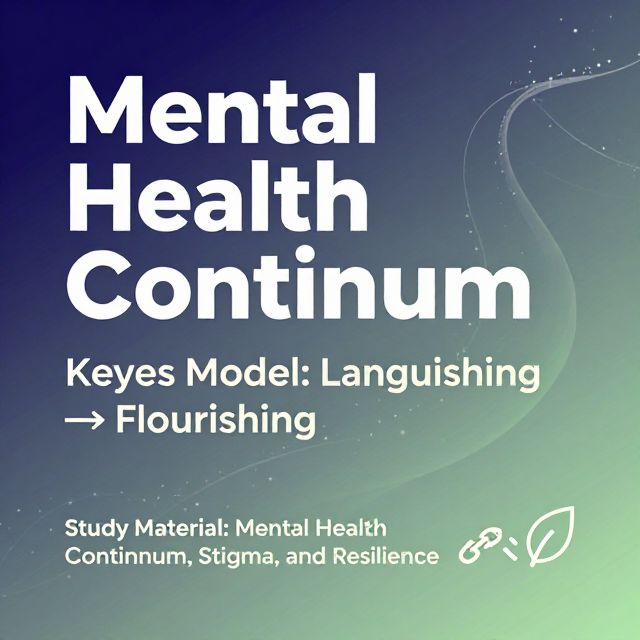
6.3 The Mental Health Continuum 📊
The Keyes model suggests that mental health is more than just the absence of illness. Individuals can experience different levels of well-being, even without a diagnosable disorder:
- Languishing: Low well-being, feeling empty or stagnant.
- Moderate: Average well-being.
- Flourishing: High well-being, experiencing optimal psychological functioning and growth.
6.4 Expanding, Not Replacing, the Framework 💡
Positive psychology does not reject the study of psychopathology. Instead, it argues that a complete understanding of mental health requires both perspectives:
- Understanding psychological suffering and disorders.
- Understanding strengths, resilience, and well-being.
Mental health is not just about reducing symptoms but also about supporting flourishing and psychological growth.