 Podit
Podit
This study material is compiled from a lecture transcript on contemporary cognitive behavioral psychotherapies.
Contemporary Cognitive Behavioral Psychotherapies: An Evolution of Understanding 🧠
📚 Introduction
Welcome to an exploration of the dynamic and evolving field of cognitive behavioral psychotherapies. This guide will delve into how our understanding of mental well-being has progressed, moving from traditional Cognitive Behavioral Therapy (CBT) to more contemporary, "third-wave" approaches. We will examine the foundational principles of CBT, understand its limitations that paved the way for new developments, and then dive deep into key contemporary therapies like Acceptance and Commitment Therapy (ACT), Dialectical Behavior Therapy (DBT), Mindfulness-Based Cognitive Therapy (MBCT), and Schema Therapy, highlighting their unique contributions and core concepts.
1️⃣ From Traditional CBT to the Third Wave: An Evolution
1.1. The Foundations of Traditional CBT 🏗️
Traditional Cognitive Behavioral Therapy, pioneered by figures like Aaron Beck and Albert Ellis, revolutionized mental health treatment by establishing a clear link between thoughts, feelings, and behaviors.
- Core Principle: Your thoughts, feelings, and behaviors are interconnected. Changing unhelpful thought patterns can lead to changes in emotional responses and behaviors.
- Mechanism: It teaches individuals to identify and challenge irrational or unhelpful thoughts.
- Example: If feeling anxious about a presentation, traditional CBT helps identify thoughts like "I'm going to mess this up," and then challenges them by asking for evidence or seeking more balanced perspectives.
- Effectiveness: Highly successful for conditions such as depression, anxiety, and phobias.
- Goal: To actively dispute and replace negative thoughts with more realistic and helpful ones.
1.2. Limitations and the Emergence of the "Third Wave" 🌊
Despite its effectiveness, traditional CBT faced some limitations:
- Suppression Paradox: Sometimes, actively trying to fight or suppress certain thoughts and feelings could inadvertently make them stronger (e.g., trying not to think of a pink elephant).
- Insufficient for Complex Issues: For individuals with chronic pain, severe emotional dysregulation, or deeply ingrained patterns, simply challenging thoughts wasn't always enough.
- Shift in Focus: This led to the development of "third-wave" CBTs, which are an expansion rather than a replacement of traditional CBT.
- New Emphasis: These therapies shift the focus from changing the content of thoughts to changing one's relationship with thoughts and feelings.
- Key Themes: Acceptance, mindfulness, and living a life guided by personal values, even in the presence of discomfort.
- Goal: To navigate one's inner world more skillfully, rather than trying to control every aspect of it.
2️⃣ Spotlight on Third-Wave Therapies: Key Approaches and Concepts
Third-wave CBTs offer a broader and more flexible toolkit for navigating the complexities of human experience, empowering individuals to relate differently to their internal world and take action aligned with what truly matters.
2.1. Acceptance and Commitment Therapy (ACT) ✅
Developed by Steven C. Hayes, ACT aims to increase psychological flexibility.
- 📚 Core Aim: To increase psychological flexibility – the ability to fully experience the present moment (including uncomfortable thoughts and feelings) and still choose to act in ways that align with one's deepest values.
- 💡 Analogy: Instead of being in a tug-of-war with difficult thoughts/feelings (the "monster"), ACT suggests "dropping the rope." Acknowledge the monster, but choose to walk away and do something meaningful.
- The Hexaflex: Six Core Processes of ACT
- Acceptance: ✅ An active, non-judgmental embrace of private experiences (thoughts, feelings, sensations) as they are, without trying to change or eliminate them. It's not resignation, but a willingness to experience.
- Cognitive Defusion: ✅ Learning to see thoughts as just thoughts, not as literal truths or commands. It's about creating distance from thoughts, observing them rather than being entangled by them.
- Example: Instead of "I am a failure," observing "I'm having the thought that I am a failure."
- Being Present (Mindfulness): ✅ Connecting with the here and now, fully aware of current experiences without judgment. It involves paying attention to the present moment.
- Self-as-Context: ✅ Seeing oneself as the observer of thoughts and feelings, rather than being defined by them. It's the "observing self" – the unchanging space in which experiences occur.
- Analogy: You are the sky, and your thoughts are just clouds passing through.
- Values: ✅ Identifying what truly matters to you in life, what kind of person you want to be, and what you want to stand for. These are chosen life directions, not goals.
- Committed Action: ✅ Taking concrete steps, guided by one's values, even when it's uncomfortable or challenging. It involves behaving in ways that are consistent with one's chosen values.
- Example: If you value connection, you might reach out to a friend, even if you feel anxious.
2.2. Dialectical Behavior Therapy (DBT) 🤝
Developed by Marsha Linehan, DBT was initially designed for Borderline Personality Disorder (BPD) due to its effectiveness in treating intense emotional dysregulation, impulsive behaviors, and unstable relationships. Its utility has since expanded to a wider range of issues involving emotional and behavioral control.
- 📚 Core Principle: Dialectics: The integration of opposites. In DBT, this primarily means balancing acceptance of oneself and one's current situation as it is with change – actively working towards modifying unhelpful behaviors and patterns. It's "both/and," not "either/or."
- Structure: Highly structured and skills-based, often delivered through a combination of individual therapy, group skills training, and phone coaching.
- Four Main Modules (Key Concepts):
- Mindfulness: ✅ Teaches individuals to be present, observe thoughts and feelings without judgment, and stay grounded. It's about increasing awareness of the present moment.
- Distress Tolerance: ✅ Focuses on learning to cope with intense, overwhelming emotions without resorting to destructive behaviors. It provides skills to get through a crisis without making things worse.
- Analogy: Riding a huge wave instead of trying to stop it.
- Emotion Regulation: ✅ Teaches individuals to understand, reduce the intensity of, and change unwanted emotions. This includes identifying triggers, reducing emotional vulnerability, and increasing positive emotional experiences.
- Interpersonal Effectiveness: ✅ Aims to improve communication skills, build healthier relationships, and assert needs effectively while maintaining self-respect and respecting others.
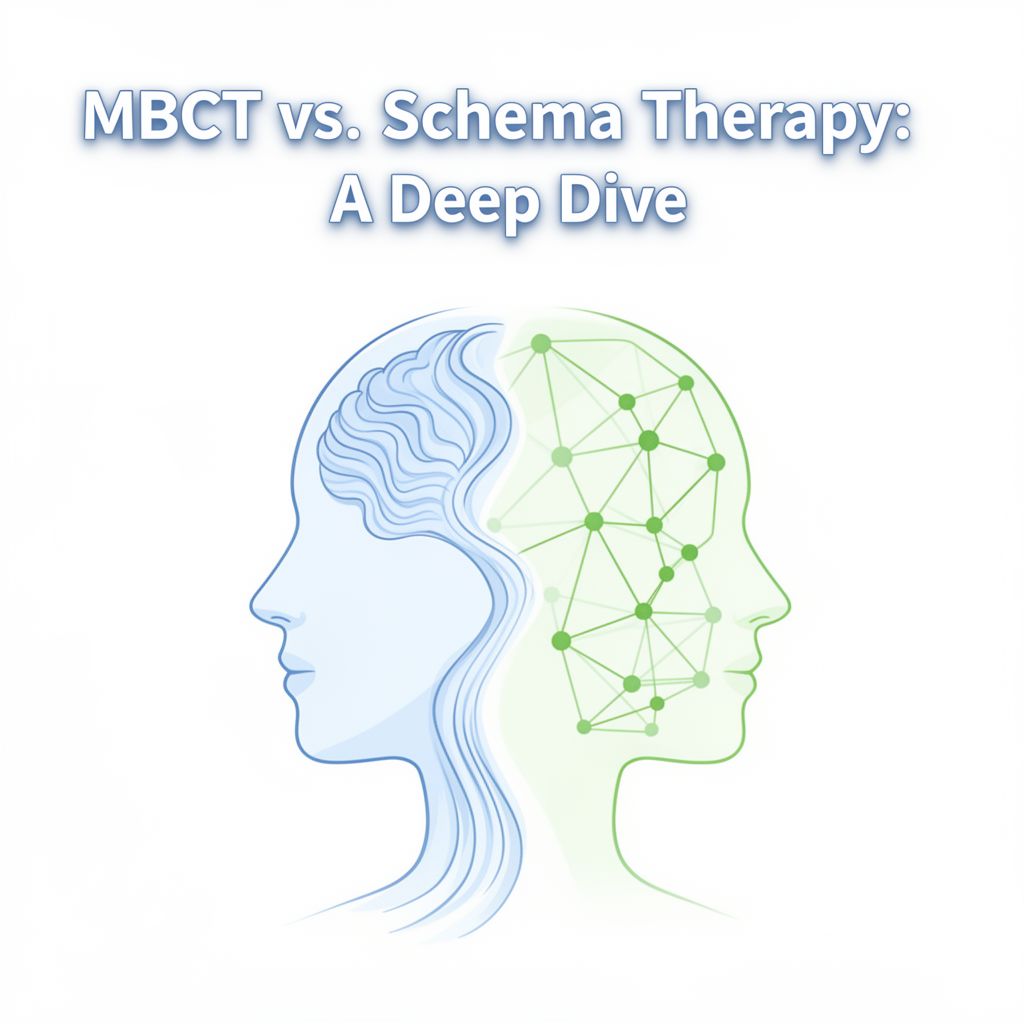
2.3. Mindfulness-Based Cognitive Therapy (MBCT) 🧘♀️
While mindfulness is a component of ACT and DBT, MBCT is a distinct third-wave therapy that specifically integrates mindfulness practices with cognitive therapy techniques.
- 📚 Core Aim: To prevent relapse in individuals with recurrent depression by teaching them to become more aware of and disengage from automatic, habitual negative thought patterns.
- Origin: Developed by Zindel Segal, Mark Williams, and John Teasdale, combining Jon Kabat-Zinn's Mindfulness-Based Stress Reduction (MBSR) with cognitive therapy.
- Mechanism: Teaches individuals to observe their thoughts and feelings as transient mental events rather than identifying with them as facts. This helps break the cycle of rumination often seen in depression.
- Key Concepts:
- Mindfulness Meditation: ✅ Practices like body scan, sitting meditation, and mindful movement to cultivate present-moment awareness.
- Cognitive Awareness: ✅ Learning to recognize the early signs of a downward mood shift and the automatic negative thoughts that accompany it.
- Decentering: ✅ The ability to observe thoughts and feelings as external events rather than as part of oneself, similar to cognitive defusion in ACT.
- Acceptance: ✅ Cultivating a non-judgmental attitude towards one's internal experiences, allowing them to be without trying to change them.
2.4. Schema Therapy (ST) 🧩
Developed by Jeffrey Young, Schema Therapy is an integrative approach that expands on traditional CBT by incorporating elements from attachment theory, psychodynamic concepts, and Gestalt therapy. It's particularly effective for chronic psychological problems, including personality disorders.
- 📚 Core Aim: To help individuals identify and change long-standing, deeply ingrained negative patterns of thinking, feeling, and behaving, known as "early maladaptive schemas."
- Early Maladaptive Schemas (EMS): ✅ Broad, pervasive themes or patterns comprised of memories, emotions, cognitions, and bodily sensations, regarding oneself and one's relationships with others. They develop during childhood or adolescence and are elaborated throughout one's lifetime, becoming dysfunctional to a significant degree.
- Examples of EMS Domains: Disconnection & Rejection, Impaired Autonomy & Performance, Impaired Limits, Other-Directedness, Overvigilance & Inhibition.
- Example Schema: Abandonment/Instability (belief that significant others will leave or are unreliable).
- Examples of EMS Domains: Disconnection & Rejection, Impaired Autonomy & Performance, Impaired Limits, Other-Directedness, Overvigilance & Inhibition.
- Schema Modes: ✅ Moment-to-moment emotional states and coping responses that are activated when schemas are triggered. These can be healthy or unhealthy.
- Example Modes: Child Modes (Vulnerable, Angry, Impulsive), Maladaptive Coping Modes (Compliant Surrenderer, Detached Protector, Overcompensator), Healthy Adult Mode.
- Key Concepts & Techniques:
- Schema Identification: ✅ Helping clients recognize their core schemas and how they manifest in their lives.
- Experiential Techniques: ✅ Using imagery, role-playing, and chair work to access and process emotions related to schemas, often involving "reparenting" the vulnerable child mode.
- Cognitive Techniques: ✅ Challenging schema-driven thoughts and beliefs.
- Behavioral Pattern-Breaking: ✅ Helping clients change maladaptive coping behaviors and develop healthier ones.
- Limited Reparenting: ✅ The therapist provides what the client missed in childhood (e.g., empathy, validation, appropriate boundaries) within the therapeutic relationship to help heal early schemas.
3️⃣ Embracing a Flexible Future with Contemporary CBT 🚀
The evolution from traditional CBT to the third-wave therapies represents a significant advancement in psychological treatment.
- Key Shift: These contemporary approaches move beyond simply changing thoughts to changing one's relationship with inner experiences.
- Empowerment: They provide a richer, more nuanced, and incredibly flexible toolkit for mental well-being, empowering individuals to live lives truly aligned with their deepest values, even in the face of discomfort.
- Practical Tools: These are not just academic concepts but evidence-based, practical tools that can profoundly impact an individual's life.
- Continuous Growth: Psychology is an ever-growing field, and these contemporary therapies represent exciting progress in helping people lead more fulfilling and meaningful lives.
Understanding these concepts offers valuable insights into the human mind and provides powerful strategies for personal growth and resilience.