 Podit
Podit
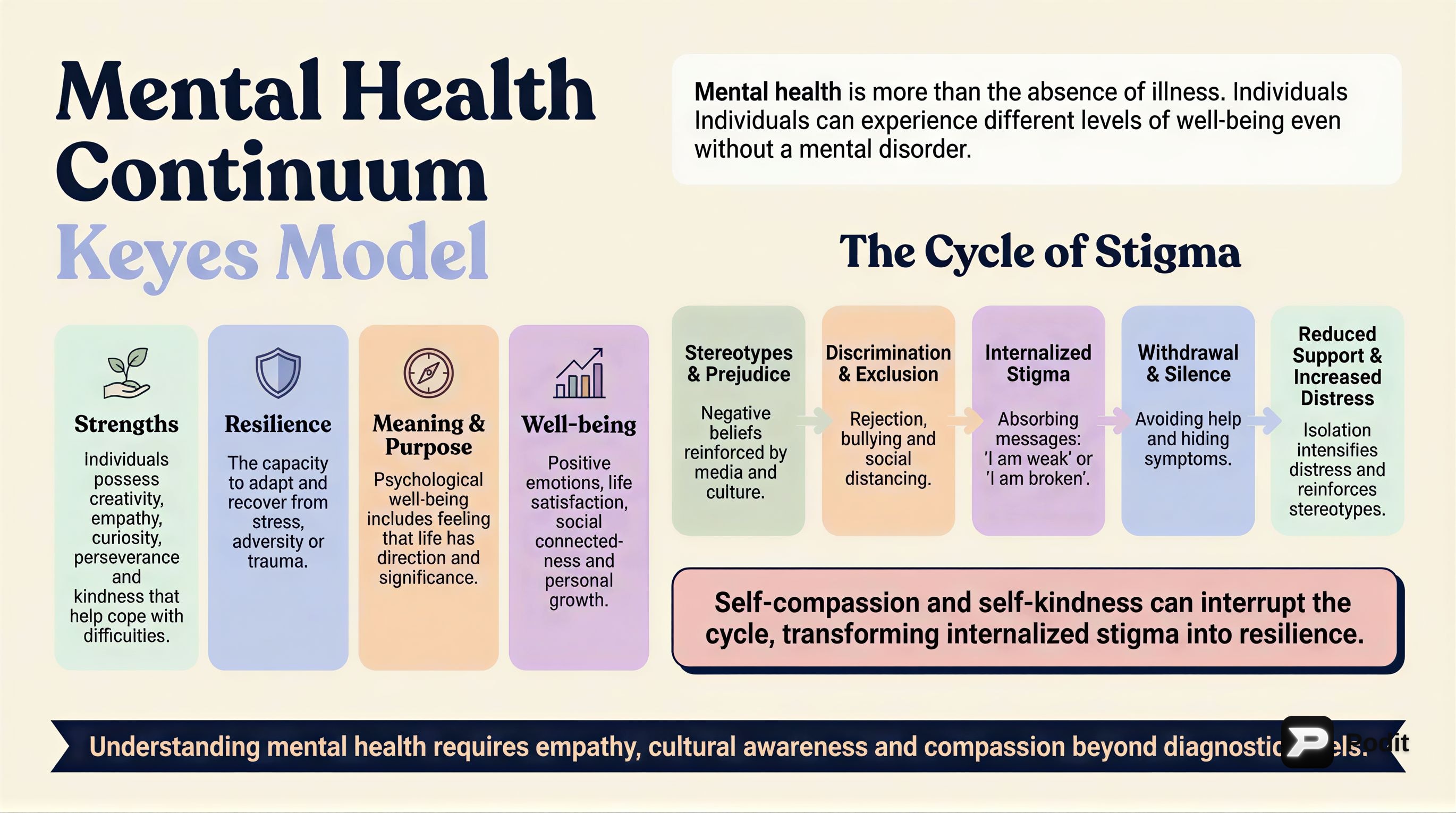
📚 Study Material: Mental Health Continuum, Stigma, and Resilience
Source Information: This study material has been compiled from a lecture audio transcript and copy-pasted text provided by the user. All content has been synthesized and organized for clarity and educational purposes.
1. Introduction: Beyond the Absence of Illness 🧠
Mental health is a dynamic and complex state, extending far beyond merely the absence of mental illness. This material explores the spectrum of mental well-being, the pervasive issue of stigma, and the crucial role of resilience and self-compassion in navigating mental health challenges.
2. The Mental Health Continuum & Positive Psychology 📈
2.1. Keyes' Mental Health Continuum Model
✅ Concept: Mental health exists on a spectrum, not as a binary state of "ill" or "well."
- Languishing: Low well-being, even without a diagnosable disorder.
- Moderate Mental Health: Average well-being.
- Flourishing: High levels of well-being and positive functioning. 💡 Insight: Individuals can experience varying levels of well-being regardless of whether they meet criteria for a mental disorder.
2.2. The Positive Psychology Perspective
This approach emphasizes human strengths and optimal functioning, moving beyond a pathology-focused view.
- Strengths: Individuals possess inherent psychological strengths that aid in coping and building meaningful lives.
- Examples: Creativity, empathy, curiosity, perseverance, kindness.
- Resilience: The capacity to adapt and recover from stress, adversity, or trauma.
- Key Idea: Highlights people's ability to navigate challenges and regain stability, rather than focusing solely on vulnerability.
- Meaning and Purpose: A strong connection exists between mental health and a sense of direction and significance in life.
- Beyond Feeling Good: Psychological well-being includes feeling that one's life has purpose.
- Well-being: A multi-dimensional concept encompassing various aspects of a fulfilling life.
- Dimensions: Positive emotions, life satisfaction, social connectedness, personal growth.
3. Stigma and Mental Health: How Labels Shape Experience 🏷️
3.1. What is Stigma?
📚 Definition: Stigma refers to negative stereotypes, prejudice, and discrimination directed toward individuals or groups.
- Mental Health Examples: People with psychiatric diagnoses may be perceived as dangerous, weak, unpredictable, or different. (Corrigan & Watson, 2002)
3.2. Types of Stigma
Stigma manifests in various forms, impacting individuals and society.
- 1️⃣ Structural Stigma: Stigma embedded within institutions or systems.
- Examples: Discrimination in employment, lack of mental health resources, negative media portrayals, unequal access to care.
- 2️⃣ Public Stigma: Negative attitudes and beliefs held by society.
- Examples: "People with schizophrenia are dangerous," "Depression is laziness."
- 3️⃣ Internalized Stigma: Occurs when individuals begin to believe negative societal stereotypes about themselves.
- Examples: Shame, self-blame, hiding symptoms, feeling "broken," avoiding help-seeking. ⚠️ Important Point: Sometimes, the stigma itself can become more painful than the symptoms a person experiences.
3.3. Labeling and Identity
A critical question arises: Can diagnoses both help and limit individuals?
- Possible Positive Effects:
- Understanding experiences
- Relief
- Access to treatment
- Community and belonging
- Possible Negative Effects:
- Stereotyping
- Self-fulfilling prophecy
- Reduction of identity to diagnosis
- Example: The difference between saying "I am depressed" (identity reduced to diagnosis) versus "I am a person experiencing depression" (emphasizing the individual beyond their condition).
4. The Cycle of Stigma: A Self-Perpetuating Process 🔄
The cycle of stigma describes how stigma can become a repeating and self-reinforcing process, influencing self-perception, relationships, and help-seeking behaviors (Corrigan, 1998).
- 1️⃣ Stereotypes and Prejudice: Societies develop negative beliefs and assumptions about mental illness.
- Examples: "People with mental illness are dangerous," "Depression is weakness," "Autistic people lack empathy."
- Reinforced by: Media, cultural narratives, families, schools, social media.
- 2️⃣ Discrimination and Exclusion: Stereotypes lead to discriminatory behaviors.
- Examples: Rejection, bullying, social distancing, unfair treatment, difficulty finding employment, being reduced to a label.
- Impact: Individuals struggle with symptoms and society's reactions.
- 3️⃣ Internalized Stigma: Individuals absorb negative societal messages and apply them to themselves.
- Examples: "I am weak," "Something is wrong with me," "I should hide my struggles."
- Associated with: Shame, self-criticism, hopelessness, lower self-esteem, reduced psychological resilience.
- 4️⃣ Withdrawal and Silence: Due to shame or fear of judgment, individuals withdraw.
- Examples: Avoiding help-seeking, hiding symptoms, social isolation, avoiding relationships, staying silent.
- Consequence: Reduced opportunities for support and connection.
- 5️⃣ Reduced Support and Increased Distress: Isolation leads to decreased social support, intensified distress, declining functioning, and increased loneliness.
- Vicious Cycle: Worsening difficulties can reinforce societal stereotypes, perpetuating the cycle.
4.1. Why is This Cycle Important?
The cycle highlights that psychological suffering is often intensified by social responses. Exclusion, shame, loneliness, and judgment can become as painful as the symptoms themselves.
5. Breaking the Cycle & The Role of Self-Compassion 💖
5.1. Strategies for Breaking the Cycle
Interventions are needed at both individual and social levels (Yanos et al., 2015).
- Individual Level:
- Self-compassion
- Supportive relationships
- Therapy and psychoeducation
- Building identity beyond diagnosis
- Social Level:
- Anti-stigma education
- Inclusive language
- Accurate representation
- Community support
- Culturally sensitive mental health care
5.2. Self-Compassion and Resilience in Bipolar Disorder (Mackali, Çetinkaya & Ay, 2023)
📊 Research Question: How does internalized stigma affect psychological resilience in bipolar disorder, and can self-compassion buffer this effect?
- Main Findings:
- Higher internalized stigma was associated with:
- Lower resilience
- Lower self-kindness
- Higher self-judgment
- More isolation
- More over-identification
- Higher internalized stigma was associated with:
- Most Important Finding: Self-compassion, particularly self-kindness and self-judgment, played a mediating role between internalized stigma and psychological resilience.
5.3. Key Clinical Message
💡 Insight: Reducing external stigma may not be enough. It is also crucial to:
- Strengthen self-kindness
- Reduce harsh self-criticism
- Support compassionate self-relating ✅ Strengths-Based Perspective: This study emphasizes resilience, strengths, compassion, and protective psychological processes, rather than focusing solely on symptoms. Self-compassion can help transform stigma into resilience.
6. Key Takeaway: A Holistic Understanding of Mental Health 🌍
Psychological understanding requires more than just diagnostic knowledge. It demands empathy, cultural awareness, critical reflection, and humility. Behind every diagnosis, symptom, or behavior is a human being trying to make sense of their experiences within a particular social, cultural, and relational world. Psychology is not only about identifying disorders; it is also about understanding suffering, resilience, meaning, connection, and humanity itself.