 Podit
📚 Bystander Intervention in Emergencies: The Diffusion of Responsibility
Source Information:
- Academic Paper Excerpt: Darley, J. M., & Latané, B. (1968). Bystander intervention in emergencies: Diffusion of responsibility. Journal of Personality and Social Psychology, 8(4), 377-383. (Copy-pasted text)
- Lecture Transcript: "The Bystander Effect and Diffusion of Responsibility"
💡 Introduction: Understanding Bystander Inaction
This study material explores the seminal research by John M. Darley and Bibb Latané (1968) on bystander intervention in emergencies, focusing on the phenomenon known as the diffusion of responsibility. This research aimed to understand why individuals sometimes fail to help someone in distress, even when an emergency is clearly unfolding.
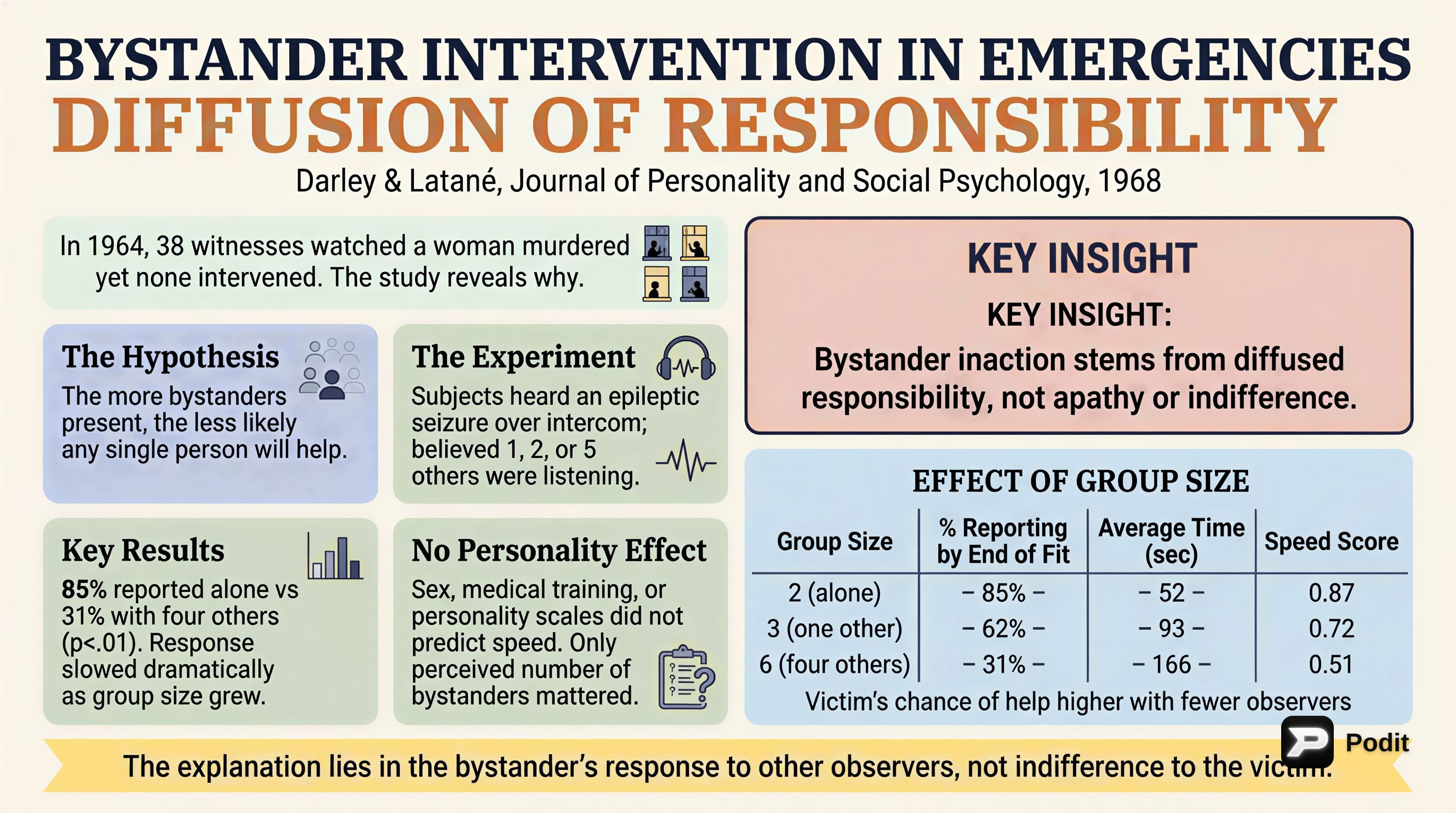
The impetus for this research stemmed from real-life tragedies, most notably the 1964 murder of Kitty Genovese in New York City. Despite being attacked for over half an hour, with at least 38 witnesses observing from their apartments, no one intervened or even called the police. Initial public explanations often attributed such inaction to societal apathy, moral decay, dehumanization, or alienation. However, Darley and Latané proposed that situational factors, particularly the presence of other onlookers, play a more significant role than individual indifference.
📖 Key Concepts & Theoretical Framework
When a person witnesses an emergency, they face an internal conflict:
- Humanitarian Norms: The societal expectation and personal desire to help someone in need.
- Personal Fears: Rational and irrational concerns about intervening, such as physical harm, public embarrassment, involvement with authorities, or other unknown dangers.
Darley and Latané theorized that the presence of other onlookers exacerbates this conflict and leads to diffusion of responsibility. This concept explains why individuals might delay or fail to help:
- Shared Obligation: When multiple people are present, the responsibility to intervene is perceived as shared among all onlookers, rather than resting solely on one individual. This reduces the unique pressure on any single person to act.
- Diffused Blame: The potential blame for not taking action is also spread among the group. If no one helps, no single individual feels entirely accountable for the inaction.
- Assumption of Others Acting: Bystanders might assume that someone else has already taken action or will do so, making their own intervention seem redundant or unnecessary. They might rationalize their inaction by thinking, "Somebody else must be doing something."
✅ Central Hypothesis: The more bystanders perceived to be present during an emergency, the less likely, or the more slowly, any single bystander will intervene to provide aid.
🔬 The Experiment: Testing the Hypothesis
To rigorously test their hypothesis, Darley and Latané designed a controlled experiment:
🎯 Objective
To create a realistic emergency situation where subjects believed they were either alone or with other unseen individuals, and to measure their response to the emergency.
👥 Participants
- 59 female and 13 male college students from introductory psychology courses at New York University.
🧪 Methodology
- Setting: Each subject was placed in an individual room and communicated with other "participants" via an intercom system. This setup ensured anonymity and prevented subjects from seeing each other.
- Cover Story: Subjects were told they were participating in a discussion about personal problems associated with college life. The experimenter would not listen to the initial discussion to avoid inhibition.
- The Emergency: During the discussion, one participant (a confederate, whose voice was pre-recorded) simulated a severe epileptic seizure. The victim's speech became increasingly incoherent, culminating in choking sounds and a plea for help ("I'm gonna die... seizure...").
- Isolation: The intercom system was designed so that only one microphone was active at a time. This meant subjects could hear the victim but could not communicate with other "participants" or know what they were doing during the emergency.
- Independent Variable (Perceived Group Size): Subjects were led to believe they were in one of three group sizes:
- 2-person group: Subject + Victim (subject believed they were alone with the victim).
- 3-person group: Subject + Victim + 1 other confederate.
- 6-person group: Subject + Victim + 4 other confederates.
- Dependent Variable: The primary measure was the speed with which the subject left their room to report the emergency to the experimenter. If 6 minutes elapsed without a response, the experiment was terminated.
📊 Key Findings
The results strongly supported the diffusion of responsibility hypothesis:
-
Impact of Group Size on Helping:
- 2-person group: 85% of subjects reported the seizure before it ended. Every subject eventually reported the emergency.
- 3-person group: 62% of subjects reported the seizure before it ended.
- 6-person group: Only 31% of subjects reported the seizure before it ended. Only 62% of subjects ever reported the emergency.
- Conclusion: As the perceived number of bystanders increased, the likelihood and speed of intervention significantly decreased (p < .01).
-
Speed of Response: Subjects in smaller perceived groups responded much faster. For example, the average response time for the 2-person group was 52 seconds, compared to 166 seconds for the 6-person group.
-
Other Factors (No Significant Impact):
- Personality Traits: Measures of Machiavellianism, anomie, authoritarianism, social desirability, and social responsibility did not predict helping behavior.
- Sex of Other Bystander: Whether the other bystander was perceived as male, female, or even a pre-medical student with emergency experience, it had no significant effect on the subject's response speed.
- Sex of Subject: Male subjects responded with almost the same speed as female subjects.
-
Distinction in Intervention Types: The study suggested differentiating between:
- Direct Intervention: Actions requiring skill, knowledge, or physical power (e.g., breaking up a fight). Cultural norms might assign more responsibility to males here.
- Reportorial Intervention: Reporting the emergency to someone qualified (e.g., calling the police or experimenter). For this type of intervention, gender or specialized training appears irrelevant. In this experiment, subjects were expected to report, not directly intervene.
🧠 Discussion & Implications
⚠️ Nature of Non-Intervention
The study revealed that non-intervening subjects were not apathetic or indifferent. Instead, they often showed signs of significant distress, such as nervousness, trembling hands, and sweating palms. They were caught in a state of indecision and conflict, torn between the guilt of not helping and the costs/embarrassment of intervening. This suggests their inaction stemmed from an unresolved internal conflict rather than a lack of concern.
✅ Challenging "Apathy" Explanations
The findings directly challenge common explanations for bystander inaction that attribute it to individual personality flaws like "apathy," "alienation," or "dehumanization." The experiment demonstrated that ordinary individuals, regardless of their personality traits, are susceptible to the powerful situational influence of perceived group size.
💡 The Power of Situational Factors
The research highlights that the explanation for bystander inaction lies more in the bystander's response to other observers (diffusion of responsibility) than in presumed personality deficiencies. The perceived presence of others, even unseen, significantly alters an individual's sense of personal responsibility.
📈 Conclusion
Darley and Latané's study profoundly changed our understanding of bystander behavior. It demonstrated that the presence of others can inhibit helping behavior due to the diffusion of responsibility. This insight is crucial because it suggests that if individuals understand these powerful situational forces, they may be better equipped to overcome hesitation and act in emergencies.