 Podit
Podit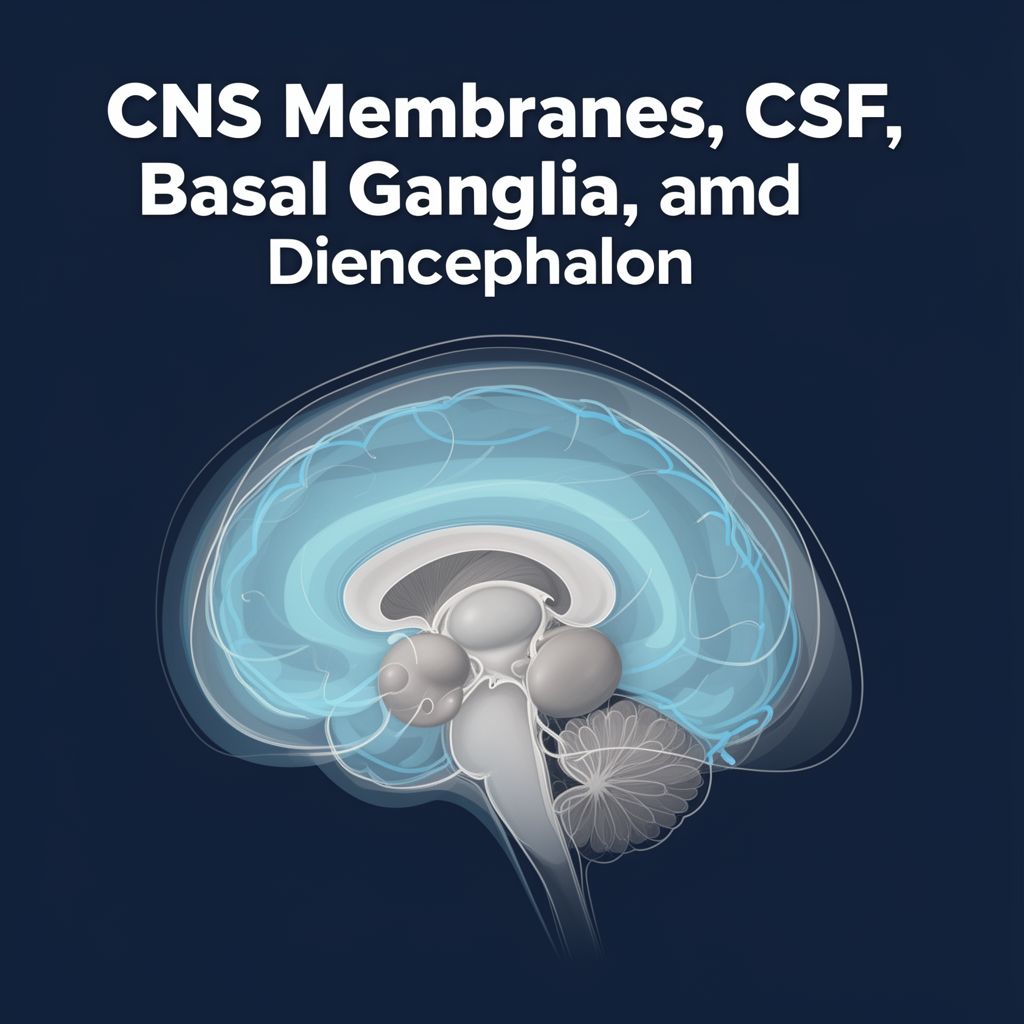
Study Material: Central Nervous System Protection and Regulation
Source Information: This study material has been compiled from a combination of copy-pasted text and a lecture audio transcript, integrating information on Central Nervous System (CNS) membranes, Cerebrospinal Fluid (CSF) circulation, Basal Ganglia, and the Diencephalon.
Introduction to CNS Protection and Regulation 🧠
The Central Nervous System (CNS), comprising the brain and spinal cord, is a highly delicate and vital organ system. It is meticulously protected by a series of membranes called meninges and cushioned by Cerebrospinal Fluid (CSF). Beyond protection, the CNS also houses critical structures like the basal ganglia for motor control and the diencephalon for sensory processing, autonomic regulation, and endocrine functions. This guide will explore these essential components, their structures, functions, and clinical significance.
I. Central Nervous System Membranes (Meninges) 📚
The meninges are three protective layers surrounding the brain and spinal cord, arranged from superficial to deep:
- Dura Mater (Pachymeninx)
- Arachnoidea Mater
- Pia Mater
A. Dura Mater (Tough Mother)
The dura mater is a thick, inelastic outermost layer. It consists of two layers:
- Outer Endosteal Layer: Adjacent to the cranial bones, forming the inner periosteum of the skull.
- Inner Meningeal-Encephalic Layer: The main protective layer.
Structural Variations:
- Around the Encephalon (Brain): The two dural layers are typically fused, separating only to form dural venous sinuses.
- Around the Medulla Spinalis (Spinal Cord): The two dural layers are separate, creating the epidural space (cavum epidurale). This space contains the internal vertebral venous plexus.
Dural Folds (Dura Encephali): These are invaginations of the meningeal layer that divide the cranial cavity and support brain structures.
- Falx Cerebri: Separates the two cerebral hemispheres.
- Falx Cerebelli: Separates the two cerebellar hemispheres.
- Tentorium Cerebelli: Divides the cerebrum from the cerebellum.
- Cavum Trigeminale (Meckel's Cave): Encloses the trigeminal ganglion.
- Diaphragma Sellae: Covers the hypophysis (pituitary gland).
Sensory Innervation of Dura Mater: The dura mater receives sensory innervation from various cranial and spinal nerves:
- Anterior Cranial Fossa: Ophthalmic nerve (CN V1), Maxillary nerve (CN V2).
- Middle Cranial Fossa: Maxillary nerve (CN V2), Mandibular nerve (CN V3).
- Posterior Cranial Fossa: Cervical spinal nerves C2 and C3.
- Tentorium Cerebelli & Falx Cerebri: Primarily innervated by the ophthalmic nerve (CN V1).
Arterial Supply of Dura Mater:
- Anterior Meningeal Artery: Branch of the internal carotid artery or its ophthalmic branch.
- Middle Meningeal Artery: The largest artery supplying the dura mater, originating from the maxillary artery.
- Posterior Meningeal Artery: Branches from the ascending pharyngeal, occipital, or vertebral arteries.
Clinical Significance: Epidural Hematoma ⚠️
- The Middle Meningeal Artery is clinically very important. It lies within a sulcus in the temporal and parietal bones.
- Cause: Fractures of the temporal-parietal bone can rupture this artery, leading to bleeding into the epidural space.
- Diagnosis: Typically appears as a biconvex (lens-shaped) image on a CT scan.
- Note: The middle meningeal artery is projected at the Pterion, a weak point of the skull.
B. Arachnoidea Mater & Pia Mater (Leptomeninx)
Together, the arachnoidea mater and pia mater are referred to as the leptomeninx.
- Arachnoidea Mater: A delicate, avascular membrane beneath the dura.
- Pia Mater: The innermost, highly vascular membrane that adheres closely to the brain and spinal cord tissue, following all its contours and entering sulci.
Meningeal Spaces:
- Epidural Space: A potential space between the dura and skull (or vertebral canal).
- Subdural Space: A potential space between the dura and arachnoidea.
- Subarachnoid Space: A true anatomical space between the arachnoidea and pia mater, filled with CSF.
Termination Levels of Meninges:
- Pia Mater: Terminates at the L1-L2 vertebral level (conus medullaris).
- Dura Mater & Arachnoidea Mater: Extend down to the S2 vertebral level.
Filum Terminale:
- Filum Terminale Internum: An extension of the pia mater, continuing within the CSF down to S2.
- Filum Terminale Externum: Beyond S2, it consists of pia, arachnoid, and dura, fusing to form the coccygeal ligament (lig. coccygeum).
II. Cerebrospinal Fluid (CSF) Circulation 💧
CSF is a clear, colorless fluid that surrounds the brain and spinal cord, providing protection, buoyancy, and nutrient exchange.
A. CSF Production
- Primary Site: Choroid Plexus ✅
- Composition: The choroid plexus consists of specialized ependymal cells and blood vessels covered by pia mater.
- Locations:
- Temporal and central parts of the lateral ventricles.
- Roof of the third ventricle.
- Posterior wall of the fourth ventricle.
- Production Rate: Approximately 500 mL of CSF is produced daily.
- Total Volume: The total volume of CSF within the CNS at any given time is about 150 mL, with 15-40 mL residing in the ventricles.
B. CSF Absorption
- Most Important Pathway: Arachnoid Villi (also known as Pacchionian Corpuscles or Arachnoid Granulations when clustered).
- These villi extend through the subdural space, pierce the dura, and drain CSF into the Superior Sagittal Sinus.
- Other Pathways:
- Perineural spaces of cranial nerves.
- Direct venous openings.
- Perilymph of the inner ear.
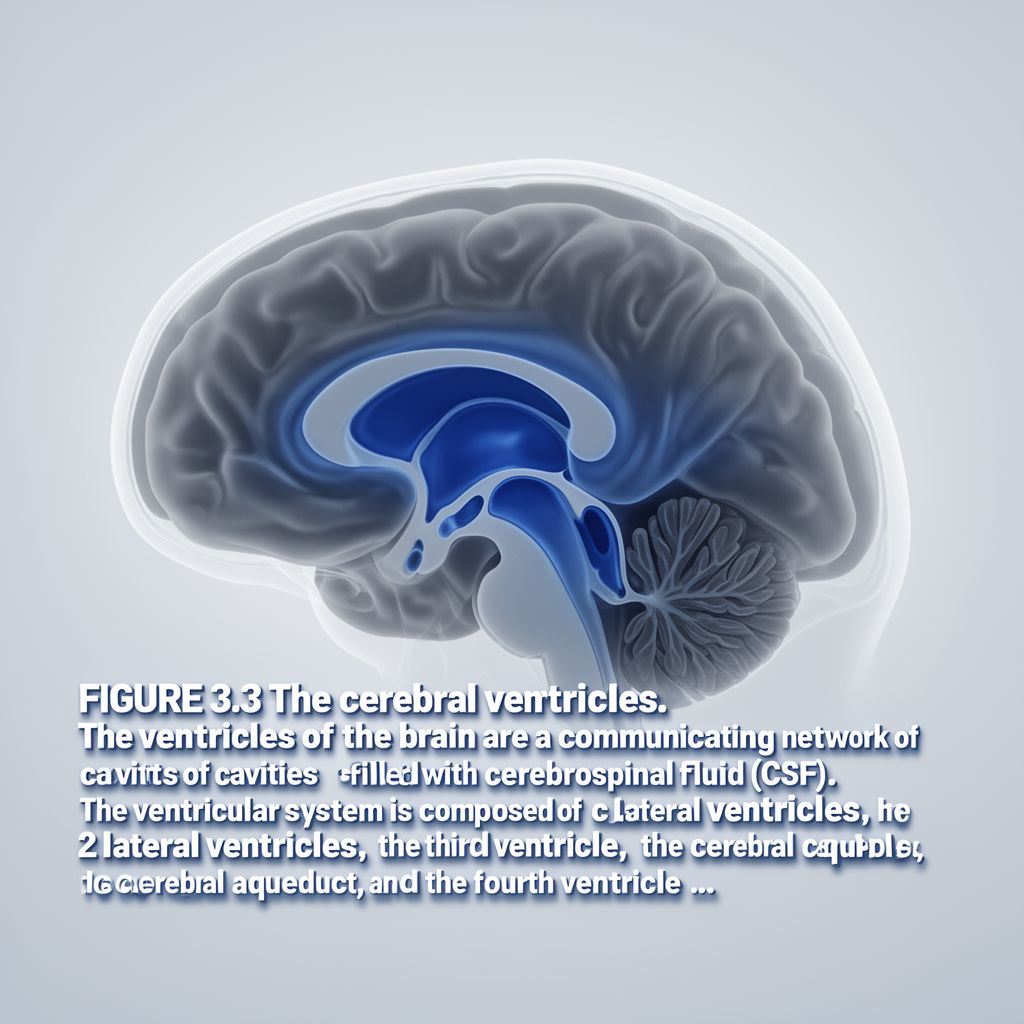
C. Ventricular System
The CSF circulates through a series of interconnected cavities within the brain.
-
Lateral Ventricles (Two):
- Each has four parts: central part, frontal horn, occipital horn, temporal horn.
- Separated by the septum pellucidum, which connects superiorly to the corpus callosum and inferiorly to the fornix.
- CSF flows from lateral ventricles to the third ventricle via the interventricular foramina (of Monro).
-
Third Ventricle (One):
- Located between the two halves of the diencephalon.
- Contains several recesses: pineal, suprapineal, infundibular, supraoptic recesses.
- CSF flows from the third ventricle to the fourth ventricle via the cerebral aqueduct (of Sylvius).
-
Fourth Ventricle (One):
- Located between the medulla oblongata, pons, and cerebellum.
- Roof: Formed by the superior cerebellar peduncle and superior medullary velum.
- Floor: Formed by the inferior cerebellar peduncle and inferior medullary velum (rhomboid fossa).
- CSF exits the fourth ventricle into the subarachnoid space through:
- Two lateral foramina (of Luschka)
- One median foramen (of Magendie)
D. CSF Flow and Cisterns
After exiting the fourth ventricle, CSF enters the subarachnoid space, which contains enlargements called cisterns.
- Cisterna Magna (Cerebellomedullary Cisterna):
- The largest cisterna.
- Located posterior to the medulla oblongata and inferior to the cerebellum.
- Quadrigeminal Cisterna:
- Contains the great cerebral vein, pineal body, and posterior cerebral arteries.
- Chiasmatic Cisterna:
- Surrounds the optic chiasm and hypophysis.
- Interpeduncular Cisterna:
- Houses the Circle of Willis and the oculomotor nerve (CN III).
- Lateral Fossa Cisterna:
- Contains the middle cerebral artery.
- Pontocerebellar Cisterna (Prepontine Cisterna):
- Associated with the basilar artery and the abducens nerve (CN VI).
III. Basal Ganglia (Nuclei Basales) 📊
The basal ganglia are a group of subcortical gray matter nuclei located deep within the telencephalon, crucial for motor control.
A. Components
The main components include:
- Claustrum
- Nucleus Caudatus
- Nucleus Lentiformis: Composed of the Putamen and Globus Pallidus.
- Substantia Nigra (located in the midbrain, functionally associated)
- Nucleus Subthalamicus (located in the diencephalon, functionally associated)
Key Groupings:
- Striatum (Neostriatum): Formed by the Caudate Nucleus + Putamen. This is the primary afferent (input) center of the basal ganglia.
- Corpus Striatum: Formed by the Caudate Nucleus + Lentiform Nucleus.
- Globus Pallidus: The primary efferent (output) center of the basal ganglia.
B. Function: Extrapyramidal System
The basal ganglia are integral to the extrapyramidal system, which is responsible for:
- Automatic, Repetitive Movements: Such as driving, writing, cycling, or walking.
- Motor Learning: When a movement is repeated frequently, its control shifts from the frontal cortex (e.g., Area 6) to the basal ganglia. This allows the cerebral cortex to focus on other tasks.
- Unforgettable Movements: Movements learned by the basal ganglia are typically not forgotten.
- Movement Characteristics: Basal ganglia-controlled movements are often characteristic, fast, and subcortical. Cortical movements tend to be slower, goal-oriented, and less automatic.
Pathways:
- Direct Pathway: Generally excites the motor cortex.
- Indirect Pathway: Generally inhibits the motor cortex.
C. Clinical Significance: Parkinson's Disease ⚠️
- Cause: Loss of dopaminergic neurons in the substantia nigra pars compacta.
- Mechanism: Leads to dopamine deficiency in the neostriatum (striatum).
- Result: Decreased motor activity in the cerebral cortex.
- Symptoms:
- Akinesia: Difficulty initiating movement.
- Rigidity: Increased muscle tone.
- Rest Tremor: Tremor that occurs at rest.
- Flexor Posture: Stooped posture.
- Mask-like Face: Reduced facial expressions.
- Difficulty with complex movements.
- Treatment: Often involves L-DOPA to replenish dopamine.
- Note: Damage to basal ganglia can cause involuntary, repetitive movements, often observed at rest, which may disappear when the cortex is actively engaged.
IV. Diencephalon 💡
The diencephalon is a central part of the brain, located between the mesencephalon and the cerebral hemispheres. All its components develop around the third ventricle and do not directly connect to the spinal cord.
A. Thalamus
The thalamus is the largest part of the diencephalon and a crucial relay and integration center.
- Function:
- Sensory Relay: Receives and integrates all sensory impulses except olfaction, filtering them and sending only suprathreshold signals to the cerebral cortex.
- Limbic System Connections: Involved in emotion, learning, and memory.
- Motor Control: Through connections with the basal ganglia, it plays a role in involuntary movements.
- Key Structures:
- Pulvinar Thalami: Posterior end of the thalamus, extending towards the superior colliculus; involved in visual processing.
- Stratum Zonale: White matter layer covering the superior thalamic surface.
- Internal Medullary Lamina: White matter dividing the thalamus into three main nuclear groups.
- Interthalamic Adhesion (Massa Intermedia): A gray matter mass connecting the two thalami (present in about 70% of individuals).
- Medial & Lateral Geniculate Bodies: Part of the metathalamus, functionally associated with the thalamus (see Metathalamus section).
- Thalamic Nuclei (Examples):
- Anterior Thalamic Nuclei: Emotion, memory, learning, attention.
- Mediodorsal Nucleus (Medial Group): Mental behavior, memory, limbic system, prefrontal connections.
- Lateral Dorsal Nucleus (Lateral Group): Limbic functions.
- Ventral Anterior & Ventral Lateral Nuclei (Ventral Group): Influence motor cortex.
- Ventral Posteromedial Nucleus: Receives sensory input from cranial nerves.
- Ventral Posterolateral Nucleus: Receives sensory input from spinal nerves.
- Arterial Supply: Primarily from the Posterior Cerebral Artery.
- Thalamic Lesions: Often arterial, can cause contralateral anesthesia, personality changes, emotional disturbances, and amnesia.
B. Hypothalamus
Located in the inferior-anterior part of the third ventricle, the hypothalamus is considered the "brain" of the Autonomic Nervous System (ANS) and Endocrine System.
- Function:
- Homeostasis: Regulates metabolism and maintains internal balance.
- ANS Control: Manages the sympathetic and parasympathetic divisions.
- Anterior/Preoptic Area: Parasympathetic functions.
- Posterior/Lateral Parts: Sympathetic functions.
- Endocrine Control: Directly influences the pituitary gland.
- Key Structures & Nuclei:
- Optic Chiasm
- Tuber Cinereum: A bulge in the floor of the third ventricle.
- Mammillary Bodies
- Preoptic Area: Structurally telencephalic, but functionally hypothalamic.
- Median Eminence: Along with the infundibulum and posterior pituitary, forms the neurohypophysis.
- Supraoptic Nucleus: Secretes Vasopressin (ADH).
- Paraventricular Nucleus: Secretes Oxytocin.
- Lateral Hypothalamic Nucleus: Signals hunger.
- Ventromedial Hypothalamic Nucleus: Signals satiety.
- Suprachiasmatic Nucleus: Regulates circadian rhythms.
- Anterior Hypothalamic Nucleus: Decreases body temperature.
- Posterior Hypothalamic Nucleus: Increases body temperature.
C. Epithalamus
The epithalamus forms the posterior border of the diencephalon.
- Components:
- Habenula: Part of the limbic system, involved in emotion, behavior, and regulation of visceral and endocrine functions (e.g., salivation, gastrointestinal motility).
- Posterior Commissure
- Pretectal Area
- Pineal Gland (Glandula Pinealis):
- Secretes Serotonin and Melatonin.
- Light exposure to the retina inhibits pineal gland activity (e.g., eye masks for jet lag).
- Melatonin inhibits gonadotropins and influences other endocrine glands (pituitary, pancreas, adrenal, parathyroid, gonads), generally causing decreased activity.
- With age, it often calcifies, forming Acervulus Cerebri (brain sand), visible on X-rays.
D. Subthalamus
- Nucleus Subthalamicus:
- Considered an upward extension of the substantia nigra.
- Functionally associated with the basal ganglia.
- Regulates muscle tone independently of the cortex.
E. Metathalamus
The metathalamus is involved in primary reflex responses to light and sound.
- Corpus Geniculatum Laterale (Lateral Geniculate Body - LGN):
- Termination site for most optic tract fibers.
- Involved in visual processing and light reflexes (fibers pass via the brachium of superior colliculus to the pretectal area for light reflex without synapsing in LGN).
- Corpus Geniculatum Mediale (Medial Geniculate Body - MGN):
- An intermediate center in auditory pathways.
Conclusion: Integrated Functions of CNS Protective and Regulatory Systems ✅
The CNS is a marvel of biological engineering, with intricate protective layers and fluid systems safeguarding its delicate neural tissue. The meninges and CSF provide mechanical protection, buoyancy, and a stable chemical environment. Simultaneously, the basal ganglia ensure the smooth execution of learned motor skills, while the diencephalon acts as a central hub for sensory integration, autonomic control, and endocrine regulation. These interconnected systems highlight the complex organization essential for maintaining neurological health and overall bodily homeostasis.