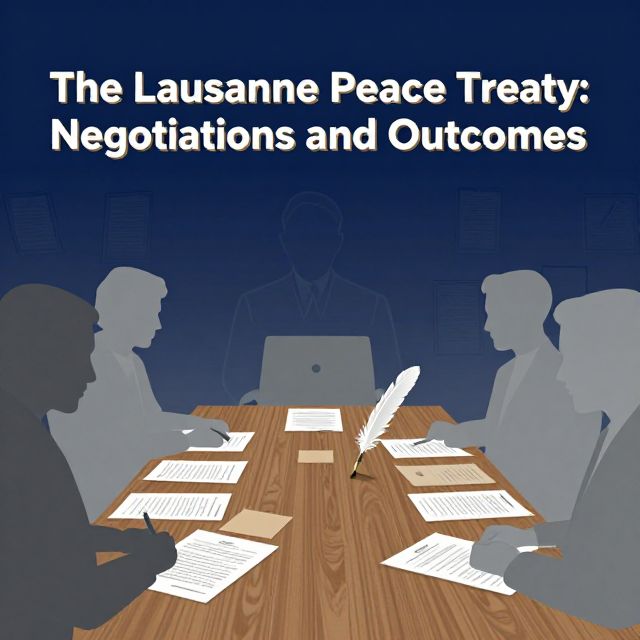
The Lausanne Peace Treaty: Negotiations and Outcomes - kapak
Tarih#lausanne treaty#turkish war of independence#international relations#diplomacy

The Lausanne Peace Treaty: Negotiations and Outcomes

An academic summary of the Lausanne Peace Treaty, covering its negotiation phases, key provisions, unresolved issues, and its profound historical significance for the Turkish Republic.

senadenzMarch 14, 2026 ~25 dk toplam
01

Sesli Özet

8 dakika

Konuyu otobüste, koşarken, yolda dinleyerek öğren.

Sesli Özet

The Lausanne Peace Treaty: Negotiations and Outcomes

0:008:14
02

Flash Kartlar

25 kart

Karta tıklayarak çevir. ← → ile gez, ⎵ ile çevir.

1 / 25
Tüm kartları metin olarak gör
  1. 1. What was the primary purpose of the Lausanne Peace Treaty?

    The Lausanne Peace Treaty was a pivotal moment in the establishment of the modern Turkish Republic. It concluded the Turkish War of Independence and defined Turkey's international status, effectively replacing the harsh terms of the Treaty of Sèvres and securing the nation's sovereignty.

  2. 2. When did the first phase of the Lausanne Peace Conference begin?

    The first phase of the Lausanne Peace Conference commenced on November 20, 1922. This followed a week of initial diplomatic engagements led by İsmet Pasha, setting the stage for the extensive negotiations that would shape the future of the region.

  3. 3. Which countries participated as main representatives in the Lausanne Peace Conference?

    The main participants included representatives from Turkey, Great Britain, Italy, Japan, Romania, the Serb-Croat-Slovene State, and Greece. These nations were directly involved in the discussions that aimed to establish a new peace settlement after World War I.

  4. 4. Which country sent an observer to the Lausanne Peace Conference?

    The United States sent its Ambassador to Rome as an observer to the conference. While not a direct participant in the negotiations, their presence indicated international interest in the proceedings and the outcomes of the treaty.

  5. 5. Which countries dispatched representatives specifically for discussions concerning the Straits?

    The Soviet Union, Bulgaria, Ukraine, and Georgia dispatched representatives specifically for discussions concerning the Straits. The strategic importance of the Dardanelles and Bosphorus necessitated broader international input on their status and future administration.

  6. 6. How long did the Lausanne Peace Conference span in total?

    The conference spanned a total of eight months, unfolding in two distinct periods. The first period was from November 21, 1922, to February 4, 1923, and the second from April 23 to July 24, 1923, highlighting the complexity and duration of the negotiations.

  7. 7. Who led the Turkish delegation at the Lausanne Peace Conference?

    The Turkish delegation was led by İsmet Bey (later İsmet İnönü). His leadership was crucial in asserting Turkey's stance on equal rights and authority, reflecting the nation's successful struggle for independence and its determination to be treated as a sovereign state.

  8. 8. What was the Turkish delegation's primary stance during the negotiations?

    The Turkish delegation asserted its stance on equal rights and authority. This reflected the nation's successful struggle for independence and its determination to be treated as an equal sovereign state, rather than a defeated power subject to imposed terms.

  9. 9. Name the three primary commissions established during the Lausanne Peace Conference.

    The three primary commissions were: one for borders, straits, and military matters; another for economic and financial issues; and a third for minority and legal concerns. This structure allowed for focused discussions on the complex array of topics requiring resolution.

  10. 10. What were some of the key topics discussed during the first phase of the Lausanne Conference?

    Key topics discussed included the status of Mosul and the Straits, the abolition of capitulations and privileges, war reparations, and population exchange. These issues were central to defining the new Turkish state's sovereignty and its international relations.

  11. 11. What significant domestic event occurred in Turkey during the interim period between the two phases of the Lausanne Conference?

    An Economy Congress was convened in İzmir on February 17, 1923, prior to the declaration of the Republic. This congress aimed to address the nation's economic situation, emphasizing that political independence necessitated economic independence.

  12. 12. What was the main objective of the Economy Congress convened in İzmir?

    The main objective was to address the nation's economic situation, emphasizing that political independence necessitated economic independence. It also advocated for a mixed economic model to rebuild and strengthen the country's economy post-war.

  13. 13. What was the 'New Turkish Thesis' and when did it emerge?

    The 'New Turkish Thesis' emerged on March 8, 1923, outlining Turkey's positions on critical issues. These issues included Mosul, the Straits, minorities, debts, and capitulations, providing a clear framework for the resumed negotiations and Turkey's demands.

  14. 14. When did the second phase of negotiations at Lausanne resume?

    The negotiations at Lausanne resumed for their second phase on April 23, 1923. This period followed significant domestic developments in Turkey and focused heavily on financial and economic matters, leading to the final signing of the treaty.

  15. 15. What was the most contentious issue during the second phase of the Lausanne negotiations?

    Capitulations proved to be the most contentious issue during the second phase. These extraterritorial rights granted to foreigners were seen by Turkey as a major infringement on its sovereignty, leading to intense debate and disagreement.

  16. 16. When was the Lausanne Peace Treaty formally signed?

    The Lausanne Peace Treaty was formally signed on July 24, 1923. This date marked the culmination of eight months of complex negotiations and diplomatic efforts to establish peace and define the new Turkish Republic's borders and international standing.

  17. 17. When and by whom was the Lausanne Peace Treaty ratified in Turkey?

    The treaty was ratified by the Grand National Assembly of Turkey on August 24, 1923, with 213 votes out of 227 members. This ratification officially brought the treaty into force for Turkey, solidifying its provisions and legal standing.

  18. 18. How was the Thracian border with Greece defined by the Lausanne Treaty?

    The Thracian border with Greece was defined by the Meriç River, with Karaağaç remaining within Turkey. This provision established a clear and recognized boundary between the two nations in the region, resolving a significant territorial dispute.

  19. 19. What was the status of the Syrian border according to the Lausanne Treaty?

    The Syrian border affirmed the 1921 Ankara Agreement. However, Hatay remained outside the national borders of Turkey at this time, indicating a partial resolution with a future issue that would later be addressed.

  20. 20. What was the initial agreement regarding the status of Iraq in the Lausanne Treaty?

    The status of Iraq was deferred to future Turkish-British negotiations. If unresolved within nine months, the agreement stipulated that the matter would be referred to the League of Nations, highlighting its complexity and the need for further diplomatic efforts.

  21. 21. Which islands were ceded to Turkey by the Lausanne Treaty?

    Gökçeada, Bozcaada, and Tavşan Island were ceded to Turkey. These islands, strategically located in the Aegean Sea, became part of the new Turkish Republic's territory, contributing to its maritime boundaries.

  22. 22. What were the key provisions of the Straits regime established by the Lausanne Treaty?

    The Straits regime stipulated a 15-kilometer demilitarized zone on both shores, with free passage in peacetime. An international commission, headed by a Turk, would administer the Straits under League of Nations supervision, balancing Turkish sovereignty with international access.

  23. 23. How did the Lausanne Treaty address the issue of capitulations?

    Capitulations were entirely abolished by the Lausanne Treaty. This meant that all foreign entities in Turkey became subject to Turkish law, marking a significant step towards full national sovereignty and legal equality within the new republic.

  24. 24. How were Ottoman debts handled under the Lausanne Treaty?

    Ottoman debts were apportioned among the successor states, with Turkey agreeing to pay its share. Payment methods were to be determined with creditor nations, aiming to resolve a long-standing financial burden inherited from the Ottoman Empire.

  25. 25. How were minorities defined in the context of the Lausanne Treaty, and what was their status?

    Minorities were defined as non-Muslims, and all minorities residing within Turkey were recognized as Turkish citizens. This provision aimed to integrate diverse populations under a common national identity, while protecting specific religious groups' rights.

03

Bilgini Test Et

15 soru

Çoktan seçmeli sorularla öğrendiklerini ölç. Cevap + açıklama.

Soru 1 / 15Skor: 0

What was the primary purpose of the Lausanne Peace Treaty?

04

Detaylı Özet

7 dk okuma

Tüm konuyu derinlemesine, başlık başlık.

📚 The Lausanne Peace Treaty: A Comprehensive Study Guide

This study material has been compiled from lecture audio transcripts and PDF/PowerPoint texts to provide a structured overview of the Lausanne Peace Treaty.


🌍 1. Introduction to the Lausanne Peace Treaty

The Lausanne Peace Treaty marks a pivotal moment in the establishment of the modern Turkish Republic. It concluded the Turkish War of Independence, defined the new nation's international status, and replaced the punitive Treaty of Sèvres. This guide details the negotiation process, key issues, treaty provisions, and its lasting significance.


🗓️ 2. The Lausanne Peace Conference: First Phase (November 1922 - February 1923)

The peace conference began on November 20, 1922, following a week of preparatory diplomatic engagements by İsmet Pasha, the head of the Turkish delegation.

2.1. Participants 🤝

  • Primary Participants: Turkey, Great Britain, Italy, Japan, Romania, the Serb-Croat-Slovene State, and Greece.
  • Observers: The United States sent its Ambassador to Rome as an observer.
  • Specific Issue Participants: The Soviet Union, Bulgaria, Ukraine, and Georgia sent representatives specifically for discussions concerning the Straits.

2.2. Conference Structure and Turkish Stance 🇹🇷

  • The conference was structured around three primary commissions:
    1. Borders, Straits, and Military Matters 🗺️
    2. Economic and Financial Issues 💰
    3. Minority and Legal Concerns ⚖️
  • The Turkish delegation, led by İsmet Pasha, firmly asserted its demand for equal rights and authority, reflecting the nation's successful struggle for independence.

2.3. Key Discussion Topics 📝

Initial discussions focused on critical issues inherited from the Ottoman Empire and the recent war:

  • The status of Mosul and the Straits.
  • The abolition of Capitulations and privileges.
  • War reparations and population exchange.

📈 3. Inter-Conference Developments in Turkey (February - April 1923)

During the break between the two phases of the Lausanne Conference, significant domestic developments occurred in Turkey, shaping its negotiating position.

3.1. İzmir Economy Congress (February 17, 1923) 💡

  • Convened in İzmir even before the Republic's declaration, this congress aimed to address the nation's economic situation.
  • Key Principle: It emphasized that political independence was insufficient without economic independence.
  • Economic Model: Advocated for a mixed economic model to achieve national development.

3.2. The 'New Turkish Thesis' (March 8, 1923) ✅

This thesis outlined Turkey's updated positions on critical issues:

  • Mosul: To be resolved later.
  • Straits and Minorities: Firm stance on Turkish sovereignty.
  • Debts and Capitulations: Demanded full abolition.

3.3. Resumption of Talks 🗳️

  • April 1, 1923: A decision was made to hold general elections.
  • April 23, 1923: The second phase of negotiations at Lausanne resumed.

✍️ 4. The Second Phase and Signing of the Treaty (April - July 1923)

The second period of negotiations lasted three months, with a strong focus on financial and economic matters.

4.1. Key Discussions and Internal Challenges ⚠️

  • Main Focus: Financial and economic sessions dominated the agenda.
  • Most Contentious Issue: The abolition of Capitulations proved to be the most difficult point of contention.
  • Internal Disagreements: Disagreements arose within the Turkish delegation between İsmet Pasha and Rauf Bey (Head of the Council of Deputies) regarding debt repayment and privileges. These were ultimately resolved through the intervention of Mustafa Kemal Pasha.

4.2. Signing and Ratification 📜

  • Signing Date: The Lausanne Peace Treaty was formally signed on July 24, 1923.
  • Ratification: It was subsequently ratified by the Grand National Assembly of Turkey on August 24, 1923, with a significant majority (213 out of 227 members).
  • Treaty Structure: The treaty comprised 143 articles, along with various annexes and letters, covering a comprehensive range of issues.

📝 5. Key Provisions of the Lausanne Treaty

The treaty addressed numerous issues, defining the borders and rights of the new Turkish state.

5.1. Borders 🗺️

  • Thrace (Greece): The border was defined by the Meriç River, with the town of Karaağaç remaining within Turkey.
  • Syria (France): The 1921 Ankara Agreement was affirmed, though Hatay remained outside Turkey's national borders at this time.
  • Iraq (Britain): The status of Mosul and the Iraq border was deferred to future Turkish-British negotiations. If unresolved within nine months, the matter would be referred to the League of Nations.

5.2. Islands 🏝️

  • To Turkey: Gökçeada (Imbros), Bozcaada (Tenedos), and Tavşan Island.
  • To Greece: Other North Aegean islands were assigned to Greece but were to be demilitarized.
  • To Italy: The Dodecanese Islands.

5.3. The Straits 🚢

  • Demilitarization: A 15-kilometer demilitarized zone was established on both shores of the Bosphorus and Dardanelles.
  • Re-armament: Provisions allowed for re-armament in times of war danger.
  • Passage: Free passage was guaranteed in peacetime.
  • Administration: An international commission, headed by a Turk, would administer the Straits under the supervision of the League of Nations.

5.4. Capitulations and Debts 💰

  • Capitulations: Entirely abolished, subjecting all foreign entities and individuals in Turkey to Turkish law.
  • Ottoman Debts: Apportioned among the successor states of the Ottoman Empire. Turkey agreed to pay its share, with payment methods to be determined with creditor nations.

5.5. Minorities and Population Exchange 👥

  • Definition: Minorities were defined solely as non-Muslims.
  • Citizenship: All minorities residing within Turkey were recognized as Turkish citizens.
  • Population Exchange: An agreement was made for a compulsory population exchange between Greeks in Anatolia and Turks in Greece, with the exception of the Turks of Western Thrace and the Greeks of Istanbul.

5.6. Other Provisions ✅

  • War Reparations: Karaağaç and its vicinity were ceded to Turkey as compensation for the destruction in Western Anatolia.
  • Evacuation of Istanbul and the Straits: Allied forces were to evacuate these areas within six weeks of the treaty's ratification.
  • Foreign Schools: Permitted to continue operations under Turkish regulations.

❓ 6. Issues Unresolved at Lausanne

Despite its comprehensive nature, certain issues could not be fully resolved during the conference and were addressed later.

  • 1️⃣ Iraq Border and Mosul Question: Settled in 1925, with Mosul ultimately assigned to Iraq by the League of Nations.
  • 2️⃣ Straits Question: The demilitarized status and international commission were later revised by the Montreux Convention in 1936, granting Turkey full sovereignty over the Straits.
  • 3️⃣ Syria Border and Hatay Issue: The border was defined by the 1921 Ankara Agreement, but the status of Hatay (İskenderun Sancağı) remained contentious and was resolved with its incorporation into Turkey in 1939.
  • 4️⃣ Population Exchange: Implementation challenges led to further agreements, with disputes resolved by 1930.
  • 5️⃣ Debts Question: Temporarily resolved in 1928, revised with a new payment plan in 1933, and the final installment paid in 1954.

🌟 7. Significance and Outcomes of the Lausanne Peace Treaty

The Lausanne Treaty holds immense historical significance for Turkey and international relations.

7.1. Historical Importance 📈

  • Equal Terms: It was the first instance where a defeated nation (Turkey) negotiated on equal terms with the victors of World War I.
  • Nullification of Sèvres: Effectively nullified the punitive Treaty of Sèvres, preventing the partition of Anatolia.
  • Resolution of Centuries-Old Issues: Addressed and resolved many long-standing problems inherited from the Ottoman Empire.
  • End of Pressures: Alleviated economic pressures by structuring Ottoman debts, ended military pressures by defining national borders, and removed political/social pressures by recognizing minorities as Turkish citizens.

7.2. Key Outcomes ✅

  • Recognition of the New Turkish State: Affirmed the existence and independence of the new Turkish state internationally.
  • Redefined Relations: Reshaped international political, legal, and social relations in the region.
  • Misak-ı Milli Borders: Secured the acceptance of the National Pact (Misak-ı Milli) borders by the Entente powers, replacing the map of Sèvres.
  • Diplomatic Victory: Unlike previous treaties imposed on defeated nations, Lausanne contained no restrictive clauses, marking a significant diplomatic triumph that complemented the military victory of the Turkish War of Independence.

7.3. Mustafa Kemal Atatürk's Perspective 🗣️

As stated by Mustafa Kemal Atatürk: "This treaty is a document that expresses the ultimate failure of a great assassination attempt against the Turkish nation, prepared for centuries and thought to be completed with the Treaty of Sèvres."


📊 8. Self-Assessment Questions

Test your understanding of the Lausanne Peace Treaty with these questions.

  1. Which of the following was NOT a provision in the Treaty of Sèvres but was a key topic at Lausanne? A) Capitulations B) Independent Kurdistan C) Population Exchange D) Greater Armenia E) Financial Commission

  2. Which of the following issues was NOT resolved at Lausanne and was deferred for later resolution? A) Thracian Border B) Mosul Question C) Foreign Schools Issue D) Minorities Issue E) Capitulations

  3. Which of the following cannot be considered a historical significance of the Lausanne Treaty? A) Preventing the partition of Anatolia B) Resolving centuries-old inherited issues C) Ending military pressures by defining borders D) The control of the Straits being left to an international commission E) Negotiating on equal terms with the victors of World War I

  4. Which of the following statements about the resolution of Ottoman debts is NOT accurate? A) All debts were to be paid in Turkish Lira. B) The payment plan was managed by a commission established in Paris. C) Debts were apportioned among the states that separated from the Ottoman Empire. D) The payment plan was revised in 1933. E) The final installment was paid in 1954.

  5. Which statement regarding the resolution of the Mosul issue is incorrect? A) It was not resolved at Lausanne. B) Bilateral talks were held between Britain and Turkey to resolve it. C) The League of Nations was approached for a solution. D) The British incited the Kurds in the region to revolt. E) The League of Nations decided to give Mosul to Britain.


Answer Key: 1. C, 2. B, 3. D, 4. A, 5. E
Kendi çalışma materyalini oluştur

PDF, YouTube videosu veya herhangi bir konuyu dakikalar içinde podcast, özet, flash kart ve quiz'e dönüştür. 1.000.000+ kullanıcı tercih ediyor.

Sıradaki Konular

Tümünü keşfet
The Road to Lausanne: Çanakkale Crisis and Mudanya Armistice

The Road to Lausanne: Çanakkale Crisis and Mudanya Armistice

An academic overview of the Çanakkale Crisis, the Mudanya Armistice, and the critical developments and instructions leading up to the Lausanne Treaty negotiations.

8 dk Özet 25 15
Key Historical Events in Ottoman and Turkish History

Key Historical Events in Ottoman and Turkish History

An in-depth exploration of pivotal moments in Ottoman and Turkish history, covering imperial edicts, the National Struggle's formation, financial strategies, and the liberation of Anatolian territories.

9 dk Özet 25 15
Ottoman Empire's 18th Century Decline

Ottoman Empire's 18th Century Decline

An academic summary of the Ottoman Empire's period of decline in the 18th century, examining internal weaknesses, external pressures, and reform attempts.

7 dk 25 15
Ottoman Empire: Early 20th Century Challenges

Ottoman Empire: Early 20th Century Challenges

Explore the critical internal and external challenges faced by the Ottoman Empire in the early 20th century, leading to its eventual decline and dissolution.

Özet 15 Görsel
Ottoman Empire in the Early 20th Century II

Ottoman Empire in the Early 20th Century II

An academic summary of the Ottoman Empire's critical period in the early 20th century, focusing on internal political shifts, major wars, and territorial losses leading up to World War I.

5 dk Özet 25 15
Anatolian Seljuks: History and Legacy

Anatolian Seljuks: History and Legacy

An academic overview of the Anatolian Seljuk Sultanate, covering its establishment, golden age, decline, and lasting impact on Turkish history and culture in Anatolia.

7 dk Özet 25 15
The Ottoman Empire's 18th-Century Decline

The Ottoman Empire's 18th-Century Decline

An academic overview of the Ottoman Empire's period of decline during the 18th century, examining its political, military, and economic challenges and the factors contributing to its weakening.

6 dk Özet 25 15
Ottoman Empire: Culture and Civilization

Ottoman Empire: Culture and Civilization

An academic overview of the Ottoman Empire's culture and civilization, covering its administrative structure, social organization, legal system, educational institutions, scientific advancements, and artistic expressions.

6 dk 25 15