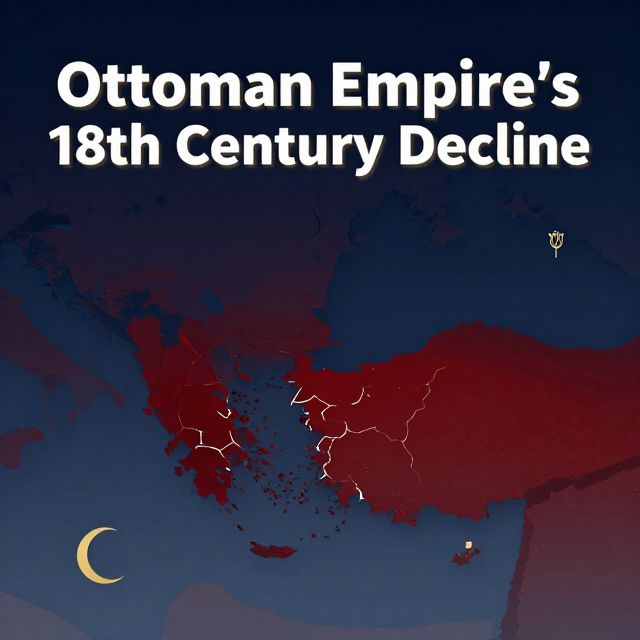
The Ottoman Empire's 18th-Century Decline - kapak
Tarih#ottoman empire#18th century#decline#history

The Ottoman Empire's 18th-Century Decline

An academic overview of the Ottoman Empire's period of decline during the 18th century, examining its political, military, and economic challenges and the factors contributing to its weakening.

nxnnFebruary 7, 2026 ~21 dk toplam
01

Sesli Özet

6 dakika

Konuyu otobüste, koşarken, yolda dinleyerek öğren.

Sesli Özet

The Ottoman Empire's 18th-Century Decline

0:006:02
02

Flash Kartlar

25 kart

Karta tıklayarak çevir. ← → ile gez, ⎵ ile çevir.

1 / 25
Tüm kartları metin olarak gör
  1. 1. What characterized the 18th century for the Ottoman Empire?

    The 18th century marked a pivotal era for the Ottoman Empire, characterized by a significant and multifaceted decline from its previous imperial grandeur. This period saw a gradual weakening of its military prowess, central administrative authority, and economic stability. It solidified a trajectory of territorial losses, internal fragmentation, and a growing disparity with rising European powers.

  2. 2. What event is considered a major turning point that highlighted the Ottoman military's weaknesses in the late 17th century?

    The unsuccessful Second Siege of Vienna in 1683 is considered a major turning point. Following this defeat, the Ottoman military machine began to demonstrate significant weaknesses compared to the modernized armies of European powers like Austria and Russia. This event signaled the end of Ottoman expansion and the beginning of a defensive posture.

  3. 3. What was the significance of the Treaty of Karlowitz (1699) for the Ottoman Empire?

    The Treaty of Karlowitz in 1699 was a watershed moment because it was the first time the Ottomans were compelled to cede large territories in Central Europe, including Hungary and Transylvania, to the Habsburg Monarchy. This treaty effectively ended Ottoman expansion into Europe and initiated a period of defensive warfare, marking a clear shift in the empire's geopolitical standing.

  4. 4. Which territories were lost by the Ottomans in the Treaty of Karlowitz?

    In the Treaty of Karlowitz (1699), the Ottoman Empire ceded significant territories in Central Europe. These included Hungary and Transylvania, which were transferred to the Habsburg Monarchy. This marked a major territorial loss and a symbolic end to Ottoman expansion into Europe.

  5. 5. What was the impact of the Treaty of Passarowitz (1718) on Ottoman territorial control?

    The Treaty of Passarowitz in 1718 resulted in further territorial losses for the Ottoman Empire. Additional territories in the Balkans were transferred to Austria, continuing the trend of ceding land to European powers. This treaty further diminished the empire's strategic depth and control over its European provinces.

  6. 6. Which European power became a significant adversary for the Ottomans in the latter half of the 18th century, leading to costly wars?

    Russia became a significant adversary for the Ottoman Empire in the latter half of the 18th century. A series of costly wars with Russia dominated this period, leading to severe military defeats and territorial concessions for the Ottomans. This rivalry profoundly impacted the empire's stability and resources.

  7. 7. What was the Treaty of Küçük Kaynarca (1774) and why was it particularly humiliating for the Ottomans?

    The Treaty of Küçük Kaynarca in 1774 was a disastrous treaty for the Ottoman Empire, concluding a costly war with Russia. It was particularly humiliating because it granted Russia significant territorial gains, including parts of the Black Sea coast, and, crucially, the right to protect Orthodox Christians within the Ottoman Empire. This established a precedent for Russian interference in Ottoman internal affairs, severely undermining Ottoman sovereignty.

  8. 8. What were the main consequences of the Treaty of Küçük Kaynarca for the Ottoman Empire?

    The Treaty of Küçük Kaynarca had several severe consequences. It resulted in significant territorial losses to Russia, including parts of the Black Sea coast. More importantly, it granted Russia the right to protect Orthodox Christians within the Ottoman Empire, which allowed for Russian interference in internal affairs. Additionally, the Crimean Khanate gained nominal independence, only to be annexed by Russia shortly after.

  9. 9. How did the Crimean Khanate's status change after the Treaty of Küçük Kaynarca?

    After the Treaty of Küçük Kaynarca in 1774, the Crimean Khanate, which had been a long-standing Ottoman vassal, gained nominal independence. However, this independence was short-lived, as Russia annexed the Khanate shortly thereafter. This represented another significant loss of influence and territory for the Ottoman Empire.

  10. 10. What was a major internal obstacle to military modernization efforts in the Ottoman Empire during this period?

    A major internal obstacle to military modernization efforts was the resistance from the Janissary corps. The Janissaries, once the elite infantry units, had become a conservative and powerful force that often resisted reforms aimed at adopting European military models. Their opposition hindered the empire's ability to adapt to changing military technologies and tactics.

  11. 11. How did military defeats and territorial losses impact the Ottoman Empire's finances and prestige?

    Military defeats and territorial losses severely eroded the Ottoman Empire's prestige on the international stage. They also diminished its strategic depth, making it more vulnerable to further incursions. Financially, these wars and losses strained the empire's already fragile resources, leading to increased debt and a weakened economy.

  12. 12. What was the role of "ayans" in the 18th-century Ottoman Empire?

    Ayans were powerful local notables who emerged in various provinces during the 18th century. They often wielded significant military and economic power, challenging the Sultan's direct control. Ayans collected taxes for themselves and sometimes formed independent power bases, contributing to the decentralization and fragmentation of central authority.

  13. 13. How did the rise of ayans affect the central administrative authority of the Ottoman Empire?

    The rise of ayans significantly fragmented the central administrative authority of the Ottoman Empire. These powerful local notables challenged the Sultan's direct control, leading to a decentralization of power. This undermined the efficiency of imperial administration and contributed to widespread corruption and inefficiency within the bureaucracy, weakening the empire's governance.

  14. 14. What economic factor contributed to the Ottoman Empire's decline by reducing its revenue from transit trade?

    The shift in global trade routes following the Age of Discovery significantly contributed to the Ottoman Empire's economic decline. These new routes favored Atlantic maritime routes over traditional overland routes through Ottoman territories, drastically reducing the empire's revenue from transit trade. This loss of income further strained the imperial treasury.

  15. 15. Explain the impact of "capitulations" on the Ottoman economy during the 18th century.

    Capitulations were a series of treaties granting extraterritorial rights and trade privileges to European merchants within the Ottoman Empire. During the 18th century, these increasingly disadvantaged Ottoman traders and industries. European manufactured goods, produced through early industrialization, flooded Ottoman markets, stifling local production and leading to a significant trade imbalance, further weakening the Ottoman economy.

  16. 16. How did European industrialization affect Ottoman local production and trade?

    European industrialization led to the production of manufactured goods at lower costs and higher volumes. These goods began to flood Ottoman markets due to the capitulations, stifling local production and industries. This created a trade imbalance where the Ottomans imported more than they exported, further weakening their domestic economy and contributing to economic stagnation.

  17. 17. What were some indicators of the Ottoman Empire's deteriorating fiscal situation in the 18th century?

    The Ottoman Empire's fiscal situation deteriorated significantly, marked by several indicators. These included currency debasement, where the value of the currency was reduced, and an increased reliance on tax farming, an inefficient and often corrupt method of revenue collection. The empire also faced a growing national debt, reflecting its inability to manage its finances effectively.

  18. 18. What was the "Tulip Period" (1718-1730) and what was its aim?

    The "Tulip Period" (1718-1730) was a period in Ottoman history characterized by a brief era of peace and cultural flourishing, alongside early attempts at reform. Its aim was to modernize aspects of the military and administration by adopting European models, particularly in areas like architecture, art, and military technology. However, these reforms were often superficial and met with resistance.

  19. 19. Which Sultan attempted significant reforms towards the end of the 18th century, and what was his primary goal?

    Sultan Selim III attempted significant reforms towards the end of the 18th century. His primary goal was to modernize the military and administration by adopting European models, particularly in response to the empire's military defeats. He sought to create a new, European-style army (Nizam-ı Cedid) and reform the bureaucracy, though these efforts faced strong opposition.

  20. 20. Who were the main conservative elements that resisted reform efforts in the Ottoman Empire during the 18th century?

    The main conservative elements that fiercely resisted reform efforts included the Janissaries and segments of the ulema (religious scholars). They viewed changes, especially those adopting European models, as a threat to traditional Ottoman institutions, their own power, and Islamic principles. Their resistance often led to the failure or reversal of reform initiatives.

  21. 21. How did the resistance from conservative elements impact reform efforts in the 18th-century Ottoman Empire?

    The fierce resistance from conservative elements, such as the Janissaries and the ulema, significantly hampered reform efforts. These groups viewed modernization as a threat to their power and traditional values, often leading to revolts or political obstruction. As a result, many reform initiatives, like those during the Tulip Period or under Selim III, were either short-lived, superficial, or ultimately unsuccessful in reversing the overall trend of decline.

  22. 22. What were the three main categories of factors contributing to the 18th-century Ottoman decline?

    The three main categories of factors contributing to the 18th-century Ottoman decline were military defeats and territorial losses, internal political deterioration, and economic deterioration. These interconnected issues collectively weakened the empire's power, stability, and ability to compete with rising European powers.

  23. 23. Which treaties are specifically mentioned as examples of significant Ottoman territorial concessions in the 18th century?

    The treaties specifically mentioned as examples of significant Ottoman territorial concessions in the 18th century are the Treaty of Karlowitz (1699), the Treaty of Passarowitz (1718), and the Treaty of Küçük Kaynarca (1774). These treaties collectively marked substantial losses of territory and prestige for the empire.

  24. 24. What does the text suggest about the awareness of the Ottoman leadership regarding the need for modernization during this period?

    The text suggests that despite the profound challenges, the 18th century also witnessed the nascent stages of reform efforts, indicating an awareness within the Ottoman leadership of the need for modernization and adaptation. Although these early attempts were largely unsuccessful in reversing the overall trend, they demonstrated a recognition of the empire's changing position in the world.

  25. 25. How did the 18th-century decline set the stage for the Ottoman Empire's future designation?

    The 18th-century decline, with its profound military, political, and economic challenges, set the stage for the Ottoman Empire's 'Sick Man of Europe' designation in the 19th century. This period initiated a long and arduous process of transformation, as the once-dominant empire grappled with its changing global position and the urgent need for comprehensive reforms.

03

Bilgini Test Et

15 soru

Çoktan seçmeli sorularla öğrendiklerini ölç. Cevap + açıklama.

Soru 1 / 15Skor: 0

What was a defining characteristic of the Ottoman Empire in the 18th century, according to the text?

04

Detaylı Özet

5 dk okuma

Tüm konuyu derinlemesine, başlık başlık.

This content is based on a YouTube video.

📚 The Ottoman Empire in the 18th Century: A Period of Decline

The 18th century marks a critical and transformative era in the history of the Ottoman Empire. Far from its previous imperial grandeur, this period witnessed a significant and multifaceted decline, characterized by a gradual weakening of the empire's military prowess, central administrative authority, and economic stability. While challenges had emerged in earlier centuries, the 18th century solidified a trajectory of territorial losses, internal fragmentation, and a growing disparity with the rising powers of Europe. This study material explores the key military, political, and economic factors that contributed to this pivotal phase of Ottoman history, laying the groundwork for subsequent reform efforts and further transformations.


⚔️ Military Reversals and Territorial Losses

A primary indicator of the Ottoman Empire's decline in the 18th century was its diminishing military effectiveness and subsequent territorial concessions. The once formidable Ottoman military machine began to show significant weaknesses compared to the modernized armies of European powers like Austria and Russia.

Key Events and Treaties:

  • Second Siege of Vienna (1683) Failure: This unsuccessful siege marked a turning point, signaling the end of Ottoman expansion into Europe and the beginning of a defensive posture.
  • Treaty of Karlowitz (1699):
    • Watershed Moment: This was the first time the Ottomans were compelled to cede large territories in Central Europe.
    • Territorial Losses: Hungary and Transylvania were lost to the Habsburg Monarchy.
    • Impact: Effectively ended Ottoman expansion and initiated a period of defensive warfare.
  • Treaty of Passarowitz (1718):
    • Further Losses: Additional territories in the Balkans were transferred to Austria.
  • Wars with Russia (Latter Half of the Century): A series of costly conflicts that further depleted Ottoman resources.
  • Treaty of Küçük Kaynarca (1774):
    • ⚠️ Humiliating Terms: This treaty was particularly disastrous for the Ottomans.
    • Russian Gains: Russia acquired significant territorial gains, including parts of the Black Sea coast.
    • Interference Precedent: Russia gained the right to protect Orthodox Christians within the Ottoman Empire, establishing a precedent for future Russian interference in Ottoman internal affairs.
    • Crimean Khanate: The long-standing Ottoman vassal, the Crimean Khanate, gained nominal independence, only to be annexed by Russia shortly thereafter.

Consequences of Military Defeats:

  • Eroded Prestige: The empire's standing and reputation suffered significantly.
  • Diminished Strategic Depth: Loss of territory reduced the empire's defensive capabilities.
  • Financial Strain: Costly wars and territorial losses severely strained the empire's already fragile financial resources.
  • Resistance to Modernization: The Janissary corps often resisted urgent military modernization efforts, clinging to outdated methods.

📉 Internal Political and Economic Deterioration

Concurrently with external military pressures, the Ottoman Empire faced profound internal political and economic challenges during the 18th century.

Political Fragmentation and Decentralization:

  • Weakening Central Authority: The Sultan's direct control, once absolute, began to fragment.
  • Rise of Ayans: Powerful local notables, known as ayans, emerged in various provinces.
    • Wielded Power: These ayans often held significant military and economic power.
    • Challenged Sultan: They frequently challenged the Sultan's direct control.
    • Independent Bases: Some ayans formed independent power bases and collected taxes for themselves.
  • Impact: This decentralization undermined the efficiency of imperial administration and contributed to widespread corruption and inefficiency within the bureaucracy.

Economic Stagnation and Decline:

  • Shift in Global Trade Routes:
    • Age of Discovery: The shift in global trade routes towards Atlantic maritime routes, bypassing traditional overland routes through Ottoman territories, significantly reduced the empire's revenue from transit trade.
  • Capitulations:
    • 📚 Definition: These were a series of treaties granting extraterritorial rights and trade privileges to European merchants.
    • ⚠️ Detrimental Impact: Capitulations increasingly disadvantaged Ottoman traders and industries.
    • Trade Imbalance: European manufactured goods, produced through early industrialization, flooded Ottoman markets, stifling local production and leading to a severe trade imbalance.
  • Fiscal Deterioration:
    • 📊 Financial Issues: The empire's fiscal situation worsened, marked by currency debasement, increased reliance on tax farming, and a growing national debt.

Early Reform Efforts and Resistance:

Despite the widespread decline, there were attempts at reform, indicating an awareness of the empire's predicament.

  • Tulip Period (1718-1730): An era characterized by a fascination with European culture and some administrative reforms.
  • Sultan Selim III (Late 18th Century): Initiated significant reforms aimed at modernizing the military and administration by adopting European models.
  • Resistance to Change:
    • ⚠️ Conservative Elements: These reform efforts often met with fierce resistance.
    • Key Opponents: Conservative elements included the Janissaries and segments of the ulema (religious scholars).
    • 💡 Reason for Resistance: They viewed such changes as a threat to traditional Ottoman institutions and Islamic principles.

💡 Conclusion: Legacy of the 18th-Century Decline

The 18th century represented a critical period of decline for the Ottoman Empire, characterized by a complex interplay of military defeats, territorial losses, and internal political and economic deterioration.

  • External Pressures: The empire's inability to match the military and technological advancements of European powers resulted in significant concessions, most notably with the Treaties of Karlowitz, Passarowitz, and Küçük Kaynarca.
  • Internal Weaknesses: Internally, the erosion of central authority, the rise of powerful provincial elites (ayans), and systemic corruption hampered effective governance.
  • Economic Challenges: Economically, the empire suffered from shifts in global trade, the detrimental impact of capitulations, and chronic fiscal instability.

While these challenges were profound and set the stage for the empire's 'Sick Man of Europe' designation in the 19th century, the 18th century also witnessed the nascent stages of reform efforts. These early attempts, though largely unsuccessful in reversing the overall trend, demonstrated an awareness within the Ottoman leadership of the need for modernization and adaptation. The legacy of this period is one of a once-dominant empire grappling with its changing position in the world, initiating a long and arduous process of transformation that would continue into the modern era.
Kendi çalışma materyalini oluştur

PDF, YouTube videosu veya herhangi bir konuyu dakikalar içinde podcast, özet, flash kart ve quiz'e dönüştür. 1.000.000+ kullanıcı tercih ediyor.

Sıradaki Konular

Tümünü keşfet
Ottoman Empire's 18th Century Decline

Ottoman Empire's 18th Century Decline

An academic summary of the Ottoman Empire's period of decline in the 18th century, examining internal weaknesses, external pressures, and reform attempts.

7 dk 25 15
Ottoman Empire in the Early 20th Century II

Ottoman Empire in the Early 20th Century II

An academic summary of the Ottoman Empire's critical period in the early 20th century, focusing on internal political shifts, major wars, and territorial losses leading up to World War I.

5 dk Özet 25 15
Ottoman Empire: Early 20th Century Challenges

Ottoman Empire: Early 20th Century Challenges

Explore the critical internal and external challenges faced by the Ottoman Empire in the early 20th century, leading to its eventual decline and dissolution.

Özet 15 Görsel
Ottoman Empire: Culture and Civilization

Ottoman Empire: Culture and Civilization

An academic overview of the Ottoman Empire's culture and civilization, covering its administrative structure, social organization, legal system, educational institutions, scientific advancements, and artistic expressions.

6 dk 25 15
Napoleon Bonaparte: Rise, Wars, and Legacy

Napoleon Bonaparte: Rise, Wars, and Legacy

This podcast offers a detailed examination of Napoleon Bonaparte's life, his pivotal role in the French Revolution, the extensive Coalition Wars, and the lasting impact of his reign on Europe, including the Congress of Vienna.

22 dk Özet 25
1876 Ottoman Constitution: Absolutism and Rights

1876 Ottoman Constitution: Absolutism and Rights

An in-depth analysis of the 1876 Ottoman Constitution, focusing on Articles 4, 7, 12, and 113, their impact on power and rights, and the vision of Namık Kemal.

24 15
Pre-Islamic Turkish Political History: Early States

Pre-Islamic Turkish Political History: Early States

An academic overview of the political history of early Turkic states before the advent of Islam, focusing on the Xiongnu, Göktürk, and Uyghur Khaganates.

7 dk Özet 25 15 Görsel
Pre-Islamic Turkish Political History

Pre-Islamic Turkish Political History

An academic overview of the political history of Turkic states before the advent of Islam, exploring their foundational characteristics, key empires, and enduring legacies.

4 dk Özet 25 15 Görsel