 Podit
Podit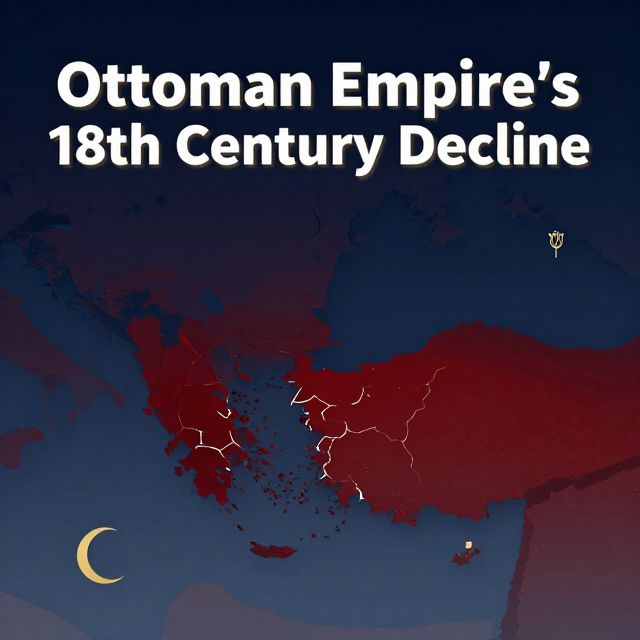
Sesli Özet
8 dakikaKonuyu otobüste, koşarken, yolda dinleyerek öğren.
Sesli Özet
Ottoman Empire's 18th Century Decline
Flash Kartlar
25 kartKarta tıklayarak çevir. ← → ile gez, ⎵ ile çevir.
Tüm kartları metin olarak gör
1. What characterized the Ottoman Empire's trajectory in the 18th century?
The 18th century marked a significant shift for the Ottoman Empire from expansion and dominance towards a period of sustained decline. This era was characterized by the culmination of internal weaknesses and intensifying external pressures from European powers, forcing the empire into a defensive posture.
2. Why is the 18th century crucial for understanding the Ottoman state's later history?
This period is crucial because it laid the groundwork for the significant challenges and reform movements of the 19th and early 20th centuries. The issues that emerged during this time, such as military obsolescence and administrative decay, directly influenced the empire's subsequent trajectory and eventual dissolution.
3. Was the Ottoman decline in the 18th century a sudden event or a gradual process?
The decline was not a sudden collapse but a gradual process. It was influenced by a complex interplay of various factors including military setbacks, administrative decay, economic difficulties, and significant geopolitical shifts, which collectively eroded the empire's power over time.
4. How did the centralized authority of the Sultanate change during the 18th century?
The centralized authority of the Sultanate began to erode significantly. This led to increased corruption and inefficiency within the bureaucracy, as the traditional meritocratic system was frequently undermined by nepotism and favoritism, weakening central control.
5. Who were the 'ayans' and what impact did they have on Ottoman central control?
'Ayans' were provincial governors and local potentates who gained greater autonomy during this period. Their increased power often came at the expense of central control, leading to a fragmentation of power and revenue, which further destabilized the empire's administration.
6. What was the state of the Janissary corps in the 18th century?
The Janissary corps, once an elite fighting force, had become a conservative and often rebellious political entity. They resisted military modernization and their tactics and weaponry became outdated, rendering them increasingly ineffective against technologically superior European armies.
7. How did the 'devşirme' system's decline affect the Janissaries?
The 'devşirme' system, which traditionally supplied the Janissaries with new recruits, had largely ceased. This led to the corps becoming hereditary, meaning membership was passed down through families rather than based on merit, significantly diminishing its quality and effectiveness as a fighting force.
8. What were the Capitulations and how did they impact the Ottoman economy?
The Capitulations were a series of treaties that granted extraterritorial rights and trade privileges to European merchants within the Ottoman Empire. These increasingly disadvantaged Ottoman commerce and industry, allowing European powers to dominate trade and extract economic benefits at the empire's expense.
9. What were the primary causes of inflation in the Ottoman Empire during the 18th century?
Inflation was primarily caused by the influx of New World silver into the global economy, which devalued existing currencies, and the debasement of Ottoman currency. This eroded the purchasing power of the populace and contributed to economic instability within the empire.
10. How did the shift in global trade routes affect the Ottoman Empire's economy?
The shift in global trade routes, particularly away from the traditional Silk Road and spice routes following the Age of Discovery, bypassed Ottoman territories. This led to a significant decline in customs revenues and overall economic vitality, as the empire lost its central role in international commerce.
11. What was the overall impact of internal structural weaknesses on the Ottoman Empire?
The internal structural weaknesses, including administrative decay, military obsolescence, and economic difficulties, created a fertile ground for instability and vulnerability. These issues severely hampered the empire's ability to respond effectively to both domestic challenges and external threats.
12. What were the main external pressures faced by the Ottoman Empire in the 18th century?
The Ottoman Empire faced escalating external pressures primarily from ambitious European powers, particularly Russia and Austria. These pressures manifested in a series of devastating wars that led to significant territorial losses and a continuous erosion of Ottoman sovereignty.
13. Which war is considered a watershed moment for the Ottoman Empire in the 18th century?
The Russo-Ottoman War of 1768-1774 proved to be a watershed moment. This conflict highlighted the empire's military decline and resulted in a humiliating defeat, setting the stage for further territorial losses and increased foreign intervention.
14. What was the Treaty of Küçük Kaynarca and when was it signed?
The Treaty of Küçük Kaynarca was a peace treaty signed in 1774, concluding the Russo-Ottoman War of 1768-1774. It was a humiliating defeat for the Ottomans, marking a significant turning point in their relations with European powers.
15. What were the key consequences of the Treaty of Küçük Kaynarca for the Ottoman Empire?
The treaty resulted in the loss of Crimea and granted Russia significant rights, including the protection of Orthodox Christians within the Ottoman Empire. This effectively established Russia as a major player in Ottoman internal affairs and marked the beginning of the 'Eastern Question.'
16. What was the 'Eastern Question' that emerged after the Treaty of Küçük Kaynarca?
The 'Eastern Question' was a complex diplomatic issue concerning the future of the Ottoman Empire, particularly its territorial integrity and the balance of power in Europe. It arose from the empire's weakening state and the competing interests of European powers over its territories.
17. How did Austria contribute to the Ottoman Empire's external pressures?
Austria, a traditional rival, continued its territorial ambitions in the Balkans throughout the 18th century. This led to further conflicts and losses for the Ottomans, contributing to the continuous erosion of their European territories and influence.
18. How did the rise of European powers contrast with the Ottoman Empire's capabilities?
The rise of European powers was characterized by strong centralized states, advanced military technology, and burgeoning industrial economies. This starkly contrasted with the Ottoman Empire's declining capabilities, which suffered from administrative decay, military obsolescence, and economic vulnerabilities.
19. How did France and Great Britain exert influence on the Ottoman Empire in the 18th century?
France and Great Britain primarily exerted influence through economic means and diplomatic maneuvering. They often exploited Ottoman weaknesses for their own strategic gains, further complicating the empire's geopolitical situation and contributing to its defensive posture.
20. What was the cumulative effect of external pressures on the Ottoman Empire?
The cumulative effect of these external pressures was a continuous erosion of Ottoman sovereignty and territorial integrity. This forced the empire into a defensive posture and compelled it to reconsider its traditional isolationist foreign policy, recognizing the need to engage with European dynamics.
21. Were there any attempts at reform within the Ottoman Empire during the 18th century?
Yes, several Ottoman sultans and statesmen initiated reform efforts, recognizing the dire state of the empire. However, these attempts were often met with significant resistance and achieved only limited success during this period.
22. Who was a notable Ottoman reformer during the late 18th century?
Sultan Selim III, who reigned from 1789 to 1807, is particularly notable for his comprehensive reform program. He recognized the need for modernization and attempted to address the empire's internal and external challenges.
23. What was Sultan Selim III's comprehensive reform program called?
Sultan Selim III's comprehensive reform program was known as the 'Nizam-ı Cedid,' which translates to 'New Order.' This program aimed at modernizing various aspects of the empire, primarily focusing on the military.
24. What were the main aims of Selim III's Nizam-ı Cedid reforms?
The reforms aimed at modernizing the military by establishing new, European-style infantry and artillery units, trained by foreign instructors. Selim III also sought to reform administrative and financial systems to support these military changes and initiated diplomatic missions to European capitals.
25. Who opposed Sultan Selim III's reforms and why?
Selim III's reforms faced staunch opposition from conservative elements, most notably the Janissaries and the Ulema (religious scholarly class). They viewed the changes as a threat to their privileges, traditional Ottoman institutions, and their established power within the empire.
Bilgini Test Et
15 soruÇoktan seçmeli sorularla öğrendiklerini ölç. Cevap + açıklama.
What was the general characterization of the Ottoman Empire during the 18th century, as described in the text?