Britain's Transformation: From Thatcherism to the Age of Insecurity - kapak
Tarih#britain#uk#history#politics

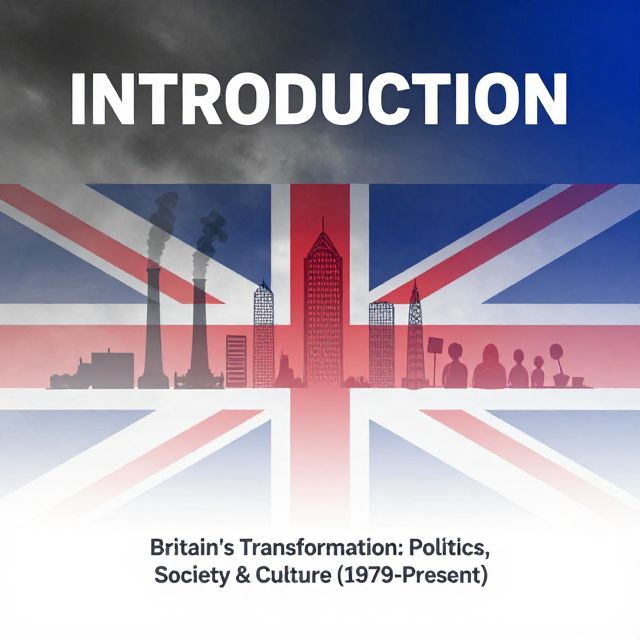
Britain's Transformation: From Thatcherism to the Age of Insecurity

Explore Britain's profound political, economic, and social changes from the late 1970s, covering Thatcherism, New Labour, the age of insecurity, multiculturalism, and evolving social and cultural landscapes.

carpedi3mMarch 31, 2026 ~18 dk toplam
01

Flash Kartlar

25 kart

Karta tıklayarak çevir. ← → ile gez, ⎵ ile çevir.

1 / 25
Tüm kartları metin olarak gör
  1. 1. What was the general period of profound transformation in Britain discussed in the introduction?

    The period of profound transformation in Britain spanned from the late 1970s through the early 2000s. During this time, the country underwent significant political, economic, and social changes, moving towards a more market-based economy and experiencing shifts in industrial focus and societal diversity. This era fundamentally shaped modern Britain.

  2. 2. What was the "post-war consensus" that Margaret Thatcher rejected, and what were its key characteristics?

    The "post-war consensus" prevailed from 1945 to 1979 and was characterized by a mixed economy and substantial state intervention in various sectors. Margaret Thatcher fundamentally rejected this approach, advocating instead for free-market economics and a significant reduction in government involvement in industry, marking a decisive ideological shift.

  3. 3. Which economic theory heavily influenced Margaret Thatcher's policies, and what were its main tenets?

    Margaret Thatcher's economic policies were heavily influenced by monetarist theories. These theories advocated for controlling the money supply to curb inflation, which led to policies like high interest rates and a significant reduction in government involvement in the economy. This approach promoted free-market principles and aimed to reduce the power of trade unions.

  4. 4. Describe the economic crisis in Britain during the early 1980s under Thatcher's government.

    The early 1980s saw a severe economic crisis in Britain, marked by the collapse of manufacturing industries such as mining, steel, and shipbuilding, particularly in northern regions. This led to soaring unemployment, exceeding three million, and heightened social unrest, exemplified by the Brixton riots in 1981. While London's financial sector eventually prospered, these industrial regions suffered long-term economic damage.

  5. 5. How did the Falklands War impact Margaret Thatcher's leadership and the implementation of her policies?

    Britain's victory in the Falklands War in June 1982 significantly bolstered Margaret Thatcher's leadership and popularity, despite ongoing economic difficulties. This increased political capital contributed to the Conservative victory in the 1983 general election, allowing her government to more confidently and fully implement Thatcherite policies, including extensive privatization and further weakening of trade unions.

  6. 6. Name at least three major industries that underwent privatization under Margaret Thatcher's government after 1983.

    After 1983, Margaret Thatcher's government embarked on extensive privatization of major industries. These included British Airways, British Steel, gas, water, and telecommunications. This policy aimed to reduce public spending, increase efficiency through market competition, and shift the economy towards private sector control, particularly benefiting London's financial services.

  7. 7. What was the significance of the miners' strike of 1984-1985 in the context of Thatcherism?

    The miners' strike of 1984-1985 was a pivotal conflict where Margaret Thatcher aimed to weaken trade unions, which she famously called 'the enemy within.' The defeat of the miners led to new legislation that permanently curtailed union power, solidifying her reputation as the 'Iron Lady' and marking a significant shift in industrial relations, reducing the influence of organized labor.

  8. 8. What were some of the social costs associated with Thatcherism, as mentioned in the text?

    Thatcherism incurred several high social costs, including increased inequality, a rise in crime, and heightened tensions between police and communities. Additionally, arts funding was reduced, leading to a more market-oriented culture, and policies like Clause 28 restricted the promotion of homosexuality in schools, sparking protests and activism.

  9. 9. What was Clause 28, introduced in 1987, and what was its impact?

    Clause 28 was a legislative measure introduced in 1987 that restricted the promotion of homosexuality in schools. This policy sparked significant protests and activism from groups like Stonewall, highlighting growing social tensions and debates around LGBTQ+ rights during the Thatcher era. It was seen as a regressive step by many campaigners for equality.

  10. 10. What were the primary reasons for Margaret Thatcher's resignation in 1990?

    Margaret Thatcher faced significant opposition over two main issues that ultimately led to her resignation in 1990. These were her increasingly rigid stance on European integration, which caused divisions within her own party, and the widespread unpopularity of the poll tax, a flat-rate community charge that replaced local property taxes and led to mass protests.

  11. 11. How did Tony Blair's "New Labour" party differ from traditional Labour socialism?

    Tony Blair's "New Labour" rebranded the party, moving away from traditional socialism towards a more centrist, pragmatic approach. Instead of reversing Thatcher-era free-market reforms, New Labour sought to combine economic efficiency with social justice, appealing to both business interests and the middle class. This shift was often termed the 'Third Way' in politics.

  12. 12. Name two key domestic policy areas where New Labour under Tony Blair focused on modernization.

    New Labour under Tony Blair focused on modernizing public services, particularly in education and the National Health Service (NHS). This included increased public spending on education, the introduction of standardized testing, and investments in the NHS to reduce waiting times and modernize hospitals. Blair also introduced devolution, granting Scotland and Wales greater autonomy.

  13. 13. What was "Cool Britannia," and what did it symbolize during the New Labour era?

    "Cool Britannia" was a cultural revival in the mid-to-late 1990s that symbolized a young, progressive, and dynamic Britain after years of Conservative rule. It was characterized by a surge in national pride, supported by figures like Tony Blair and the DCMS, and epitomized by cultural activities like Britpop, emphasizing national identity. However, it was criticized for being predominantly England-centered.

  14. 14. What major foreign policy decision by Tony Blair's government sparked widespread controversy?

    The major foreign policy decision by Tony Blair's government that sparked widespread controversy was the Iraq War in 2003. This intervention, based on claims of weapons of mass destruction, led to significant public protests and a decline in public trust. It remains a contentious part of New Labour's legacy, generating considerable debate about its justification and consequences.

  15. 15. What event marked the beginning of the "Age of Insecurity" in Britain, and what was its immediate impact?

    The global financial crisis of 2008 marked the beginning of the "Age of Insecurity" in Britain, shattering the perceived stability of the New Labour years. Its immediate impact included Gordon Brown's government struggling against global economic forces, leading to the formation of the 2010 Coalition Government and the introduction of harsh austerity measures to address government debt.

  16. 16. Describe the impact of austerity measures introduced by the 2010 Coalition Government.

    The austerity measures introduced by the 2010 Coalition Government resulted in massive cuts to public spending, including the arts, in an effort to reduce government debt. This period saw unemployment approach 10%, affecting 2.7 million people, alongside a rise in food banks and a surge in homelessness, reflecting significant social and economic hardship across the country.

  17. 17. Name two major scandals that contributed to the collapse of public trust in institutions during the Age of Insecurity.

    Two major scandals that contributed to the collapse of public trust were the banking scandals, where institutions like RBS and Lloyds were bailed out with taxpayer money while executives received huge bonuses, and the 2009 Expenses Scandal, which exposed fraudulent claims by Members of Parliament. These events fueled public anger and disillusionment with established institutions.

  18. 18. How did the press and the BBC face scrutiny during the Age of Insecurity?

    The press faced scrutiny with Rupert Murdoch's News International embroiled in the phone-hacking scandal, leading to the closure of News of the World and the Leveson Inquiry. The BBC also faced widespread revulsion over the Jimmy Savile sex abuse scandal (Operation Yewtree) and the subsequent resignation of Director-General George Entwistle, severely damaging public confidence in both media sectors.

  19. 19. What were the outcomes of the 2014 Scottish Independence Referendum and Margaret Thatcher's death in 2013?

    The 2014 Scottish Independence Referendum resulted in 55.3% voting 'No' to independence, keeping Scotland part of the UK. Margaret Thatcher's death in 2013 briefly reignited deep class divisions, with her loyalists mourning and mining communities celebrating her passing, highlighting her divisive legacy and the lasting impact of her policies on different parts of society.

  20. 20. What significant demographic change occurred in Britain, particularly highlighted by the 2011 Census?

    Britain experienced significant demographic changes driven by immigration, leading to a more multicultural society. The 2011 Census for England and Wales revealed that about 7.5 million residents were born outside the UK, with a notable decrease in the percentage of people identifying as 'white British' to 80%. This reflected a growing diversity, especially in urban centers like London.

  21. 21. Which religious group became the largest minority in Britain according to the 2011 Census, and where are they concentrated?

    According to the 2011 Census, Muslims became the largest religious minority group, constituting 4.8% of the population. This community, primarily of Pakistani and Kashmiri descent, is concentrated in cities such as London, Bradford, Birmingham, Leicester, and Oldham. Many arrived in the 1960s for work and formed communities in less affluent areas.

  22. 22. How did perceptions of Muslim integration differ between non-Muslims and Muslims themselves, according to a 2012 report?

    A 2012 report from Essex University highlighted a perception mismatch: non-Muslims often believed Muslims struggled to integrate, with only 28% thinking Muslims wanted to integrate. However, the report found that Muslims identified more strongly with being British than other Britons, leading to feelings of disaffection among some Muslims who felt unfairly labeled as outsiders and a threat.

  23. 23. What evidence suggests increasing racial mixing and assimilation in Britain?

    Evidence suggests increasing racial mixing and assimilation, with the 2012 Census revealing over one million people of mixed-race parentage, and estimates suggesting the real number could be closer to two million. Public figures like Jessica Ennis, Lewis Hamilton, and Leona Lewis exemplify this trend, gradually eroding clear racial boundaries seen from the 1960s to the 1990s and indicating a more integrated society.

  24. 24. What legislative changes improved LGBT+ rights in Britain during the early 21st century?

    Several legislative changes improved LGBT+ rights, including reducing the legal age of consent for same-sex relationships to 16 in 2000, making discrimination based on sexual orientation illegal in the workplace, and granting same-sex couples equal rights regarding property, taxation, and pensions in 2004. The Civil Partnership Act of 2004 and the Marriage (Same Sex Couples) Act of 2013 were also crucial milestones.

  25. 25. What was the significance of the Civil Partnership Act of 2004 and the Marriage (Same Sex Couples) Act of 2013 for LGBT+ rights?

    The Civil Partnership Act of 2004 officially recognized gay civil partnerships, providing legal recognition and many of the same rights as marriage. The landmark Marriage (Same Sex Couples) Act of 2013 further granted gay and lesbian couples the same rights and responsibilities as married heterosexual couples, marking full legal equality in marriage. These acts significantly advanced LGBT+ rights in Britain.

02

Bilgini Test Et

15 soru

Çoktan seçmeli sorularla öğrendiklerini ölç. Cevap + açıklama.

Soru 1 / 15Skor: 0

What was the prevailing economic consensus in Britain from 1945 to 1979, which Margaret Thatcher fundamentally rejected?

03

Detaylı Özet

8 dk okuma

Tüm konuyu derinlemesine, başlık başlık.

Study Material: Britain's Transformation (Late 1970s - Present)

Source Information: This study material is compiled from a lecture audio transcript and a copy-pasted text, both providing insights into significant political, economic, social, and cultural changes in Britain from the late 1970s to the present day.


🇬🇧 Introduction: A Nation in Flux

From the late 1970s through the early 2000s, Britain underwent profound political, economic, and social transformations. This era saw a decisive shift towards a more market-based economy, significant government and societal reforms, and a decline in traditional heavy industries alongside the rise of new sectors like finance and media. British society also became increasingly diverse and multicultural, bringing debates about equality, identity, and rights to the forefront. This period is crucial for understanding modern Britain and its ongoing trajectory.


1️⃣ The Thatcher Era: End of Consensus (1979-1990)

Margaret Thatcher's ascent to power in 1979 marked a radical departure from the post-war consensus (1945-1979), which had favored a mixed economy and strong state intervention.

  • Rejection of Consensus ✅: Thatcher, Britain's first female Prime Minister, championed free-market economics, influenced by monetarism. Her policies included high interest rates to control inflation and reduced government involvement in industry.
  • Economic Crisis & Industrial Decline 📉:
    • The early 1980s saw a deep economic crisis. Manufacturing industries (mining, steel, shipbuilding) collapsed, particularly in Scotland, Wales, and northern England.
    • Unemployment soared above three million, leading to social unrest, exemplified by the Brixton riots in 1981.
    • While London's financial sector later grew, industrial regions suffered long-term damage.
  • The Falklands War (1982) ⚔️:
    • Britain's victory over Argentina in the Falklands War significantly boosted Thatcher's leadership and popularity.
    • This success contributed to the Conservative victory in the 1983 general election, allowing Thatcherism to be implemented more confidently.
  • Thatcherism and Privatisation 💡:
    • Post-1983, Thatcherism fully developed, characterized by reduced public spending and extensive privatization of major industries (e.g., British Airways, British Steel, gas, water, telecommunications).
    • North Sea oil revenues helped finance these reforms, shifting Britain's economy from heavy industry to financial services, especially in London's Docklands.
  • The Miners' Strike (1984-1985) ⚒️:
    • A pivotal conflict where Thatcher aimed to weaken trade unions, famously calling them "the enemy within."
    • The defeat of the miners led to new legislation that permanently curtailed union power, solidifying her image as the "Iron Lady."
  • Social and Cultural Consequences ⚠️:
    • Thatcherism had high social costs: increased inequality, rising crime, and heightened tensions between police and communities.
    • Arts funding was reduced, and culture became more market-oriented.
    • Clause 28 (1987) restricted the promotion of homosexuality in schools, sparking protests and activism (e.g., Stonewall).
    • Economic growth primarily benefited the south, while the north faced persistent unemployment and social decline.
  • Fall of Thatcher and John Major (1990-1997) 📉:
    • By 1990, Thatcher faced opposition over European integration and the unpopular poll tax, leading to her resignation after 11 years.
    • Her successor, John Major, struggled with economic recession, party divisions, and political scandals ("sleaze"), further eroding public trust.

2️⃣ Forward with New Labour (1997-2007)

Tony Blair's landslide victory in 1997 ended 18 years of Conservative rule, ushering in the "New Labour" era.

  • New Labour Ideology 🤝: The party moved away from traditional socialism towards a more centrist, pragmatic approach. It aimed to combine economic efficiency with social justice, appealing to both business and the middle class, rather than reversing Thatcher-era reforms.
  • Domestic Policies 🏥📚:
    • Public Services: Increased public spending on education, introduced standardized testing, and fostered private sector partnerships in schools.
    • NHS: Strengthened through investments to reduce waiting times and modernize hospitals.
    • Devolution: Granted Scotland and Wales their own parliaments and greater autonomy.
    • Social Policies: Targeted poverty and inequality with measures like tax credits for low-income families.
  • Economic Stability 📈: Britain experienced stability and growth, characterized by low inflation and steady expansion.
  • Foreign Policy & Legacy 🌍:
    • The Iraq War in 2003 sparked widespread controversy, leading to protests and declining public trust.
    • Blair's government left a mixed legacy, balancing economic liberalism, social reform, and international engagement, but facing debate over military interventions and the shift from traditional socialism.
  • Cool Britannia 🎨🎶:
    • A cultural revival in the mid-to-late 1990s, fueled by a desire for change after years of Conservative rule.
    • Events like Euro 96 fostered national pride, and Tony Blair's interest in arts helped project Britain as young and dynamic.
    • The Department for Culture, Media and Sport (DCMS) supported creative industries, with "Cool Britannia" emphasizing national identity, symbolized by Britpop.
    • Criticisms ⚠️: The movement was criticized for being England-centered and dominated by white middle-class males. Central arts funding later declined, replaced by crowdfunding and National Lottery support, leading to debates about commercialization versus accessibility.

3️⃣ The Age of Insecurity (2007-Present)

This period is defined by a profound national crisis of trust, shifting from the perceived abundance of the New Labour years.

  • Global Financial Crisis (2008) 💸:
    • Shattered stability, leading to Gordon Brown's government struggles and the formation of the 2010 Coalition Government under David Cameron.
    • Harsh austerity measures were introduced to repay government debt, resulting in massive cuts to public spending and the arts.
    • Consequences included unemployment nearing 10% (2.7 million), a rise in food banks, and increased homelessness.
  • Collapse of Public Trust: Scandals 🚨:
    • Banking: Public anger over taxpayer bailouts for RBS and Lloyds while executives received huge bonuses (Occupy London protests, 2011-2012).
    • Politics: The 2009 Expenses Scandal exposed fraudulent claims by MPs, further alienating the public.
    • Press: Rupert Murdoch's News International faced the phone-hacking scandal (Operation Weeting), leading to the closure of News of the World and the Leveson Inquiry.
    • BBC: Widespread revulsion over the Jimmy Savile sex abuse scandal (Operation Yewtree) and the resignation of Director-General George Entwistle.
  • Social Tensions and National Identity 🏴󠁧󠁢󠁳󠁣󠁴󠁿:
    • Temporary relief came from the 2012 London Olympics and the Diamond Jubilee.
    • However, social unrest persisted: racism allegations, "stop-and-search" policies, and nationwide riots in 2011 following Mark Duggan's death.
    • Public confidence in the police was damaged by manipulated crime statistics.
    • Polarization: The 2014 Scottish Independence Referendum (55.3% 'No' vote) and Margaret Thatcher's death in 2013 (reigniting class divisions) highlighted deep societal rifts.
    • A mood of "Keep Calm and Carry On" reflected a public feeling of state powerlessness against global forces.

4️⃣ Societal Transformation: Diversity, Gender, and Rights

Britain experienced significant demographic and social changes, leading to a more multicultural society and evolving views on gender and LGBT+ rights.

  • Multicultural Society & Immigration 🌍:
    • Immigration Trends: Strong economy in the early 2000s attracted many immigrants. The 2011 Census showed 7.5 million foreign-born residents (4.5% of population), with half arriving between 2001-2011. Main origins: India, Poland, Pakistan, Ireland, Germany.
    • Ethnic Identity: "White British" identity decreased by 5% to 80% in 2011. London exemplified diversity, with 2.5 million foreign-born residents.
    • Religious Demographics (2011): Christians (59.3%), Muslims (4.8% – largest religious minority, 2.7 million).
    • Muslim Community Profile: Primarily Pakistani/Kashmiri descent, concentrated in cities, young population (50% under 25). Faced challenges in education and economic opportunities.
    • Post-9/11 Impact: Immigration became controversial. A 2012 report showed Muslims identified strongly as British (83% proud to be British vs. 79% others), yet 47% of Britons viewed Muslims as a threat, leading to disaffection among some Muslims.
  • Mixed-Race Population & Assimilation 🤝:
    • Growing mixed-race population (over 1 million in 2012 Census, possibly 2 million).
    • Evidence of increasing mixing and assimilation, blurring traditional racial boundaries.
    • Examples: Jessica Ennis, Lewis Hamilton, Leona Lewis.
    • Immigration Debate: During recession, parties like UKIP blamed immigration for economic problems, advocating stricter controls.
  • Gender Issues ♀️:
    • Male Dominance: Institutions like Parliament and the Church of England remained largely male-dominated. In 2010, only 143 out of 650 MPs were women.
    • Progressive Measures: Labour Party used "all-women shortlists" (allowed by Equality Act 2010). Women became priests in the Church of England in 1994, bishops in 2015.
    • "Glass Ceiling" 🚧: Despite progress for some women, a pay gap persisted (women earned 20% less than men in 2013). In 2012, women held only 20% of top positions (company directors, university professors, judges).
  • LGBT+ Rights and Equality 🌈:
    • Increased acceptance by the mid-2000s.
    • Legislative Milestones ✅:
      • 2000: Age of Consent for same-sex relationships equalized to 16.
      • 2004: Discrimination based on sexual orientation made illegal in employment; same-sex couples granted equal rights in property, taxation, pensions.
      • 2004: Civil Partnership Act recognized gay civil partnerships.
      • 2007: Equality Act made discrimination against same-sex couples illegal in goods/services.
      • 2013: Marriage (Same Sex Couples) Act granted equal marriage rights (approx. 8,000 ceremonies annually).
    • Church of England Division: These laws caused disagreement within the Church of England.

5️⃣ The Arts and Popular Culture in the 21st Century

The artistic landscape shifted from political engagement to an era of uncertainty, diverse audiences, and evolving definitions of "culture."

  • Shift in Artistic Landscape 🎭:
    • Disconnection: The strong link between arts and political movements (class, ethnicity, gender) weakened by the 21st century as these issues became more mainstream.
    • New Challenges: A perceived lack of artistic engagement with new global problems like recession and terrorism.
  • Diversification of Audiences & Economic Realities 📊:
    • Fragmented Audiences: Decline of heavy industries and rise of retail/finance led to less unified working-class audiences.
    • Creative Industries Success: Despite challenges, UK creative industries performed well, generating £71.4 billion annually and employing 1.68 million people in 2012.
  • Funding Cuts & Commercialization 💰:
    • Shift from public to private funding, leading to less risk-taking and reluctance to fund experimental works.
    • Concerns about "dumbing down" culture to appeal to mass audiences.
    • Online abundance of free content challenged profitability for creative industries.
  • Popular Culture in the 21st Century 📚:
    • Definitions: Moved from Arnold's elitist "best" (1960s) to a broader, anthropological view encompassing diverse tastes, entertainment, and human-made expressions.
    • Changing Discussion: Focus shifted from simply accepting classic works to questioning their origins, interests served, and public reception.
    • "High" and "Low" Culture: Debates became less important, with more focus on arts as entertainment and information, acknowledging quality across all forms.
    • Raymond Williams' Predictions 💡: His 1961 predictions about broader education came true, with cultural studies, media, and communications becoming widely taught university subjects and growing employment fields.
Kendi çalışma materyalini oluştur

PDF, YouTube videosu veya herhangi bir konuyu dakikalar içinde podcast, özet, flash kart ve quiz'e dönüştür. 1.000.000+ kullanıcı tercih ediyor.

Sıradaki Konular

Tümünü keşfet
Britain's Social, Cultural, and Linguistic Evolution (1950s-2010s)

Britain's Social, Cultural, and Linguistic Evolution (1950s-2010s)

An academic summary exploring Britain's profound social, cultural, and linguistic transformations from the mid-20th century, covering political shifts, societal changes, and the evolution of the English language.

9 dk Özet 25 15
Multiculturalism and Gender in Britain: A Historical and Political Analysis

Multiculturalism and Gender in Britain: A Historical and Political Analysis

An academic overview of Britain's multicultural society and evolving gender issues, examining historical contexts, policy developments, and the significant influence of figures like Margaret Thatcher.

6 dk Özet 25 15
Ottoman Empire's 18th Century Decline

Ottoman Empire's 18th Century Decline

An academic summary of the Ottoman Empire's period of decline in the 18th century, examining internal weaknesses, external pressures, and reform attempts.

7 dk 25 15
Ottoman Empire: Early 20th Century Challenges

Ottoman Empire: Early 20th Century Challenges

Explore the critical internal and external challenges faced by the Ottoman Empire in the early 20th century, leading to its eventual decline and dissolution.

Özet 15 Görsel
Sociopolitical, Demographic, and Cultural Shifts in Britain

Sociopolitical, Demographic, and Cultural Shifts in Britain

This summary examines significant sociopolitical, demographic, and cultural transformations in Britain from 2007 to the mid-2010s, focusing on public trust, immigration, social norms, and the evolving arts landscape.

10 dk Özet 25 15
The Ottoman Empire's 18th-Century Decline

The Ottoman Empire's 18th-Century Decline

An academic overview of the Ottoman Empire's period of decline during the 18th century, examining its political, military, and economic challenges and the factors contributing to its weakening.

6 dk Özet 25 15
Ottoman Empire: Culture and Civilization

Ottoman Empire: Culture and Civilization

An academic overview of the Ottoman Empire's culture and civilization, covering its administrative structure, social organization, legal system, educational institutions, scientific advancements, and artistic expressions.

6 dk 25 15
Women's Evolving Roles and Suffrage in Wartime Britain

Women's Evolving Roles and Suffrage in Wartime Britain

This podcast explores the significant changes in women's roles and the suffrage movement in Britain, from early campaigns to their contributions during both World Wars, and the lasting impact on society.

6 dk 25 15