 Podit
Podit
This content is based on a YouTube video.
📚 The Ottoman Empire in the Early 20th Century: Crisis and Transformation (Part II)
Introduction: A Period of Profound Crisis (1908-1914)
The early 20th century marked a critical and tumultuous era for the Ottoman Empire, characterized by an accelerating decline that ultimately paved the way for its dissolution. Following the re-establishment of constitutional rule in 1908, the empire found itself grappling with a complex web of internal political instability, ideological shifts, and relentless external pressures. This period witnessed significant territorial losses, a desperate struggle for survival against rising nationalism, and the aggressive imperial ambitions of Great Powers. Understanding this era requires a detailed examination of the interplay between domestic political factions, evolving state ideologies, and the volatile geopolitical landscape. This study material will delve into the internal political developments, major military conflicts, and the resulting territorial contractions that defined the Ottoman experience during these critical years, leading up to World War I.
1️⃣ Internal Dynamics and Political Transformations (1908-1913)
The restoration of the 1876 Constitution and the reconvening of Parliament in 1908, following the Young Turk Revolution, ushered in the Second Constitutional Era. This period, however, was far from stable, quickly becoming a hotbed of political fragmentation and power struggles.
1.1 The Rise of the Committee of Union and Progress (CUP)
- Initial Stance: The Committee of Union and Progress (CUP) emerged as the dominant political force. Initially, the CUP championed:
- ✅ Constitutionalism: Advocating for a government bound by a constitution.
- ✅ Modernization: Pushing for reforms across various sectors.
- ✅ Ottomanism: An ideology promoting equality among all subjects, regardless of religion or ethnicity, with the aim of preserving the multi-ethnic empire.
- Shift in Ideology: As the empire continued to lose non-Turkish territories and populations, the CUP's policies gradually shifted from Ottomanism towards a more Turkist orientation. This ideological evolution was a direct response to the burgeoning nationalisms among the empire's diverse ethnic groups, including Arabs, Albanians, and various Balkan peoples.
- Goals: The CUP aimed to centralize power, modernize administration, and strengthen the military, often resorting to coercive measures.
1.2 Key Political Events and Power Consolidation
The CUP's path to absolute power was marked by several significant events:
- ⚠️ The 31 March Incident (1909):
- Nature: An anti-constitutionalist uprising.
- Support: Backed by conservative religious elements and some military units.
- Objective: Challenged the CUP's authority and sought to revert to autocratic rule.
- Suppression: Swiftly suppressed by the 'Action Army' led by Mahmud Shevket Pasha.
- Consequence: Led to the deposition of Sultan Abdülhamid II and his replacement by Mehmed V. This event significantly solidified the CUP's control over the government and military, marking a more authoritarian phase of their rule.
- The 'Club Elections' (1912):
- Context: These elections, known as 'Sopalı Seçimler' in Turkish, were characterized by alleged irregularities.
- Outcome: The CUP successfully consolidated its parliamentary majority, further strengthening its political grip.
- Opposition and Discontent: Despite the CUP's dominance, discontent simmered, leading to the formation of opposition groups, such as the Freedom and Accord Party.
- ⚠️ The Bab-ı Ali Raid (Sublime Porte Coup) (January 1913):
- Nature: A military coup orchestrated by prominent CUP leaders: Enver Pasha, Talat Pasha, and Cemal Pasha.
- Outcome: This event effectively established a triumvirate that would govern the empire with dictatorial powers until the end of World War I.
- Significance: It marked the end of any meaningful parliamentary democracy in the Ottoman Empire for the duration of the CUP's rule, centralizing decision-making in the hands of a few powerful figures.
2️⃣ External Pressures and Devastating Territorial Losses (1911-1913)
Concurrent with its internal political struggles, the Ottoman Empire faced immense external pressures that resulted in catastrophic territorial losses, severely diminishing its geographical extent and geopolitical standing.
2.1 The Italo-Turkish War (1911-1912)
- Cause: Italy, driven by colonial ambitions, invaded the Ottoman provinces of Tripolitania and Cyrenaica (modern-day Libya).
- Ottoman Response: Despite fierce resistance from local Arab and Berber populations, supported by Ottoman officers like Mustafa Kemal and Enver Pasha, the empire was unable to effectively defend these distant territories.
- Challenges: The Ottoman military was in a weakened state, and British control of Egypt prevented direct land access to Libya.
- Outcome: The war concluded with the Treaty of Lausanne in October 1912.
- Consequence: The Ottoman Empire ceded Tripolitania and Cyrenaica to Italy.
- Significance: This loss marked the definitive end of Ottoman rule in North Africa, demonstrating the empire's inability to protect its peripheral territories and highlighting its military and logistical weaknesses.
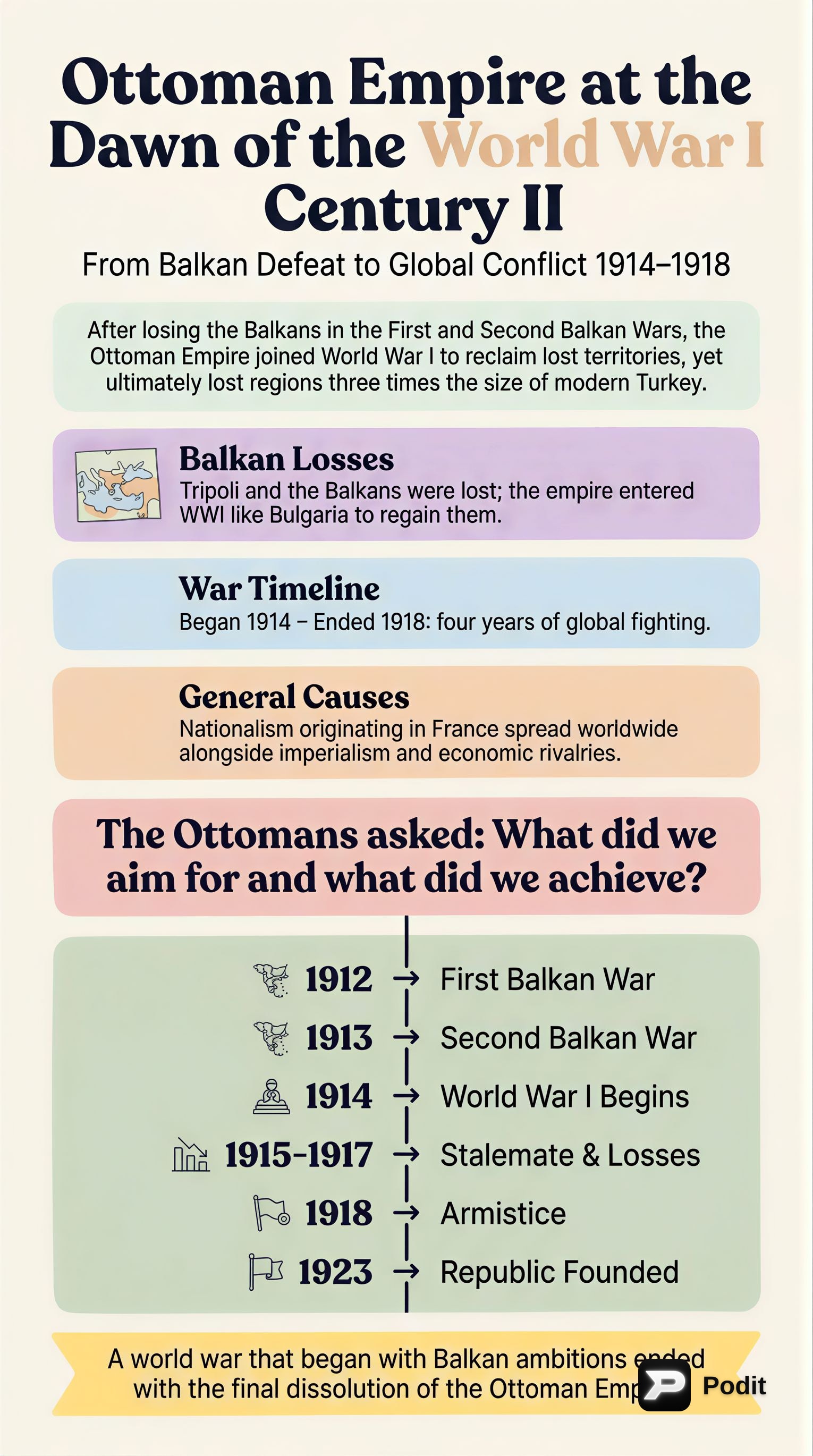
2.2 The Balkan Wars (1912-1913)
Immediately following the Italo-Turkish War, the Ottoman Empire was plunged into the even more devastating Balkan Wars, which dramatically reshaped the map of Southeast Europe.
2.2.1 The First Balkan War (October 1912 - May 1913)
- Combatants: The Balkan League (comprising Bulgaria, Serbia, Greece, and Montenegro) launched a coordinated attack on the Ottoman Empire.
- Motivations: These newly independent Balkan states sought to expand their territories at the expense of the Ottomans, capitalizing on the empire's internal weaknesses and its ongoing conflict with Italy.
- Ottoman Performance: The Ottoman army, still undergoing reorganization and demoralized by recent defeats, suffered a series of rapid and decisive losses.
- Key Losses: Within weeks, Balkan League forces advanced deep into Ottoman territory, capturing significant cities such as Salonica and Adrianople.
- Outcome: The war concluded with the Treaty of London in May 1913.
- Consequence: The Ottomans were forced to surrender nearly all of their remaining European territories west of the Enos-Midia line. This included Macedonia, Albania, and most of Thrace.
- Significance: This treaty drastically reduced the Ottoman Empire's presence in Europe, a region it had dominated for centuries.
2.2.2 The Second Balkan War (June - August 1913)
- Combatants: This conflict saw the former allies of the Balkan League turn against each other, primarily over the division of Macedonia. Bulgaria attacked Serbia and Greece, leading to a counter-attack by Romania and the Ottoman Empire.
- Ottoman Involvement: The Ottomans, under the leadership of Enver Pasha, seized this opportunity to reclaim some lost territory.
- Key Gain: They successfully retook Adrianople in July 1913.
- Outcome: The Treaty of Bucharest in August 1913 formally ended the Second Balkan War.
- Consequence: The Ottoman Empire's gains were limited to Eastern Thrace, including Adrianople.
- Overall Impact of Balkan Wars:
- Massive Territorial Loss: Collectively, the Balkan Wars represented a monumental disaster, resulting in the loss of approximately 83% of the Ottoman Empire's European territory and 69% of its European population. 📈
- Exacerbated Problems: These conflicts not only diminished the empire's geographical extent but also:
- Fueled nationalist sentiments within its remaining territories.
- Exacerbated its financial woes.
- Further destabilized its political structure.
- Geopolitical Shift: The wars pushed the empire closer to the brink of collapse and into the orbit of the Central Powers in the lead-up to World War I.
3️⃣ Conclusion: The Ottoman Empire on the Eve of World War I
The early 20th century was a period of intense turmoil and irreversible decline for the Ottoman Empire. A confluence of internal political instability and devastating external conflicts left the empire severely weakened and vulnerable.
3.1 Internal Weakness and Authoritarianism
- Fragile Constitutionalism: The Second Constitutional Era, initially promising reform, quickly devolved into a ruthless struggle for power dominated by the Committee of Union and Progress (CUP).
- Ideological Evolution: The CUP's evolving ideologies, from the inclusive Ottomanism to the more exclusive Turkism, reflected the empire's desperate attempts to redefine itself amidst the erosion of its multi-ethnic character. 📚
- Political Instability: Events like the 31 March Incident and the Bab-ı Ali Raid (Sublime Porte Coup) underscored the fragility of the political system and the increasing authoritarianism of the CUP leadership, culminating in the establishment of a dictatorial triumvirate. ⚠️
3.2 External Pressures and Irreparable Damage
- Loss of North Africa: The Italo-Turkish War resulted in the loss of Libya, severing the empire's last ties to North Africa and exposing its military and logistical shortcomings.
- Dramatic Contraction in Europe: The subsequent Balkan Wars inflicted irreparable damage, leading to the dramatic contraction of its European territories. This resulted in:
- Massive demographic shifts.
- A profound sense of national humiliation.
- Further exposure of the empire's military and administrative weaknesses.
- Weakened Geopolitical Standing: By 1913, the Ottoman Empire was a shadow of its former self:
- Economically indebted.
- Politically centralized under a triumvirate.
- Geographically diminished.
These cumulative crises left the empire vulnerable and increasingly isolated. Ultimately, these circumstances compelled the Ottoman Empire to align with the Central Powers in World War I, a decision that would seal its ultimate fate and lead to its final dissolution. 💡 The events of this period were not merely isolated incidents but interconnected factors that systematically dismantled a centuries-old empire, setting the stage for the emergence of new nation-states and a new geopolitical order.