 Podit
Podit
This content is based on a YouTube video.
📚 Pre-Islamic Turkish Political History: An Overview
This study material explores the political history of Turkish states before the advent of Islam, focusing on their foundational characteristics, state-building traditions, and major empires. Understanding this period is crucial for grasping the origins of Turkish statehood, culture, and military prowess. We will delve into how nomadic life shaped powerful empires, the role of divine legitimacy in leadership, and the enduring legacy of these early states.
🌍 General Characteristics of Pre-Islamic Turkish States
Early Turkish states shared several defining features that influenced their political, social, and military structures.
1. Nomadic Lifestyle and Its Impact ✅
Turkish societies were primarily nomadic or semi-nomadic, moving with their herds across vast steppes. This lifestyle profoundly shaped their civilization:
- Military Organization: Fostered a highly adaptable and formidable cavalry-based military. Every man was essentially a warrior, and women could defend the camp.
- Mobility: Led to a focus on flexibility and military readiness.
- Territory: The concept of 'land' was often tied to grazing areas rather than permanent settlements, with fixed capitals being rare.
2. The Concept of 'Kut' (Divine Mandate) 💡
'Kut' was a central ideological concept, referring to a divine blessing or mandate from Tengri (the sky god).
- Legitimacy: Bestowed upon the Khagan (ruler) the legitimate right to govern.
- Authority: Provided a powerful ideological basis for the Khagan's rule and helped maintain social order.
- Succession: If a ruler lost his 'Kut,' it was believed he would lose his ability to govern, leading to his downfall. This also meant any male member of the ruling family could potentially claim 'Kut,' often leading to internal struggles.
3. Dual Administration System ⚖️
Many early Turkish states employed a dual administration system to govern vast territories.
- Structure: The Khagan (supreme ruler) governed the eastern part (considered more prestigious and sacred), while his brother or a close relative, often with the title 'Yabgu,' ruled the western part.
- Autonomy: The Yabgu was subordinate but often enjoyed significant autonomy.
- Challenges: While practical, this system carried the risk of division and conflict, as the western Yabgu might seek independence, weakening central authority.
4. Military Prowess and Organization ⚔️
The Turkish military was legendary for its effectiveness.
- Horsemanship & Archery: Mastery of these skills made them a dominant force on the steppes.
- Decimal System: Military units were structured in groups of ten, hundred, thousand, and ten thousand. This system, attributed to the Huns and adopted by others, allowed for highly organized, disciplined, and flexible armies.
- Tactics: Often involved feigned retreats, encirclement, and swift cavalry charges, making them difficult to defeat.
- Purpose: Essential for expansion, securing trade routes, and extracting tribute.
5. Social Structure 👨👩👧👦
Turkish society was generally hierarchical but relatively egalitarian compared to many settled empires.
- Tribal System: Organized from smaller to larger units:
- Oğuş: Family
- Urug: Clan
- Bod: Tribe
- Budun: People/Nation
- İl: State (seen as the protector and organizer of the 'Budun')
- Meritocracy: Strong emphasis on meritocracy within the military.
- Women's Role: Women held a more prominent position than in many contemporary societies, often participating in political life and warfare.
📈 Key Pre-Islamic Turkish Empires
1. The Huns (Xiongnu) 🐎
The Huns were arguably the first major Turkish state to establish a vast empire, significantly impacting both East and West.
- Great Hun Empire (Xiongnu): Rose to prominence in Central Asia around the 3rd century BCE.
- Mete Khan (209-174 BCE): Unified various nomadic tribes, reorganized the army using the decimal system, and expanded the empire. He famously defeated the Chinese Han Dynasty, forcing them to pay tribute and contributing to the construction of the Great Wall.
- Political Strategy: Combined military dominance with diplomatic pressure, often playing rival Chinese factions against each other.
- Decline: Internal strife, succession disputes, and external pressures led to fragmentation.
- European Huns: A portion of the Huns migrated westward, initiating the 'Migration Period' in Europe.
- Attila (5th century CE): Under his leadership, the European Huns struck fear into the Roman Empire, reshaping the political map of the continent and contributing to the fall of the Western Roman Empire.
2. The Göktürk Khaganates (Celestial Turks) 🦅
The Göktürks established two powerful empires, leaving a direct and lasting legacy on Turkish history and culture.
a. First Göktürk Khaganate (552-630 CE)
- Founder: Bumin Khagan (552 CE), who united Turkish tribes and overthrew the Rouran Khaganate.
- Extent: Stretched from Manchuria to the Black Sea.
- Zenith: Under Mukan Khagan, controlled crucial sections of the Silk Road and engaged with the Byzantine Empire, Sassanid Persia, and Chinese dynasties.
- Characteristics: Known for sophisticated state organization, unique runic script, and strong emphasis on 'Kut' and the dual administration system.
- Fall: Internal power struggles (especially between eastern and western wings) and external pressures from China led to its collapse in 630 CE.
b. Second Göktürk Khaganate (Kutluk State) (682-744 CE)
- Revival: Founded by Kutluk Khagan in 682 CE, marking a period of resurgence and consolidation after Chinese suzerainty.
- Key Figures: Kül Tigin, Bilge Khagan, and the wise minister Tonyukuk played pivotal roles in re-establishing Turkish dominance.
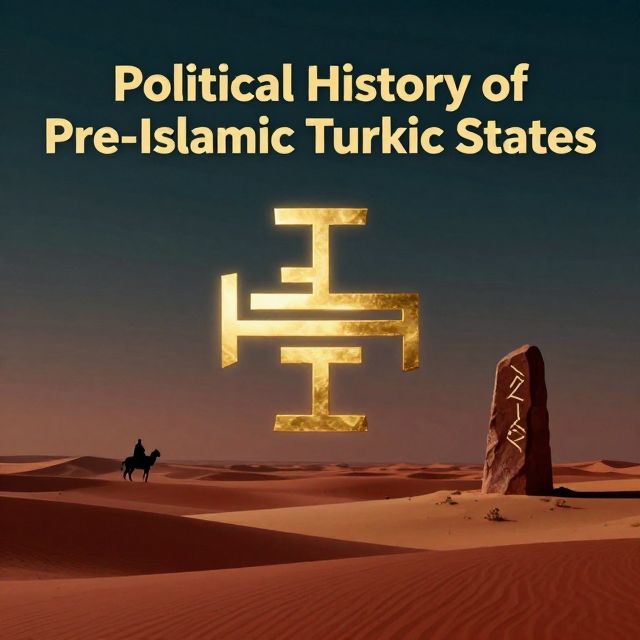
- Orkhon Inscriptions: Monumental stone steles from the early 8th century.
- Significance: Earliest known examples of Turkish writing (Old Turkic script).
- Content: Provide invaluable historical records, detailing history, political ideology, and advice for future rulers, emphasizing unity, loyalty, and the dangers of foreign assimilation.
- Impact: Showcased a strong sense of national identity and a determination to preserve Turkish independence.
- Fall: Fell to a coalition of Uyghur, Karluk, and Basmil tribes in 744 CE.
📜 Conclusion and Legacy
The pre-Islamic Turkish period is a foundational era that shaped the political thought, military traditions, and cultural identity of Turkish peoples.
- Key Takeaways:
- ✅ Nomadic lifestyle as a fundamental shaper of political and military structures.
- ✅ 'Kut' as the source of divine legitimacy for rulers.
- ✅ Dual administration system for governing vast territories.
- ✅ Legendary military prowess, particularly cavalry and the decimal system.
- ✅ Influential empires like the Huns and Göktürks, who left lasting impacts on both East and West.
- Enduring Impact: The resilience, state-building capacity, and military innovations of these early states laid the groundwork for future Turkish empires and continue to be a source of study and pride. Understanding this era provides crucial context for the long and complex journey of Turkish statehood.