Podit
Podit
This content is based on a YouTube video.
📚 The Anatolian Seljuk Sultanate: A Comprehensive Study Guide
Introduction to the Sultanate of Rum
The Anatolian Seljuk Sultanate, also known as the Sultanate of Rum, represents a pivotal era in the history of Anatolia and the broader Turkic world. Emerging in the wake of the decisive Battle of Manzikert in 1071, this state was instrumental in the Turkification and Islamization of Anatolia, laying crucial groundwork for subsequent Turkish states, most notably the Ottoman Empire. Unlike the Great Seljuk Empire, which was primarily centered in Persia, the Anatolian Seljuks forged a distinct political and cultural entity within the heart of what was once Byzantine territory. Their rule, spanning from the late 11th century to the early 14th century, was characterized by periods of significant expansion, remarkable cultural flourishing, and an eventual decline under the immense pressure of Mongol invasions. This study guide will delve into the key phases of the Anatolian Seljuk Sultanate, examining its foundation, its golden age of prosperity and cultural synthesis, its eventual fragmentation, and its enduring legacy on the region's historical trajectory.
1️⃣ Establishment and Early Development (1077-1194)
The genesis of the Anatolian Seljuk Sultanate is intrinsically linked to the Seljuk victory at the Battle of Manzikert in 1071. This monumental battle effectively opened Anatolia to widespread Turkic settlement, fundamentally altering the demographic and political landscape of the region.
1.1 The Aftermath of Manzikert and Foundation
- Battle of Manzikert (1071): A decisive Seljuk victory that weakened Byzantine control over Anatolia and paved the way for Turkic migration and settlement. ✅
- Emergence of Principalities: Following the battle, various Turkic tribes and commanders, including those affiliated with the Seljuk dynasty, began establishing independent or semi-independent principalities across Anatolia.
- Suleiman ibn Qutulmish: A cousin of the Great Seljuk Sultan Malik-Shah I, Suleiman is widely credited with founding the Sultanate of Rum.
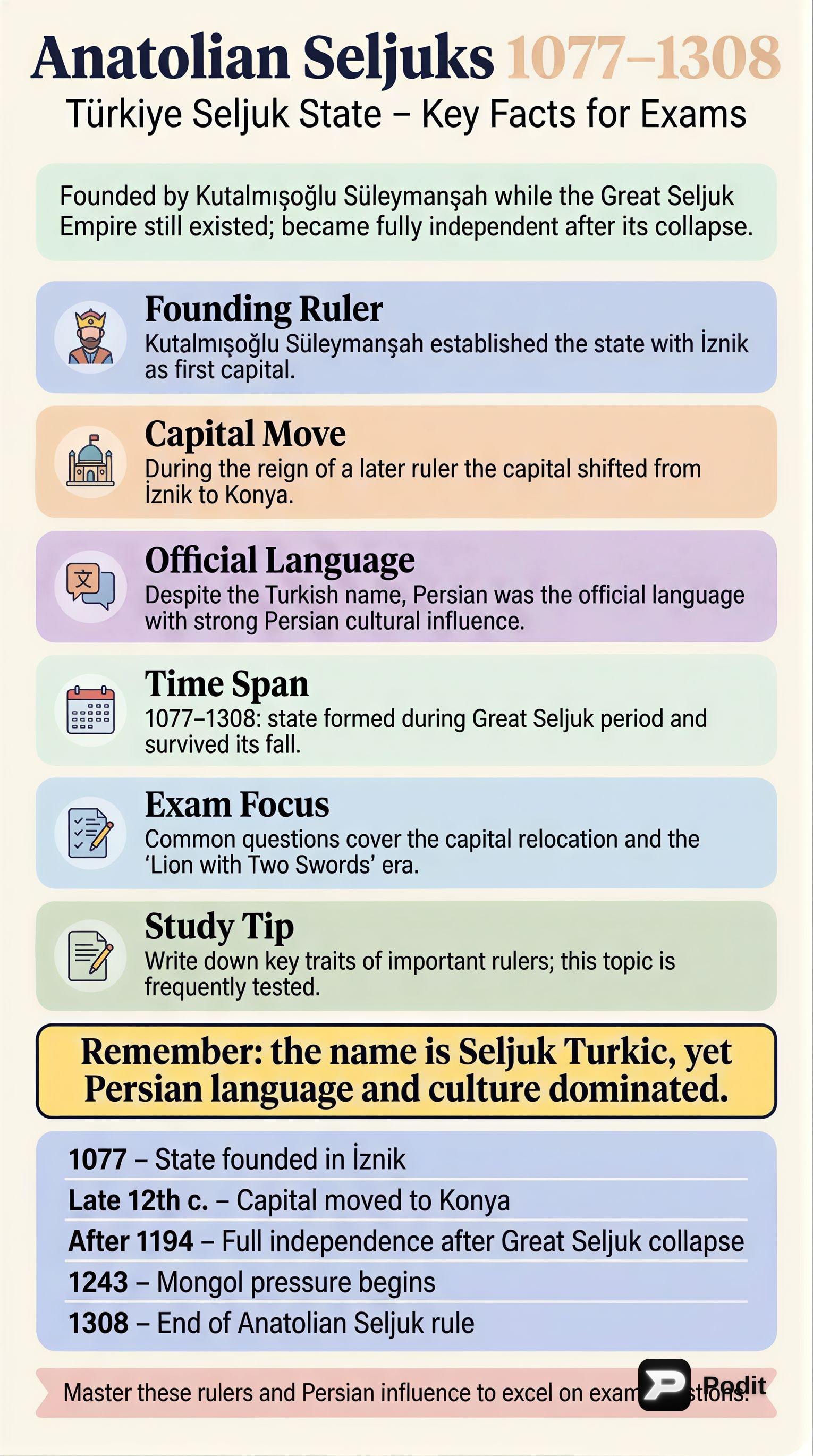
- First Capital at Iznik (Nicaea): In 1077, Suleiman established his capital at Iznik, a strategic move that directly challenged Byzantine authority in the region. 📍
1.2 Early Challenges and Consolidation
- Continuous Warfare: The initial decades of the Sultanate were marked by persistent conflicts with the Byzantine Empire, which sought to reclaim lost territories.
- Crusader States: The establishment of Crusader states in the Levant and Anatolia introduced another formidable adversary for the nascent Seljuk state.
- Kilij Arslan I: Suleiman's son, Kilij Arslan I, faced the brunt of the First Crusade. He suffered significant losses and was forced to temporarily cede Iznik to the Crusaders.
- Relocation to Konya: This strategic setback led to the relocation of the Seljuk capital to Konya, a city that would become synonymous with Seljuk power and culture. 🏛️
- Territorial Expansion: Despite these challenges, the Seljuks gradually consolidated their control over central Anatolia through sustained military campaigns and astute strategic alliances.
1.3 The Battle of Myriokephalon (1176)
- Decisive Victory: This battle marked a critical turning point, as the Seljuk forces achieved a conclusive victory over the Byzantine Emperor Manuel I Komnenos. ⚔️
- End of Byzantine Reclamation: The Battle of Myriokephalon effectively cemented Turkish dominance in Anatolia and signaled the end of any serious Byzantine attempts to reclaim the region. ✅
- Integration and Administration: This period saw the gradual integration of diverse populations under Seljuk rule, the establishment of foundational administrative structures, and the initial development of trade routes that would later become the economic backbone of the Sultanate.
- Geopolitical Acumen: Early Seljuk rulers skillfully navigated a complex geopolitical landscape, balancing relations with the Great Seljuks, Byzantines, and Crusaders, while steadily building a distinct Anatolian Turkish state. 💡
2️⃣ The Golden Age and Cultural Flourishing (1194-1243)
The late 12th and early 13th centuries represent the zenith of the Anatolian Seljuk Sultanate, a period characterized by remarkable political stability, economic prosperity, and extraordinary cultural achievements.
2.1 Prominent Sultans and Territorial Expansion
- Key Rulers: Under powerful sultans such as Kaykhusraw I, Kaykaus I, and particularly Alaeddin Kayqubad I, the Sultanate reached its peak. 👑
- Alaeddin Kayqubad I (1220-1237): Often regarded as the most illustrious of the Seljuk sultans, his reign saw significant territorial expansion.
- Access to Seas: Kayqubad I secured vital access to both the Mediterranean and Black Seas through the conquest of key port cities like Alanya and Sinop. This expansion greatly facilitated extensive maritime trade. 🚢
2.2 Economic Prosperity and Infrastructure
- Vibrant Commercial Network: The Seljuks fostered a dynamic commercial network, establishing and diligently protecting trade routes that connected Anatolia to the Middle East, Central Asia, and Europe. 📈
- Caravanserais: A defining feature of Seljuk economic policy was the widespread construction of caravanserais. These fortified roadside inns provided essential lodging, food, and security for merchants and their goods, thereby promoting long-distance trade.
- Architectural Marvels: Caravanserais were not merely functional; they were also architectural marvels, showcasing the distinctive Seljuk aesthetic and advanced engineering. 🕌
2.3 Cultural and Intellectual Achievements
- Beacon of Learning and Art: The Sultanate became a prominent center for learning and artistic innovation, attracting scholars and artists from across the Islamic world.
- Seljuk Architecture: Renowned for its distinctive style, Seljuk architecture is characterized by intricate stone carvings, geometric patterns, and monumental scale. This is evident in numerous mosques, madrasas (religious schools), hospitals, and bridges that still stand today. 🏗️
- Konya as a Cultural Hub: The capital city of Konya transformed into a major intellectual and spiritual center, drawing scholars, poets, and mystics.
- Patronage of Sufism: The Seljuks actively patronized Sufi orders, most notably the Mevlevi Order founded by the renowned poet and mystic Rumi. This patronage significantly shaped the spiritual landscape of Anatolia. 💫
- Scientific Advancements: Support was also extended to scientific advancements in fields such as medicine, astronomy, and mathematics, with many institutions dedicated to their study. 🔭
- Cultural Synthesis: This era witnessed a remarkable synthesis of Turkic traditions, Persianate high culture, and local Byzantine elements, forging a unique Anatolian identity that would profoundly influence future Turkish states. 🎨
3️⃣ Decline, Mongol Domination, and Fragmentation (1243-1308)
The golden age of the Anatolian Seljuk Sultanate was abruptly brought to an end by the devastating Mongol invasions in the mid-13th century.
3.1 The Battle of Kose Dag (1243)
- Catastrophic Defeat: The decisive turning point was the Battle of Kose Dag in 1243, where the Seljuk army, led by Sultan Kaykhusraw II, suffered a catastrophic defeat at the hands of the Mongol forces under Bayju Noyan. ⚠️
- Vassal State: This battle shattered Seljuk military power and effectively reduced the Sultanate to a vassal state of the Mongol Ilkhanate, which controlled Persia and much of the Middle East.
3.2 Mongol Rule and Internal Instability
- Period of Upheaval: The Mongol victory initiated a period of severe political instability, economic exploitation, and widespread social upheaval throughout Anatolia.
- Puppet Sultans: The Seljuk sultans became mere puppets, appointed and deposed by the Ilkhanid rulers, leading to frequent changes in leadership and intense internal power struggles among rival factions. 📉
- Economic Ruin: Heavy Mongol taxation and the disruption of established trade routes crippled the Seljuk economy, resulting in widespread poverty and famine.
3.3 Rise of the Beyliks
- Erosion of Authority: The central authority of the Sultanate rapidly eroded, giving rise to numerous semi-independent Turkic principalities, known as Beyliks.
- Border Regions: These Beyliks emerged particularly in the border regions (uç beylikleri), asserting their independence as Mongol power began to wane.
- Key Beyliks: Notable examples include the Karamanids, Germiyanids, and crucially, the Ottoman Beylik.
- Mongol Presence: The presence of Mongol garrisons and administrators further alienated the local population and significantly contributed to the fragmentation of the Seljuk state.
3.4 The End of the Sultanate
- Failed Recovery: Despite attempts by some sultans to regain autonomy, the Seljuk Sultanate was unable to recover its former strength or unity.
- Last Sultan: The last nominal Seljuk Sultan, Mesud II, died in 1308, marking the official end of the Anatolian Seljuk Sultanate. 🔚
- Paving the Way for Ottomans: Its disintegration paved the way for the rise of the Beyliks, one of which, the Ottoman Beylik, would eventually grow to establish a vast empire that would dominate the region for centuries. 🌍
4️⃣ Legacy of the Anatolian Seljuks
Despite its eventual decline and fragmentation, the Anatolian Seljuk Sultanate left an indelible mark on the history, culture, and identity of Anatolia. Its contributions are fundamental to understanding the historical trajectory of modern Turkey.
4.1 Turkification and Islamization of Anatolia
- Permanent Presence: The most significant contribution of the Seljuks was the permanent establishment of Turkish presence and Islamic civilization in the region. They transformed Anatolia from a predominantly Christian Byzantine land into a Turkic and Islamic heartland. ✅
- Methods of Turkification: This was achieved not only through military conquest but also through the systematic settlement of Turkic tribes and the active promotion of Turkish language and customs.
4.2 Cultural and Architectural Heritage
- Unique Synthesis: The Seljuks fostered a unique cultural synthesis that blended Turkic traditions with Persianate high culture and local Anatolian influences, creating a rich artistic and intellectual heritage. 🎨
- Architectural Masterpieces: Their architectural achievements, including magnificent mosques, madrasas, caravanserais, and bridges, remain prominent features of the Anatolian landscape. These structures stand as enduring testaments to their sophisticated craftsmanship and aesthetic vision. 🏛️
4.3 Spiritual and Economic Foundations
- Development of Sufism: The Seljuks played a crucial role in the development and spread of Sufism in Anatolia, providing extensive patronage to mystics and Sufi orders that profoundly shaped the spiritual life of the region. 💫
- Economic Infrastructure: Their emphasis on trade and the development of robust infrastructure, such as the caravanserai network, laid essential economic foundations for future prosperity in Anatolia. 📊
4.4 Political Influence and Continuity
- Influence on Successor States: While their state ultimately dissolved, the administrative and military traditions established by the Seljuks significantly influenced the successor Beyliks, particularly the nascent Ottoman state. 💡
- Historical Bridge: The Anatolian Seljuks thus served as a vital bridge between the Great Seljuk Empire and the Ottoman Empire, ensuring the continuity of Turkic statecraft and cultural development in Anatolia.
- Foundation of Modern Turkey: Their legacy is fundamental to understanding the deep-rooted cultural heritage and historical trajectory of modern Turkey. 🇹🇷
Conclusion
The Anatolian Seljuk Sultanate was a transformative power that reshaped the destiny of Anatolia. From its foundation by Suleiman ibn Qutulmish to its golden age under rulers like Alaeddin Kayqubad I, the Sultanate established a vibrant Turkic-Islamic civilization, leaving behind an unparalleled legacy of architectural marvels, intellectual pursuits, and a unique cultural synthesis. Although its eventual decline under Mongol pressure led to fragmentation, the Seljuks' contributions in Turkifying and Islamizing Anatolia, fostering trade, and nurturing a rich cultural identity were indispensable. Their administrative and cultural traditions profoundly influenced the Beyliks, most notably the Ottoman Empire, ensuring their enduring impact on the region's history and the formation of modern Turkey.