 Podit
Podit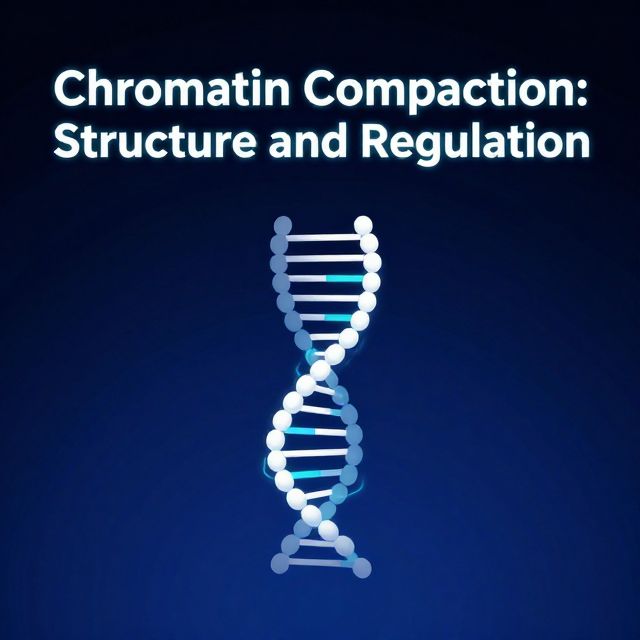
This study material has been compiled from a lecture audio transcript and copy-pasted text provided by the user.
Chromatin Compaction: Packaging the Genetic Blueprint 🧬
📚 Introduction
Chromatin compaction is a fundamental biological process essential for efficiently packaging vast amounts of genetic material within the confined space of a cell. This intricate organization not only allows DNA to fit but also plays a crucial role in regulating gene expression and cellular functions. This material explores the mechanisms of DNA compaction in both prokaryotic and eukaryotic cells, highlighting the hierarchical levels of organization and the dynamic nature of chromatin.
🦠 Prokaryotic Chromatin Compaction
In prokaryotic organisms, DNA compaction is achieved primarily through supercoiling. The circular DNA molecule wraps around itself, forming loops. This process is facilitated by nucleoid-associated proteins (NAPs), which bind to the DNA, inducing bends and folds. NAPs are also involved in essential processes like DNA replication and transcription.
eukaryotic Chromatin Compaction: A Hierarchical Process
Eukaryotic cells face a significantly greater challenge in DNA packaging. A single set of human chromosomes, if stretched end-to-end, would measure nearly three meters in length, yet it must be contained within a nucleus merely 2 to 4 micrometers in diameter. This necessitates a highly organized and dynamic compaction mechanism involving intricate interactions between DNA and various proteins. These protein-DNA interactions are not static; they change throughout the cell's life, directly influencing the degree of chromatin compaction.
1️⃣ Level 1: Nucleosomes – The "Beads on a String"
The initial level of eukaryotic DNA compaction involves histone proteins.
- Histones are basic (positively charged) proteins rich in lysine and arginine, allowing them to bind tightly to the negatively charged DNA backbone.
- Four core histones (H2A, H2B, H3, and H4) form an octamer (two of each).
- Approximately 147 base pairs of DNA wrap around this histone octamer, forming a nucleosome.
- A fifth histone, H1, acts as a linker histone, binding to the DNA between nucleosomes.
- This structure resembles "beads on a string" and achieves an initial ~7-fold shortening of the DNA length. ✅
2️⃣ Level 2: The 30 nm Fiber
Nucleosomes further associate to form a more compact structure known as the 30-nanometer fiber.
- Histone H1 plays a crucial role in stabilizing and compacting nucleosomes into this fiber.
- This level of compaction shortens the DNA approximately 50-fold from its original length. ✅
- The 30 nm fiber can form either a solenoid (a single helix coiling of the 11 nm nucleosome fiber) or a zig-zag stacking of nucleosomes that then coils.
3️⃣ Level 3: Radial Loop Domains
A subsequent level of compaction involves the interaction between the 30-nanometer fiber and the nuclear matrix.
- The nuclear matrix is composed of two parts: the nuclear lamina and internal matrix proteins.
- This interaction leads to the formation of radial loop domains, where DNA loops are anchored to the nuclear matrix at specific regions called Matrix-Attachment Regions (MARs) or Scaffold-Attachment Regions (SARs).
- These loops typically range from 25,000 to 200,000 base pairs.
- The attachment of radial loops to the nuclear matrix is significant for two primary reasons:
- It plays a role in gene regulation.
- It serves to organize chromosomes within the nucleus, establishing discrete and non-overlapping chromosome territories. 💡
🔄 Dynamic States of Chromatin
The compaction level of chromosomes is not uniform and changes dynamically throughout the cell cycle, influencing gene activity.
Interphase Chromatin
During interphase, chromatin exists in two main forms:
- Euchromatin:
- Less condensed regions of chromosomes.
- Generally transcriptionally active.
- Typically forms radial loop domains. ✅
- Heterochromatin:
- Tightly compacted regions of chromosomes.
- Generally transcriptionally inactive.
- Radial loop domains are compacted even further. ✅
- Types of Heterochromatin:
- Constitutive heterochromatin: Always heterochromatic and permanently inactive with regard to transcription.
- Facultative heterochromatin: Regions that can interconvert between euchromatin and heterochromatin. A classic example is the Barr body (an inactivated, condensed X chromosome in female cells), which is essential for regulating the amount of X-linked gene product. ⚠️
Metaphase Chromosomes
During cell division (mitosis), chromosomes undergo dramatic further compaction, reaching their most condensed state.
- These highly condensed structures are referred to as metaphase chromosomes.
- By the end of prophase, sister chromatids become entirely heterochromatic.
- These chromosomes exhibit minimal gene transcription.
- In metaphase chromosomes, the radial loops are compacted and anchored to the nuclear matrix scaffold.
- Condensin: This protein, normally in the cytoplasm during interphase, travels into the nucleus during mitosis. It binds to chromosomes and compacts the radial loops, reducing the diameter of each loop without changing their number. 1️⃣ 2️⃣ 3️⃣
- Cohesin: This protein aligns sister chromatids. During anaphase, cohesins along chromosome arms are released, but cohesin remains at the centromere until its degradation, allowing sister chromatids to separate.
🔑 Key Chromosome Structural Elements
To analyze human chromosomes, scientists examine three key features: size, banding pattern, and centromere position.
Centromeres 📚
- Primary constriction on a chromosome.
- Crucial for chromosome separation during cell division.
- Serve as the attachment point for spindle fibers via the kinetochore.
- Regions of sister chromatid cohesion.
- Composed of constitutive heterochromatin with repeat sequences (e.g., 5 to 170 bp).
- Associated with specific proteins, such as Centromere-specific histone H3 (CenH3).
- Centromere position relative to the chromosome end defines types: metacentric, submetacentric, acrocentric, and telocentric.
Origins of Replication
- Multiple origins of replication are present on eukaryotic chromosomes, occurring approximately every 100 kilobase pairs in humans.
- Heterochromatin typically replicates later in the S phase.
Telomeres 📚
- End structures of linear chromosomes.
- Vital for replicating chromosome ends and stabilizing them, preventing non-homologous end joining (NHEJ).
- Consist of G-rich tandem repeats (e.g., TTAGGG in vertebrates).
- The 3′ G overhang forms a distinct nucleoprotein structure called the t-loop, which helps protect chromosome ends from being recognized as damaged DNA.
- Telomerase: A specialized reverse transcriptase enzyme with an RNA primer. It extends the parental strand, building a template for lagging strand replication and maintaining telomere length.
- Abundant in rapidly dividing cells like mammalian embryos, stem cells, and cancer cells.
- Generally absent in mammalian somatic cells, leading to telomere shortening with each cell division and ultimately cellular senescence. ⚠️
💡 Histone Modifications
Post-translational modifications on histone proteins are crucial for establishing global chromatin structure (e.g., heterochromatin vs. euchromatin) and regulating DNA-based functions such as replication, transcription, recombination, and repair.
- Histone acetylation: Generally associated with the activation of transcription.
- Histone de-acetylation: Generally associated with the repression of transcription.
- Other modifications include methylation, phosphorylation, ubiquitylation, sumoylation, ADP ribosylation, deimination, and proline isomerization. These modifications create a "histone code" that influences chromatin accessibility and gene expression. 📊