 Podit
Podit
Eukaryotic Cell Characteristics and Molecular Organization
Source Information: This study material has been compiled from lecture notes and accompanying presentation slides, integrating information on eukaryotic cell morphology and their fundamental chemical composition.
1. Introduction to Cellular Foundations 📚
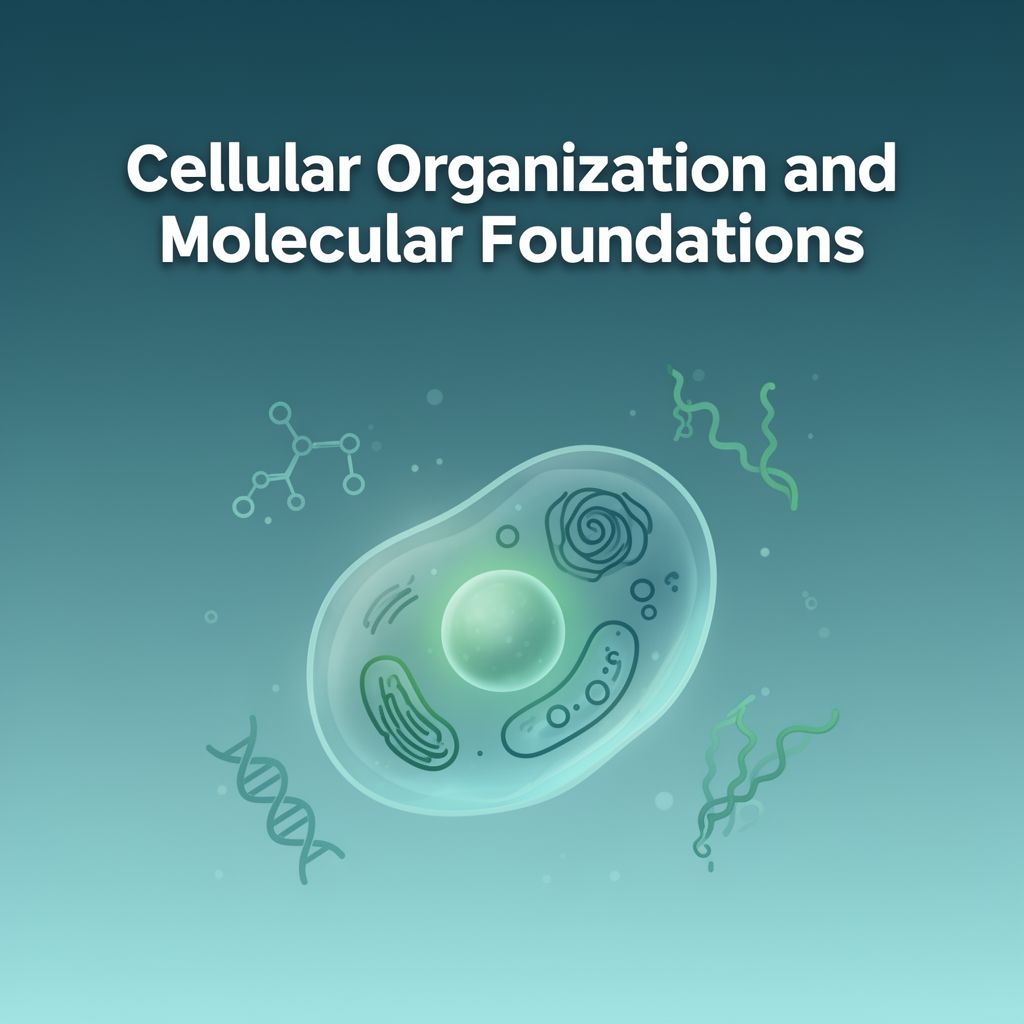
This study guide explores the fundamental characteristics of eukaryotic cells, focusing on their physical attributes like shape, size, and volume, as well as the intricate molecular bases of their chemical organization. Understanding these foundational concepts is crucial for comprehending the complex functions of living organisms.
2. General Notions Concerning Eukaryotic Cells 🔬
2.1. Cell Shape: Form Follows Function ✅
Young cells are typically spherical (e.g., egg cells, pluripotent stem cells). However, as cells differentiate, their shape adapts precisely to their specific function. This principle is often summarized as "form follows function."
- Nerve Cells: Develop long extensions to efficiently send and receive electrical impulses.
- Muscle Cells: Are elongated to facilitate contraction and movement.
- Red Blood Cells: Possess a biconcave disc shape, optimized for efficient oxygen transport and flexibility through capillaries.
2.2. Cell Size: Microscopic Diversity 📏
The size of eukaryotic cells varies significantly, even within the same organism.
- Average Human Cells: Typically range from 20-30 micrometers (µm). (1 µm = 10⁻⁶ m).
- Smallest Cells:
- Neurons from the cerebellum: 3-6 µm in diameter.
- Lymphocytes: 4-5 µm.
- Largest Cells:
- Pyramidal neurons from the frontal cortex: 125-150 µm.
- Ovocyte: Up to 250 µm.
- 💡 Striking Example: The yolk of an ostrich egg is a single cell approximately 10 cm in diameter.
2.3. Cell Volume: The Law of Constancy ⚖️
While cell size varies, the volume of a specific cell type tends to remain constant regardless of the species or the overall size of the organism.
- Human Cell Volume: Can range from 300 to 15,000 µm³.
- Key Principle: The dimension of various organs is determined not by the size of the cells that compose them, but by the sheer number of cells within that organ.
3. Molecular Bases of Chemical Organization of the Cell ⚛️
3.1. Chemical Elements in Living Organisms 📊
Living organisms are composed of a diverse array of chemical elements.
- Total Identified Elements: Around 92 elements can be found in cells.
- Essential Elements: Approximately 20 elements are crucial for life processes.
3.1.1. Classification of Elements:
Elements are categorized based on their abundance in living matter:
-
Macroelements (Major Chemical Elements):
- Constitute 2-65% each of cellular mass.
- Examples: Carbon (C), Hydrogen (H), Oxygen (O), Nitrogen (N).
- Carbon (C): The main element of organic compounds.
- Features: Tetravalent (forms four bonds), can establish strong covalent bonds with other carbon atoms and with H, N, O, forming complex structures (long chains, branched trees, rings).
- Reactivity: Unsaturated carbon compounds are highly reactive, playing a vital role in metabolic processes.
-
Microelements (Less Abundant Elements):
- Constitute 0.02-0.1% each.
- Examples: Phosphorus (P), Sulfur (S), Chlorine (Cl) (metalloids); Sodium (Na), Potassium (K), Calcium (Ca) (metals).
- Plastic Elements: Macroelements and Microelements together are often referred to as "plastic elements" due to their structural roles.
-
Oligoelements (Trace Elements):
- Constitute less than 0.02% each, but are extremely important for life and medicine.
- Examples & Importance:
- Iron (Fe): Essential component of hemoglobin (oxygen transport in blood) and myoglobin (oxygen storage in muscles).
- Iodine (I): Crucial for the structure of thyroid hormones, which regulate metabolism.
- Cobalt (Co), Zinc (Zn), Lead (Pb), Cadmium (Cd): Can act as enzymatic activators or inhibitors, influence the cardiovascular system, affect gamete formation, and impact intra-uterine development of the embryo and fetus. Some (Pb, Cd) can induce neuropsychological conditions in children.
- Medical Implications (Biochemical Endemics):
- ⚠️ Absence of Oligoelements: Can lead to endemic diseases.
- Iodine Deficiency: Results in hypothyroidism in adults and cretinism in children.
- Iron Insufficiency: Causes ferriprive anemia.
- Selenium (Se) Deficiency: Associated with a higher risk of cancer.
- Fluorine (F) Deficiency: Leads to dental caries.
- Magnesium (Mg) Deficiency: Linked to a higher incidence of cardiovascular diseases.
3.2. Chemical Substances: Building Blocks of Life 🧬
Living organisms are primarily composed of a few key chemical substances in similar proportions:
- Water: ~70%
- Proteins: ~15%
- Nucleic Acids: ~7%
- Sugars (Glucids) & Metabolites: ~3%
- Lipids & Metabolites: ~2%
- Inorganic Ions: ~1%
- Other Substances: <1%
3.2.1. Inorganic Substances:
-
Water (H₂O): The Universal Solvent 💧
- Major Component: Makes up 60-95% of cellular mass.
- Distribution:
- Intracellular water: ~55%
- Extracellular water: ~45% (plasma, lymph, interstitial liquids, digestive secretions, cerebrospinal fluid).
- Crucial Role: Water is the only solvent of living matter.
- Physico-Chemical Properties:
- 1️⃣ Polar Nature: Asymmetric electron distribution creates an electric dipole.
- High Dielectric Constant: Attenuates electrical interactions, acting as an "electrical shield" for living structures.
- Excellent Solvent: Due to its polarity, it dissolves many substances.
- 2️⃣ Dissociation: Water molecules can dissociate into protons (H⁺) and hydroxyl ions (OH⁻), participating in biochemical reactions.
- 3️⃣ Hydrogen Bonding: Each water molecule can form 1-4 hydrogen bonds with other water molecules.
- Stability: Stable in ice, labile (continuously formed and broken) in liquid water.
- High Heat Capacity: Allows water to absorb significant heat, making it an excellent cooler and temperature regulator.
- High Value of Vaporization: Important for cooling organisms through evaporation (thermoregulatory property).
- 1️⃣ Polar Nature: Asymmetric electron distribution creates an electric dipole.
- Water Phases in Cells:
- Aquatic Phase:
- Free-water (~95%): Acts as a solvent or dispersion medium.
- Bound water (~5%): Water molecules bound by hydrogen bonds to other structures (mainly proteins).
- Non-aquatic Phase: Areas where water is excluded (e.g., inner space of macromolecules, inside cell membranes).
- Aquatic Phase:
- Transport: Water transport across cell membranes is facilitated by specialized channels called aquaporins.
-
Mineral Salts: Essential Ions 🧂
- Cations: Na⁺, K⁺, Ca²⁺, Mg²⁺
- Anions: Phosphates (PO₄³⁻, HPO₄²⁻, H₂PO₄⁻), Sulfate (SO₄²⁻), Carbonates (HCO₃⁻, CO₃²⁻), Nitrate (NO₃⁻).
- Importance:
- Maintain osmotic pressure and acid-base equilibrium.
- Components of heteroproteins.
- Participate in crucial membrane processes: permeability, excitability, contractility, conductibility, cytoplasmic viscosity.
- ⚠️ Critical Note: Small variations in ion concentrations can lead to severe functional alterations (e.g., cardiac arrhythmias) or even sudden death.
3.2.2. Organic Substances:
Cells contain four major families of small organic molecules. Here we focus on glucids and lipids.
-
Glucids (Sugars/Carbohydrates): Energy & Structure 🍬
- Monosaccharides:
- Structure: (CH₂O)n with two or more hydroxyl groups; can be aldoses (aldehyde group) or ketoses (ketone group).
- Plastic Role: Form structural components of DNA and RNA.
- Energetic Role: Glucose is a prime example.
- Highly soluble in water, easily absorbed and transported.
- Stable hexose; breaking its covalent bonds releases high energy.
- Easily metabolized to produce ATP (adenosine triphosphate), the cell's energy currency.
- Polysaccharides:
- Glycogen: Storage form for glucose in animal cells (similar to starch in plants).
- Benefits: Reduces osmotic pressure within the cell. Its branched structure allows enzymes to rapidly attach or separate glucose molecules.
- Regulation: Rapidly synthesized (glucose added to glycogen after meals) and degraded (glucose dissociated from glycogen during hypoglycemia) according to energy needs.
- Pathology: Lafora disease is an autosomal recessive progressive myoclonus epilepsy characterized by abnormal glycogen accumulation (Lafora bodies) in neurons.
- Glycogen: Storage form for glucose in animal cells (similar to starch in plants).
- Mucopolysaccharides:
- Structure: Polysaccharides with monomer units containing amino derivatives of monosaccharides (e.g., glucosamine, galactosamine).
- Examples: Fibrous molecules.
- Proteoglycans: Mucopolysaccharides attached to polypeptide chains.
- Role: Important components of the extracellular matrix, providing mechanical functions (support, shock absorption, lubrication) and actively participating in tissue metabolism.
- Monosaccharides:
-
Lipids (Fats): Energy, Structure & Regulation 🥑
- Functions:
- a) Energetic Role: The biggest source of energy, releasing more energy than sugars and proteins.
- b) Plastic Role: Basic constituents of cell membranes.
- c) Regulatory Role: Liposoluble vitamins, steroid hormones, and prostaglandins regulate various metabolic processes.
- Classification:
- A) Simple Lipids: Free fatty acids (e.g., with 16 or 18 carbon atoms).
- Used in beta-oxidation for energy production.
- Precursors for biosynthesis of triglycerides and complex lipids.
- B) Triglycerides (Storage Lipids):
- Found in adipose cells, giving them a characteristic "signet ring" appearance.
- Pathological Conditions: Accumulation can lead to hepatic steatosis in obese and alcoholic patients or those with liver diseases.
- C) Complex Lipids:
- Present in cellular membranes.
- Types: Phospholipids and glycolipids.
- A) Simple Lipids: Free fatty acids (e.g., with 16 or 18 carbon atoms).
- Functions:
Conclusion 💡
The intricate interplay between the physical characteristics and the diverse chemical components discussed here forms the fundamental basis of eukaryotic cell structure and function. From the precise shapes cells adopt to perform their roles, to the essential elements and complex organic molecules that build and power them, each aspect is critical for the maintenance of life.