Podit
Podit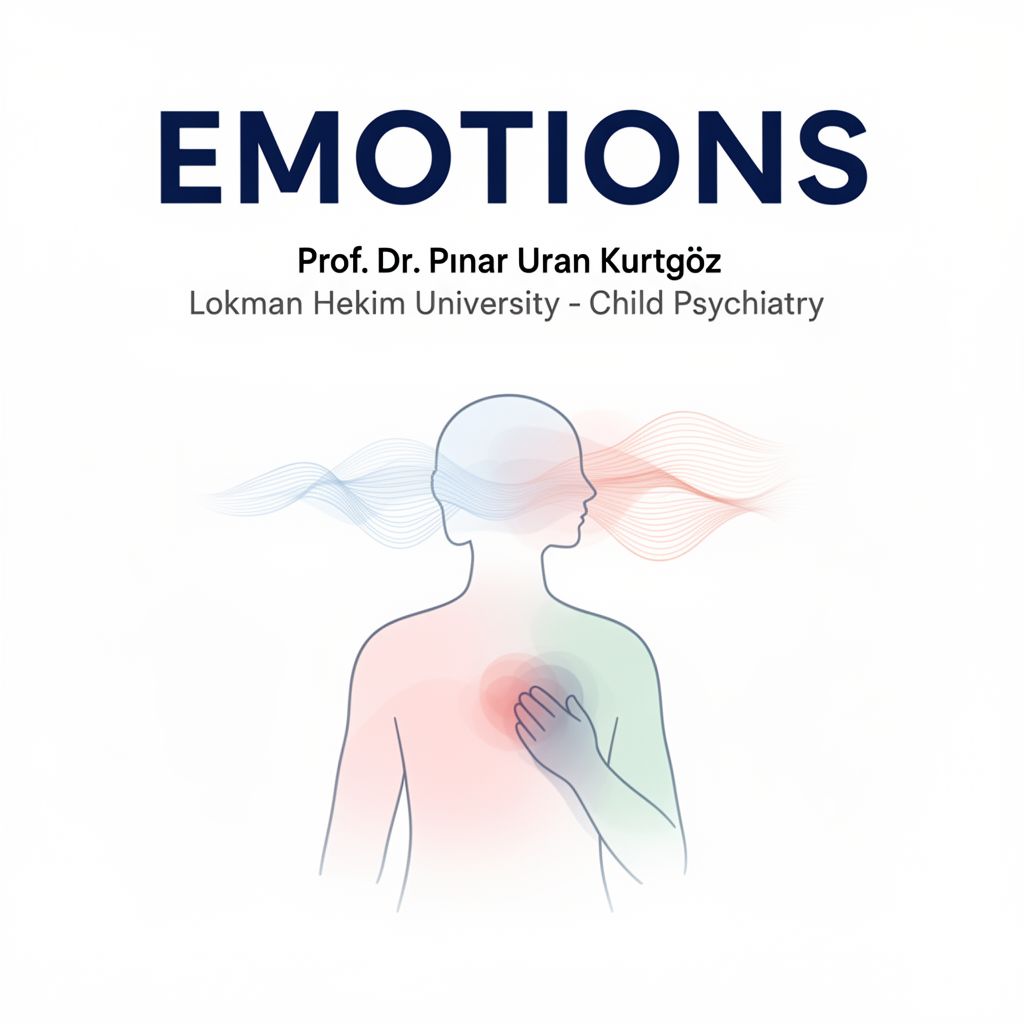
📚 Study Material: Understanding Emotions
Source Information: This study material has been compiled from a lecture audio transcript and a copy-pasted text provided by Prof. Dr. Pınar Uran Kurtgöz from Lokman Hekim University Faculty of Medicine, Department of Child and Adolescent Psychiatry.
1.0 Introduction to Emotions 🌍
Emotions are fundamental to human experience, acting as complex, multifaceted processes that profoundly influence our behavior, motivation, and actions. They are not merely internal states but involve a dynamic interplay of physiological, expressive, and subjective components.
✅ Key Characteristics of Emotions:
- Complex Processes: Involve many different aspects.
- Behavioral Determinants: Shape our actions and reactions.
- Motivational Drivers: Significantly impact our drive and initiation of actions.
- Physiological Manifestations: Include changes like heart rate, pupil dilation, sweating, and facial flushing, which vary with context.
- Expressive & Subjective Aspects: Beyond physical reactions, emotions have outward expressions and internal subjective experiences.
- Biological System Organization: Emotion-related systems rapidly coordinate responses across various biological systems (facial expression, muscle tone, autonomic nervous system, endocrine responses) to create an optimal bodily environment for effective reactions.
2.0 Distinguishing Key Concepts: Emotion, Feeling, Affect, and Mood 💡
While often used interchangeably, these terms have distinct meanings in the study of emotions.
2.1 Emotion 📚
Emotion refers to a specific, relatively intense, and sudden reaction to an internal or external situation. It is a subjective state that manifests through feelings and leads to alterations in biological systems, impacting physiological, experiential, behavioral, and cognitive processes linked to different neural systems. Responding to an emotional stimulus is an adaptive process, involving peripheral physiological responses, behavioral responses, and subjective experiences (feelings).
2.2 Feeling 📚
Feeling is the subjective experience of emotion. It is the conscious awareness of somatic (bodily) and cognitive changes that occur during an emotional state, but it is not the emotion itself.
2.3 Affect 📚
Affect is an individual's capacity to engage with stimuli, events, thoughts, and memories through emotional reactions such as joy, anger, or sadness. It represents the immediate, observable expression of emotion.
2.4 Mood 📚
Mood describes an individual's presence in a certain type of affect for a sustained period, within specific limits.
- It is a longer-standing but less intense state compared to a temporary emotion triggered by an event.
- Mood does not typically have a specific object or triggering stimulus.
- Mood traits may not always be consciously recognized or identified.
- Mood States:
- Normal (Euthymic): A balanced, non-depressed, non-elevated mood.
- Elevated (Euphoric): An excessively happy or excited mood.
- Depressed or Dysphoric: A state of sadness, gloom, or general dissatisfaction.
3.0 Factors Influencing Emotional Experiences 📊
The formation of emotional experiences is determined by various factors, leading to different emotional reactions in different people to the same situation. Both the nature of the external stimulus and individual personality traits play a role. These factors can be categorized into two main groups:
1️⃣ Conditioning:
- Certain emotional responses to specific stimuli are often learned behaviors.
- Individuals learn in parallel with the cultural norms of their environment.
- Conditioning can lead to habits of both positive and negative emotions.
- Negative Conditioning Example: A child learning to associate fear with a mouse, and subsequently feeling fear upon seeing a mouse. Fears are among the most easily conditioned emotional experiences.
- Positive Conditioning Example: A child in a home where cats are loved becomes positively conditioned towards cats.
2️⃣ Individual Factors:
- These are internal states that can influence emotional responses.
- Examples: Hunger, hormonal changes, and other physiological states.
4.0 Functions of Emotion ✅
Emotions serve several critical functions that contribute to our survival, well-being, and social interactions:
- Cognitive Processing: Contribute to assessing the significance of events, setting priorities, and attributing value.
- Life Enrichment: Make life worthwhile and enable us to feel present in the moment.
- Hazard Protection: Generate signals for protection against danger.
- Action & Motivation: Direct us to action, motivate behaviors, and initiate them.
- Social Interaction: Regulate and facilitate social interactions.
- Non-verbal Communication: Facilitate communication without words.
- Self-Development: Contribute to personal growth and understanding.
5.0 Theories of Emotion 🧠
Several theories attempt to explain how emotions arise and are experienced.
5.1 1️⃣ James-Lange Theory
- Core Idea: Emotions are a direct result of physiological changes in the body.
- Mechanism: Suggests that emotions arise after physiological symptoms occur, following the activation of the sympathetic nervous system in response to a danger or threat.
- Example: The "fight or flight" response (e.g., respiratory symptoms, tachycardia) occurs first, and then the emotion (e.g., fear) is experienced as a consequence of these bodily changes.
5.2 2️⃣ Cannon-Bard Theory
- Core Idea: Physiological arousal and the experience of emotion occur simultaneously and independently.
- Mechanism: The brain (specifically the thalamus) sends signals to both the body (causing physiological arousal) and the cerebral cortex (causing the conscious experience of emotion) at the same time.
- Example: When you see a dog, your body prepares for a fight-or-flight response, and you feel fear at the same time. One does not cause the other; they are parallel processes.
5.3 3️⃣ Schachter-Singer Theory (Two-Factor Theory)
- Core Idea: Emotional response consists of two factors: physiological arousal and cognitive interpretation.
- Mechanism:
- Stage 1: A stimulus leads to undifferentiated physiological arousal.
- Stage 2: This arousal is then interpreted and labeled by making sense of the situation and context.
- Example: If you experience a racing heart (arousal) in a dangerous situation, you might label it as fear. If you experience the same racing heart during an exciting event, you might label it as excitement.
5.4 4️⃣ Facial Feedback Hypothesis
- Core Idea: Changes in facial expressions can directly influence and alter the experience of emotion.
- Mechanism: Proposed by Tomkins in 1962, this hypothesis suggests that our facial expressions provide feedback to the brain, which then influences our emotional state.
- Example: Smiling should typically make individuals feel happier, while frowning should make them feel sadder.
6.0 Primary and Secondary Emotions ⚠️
Emotions can also be categorized based on their directness and origin.
- Primary Emotions: These are initial, direct, and immediate emotional responses to a situation. They are often considered basic or fundamental emotions.
- Secondary Emotions: These are learned responses that arise in reaction to primary emotions. They are often more complex and can involve cognitive appraisal and social learning.
Example:
- Primary Emotion: "I just found out that we have to move to a different city because my Dad got a new job, and I'm sad." (Sadness is the direct, immediate response.)
- Secondary Emotion: "I feel guilty for feeling sad because I know I should be supporting my family and my Dad even though I don't want to move." (Guilt arises as a learned response to the primary feeling of sadness, influenced by social expectations or personal values.)