 Podit
Podit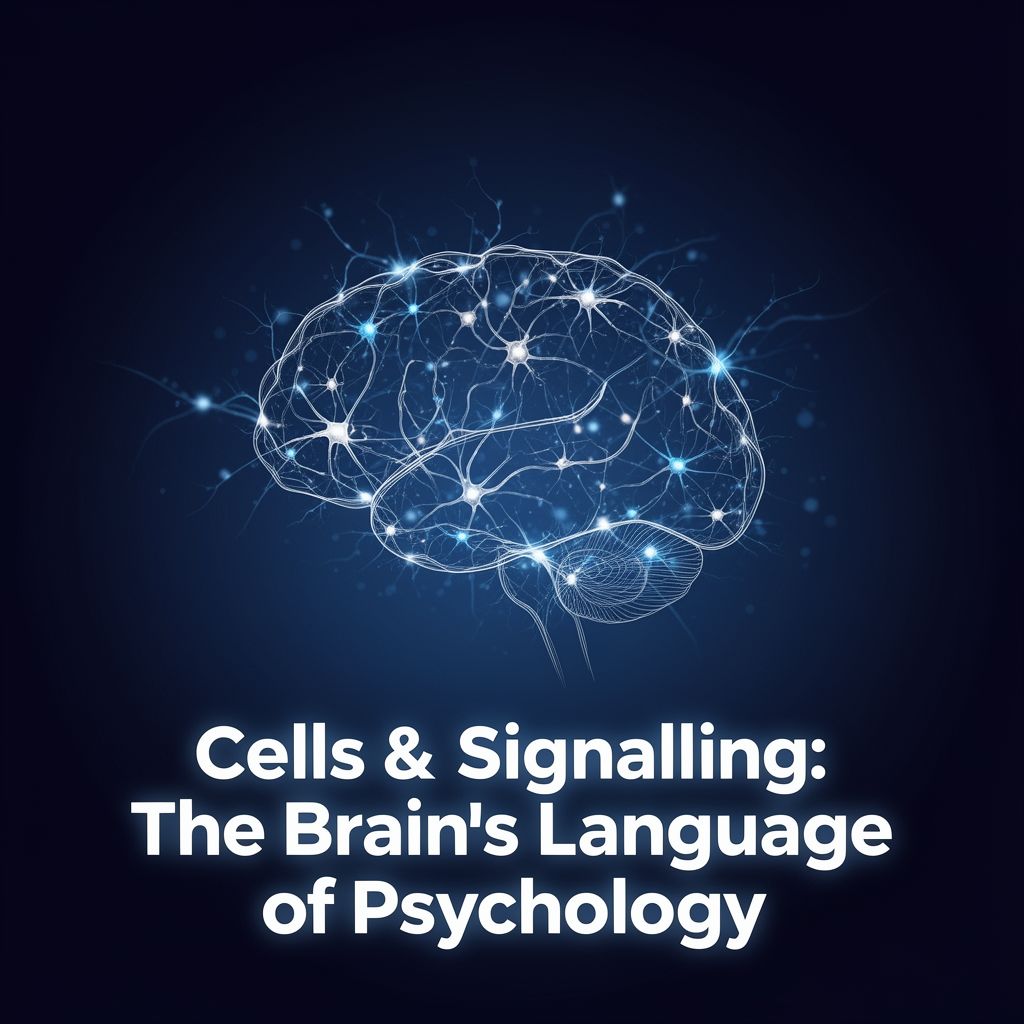
🧠 Cells and Signalling in Psychology: The Biological Basis of Mind
Source Information: This study material is compiled from a lecture audio transcript titled "Welcome to the Inner Workings of Your Mind," focusing on the cellular and signalling mechanisms underlying psychological processes.
📚 Introduction: Unveiling the Brain's Symphony
Psychology often explores theories, behaviors, and mental processes. However, understanding the fundamental biological mechanisms that enable these phenomena is crucial. This study guide delves into the microscopic interactions within the brain – the cells and their communication – that form the very fabric of our thoughts, feelings, and actions. By exploring these foundational concepts, we gain a deeper appreciation for the biological underpinnings of the human mind.
1️⃣ The Cellular Foundation: Neurons and Glia
The brain's incredible capabilities stem from the intricate interplay of two primary cell types: neurons and glial cells. While neurons are often considered the "information processors," glial cells provide essential support, ensuring optimal neuronal function.
1.1. 🌟 Neurons: The Information Processors
Neurons are the fundamental units responsible for transmitting electrical and chemical signals throughout the nervous system. They are specialized cells designed for communication.
✅ Key Components of a Neuron:
- Cell Body (Soma) 📚:
- The neuron's control center, containing the nucleus and essential organelles.
- Responsible for maintaining the cell's life and function.
- Integrates incoming signals and determines whether to generate an outgoing message.
- Dendrites 📚:
- Branching extensions resembling antennae, extending from the cell body.
- Primary function is to receive signals from other neurons.
- The more dendrites and branches a neuron has, the more connections it can form and the more information it can potentially process.
- Axon 📚:
- A long, slender projection that extends from the cell body.
- Carries the electrical signal (message) away from the cell body to other neurons, muscles, or glands.
- Myelin Sheath 💡: A fatty, insulating substance that covers many axons.
- Acts like insulation around an electrical wire.
- Significantly speeds up the transmission of electrical signals.
- Without myelin, neural communication would be much slower.
- Nodes of Ranvier 📚: Gaps in the myelin sheath.
- Allow the electrical signal to "jump" from node to node, further accelerating transmission (saltatory conduction).
1.2. 🛠️ Glial Cells: The Essential Support Crew
Historically, glial cells were thought to be mere "glue" (from the Greek "glia") holding neurons together. However, we now understand they play active and crucial roles in brain function, development, and maintenance.
✅ Types and Functions of Glial Cells:
- Astrocytes 📚:
- Star-shaped glial cells.
- Help form the blood-brain barrier, regulating the passage of substances into the brain.
- Regulate the chemical environment around neurons (e.g., neurotransmitter reuptake, ion balance).
- Participate in synaptic signaling and neuronal development.
- Oligodendrocytes (Central Nervous System) & Schwann Cells (Peripheral Nervous System) 📚:
- Responsible for producing the myelin sheath that insulates axons.
- Oligodendrocytes myelinate multiple axons in the CNS.
- Schwann cells myelinate a single axon in the PNS.
- Microglia 📚:
- The immune cells of the brain.
- Act as scavengers, clearing away waste products, dead cells, and pathogens.
- Protect the brain from invaders and inflammation.
💡 Insight: The intricate dance between neurons and glial cells is fundamental to all brain functions, influencing everything from information processing to mood regulation.
2️⃣ The Language of Signalling: How Cells Communicate
Neural communication involves a sophisticated interplay of electrical and chemical signals, allowing billions of neurons to coordinate and process information rapidly.
2.1. ⚡ Action Potential: The Electrical Signal
The primary way neurons send electrical messages is through an action potential.
- Definition 📚: A brief, rapid electrical impulse that travels down the axon. It's a sudden, temporary change in the electrical potential across the neuron's membrane.
- "All-or-Nothing" Principle ✅: An action potential either fires completely or not at all. There's no "half-fire." Once the threshold is reached, the impulse is generated with full strength.
- Mechanism 1️⃣ 2️⃣ 3️⃣:
- Resting State: The neuron maintains a negative electrical charge inside compared to outside (resting potential).
- Depolarization: If sufficient excitatory signals are received, ion channels open, allowing positively charged ions (e.g., sodium) to rush into the cell. This makes the inside of the neuron temporarily positive.
- Repolarization: Other ion channels open, allowing positively charged ions (e.g., potassium) to rush out, restoring the negative charge inside.
- Hyperpolarization: The neuron briefly becomes even more negative than its resting state before returning to normal, preventing immediate re-firing.
- This rapid change in electrical charge propagates down the axon like a wave.
2.2. 🌉 Synapse: The Communication Junction
When an action potential reaches the end of an axon, it arrives at a specialized junction called a synapse. This is where the electrical signal is converted into a chemical signal to communicate with the next neuron.
- Definition 📚: The specialized gap between two neurons where information is transmitted.
- Components of a Synapse ✅:
- Presynaptic Neuron 📚: The neuron sending the signal. Its axon terminal contains neurotransmitters.
- Synaptic Cleft 📚: The tiny physical gap between the axon terminal of the presynaptic neuron and the dendrite or cell body of the postsynaptic neuron. Neurons do not directly touch.
- Postsynaptic Neuron 📚: The neuron receiving the signal. Its membrane contains receptor sites for neurotransmitters.
2.3. 🧪 Neurotransmitters: The Chemical Messengers
Neurotransmitters are chemical substances that transmit signals across the synaptic cleft.
-
Mechanism of Action 1️⃣ 2️⃣ 3️⃣:
- Release: When an action potential reaches the presynaptic axon terminal, it triggers the release of neurotransmitters into the synaptic cleft.
- Diffusion: Neurotransmitters diffuse across the synaptic cleft.
- Binding: They bind to specific receptor sites on the postsynaptic neuron, much like a key fitting into a lock.
- Effect: This binding causes a change in the postsynaptic neuron's electrical potential, either exciting it (making it more likely to fire an action potential) or inhibiting it (making it less likely to fire).
- Termination: Neurotransmitters are then either reabsorbed by the presynaptic neuron (reuptake), broken down by enzymes, or diffuse away, clearing the synaptic cleft for new signals.
-
Excitatory vs. Inhibitory Neurotransmitters 💡:
- Excitatory: Increase the likelihood of the postsynaptic neuron firing an action potential.
- Inhibitory: Decrease the likelihood of the postsynaptic neuron firing an action potential.
- The balance of these signals determines the overall activity of the neuron.
-
Key Neurotransmitters and Their Psychological Impact 📊:
- Dopamine (DA) 🧠:
- Function: Associated with pleasure, reward, motivation, motor control, and executive functions.
- Psychological Impact: Imbalances linked to Parkinson's disease (too little), schizophrenia (too much), and addiction. Plays a role in feelings of excitement and goal achievement.
- Serotonin (5-HT) 🧠:
- Function: Crucial for mood regulation, sleep, appetite, digestion, learning, and memory.
- Psychological Impact: Low levels are associated with depression, anxiety, and obsessive-compulsive disorder. Many antidepressant medications (SSRIs) work by increasing serotonin levels.
- Acetylcholine (ACh) 🧠:
- Function: Vital for muscle contraction (at the neuromuscular junction), learning, memory, and attention.
- Psychological Impact: Involved in cognitive functions. Degeneration of cholinergic neurons is linked to Alzheimer's disease.
- Norepinephrine (NE) / Noradrenaline 🧠:
- Function: Involved in the "fight or flight" response, alertness, arousal, attention, and stress response.
- Psychological Impact: Helps focus and react to stressful situations. Imbalances can contribute to mood disorders and anxiety.
- Gamma-Aminobutyric Acid (GABA) 🧠:
- Function: The primary inhibitory neurotransmitter in the brain. Acts as the "brake" for neural activity.
- Psychological Impact: Reduces neuronal excitability, promoting relaxation and reducing anxiety. Medications for anxiety often enhance GABA's effects.
- Glutamate 🧠:
- Function: The primary excitatory neurotransmitter in the brain. Acts as the "accelerator" for neural activity.
- Psychological Impact: Crucial for learning, memory formation, and synaptic plasticity. Excessive glutamate can be neurotoxic.
- Dopamine (DA) 🧠:
3️⃣ Conclusion: The Biological Basis of You
Our exploration reveals that every thought, emotion, decision, and memory is rooted in the intricate biological machinery of the brain. The constant communication between neurons, facilitated by glial cells and mediated by electrical action potentials and chemical neurotransmitters across synapses, forms the complex tapestry of our psychological experience.
Understanding these cellular and signalling processes provides a tangible foundation for comprehending the human mind, psychological disorders, and the development of effective treatments. It underscores that psychology is deeply intertwined with the biological mechanisms occurring within us. Every new piece of information we learn literally reshapes these incredible cellular networks, highlighting the dynamic and adaptable nature of the brain.