Podit
Podit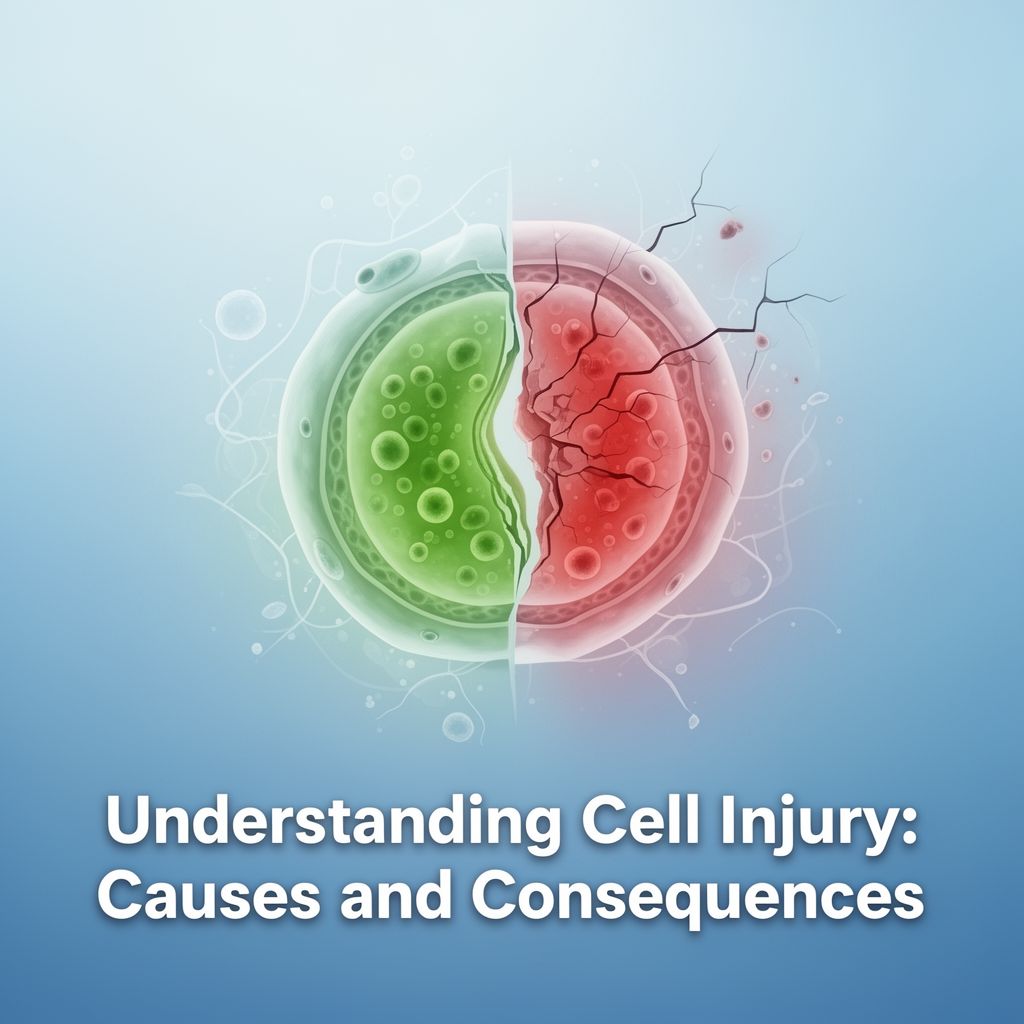
Sesli Özet
6 dakikaKonuyu otobüste, koşarken, yolda dinleyerek öğren.
Sesli Özet
Understanding Cell Injury: Causes and Consequences
Flash Kartlar
22 kartKarta tıklayarak çevir. ← → ile gez, ⎵ ile çevir.
Tüm kartları metin olarak gör
1. What is the fundamental definition of cell injury?
It is the result of a cell being subjected to stress from etiological agents, leading to changes in its internal and external environment.
2. What factor determines if cell injury is reversible or irreversible?
The severity of the stress; mild to moderate stress is reversible, while severe stress is irreversible.
3. What is Hypoxia?
A deficiency in the amount of oxygen reaching the tissues.
4. According to the text, what is a primary cause of hypoxia?
Significant blood loss, which reduces the body's capacity to transport oxygen to cells.
5. List three examples of 'physical agents' that can cause cell injury.
Mechanical trauma, extreme temperatures, radiation, and electric shock.
6. What is an 'etiological agent'?
A factor, such as a microorganism or chemical, that is a cause of a disease or injury.
7. Can therapeutic drugs cause cell injury?
Yes, they can have toxic effects at certain doses or in susceptible individuals.
8. Name two types of immunological reactions that can harm cells.
Autoimmune reactions, where the body attacks its own cells, and allergic reactions.
9. How can genetic defects lead to cell injury?
By causing the production of a misfolded protein or by reducing a cell's ability to cope with stress.
10. What is the defining characteristic of reversible cell injury?
The cell can repair the damage and return to its normal state if the stress is removed.
11. What is 'bleb formation' in the context of cell injury?
An alteration in the plasma membrane during reversible injury where the membrane bulges outward.
12. What is 'steatosis'?
It is the accumulation of fat within the cell, which is a sign of reversible injury.
13. What are two changes that occur in mitochondria during reversible injury?
They can exhibit swelling (hydropic change), rarefaction (becoming less dense), and formation of amorphous densities.
14. What nuclear change is characteristic of reversible cell injury?
The disaggregation of granular and fibrillar elements within the nucleus.
15. What does 'dilatation' of the Endoplasmic Reticulum (ER) signify?
It refers to the swelling of the ER, a change that occurs during reversible cell injury.
16. What is the ultimate fate of a cell that has undergone irreversible injury?
Cell death, because recovery is no longer possible.
17. Which two organelles are mentioned as showing severe swelling during irreversible injury?
The Endoplasmic Reticulum (ER) and the lysosomes.
18. What is the field of study, also known as pathology, that covers cell injury?
The text refers to it as Roganidana.
19. What happens to the connections between cells during reversible injury?
There is a loosening of intracellular attachments, which weakens the connections.
20. Besides swelling, what other change happens to the Endoplasmic Reticulum during reversible injury?
Detachment of ribosomes and disaggregation of its components.
21. Can nutritional excesses, not just deficiencies, cause cell injury?
Yes, excesses such as those seen in obesity or high cholesterol can disrupt cellular function.
22. What are lysosomes?
They are the cell's recycling centers, and their breakdown is a feature of irreversible injury.
Bilgini Test Et
10 soruÇoktan seçmeli sorularla öğrendiklerini ölç. Cevap + açıklama.
According to the text, what is the primary factor that determines whether cell injury is reversible or irreversible?