 Podit
Podit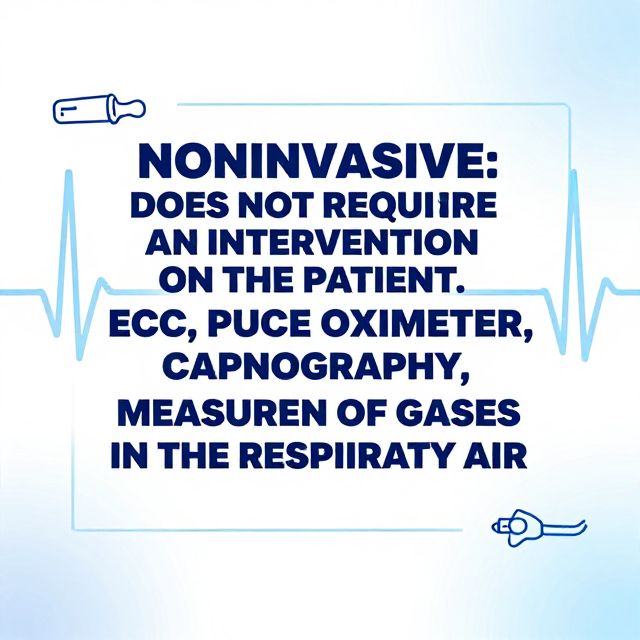
This study material is compiled from a lecture audio transcript and supplementary copy-pasted notes, providing a comprehensive overview of patient monitoring techniques and the critical limitations of pulse oximetry.
Patient Monitoring Techniques & Pulse Oximetry Limitations
📚 Introduction to Patient Monitoring
Monitoring vital physiological parameters is fundamental in patient care. It allows healthcare professionals to assess a patient's condition, guide treatment decisions, and detect potential complications early. These monitoring techniques are broadly categorized into two types: non-invasive and invasive. Understanding the distinction between these methods is crucial for effective clinical practice and accurate interpretation of patient data.
1️⃣ Patient Monitoring Techniques
1.1 Non-Invasive Monitoring 🩺
Non-invasive monitoring techniques are characterized by not requiring any physical intervention or breach of the patient's body. This makes them generally safer, less uncomfortable for the patient, and ideal for continuous, routine monitoring.
✅ Key Characteristics:
- No direct contact with internal body tissues or fluids.
- Lower risk of infection or complications.
- Often used for continuous, long-term monitoring.
Examples of Non-Invasive Techniques:
-
Electrocardiogram (ECG) 🫀
- Purpose: Measures the electrical activity of the heart.
- Method: Electrodes are placed on the skin.
- Information Provided: Heart rate, rhythm, and detection of conduction abnormalities.
-
Pulse Oximetry (SpO2) 👆
- Purpose: Measures the oxygen saturation of arterial blood (SpO2) and pulse rate.
- Method: A small, clip-like device is placed on a finger, toe, or earlobe, emitting light through the tissue and measuring absorption.
- Information Provided: Percentage of hemoglobin saturated with oxygen.
-
Capnography 🌬️
- Purpose: Measures the concentration of carbon dioxide (CO2) in a patient's exhaled breath.
- Information Provided: Crucial for assessing ventilation effectiveness and respiratory status.
-
Measurement of Respiratory Gases 💨
- Purpose: Analysis of inhaled and exhaled gases.
- Method: Performed externally without direct patient intervention.
- Includes: Capnography and other gas analyses.
1.2 Invasive Monitoring 💉
Invasive monitoring techniques require the placement of patient-specific catheters or probes directly into the body. While these methods carry a higher risk of complications (e.g., infection, bleeding), they often provide more precise and continuous data that cannot be obtained non-invasively, especially in critically ill patients.
⚠️ Key Characteristics:
- Requires insertion of devices into body cavities, vessels, or tissues.
- Higher risk of complications compared to non-invasive methods.
- Provides highly accurate and continuous physiological data.
Examples of Invasive Techniques:
-
Arterial and Central Catheters ❤️🩹
- Arterial Catheter: Inserted into an artery (e.g., radial artery) for continuous, real-time blood pressure monitoring and frequent arterial blood gas (ABG) sampling.
- Central Catheter: Placed into a large vein (e.g., jugular, subclavian, femoral) for central venous pressure (CVP) monitoring, rapid fluid administration, and medication delivery.
-
Pulmonary Artery Catheter (Swan-Ganz Catheter) 🫁
- Purpose: A highly invasive device guided into the pulmonary artery.
- Information Provided: Detailed cardiac output measurements, pulmonary artery pressures, and other hemodynamic parameters.
-
Urinary Catheter 💧
- Purpose: Inserted into the bladder via the urethra.
- Information Provided: Drains urine and allows for precise monitoring of urine output, which is an indicator of renal function and fluid balance.
-
Nasopharyngeal Temperature Measurement 🌡️
- Purpose: Obtains an accurate core body temperature reading.
- Method: A temperature probe is placed into the nasopharynx.
- Classification: Considered invasive due to the internal insertion.
2️⃣ Critical Limitations of Pulse Oximetry ⚠️
Pulse oximetry is an invaluable non-invasive tool, but its readings must be interpreted with an understanding of its limitations to avoid misdiagnosis and ensure optimal patient care. Several factors can significantly affect the reliability and accuracy of pulse oximeter readings.
2.1 Motion Artefact 🏃♀️
- Description: Any movement by the patient (voluntary or involuntary) can interfere with the sensor's ability to detect a stable pulsatile signal.
- Impact: Leads to erratic readings, false alarms, or an inability to obtain a reading at all.
2.2 Inadequate Signal Quality 📉
Several conditions can weaken the pulsatile signal, making accurate readings challenging:
- Anemia: While low hemoglobin levels might not directly affect the percentage of oxygen saturation, severe anemia can lead to poor peripheral perfusion, making it difficult for the oximeter to detect a strong signal.
- Nail Polish: Dark or opaque nail polish colors can block the light emitted by the oximeter, resulting in falsely low readings or no reading at all.
- Low Perfusion: Conditions such as hypothermia, shock, or vasoconstriction (e.g., due to certain medications or peripheral vascular disease) reduce blood flow to the extremities, weakening the pulsatile signal.
2.3 Dyshemoglobinemia 🩸
Dyshemoglobinemia refers to the presence of abnormal forms of hemoglobin that interfere with the oximeter's ability to accurately distinguish between oxygenated and deoxygenated hemoglobin.
-
Carboxyhemoglobin (CO Poisoning) 💨
- Mechanism: Carbon monoxide (CO) binds to hemoglobin, forming carboxyhemoglobin (COHb). Pulse oximeters cannot differentiate between oxyhemoglobin and COHb because both absorb light at similar wavelengths.
- Impact: In cases of significant CO poisoning, the oximeter will often display a falsely high SpO2 reading, potentially trending towards 100%, even when the patient is severely hypoxic. This can give a dangerous false sense of security.
-
Methemoglobinemia 🧪
- Mechanism: Methemoglobin (MetHb) is an oxidized form of hemoglobin that cannot bind oxygen. Pulse oximeters tend to interpret MetHb as a mixture of oxygenated and deoxygenated hemoglobin.
- Impact: Significant methemoglobinemia causes the SpO2 reading to trend towards approximately 85%, regardless of the patient's true oxygen saturation. If the true SpO2 is very low, the oximeter might read higher (e.g., 85%), and if true SpO2 is high, it might read lower (e.g., 85%).
2.4 Factors NOT Affecting Accuracy ✅
- Hyperbilirubinemia (Jaundice): High levels of bilirubin, a yellow pigment, do not interfere with the light absorption properties that pulse oximeters rely on for SpO2 measurement. Therefore, jaundice will not inherently lead to inaccurate pulse oximetry readings.
💡 Clinical Insight: Understanding these limitations is paramount for healthcare providers to correctly interpret pulse oximetry data and integrate it with other clinical findings to ensure optimal patient care. Always consider the patient's overall clinical picture, not just isolated SpO2 readings.