Mechanisms of Antimicrobial Action and Resistance - kapak
Bilim#antibiotics#antimicrobials#protein synthesis inhibition#nucleic acid synthesis inhibition

Mechanisms of Antimicrobial Action and Resistance

This podcast explores the diverse mechanisms by which antimicrobial agents inhibit bacterial and viral growth, focusing on protein synthesis, nucleic acid synthesis, and folate metabolism, alongside key resistance strategies.

d123March 27, 2026 ~16 dk toplam
01

Flash Kartlar

25 kart

Karta tıklayarak çevir. ← → ile gez, ⎵ ile çevir.

1 / 25
Tüm kartları metin olarak gör
  1. 1. What is the primary goal of antimicrobial agents?

    Antimicrobial agents aim to combat pathogens by interfering with essential cellular processes. This understanding is crucial for both their effectiveness and the challenges posed by microbial resistance, as microorganisms constantly evolve ways to evade these drugs.

  2. 2. Which cellular process is targeted by drugs like Oxazolidinones, Chloramphenicol, and Macrolides?

    These drugs primarily target protein synthesis in bacteria. They interfere with different stages of translation, such as initiation, peptide bond formation, or translocation, ultimately preventing the pathogen from producing essential proteins required for its survival and replication.

  3. 3. How do Oxazolidinones, such as Linezolid, inhibit bacterial growth?

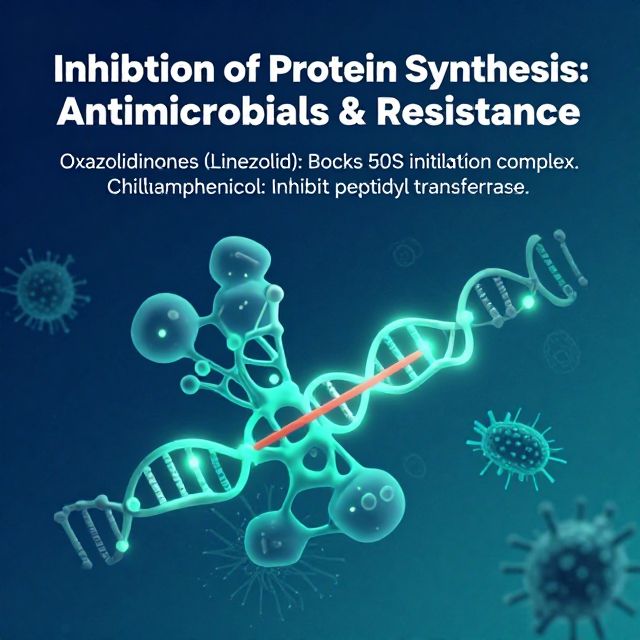
    Oxazolidinones block the initiation of protein synthesis by targeting the 50S ribosomal subunit. They specifically prevent the formation of the initiation complex, which includes tRNA, mRNA, and the ribosome, thereby halting the translation of messenger RNA into proteins.

  4. 4. For which types of bacteria is Linezolid particularly effective?

    Linezolid is notably effective against staphylococci, streptococci, and enterococci. Its unique mechanism of blocking protein synthesis initiation makes it a valuable treatment option for infections caused by these specific bacterial groups, especially those that are resistant to other antibiotics.

  5. 5. Explain the mechanism of action of Chloramphenicol.

    Chloramphenicol exerts a bacteriostatic effect by reversibly binding to the 50S ribosomal subunit. It inhibits peptide elongation by blocking peptidyl transferase activity, which is essential for forming peptide bonds between amino acids during protein synthesis. This prevents the bacterial cell from building necessary proteins.

  6. 6. What is a significant limitation of Chloramphenicol's use, especially in children?

    A significant limitation of Chloramphenicol is its potential to disrupt protein synthesis in human bone marrow cells, leading to adverse effects like aplastic anemia. This toxicity makes it less suitable for children and restricts its general use, despite its broad-spectrum antibiotic activity.

  7. 7. How do bacteria commonly develop resistance to Chloramphenicol?

    Resistance to Chloramphenicol often arises when bacteria produce a plasmid-encoded enzyme that acetylates the drug. This acetylation modifies Chloramphenicol, rendering it unable to bind to the 50S ribosomal subunit and inhibit protein synthesis, thus allowing the bacteria to continue growing.

  8. 8. Describe the mechanism by which Macrolides inhibit bacterial protein synthesis.

    Macrolides, including erythromycin, azithromycin, and clarithromycin, target the 50S ribosomal subunit. They block the translocation reaction, which is the movement of the ribosome along the mRNA. This inhibition prevents protein elongation, thereby halting protein synthesis and exhibiting bacteriostatic activity.

  9. 9. List some common clinical uses for Macrolides.

    Macrolides are commonly used for pulmonary infections caused by Mycoplasma, Chlamydia, and Legionella. They are also effective against Campylobacter and are a valuable option for treating gram-positive bacterial infections in patients who are allergic to penicillin, offering a broad range of applications.

  10. 10. What are the primary mechanisms of resistance to Macrolides?

    Resistance to Macrolides can develop through two main mechanisms: methylation of the 23S ribosomal RNA, which prevents the antibiotic from binding to its target site, or the production of enzymes by bacteria that inactivate the macrolide drug, rendering it ineffective.

  11. 11. How does Clindamycin exert its antimicrobial effect?

    Clindamycin works by binding to the 50S ribosomal subunit, similar to macrolides. This binding specifically blocks protein elongation, thereby inhibiting bacterial protein synthesis. It exhibits bacteriostatic activity against susceptible organisms, preventing their growth and reproduction.

  12. 12. Against which types of bacteria is Clindamycin active?

    Clindamycin is active against staphylococci and anaerobic gram-negative bacteria. Its spectrum of activity makes it useful for treating infections where these specific bacterial types are implicated, such as certain skin and soft tissue infections or intra-abdominal infections caused by anaerobes.

  13. 13. What is the main resistance mechanism for Clindamycin, and what is its implication regarding other antibiotics?

    The primary resistance mechanism for Clindamycin is methylation of the 23S rRNA, which prevents the drug from binding to its target. Importantly, cross-resistance is observed between clindamycin and erythromycin (a macrolide) due to their shared binding site and similar resistance mechanism, meaning resistance to one often implies resistance to the other.

  14. 14. Explain the synergistic action of Streptogramins like Quinupristin-dalfopristin.

    Streptogramins act synergistically: Dalfopristin prevents peptide chain elongation by binding to the 50S ribosomal subunit, while Quinupristin initiates the premature release of the peptide chain. This combined action enhances their bactericidal effect, making them more potent together than individually.

  15. 15. For what specific type of infection is Quinupristin-dalfopristin primarily used?

    Quinupristin-dalfopristin is primarily used for vancomycin-resistant Enterococcus faecium (VRE) infections. It is also active against staphylococci and streptococci, making it a crucial option for difficult-to-treat resistant gram-positive infections where other antibiotics may be ineffective.

  16. 16. What are the general mechanisms by which antimicrobials inhibit nucleic acid synthesis?

    Antimicrobials can inhibit nucleic acid synthesis through several general mechanisms. These include targeting DNA gyrase and topoisomerase, blocking folate synthesis (acting as antimetabolites), inflicting direct breaks in DNA, or inhibiting RNA synthesis by blocking RNA polymerase, all of which disrupt genetic material processes.

  17. 17. How do Quinolones, such as ciprofloxacin, inhibit bacterial growth?

    Quinolones specifically target bacterial DNA gyrase and topoisomerase IV. These enzymes are essential for the supercoiling and uncoiling of bacterial DNA during replication and transcription. By inhibiting them, quinolones prevent DNA replication and repair, leading to bacterial death, making them bactericidal.

  18. 18. Describe the spectrum of activity for Quinolones and a common resistance mechanism.

    Quinolones are bactericidal against a broad spectrum of aerobic and facultative anaerobic bacteria, including both Gram-positive and Gram-negative species. Resistance often emerges from chromosomal mutations in topoisomerase genes, which alter the drug's target, or decreased drug uptake by the bacterial cell, reducing its intracellular concentration.

  19. 19. What is the mechanism of action for Rifampin and Rifabutin?

    Rifampin and Rifabutin inhibit the initiation of RNA synthesis by binding to DNA-dependent RNA polymerase. This binding prevents the enzyme from transcribing DNA into RNA, thereby halting the production of essential bacterial proteins and ultimately leading to bacterial death, making them bactericidal.

  20. 20. What are the primary uses for Rifampin and Rifabutin, and how do bacteria resist them?

    Rifampin is bactericidal for Mycobacterium tuberculosis, while Rifabutin targets Mycobacterium avium. Resistance in Gram-positive bacteria often involves chromosomal gene mutations in the RNA polymerase, whereas Gram-negative bacteria are intrinsically resistant due to reduced uptake of these hydrophobic antibiotics, limiting their entry into the cell.

  21. 21. How does Metronidazole disrupt bacterial DNA?

    Metronidazole's antimicrobial action stems from the reduction of its nitro group under anaerobic conditions. This reduction creates reactive intermediates that cause direct breaks in the bacterial DNA strands. These DNA breaks are lethal to the bacterial cell, leading to its death.

  22. 22. For which types of infections is Metronidazole effective, and how can resistance occur?

    Metronidazole is effective against Trichomonas vaginitis, amebiasis, giardiasis, and various anaerobic infections. Resistance can involve decreased antibiotic uptake by the bacterial cell, preventing the drug from reaching its target, or the elimination of the cytotoxic compounds generated from the drug, reducing its damaging effects.

  23. 23. Explain the selective toxicity of Folate Inhibitors like sulfonamides and trimethoprim.

    Folate inhibitors are selectively toxic because mammalian cells acquire preformed folate from their diet, unlike bacteria which must synthesize it. These drugs interfere with bacterial folic acid synthesis, a pathway essential for nucleic acid and protein synthesis, without harming human cells that obtain folate externally.

  24. 24. How do Sulfonamides and Trimethoprim often work synergistically?

    Sulfonamides and Trimethoprim often work synergistically by blocking two sequential steps in bacterial folate metabolism. Sulfonamides inhibit an early step, and Trimethoprim inhibits a later step, leading to a more potent and complete inhibition of folic acid synthesis, thereby significantly impairing bacterial growth.

  25. 25. Name some uses for Folate Inhibitors and a resistance mechanism.

    The combination of sulfonamides and trimethoprim is used for various infections, including urinary tract infections and Pneumocystis jiroveci. Resistance mechanisms include permeability barriers, which prevent drug entry, decreased affinity to target enzymes, or the ability of bacteria to use exogenous thymidine, bypassing the inhibited pathway.

02

Bilgini Test Et

15 soru

Çoktan seçmeli sorularla öğrendiklerini ölç. Cevap + açıklama.

Soru 1 / 15Skor: 0

Which of the following antimicrobial mechanisms is NOT directly involved in inhibiting protein synthesis?

03

Detaylı Özet

6 dk okuma

Tüm konuyu derinlemesine, başlık başlık.

Antimicrobial Mechanisms and Resistance: A Comprehensive Study Guide

This study material is compiled from a lecture transcript and supplementary copy-pasted text, providing a detailed overview of antimicrobial agents, their mechanisms of action, and the critical issue of microbial resistance.


1. Introduction to Antimicrobial Action 📚

Antimicrobial agents are vital tools in combating infectious diseases. They work by interfering with essential cellular processes in pathogens, such as protein synthesis, nucleic acid synthesis, and metabolic pathways. Understanding these mechanisms is crucial for comprehending drug efficacy and the challenges posed by microbial resistance.


2. Inhibition of Protein Synthesis 🧬

Many antibiotics target bacterial ribosomes, which are responsible for protein synthesis. By disrupting this fundamental process, these drugs prevent bacteria from producing essential proteins needed for growth and survival.

2.1. Oxazolidinones (e.g., Linezolid)

  • Mechanism: Blocks the initiation of protein synthesis. Linezolid binds to the 50S ribosomal subunit, preventing the formation of the initiation complex (tRNA, mRNA, and ribosome). ✅
  • Effect: Halts the translation of messenger RNA (mRNA) into proteins.
  • Spectrum: Active against all staphylococci, streptococci, and enterococci.

2.2. Chloramphenicol

  • Mechanism: Binds reversibly to the 50S ribosomal subunit, blocking peptide elongation by inhibiting peptidyl transferase activity. ✅
  • Effect: Bacteriostatic.
  • Spectrum: Broad-spectrum, active against both aerobic and anaerobic species.
  • Limitations: Limited use due to potential disruption of protein synthesis in human bone marrow cells (toxicity). Not preferred for children. ⚠️
  • Resistance: Production of a plasmid-encoded enzyme that acetylates chloramphenicol.

2.3. Macrolides (e.g., Erythromycin, Azithromycin, Clarithromycin)

  • Mechanism: Bind to the 50S ribosomal subunit, blocking the translocation reaction and thus inhibiting protein elongation. ✅
  • Effect: Bacteriostatic.
  • Uses:
    • Pulmonary infections (Mycoplasma, Chlamydia, Legionella).
    • Infections caused by Campylobacter and Gram-positive bacteria in penicillin-allergic patients.
  • Resistance:
    • Methylation of the 23S ribosomal RNA, preventing antibiotic binding.
    • Enzyme production that inactivates macrolides.

2.4. Clindamycin

  • Mechanism: Blocks protein elongation by binding to the 50S ribosome. ✅
  • Spectrum: Active against staphylococci and anaerobic Gram-negative bacteria.
  • Resistance: Methylation of the 23S rRNA.
  • Cross-Resistance: Observed between clindamycin and erythromycin. If a microorganism is resistant to clindamycin, it is often also resistant to erythromycin. 💡

2.5. Streptogramins (e.g., Quinupristin-dalfopristin)

  • Mechanism: Group A (dalfopristin) and Group B (quinupristin) act synergistically.
    • Dalfopristin: Prevents peptide chain elongation.
    • Quinupristin: Initiates premature release of the peptide chain. ✅
  • Uses: Primarily for vancomycin-resistant Enterococcus faecium infections. Also active against staphylococci and streptococci.

3. Inhibition of Nucleic Acid Synthesis 🧬

Antimicrobials can target various stages of DNA and RNA synthesis, crucial processes for bacterial replication and function.

3.1. Quinolones (e.g., Nalidixic acid, Ciprofloxacin, Levofloxacin)

  • Target: DNA gyrase and topoisomerase IV. These enzymes are responsible for nicking, supercoiling, and sealing bacterial DNA during replication. ✅
  • Effect: Bactericidal.
  • Spectrum: Highly active against a wide range of aerobes and facultative anaerobes (both Gram-positive and Gram-negative).
  • Limitations: Strict anaerobes are generally resistant.
  • Resistance:
    • Chromosomal mutation in the structural genes for topoisomerases.
    • Decreased drug uptake.

3.2. Rifampin and Rifabutin

  • Target: DNA-dependent RNA polymerase. They inhibit the initiation of RNA synthesis. ✅
  • Uses:
    • Rifampin: Bactericidal for Mycobacterium tuberculosis.
    • Rifabutin: Active against Mycobacterium avium.
  • Resistance:
    • Gram-positive bacteria: Mutation in the chromosomal gene.
    • Gram-negative bacteria: Intrinsically resistant due to decreased uptake of the hydrophobic antibiotic.

3.3. Metronidazole

  • Mechanism: Disrupts bacterial DNA. Its nitro group is reduced under anaerobic conditions by bacterial nitroreductase, leading to products that induce breaks in DNA strands. ✅
  • Uses: Effective against Trichomonas vaginitis, amebiasis, giardiasis, and anaerobic infections.
  • Resistance:
    • Decreased uptake of the antibiotic.
    • Elimination of cytotoxic compounds before they can interact with DNA.

4. Folate Inhibitors (Antimetabolites) 🧪

These drugs interfere with the bacterial synthesis of folic acid, a critical precursor for purine and pyrimidine synthesis, which are essential components of nucleic acids and proteins.

  • Selective Toxicity: Mammalian cells obtain preformed folate from their diet, making this pathway a selective target in bacteria. ✅
  • Folic Acid Pathway: Derived from para-aminobenzoic acid (PABA), glutamate, and a pteridine unit.

4.1. Sulfonamides and Trimethoprim

  • Mechanism: Interfere with folic acid metabolism at two different steps, often used in combination for synergistic effect. ✅
    • Sulfonamides: Block the incorporation of PABA into dihydrofolic acid.
    • Trimethoprim: Inhibits dihydrofolate reductase, blocking the conversion of dihydrofolic acid to tetrahydrofolic acid.
  • Effect: This inhibition blocks the formation of thymidine, some purines, methionine, and glycine.
  • Uses:
    • Acute and chronic urinary tract infections.
    • Lower respiratory tract infections, otitis media, uncomplicated gonorrhea.
    • Pneumocystis jiroveci infections.
  • Spectrum: Sulfonamides are effective against Gram-positive and Gram-negative bacteria, Chlamydia, Nocardia, and some protozoa.

4.2. Dapsone and p-Aminosalicylic Acid

  • Mechanism: Also antifolates.
  • Uses: Useful for mycobacterial infections.

4.3. Resistance to Folate Inhibitors

  • Permeability barriers (e.g., Pseudomonas).
  • Decreased affinity to the target enzyme.
  • Bacteria can use exogenous thymidine (e.g., Enterococci).

5. Mechanisms of Antimicrobial Resistance 🛡️

Antimicrobial resistance is a major global health threat. Microorganisms develop various strategies to evade the effects of antibiotics.

  1. Altering the Target Protein: The drug can no longer bind effectively to its intended target.
    • Example: Changes in penicillin-binding protein 2b (PBP2b) in pneumococci lead to penicillin resistance. ✅
  2. Upregulating Production of Inactivating Enzymes: Bacteria produce enzymes that chemically modify or destroy the antimicrobial agent.
    • Example: Staphylococci resistant to penicillin G produce beta-lactamase, which destroys the drug. ✅
  3. Changing Permeability to the Drug:
    • Decreased Uptake: Downregulating or altering outer membrane protein channels that the drug requires for cell entry (e.g., OmpF in E. coli).
    • Increased Efflux: Upregulating efflux pumps that actively expel the drug from the cell.
      • Example: Efflux of fluoroquinolones in S. aureus. ✅
  4. Developing an Altered Metabolic Pathway: The microorganism bypasses the metabolic reaction inhibited by the drug.
    • Example: Some sulfonamide-resistant bacteria do not require extracellular PABA, which is the target of sulfonamides. ✅
  5. Developing an Altered Enzyme: The enzyme targeted by the drug is modified but can still perform its metabolic function.
    • Example: Instead of the original PBP, bacteria may produce an altered PBP-A. ✅
  6. Genetic Resistance: Can be intrinsic (natural resistance) or acquired through chromosomal mutations or horizontal gene transfer (e.g., plasmids).

6. Antiviral Agents 🦠

Antiviral drugs face a unique challenge: inhibiting viral replication without harming host cells. They primarily target viral-encoded enzymes or structures essential for the viral life cycle.

  • General Principle: Most antiviral drugs target viral-encoded enzymes or structures important for replication. Some stimulate host innate immune responses.

6.1. Selected Antiviral Agents and Their Targets

  • Inhibitors of Attachment: Prevent the virus from binding to host cell receptors.
    • Example: Antibodies can bind to extracellular viruses.
  • Inhibitors of Cell Penetration and Uncoating: Prevent the virus from entering the cell or releasing its genetic material.
    • Example: Amantadine and rimantadine inhibit viral uncoating. ✅
  • Neuraminidase Inhibitors: Prevent the release of new viral particles from infected cells.
    • Example: Oseltamivir and zanamivir inhibit neuraminidase of influenza A and B viruses. ✅
  • Nucleotide Analogs: Mimic natural nucleotides, disrupting viral nucleic acid synthesis.
    • Example: Cidofovir inhibits viral DNA polymerase; Ribavirin is an analog of guanosine.
  • Inhibitors of Nucleic Acid Synthesis: Directly block the synthesis of viral DNA or RNA.
    • Example: Idoxuridine and trifluorothymidine block DNA synthesis. Acyclovir is effective against herpesviruses by inhibiting viral DNA polymerase and terminating viral DNA chain growth. ✅
  • Interferons: Host cell-encoded proteins that protect uninfected cells by inhibiting viral protein synthesis.
    • Example: Interferon α is beneficial in treating chronic active hepatitis B and C infection.

This study guide provides a foundational understanding of how various antimicrobial agents work and the complex ways microorganisms develop resistance. This knowledge is essential for effective treatment strategies and combating the ongoing challenge of antimicrobial resistance. 💡

Kendi çalışma materyalini oluştur

PDF, YouTube videosu veya herhangi bir konuyu dakikalar içinde podcast, özet, flash kart ve quiz'e dönüştür. 1.000.000+ kullanıcı tercih ediyor.

Sıradaki Konular

Tümünü keşfet
Introduction to Microbiology: History, Classification, and Impact

Introduction to Microbiology: History, Classification, and Impact

Explore the fascinating world of microbiology, covering its definition, historical milestones, classification of microorganisms, and their diverse roles in our lives.

11 dk Özet 25 15
Antiviral Drug Mechanisms and Viral Replication

Antiviral Drug Mechanisms and Viral Replication

Explore the intricate world of antiviral drugs, their mechanisms of action, and how they target various stages of viral replication, including strategies to combat drug resistance.

14 dk Özet 15
Bacterial Pathogens: Characteristics, Diagnosis, and Treatment

Bacterial Pathogens: Characteristics, Diagnosis, and Treatment

Explore key bacterial pathogens, their unique characteristics, disease mechanisms, diagnostic approaches, and effective treatment and prevention strategies based on a comprehensive medical document.

7 dk Özet
SI-Tuberculosis: Unraveling the Unknown

SI-Tuberculosis: Unraveling the Unknown

Explore Susceptibility-Indeterminate Tuberculosis (SI-TB). Learn what it means, why it's challenging to diagnose, and how healthcare tackles this complex form of TB for better patient care.

13 dk Özet 23 15
Understanding the Borehole Environment

Understanding the Borehole Environment

This summary provides an academic overview of the borehole environment, detailing its characteristics, influencing factors, and significance in subsurface investigations and resource extraction.

6 dk Özet 15
Types of Dissolution and Solution Concentration

Types of Dissolution and Solution Concentration

Explore the different ways substances dissolve, including physical and chemical dissolution, and understand key concentration units like molarity and parts per million (ppm).

Özet 15 Görsel
The Musculoskeletal System: Structure, Function, and Locomotion

The Musculoskeletal System: Structure, Function, and Locomotion

Explore the intricate musculoskeletal system, its components, functions, and the mechanisms of locomotion in various organisms, with a detailed focus on the human body.

Özet 25 15 Görsel
The Nervous and Endocrine Systems: Body's Control Centers

The Nervous and Endocrine Systems: Body's Control Centers

Explore the intricate workings of the nervous and endocrine systems, their structures, functions, and how they maintain the body's homeostasis.

Özet 25 15 Görsel