 Podit
Podit
This study material compiles information from a copy-pasted text and a lecture audio transcript to provide a comprehensive overview of fundamental literary terms and concepts.
📚 Literary Terminology: A Comprehensive Study Guide
This guide explores key literary terms and concepts, ranging from classical Greek drama to broader literary devices, themes, and the profound influence of the Bible as a literary work. Understanding these elements is crucial for a deeper engagement with literature.
🏛️ Classical Concepts in Drama and Poetics
This section delves into foundational terms originating from classical Greek literary theory, particularly Aristotle's Poetics.
1. Imitation (Mimesis) 🎭
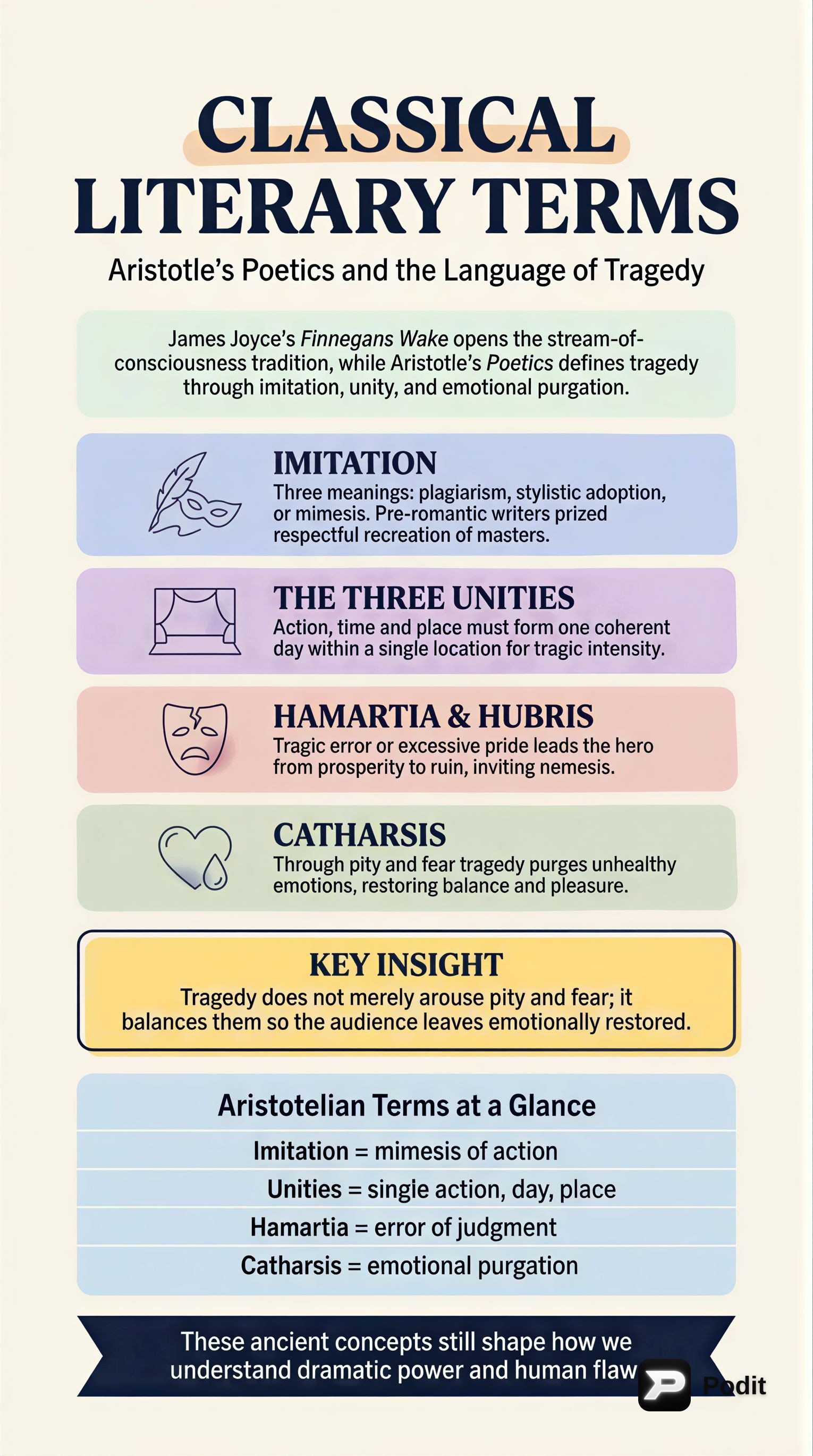
📚 Definition: The concept of imitation, or mimesis, refers to the representation of reality in art. ✅ Three Meanings: 1. Copying or Plagiarism: Taking another's thoughts or writings as one's own. 2. Adoption of Style: Re-creating the tone, style, and attitude of another writer. Historically, this was a respected practice before the Romantic period. 3. Representation: The general act of depicting reality. 💡 Historical Context: Before the Romantic period, adopting a master's style was highly regarded. Post-Romanticism, it was often seen as lacking originality. Today, "imitation" is largely synonymous with "mimesis," which Aristotle used broadly to describe the construction of a play.
2. Unities of Drama ⏳
📚 Definition: The three unities of drama are action, time, and place, principles for structuring a play. ✅ Aristotle's View: * Action: A play should imitate a single, coherent action where removing any part would harm the whole. * Time: Tragedy should be limited to a single day or slightly more. * Place: Tragedy should be confined to a narrow compass (less explicit than action/time). ⚠️ Renaissance Interpretation: Italian and French critics formalized these into strict rules, limiting action to 24 hours and the scene to a single location. 📈 Evolution: These rules were often ignored by English dramatists and challenged by writers like Lope de Vega, Molière, and Victor Hugo. However, they can still be observed for dramatic intensity. * Example: Tennessee Williams' Cat on a Hot Tin Roof (1955) adheres strictly to the unities.
3. Hamartia (Tragic Flaw) 💔
📚 Definition: A Greek term meaning "error," hamartia is an error of judgment that leads to a tragic hero's misfortune. It stems from ignorance or a moral shortcoming, not vice or depravity. ✅ Synonym: Often used interchangeably with "tragic flaw." * Examples: * Oedipus: Kills his father from impulse and marries his mother out of ignorance. * Antigone: Resists state law from stubbornness and defiance. * Othello: A capacity for extreme jealousy. * Macbeth: Ambition. * Lear: Arrogance and willfulness. * Hamlet: An acute inability to make decisions.
4. Hubris 😠
📚 Definition: Greek for "insolence, pride," hubris is a defect in a tragic hero that causes them to ignore divine warnings and disobey laws, ultimately leading to their downfall. * Example: Creon in Sophocles' Antigone rejects the prophet Tiresias's warnings due to pride, leading to the deaths of his wife and son.
5. Nemesis ⚖️
📚 Definition: Greek for "retribution," nemesis is the personification of divine anger at human insolence and excessive pride (hubris). It represents the punishment that befalls a tragic hero for violating the natural order or moral law.
6. Catharsis 💧
📚 Definition: Greek for "purgation," Aristotle used this term in his definition of tragedy. ❓ Debate: Its exact meaning is debated, but key interpretations include: * Emotional Release: Tragedy, through pity and fear, effects a purgation of these emotions, restoring emotional health. The pleasure derived from tragedy comes from removing the "morbidity" of these feelings. * Emotional Balance: Tragedy balances and proportions pity and fear, directing them to the right objects in the right way, exercising them within the play's limits as a good person's emotions would be exercised.
7. Peripeteia 🔄
📚 Definition: Greek for "sudden change," peripeteia is a reversal of fortune in drama, typically from prosperity to ruin. * Example: In Oedipus Rex, the messenger who intends to gladden Oedipus by revealing his adoption inadvertently reveals the secret of his birth, leading to his downfall.
8. Anagnorisis 💡
📚 Definition: Greek for "recognition," anagnorisis is the moment when ignorance gives way to knowledge. ✅ Ideal Coincidence: According to Aristotle, the ideal moment of anagnorisis coincides with peripeteia. * Example: Oedipus's realization that he himself killed Laius, his father.
📝 Literary Devices, Themes, and Conventions
This section covers various tools and recurring ideas used in literature.
1. Symposium 🗣️
📚 Definition: * Original: Greek festive meetings or banquets characterized by merry conversation. * Modern: A discussion by different persons on a single topic, or a collection of speeches, essays, or articles by various persons on a special topic.
2. Muses 🎨
📚 Definition: In Greek mythology, the nine goddesses, daughters of Zeus and Mnemosyne (Memory), invoked by poets for inspiration. ✅ The Nine Muses: 1. Calliope: Epic poetry (symbol: tablet and stylus/scroll) 2. Clio: History (symbol: scroll or open chest of books) 3. Erato: Love poetry (symbol: lyre) 4. Euterpe: Lyric poetry (symbol: flute) 5. Melpomene: Tragedy (symbols: tragic mask, club of Heracles, sword; wears cothurnus, wreathed with vine leaves) 6. Polyhymnia: Sacred poetry (sits pensive, no specific attribute) 7. Terpsichore: Choral song and dance (symbol: lyre) 8. Thalia: Comedy (symbols: comic mask, shepherd’s crook, ivy wreath) 9. Urania: Astronomy (symbol: staff pointing to a globe)
3. Theme 🎯
📚 Definition: 1. The central or dominating idea in a literary work. 2. The implicit message or moral in a work of art. * Examples: * Keats's Ode on a Grecian Urn: The permanence of art and the brevity of human life. * Chekhov's short stories: The loneliness of the human soul. * Tolstoy's Anna Karenina: The destructive force of love.
4. Carpe Diem 🌸
📚 Definition: Latin for "seize the day," this theme encourages enjoying the present due to the brevity of life and the inevitability of death. * Prevalence: Found in Greek, Latin, and Renaissance poetry. * Examples: * Shakespeare's Twelfth Night: "Then come kiss me, sweet and twenty, / Youth's a stuff will not endure." * Robert Herrick's To the Virgins, to Make Much of Time: "Gather ye rose-buds while ye may, / Old Time is still a-flying." * Andrew Marvell's To His Coy Mistress: "Had we but world enough, and time, / This coyness, lady, were no crime."
5. Ubi Sunt Theme 🍂
📚 Definition: Latin for "where are," this theme expresses lament or nostalgia for the transitory nature of life, youth, and beauty. It often appears as a motif, opening a poem or stanza, or serving as a refrain. * Example: Old English poems like The Wanderer, which asks, "Where has the horse gone? Where the young warrior? Where is the giver of treasure?"
6. Motif 🖼️
📚 Definition: A recurrent theme, dominant idea, character, or verbal pattern within a work of literature or across multiple works. * Examples: * The carrying off of a mortal queen by a fairy lover in medieval romance. * The motif of the immortality of art in Shakespeare, Keats, and Yeats. * In music and art, a recurring melodic phrase or design.
7. Leitmotif 🎶
📚 Definition: German for "leading motif," originally a musical term (especially Wagner) designating a theme associated with a particular object, character, or emotion throughout a work. * Literary Extension: In literature, it refers to an author's favorite recurring themes. * Example: In Thomas Mann's The Magic Mountain, each appearance of Settembrini is accompanied by the same brief description of his clothes.
8. Literary Convention 📜
📚 Definition: A generally accepted literary device, principle, procedure, or form. ✅ Importance: Ignorance of conventions can lead to misunderstanding or misinterpretation. * Dramatic Conventions: The stage itself, suspension of disbelief, use of verse, chorus, unities, aside, soliloquy. * Genre Conventions: A sonnet has fourteen lines; an epic often begins "in medias res."
9. Aside 🤫
📚 Definition: In drama, a few words or a short passage spoken in an undertone or directly to the audience, presumed inaudible to other characters on stage (unless between two characters). * Usage: Common until the 20th century, especially in comedy and melodrama; still used in pantomime and farce.
10. Soliloquy 🎤
📚 Definition: Derived from Latin "to speak alone," a speech (often lengthy) in which a character, alone on stage, expresses their thoughts and feelings. ✅ Purpose: Allows dramatists to convey a character's state of mind, intimate thoughts, feelings, motives, and intentions directly to the audience. * Examples: Hamlet's "To be or not to be," Richard III's opening speech, Iago's self-revelatory statements in Othello.
11. Anachronism 🕰️
📚 Definition: Placing an event, person, item, or language expression in the wrong historical period. * Purpose: Can be an error, or used deliberately to create timelessness, or for comic/satiric effect. * Examples: * Shakespeare: References to a clock in Julius Caesar, billiards in Antony and Cleopatra, a cannon in King John. * Mark Twain: A Connecticut Yankee in King Arthur's Court uses sustained anachronism for humor.
12. Deus ex Machina 🤖
📚 Definition: Latin for "god out of the machine." * Original Use: In Greek drama, a god was lowered onto the stage by a crane ("mechane") to resolve plot difficulties or untangle the plot. * Aristotle's View: Condemned its use, arguing that plot resolution should arise from the action itself. * Modern Use: Any artificial device for the easy resolution of difficulties in a plot. * Example: A rich relative appearing at the last moment to solve financial problems and enable a marriage.
🗣️ Rhetorical and Stylistic Elements
This section explores terms related to language use and persuasive techniques.
1. Wit 🤔
📚 Definition: A term with evolving meanings, generally referring to intellectual amusement and cleverness. ✅ Evolution of Meaning: * Aristotle: Ability to make apt comparisons. * Renaissance: Ingenuity, ability to create the bizarre, unique; equated with intelligence. * 17th Century (Metaphysical Poets): "Fancy," ability to correlate dissimilar ideas through brilliant, paradoxical figures (metaphor, irony, paradox, pun). John Donne was called "the monarch of wit." * Later 17th Century (Hobbes, Pope): Shifted emphasis to "judgment" over "fancy." True wit was seeing similarities in dissimilar things, while false wit involved mere word association. Pope defined true wit as "What oft was thought, but ne'er so well expressed." * Modern: Limited to intellectually amusing utterances calculated to delight and surprise.
2. Aphorism 🧠
📚 Definition: Often synonymous with "maxim," it is a brief, pithy, concise statement generally received as true. * Origin: Ancient, timeless, and international. * Example: Hippocrates' "Life is short, art is long, opportunity fugitive, experimenting dangerous, reasoning difficult." * Proverb: A short, aphoristic saying of unknown or ancient origin that expresses a useful thought or commonplace truth in simple language (e.g., "A stitch in time saves nine").
3. Epigram ✒️
📚 Definition: 1. Originally: An inscription suitable for carving on a monument, later any brief and pithy verse pointing a moral. 2. A short, witty, ingenious, or pointed saying that can be complimentary, satiric, or aphoristic. ✅ Distinction: Distinguished from a proverb by its personal and specific quality. * Examples: * Matthew Prior: "Sir, I admit your general rule, / That every poet is a fool: / But you yourself may serve to show it, / That every fool is not a poet." * John Dryden: "Here lies my wife! here let her lie! / Now she's at rest, and so am I." * Alexander Pope: "We think our fathers fools, so wise we grow; / Our wiser sons, no doubt, will think us so."
📖 The Bible as a Literary Work
This section examines the Bible's literary significance and structure.
1. Overview and Structure 🌍
📚 Definition: Derived from the Greek "biblia" (books), the Bible is the sacred writings of the Christian faith, a collection of diverse texts. ✅ Content: Encompasses history, legend, biography, genealogies, ethics, law, proverbial wisdom, sermons, prophecy, lyric poetry, hymns, and theology. ✅ Divisions: * Old Testament: Thirty-nine books (King James Version), primarily in Hebrew and Aramaic (11th-2nd c. B.C.). Represents the national religious literature of Israel. * New Testament: Twenty-seven books (King James Version), in Greek (c. A.D. 40-150). Contains documents on Jesus's life, teachings, crucifixion, resurrection, and the early Christian Church.
2. Literary Value and Influence 🌟
✅ Diversity and Richness: Particularly in the Old Testament, folklore illustrates religious beliefs and moral truths. * Narratives: Numerous short stories, historical and fictional (e.g., Isaac's marriage, Joseph stories, David and Jonathan, Jonah and the whale, Job, Ruth, parables, miracles). * Poetry: Entire books (Psalms, Proverbs, Lamentations, Song of Solomon, Job) are poetic compositions. * Essays: Represented in Ecclesiastes and the Epistles of Paul. * Character Portrayal: Vivid depiction of incidents and strong personalities, though not adhering to modern historiography standards. 💡 Profound Influence: The Bible has profoundly influenced Western civilization, pervading literature, jurisprudence, and customs. It offers deep insights into human nature, depicting the tragedy of human destiny and the search for a "better country."
3. The Song of Songs (Song of Solomon) ❤️
📚 Definition: A Hebrew love poem (probably 5th-4th c. B.C.) included in the Old Testament. ✅ Interpretation: Its imagery is often interpreted allegorically as God's love for Israel or Christ's love for the Church. * Example of Imagery: "Behold, thou art fair, my love; behold, thou art fair; thou hast doves' eyes within thy locks: thy hair is as a flock of goats, that appear from mount Gilead." (King James Version)
🏁 Conclusion
This exploration of literary terms and concepts highlights the intricate framework that underpins literary creation and interpretation. From the structural principles of classical drama to the nuanced expressions of human experience and the profound influence of foundational texts like the Bible, understanding these elements is essential for a comprehensive engagement with literature.