Linguistics, Literature, and Stylistic Analysis - kapak
Edebiyat#linguistics#literature#stylistics#literary analysis

Linguistics, Literature, and Stylistic Analysis

This summary explores the intricate relationship between linguistics and literature, defines stylistics, outlines its major categories and subdisciplines, and highlights its application in analyzing literary texts.

carpedi3mJune 4, 2026 ~23 dk toplam
01

Sesli Özet

7 dakika

Konuyu otobüste, koşarken, yolda dinleyerek öğren.

Sesli Özet

Linguistics, Literature, and Stylistic Analysis

0:006:32
02

Görsel Özet

İnfografik

Konunun tüm parçalarını tek bakışta gör.

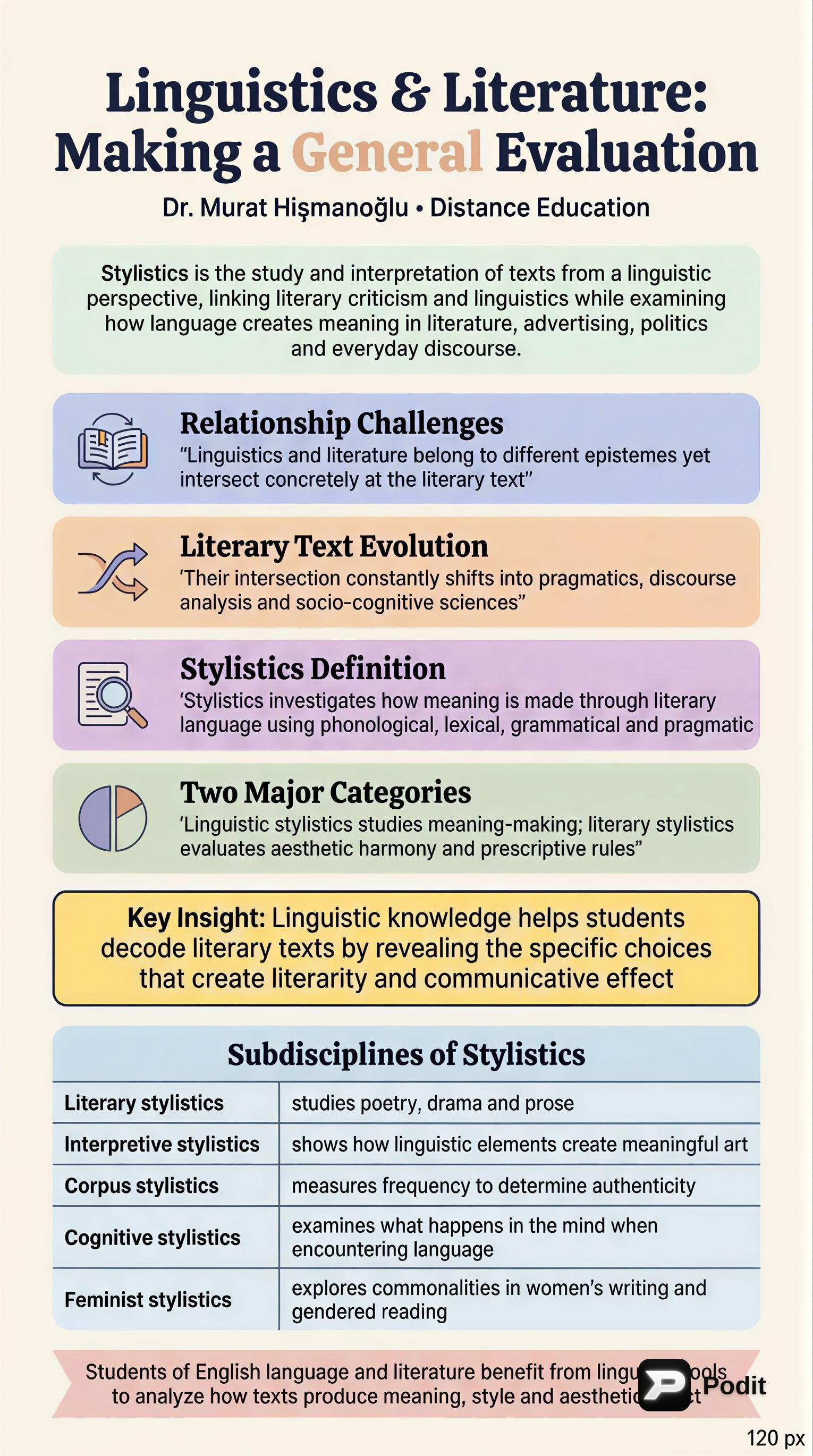
Linguistics, Literature, and Stylistic Analysis - görsel özet infografik
Tam boyutta görüntüle →
03

Flash Kartlar

25 kart

Karta tıklayarak çevir. ← → ile gez, ⎵ ile çevir.

1 / 25
Tüm kartları metin olarak gör
  1. 1. What is the primary challenge in understanding the relationship between linguistics and literature?

    The primary challenge stems from their placement in the same language-related study context despite belonging to different epistemes or fields of knowledge. They approach language, speech, and discourse differently, outlining distinct objects of study from an epistemological perspective.

  2. 2. What is the common intersection point between linguistics and literature?

    The common intersection point between linguistics and literature is the text, specifically the literary text. While their correlation is complex, their shared focus on the text provides a concrete area for their interaction and analysis, despite their differing epistemological approaches to language.

  3. 3. How has the nature of the literary text evolved in relation to linguistics and other studies?

    The nature of the literary text, as conceived by linguistics, discourse studies, and other literary studies, has continually evolved. Consequently, its area of intersection has shifted into territories drawing from other epistemes, primarily the humanities and socio-cognitive sciences, alongside pragmatics, text linguistics, and discourse analysis.

  4. 4. What is the role of linguistic disciplines in analyzing literary texts?

    Linguistic disciplines aim to illuminate factors contributing to a literary text's "literarity" by viewing the text as a discursive form within communication. They also reveal other characteristics beyond literarity, which some interpret as a "desanctification" of the literary text, moving away from romantic aesthetics.

  5. 5. How is the intersection between linguistics and the literary text often perceived in primary education?

    In primary education, the intersection between linguistics and the literary text is often partial or insignificant. It primarily involves reading for comprehension and value internalization, where linguistics plays a crucial role, especially in decoding messages through cognitive processes.

  6. 6. Define stylistics according to the provided text.

    Stylistics is defined as the study and interpretation of texts from a linguistic perspective. It functions as a bridge between literary criticism and linguistics, aiming to establish principles explaining individual and social group language choices, meaning production, and reception.

  7. 7. What types of texts does stylistics encompass, beyond "high literature"?

    While literature is a preferred object of stylistic studies, stylistics is not exclusively limited to "high literature." It also encompasses texts from various domains such as advertising, pop culture, politics, or religion, demonstrating its broad applicability to different forms of language use.

  8. 8. What are some key features examined by stylistics in texts?

    Stylistics examines various features including dialogue, regional accents, dialects, descriptive language, and grammatical structures like active or passive voice. It also analyzes sentence length distribution and language registers to understand how these elements contribute to style and meaning.

  9. 9. What is the ultimate goal of stylistics regarding form and effects in language?

    Ultimately, stylistics determines connections between form and effects within a language variety. It aims to reveal the linguistic associations inherent in style, thereby explaining how specific linguistic choices contribute to the overall impact and meaning of a text.

  10. 10. What are the two broad categories of stylistics?

    Stylistics is broadly categorized into two major types: linguistic stylistics, also known as general stylistics, and non-linguistic stylistics, which is referred to as literary stylistics. These categories differentiate between approaches focusing on linguistic structures versus aesthetic evaluation.

  11. 11. What is the primary focus of non-linguistic or literary stylistics?

    Non-linguistic or literary stylistics focuses on evaluating the aesthetic aspects and prescriptive harmony of written or spoken language. It assesses the reader's impression (aesthetic perception) and adherence to recommended social and stated rules for effective writing (prescriptive perception), often associated with literary criticism.

  12. 12. How does linguistic stylistics approach the study of meaning in texts?

    Linguistic stylistics investigates how meaning is constructed through literary language and other text types. It employs linguistic models and theories as analytical tools to describe the conditions enabling a text's function, focusing on the underlying linguistic mechanisms rather than just aesthetic appreciation.

  13. 13. What specific traits do stylistic analyses typically concentrate on?

    Stylistic analysis typically concentrates on phonological, lexical, grammatical, semantic, pragmatic, or discoursal traits of texts. Additionally, it considers the cognitive facets involved in processing these traits, providing a comprehensive linguistic examination of how texts function and create meaning.

  14. 14. What are the different methods within linguistic stylistics for studying style?

    Methods within linguistic stylistics study the style of a particular author, the text itself, or the reader's role in meaning construction. This approach considers stylistics as a linguistic method applied to literature, offering various angles for analyzing how style is created and perceived.

  15. 15. What recent trends are observed in stylistic analysis regarding text types?

    While much stylistic analysis traditionally focuses on literary works, recent trends show stylisticians increasingly concentrating on non-fictional works. These include advertising, news reports, speeches, academic writings, and non-printed media like movies and multi-modal publications, broadening the scope of stylistic inquiry.

  16. 16. What is Literary stylistics?

    Literary stylistics is a subdiscipline that involves studying forms such as poetry, drama, and prose. It focuses on the stylistic features inherent in these traditional literary genres, analyzing how language is used to create specific effects and meanings within them.

  17. 17. What is Interpretive stylistics?

    Interpretive stylistics is a subdiscipline focusing on how linguistic elements function to create meaningful art. It delves into the relationship between linguistic choices and the artistic impact of a text, aiming to understand the deeper meanings conveyed through stylistic devices.

  18. 18. What is Evaluative stylistics?

    Evaluative stylistics is a subdiscipline that assesses the effectiveness of an author's style within a work. It involves judging how well an author's linguistic choices contribute to their intended purpose or the overall quality of the text, often linking style to artistic success.

  19. 19. What is Corpus stylistics primarily dedicated to?

    Corpus stylistics is dedicated to studying the frequency of various elements in a text, often utilizing large collections of texts (corpora). This subdiscipline frequently employs computational methods to determine patterns, which can be used for purposes like determining manuscript authenticity or identifying characteristic stylistic features.

  20. 20. What does Discourse stylistics examine?

    Discourse stylistics examines how language in use generates meaning, through analysis of features like parallelism, assonance, alliteration, and rhyme. It focuses on the broader patterns of language in communication, looking at how stylistic choices contribute to the overall discourse structure and meaning.

  21. 21. What are the main areas of exploration in Feminist stylistics?

    Feminist stylistics explores commonalities in women's writing, how writing is gendered, and how women's writing is perceived differently from men's. This subdiscipline critically analyzes the relationship between gender, language, and literary representation, often challenging traditional interpretations.

  22. 22. What is the primary method used in Computational stylistics?

    Computational stylistics utilizes computers for text analysis to determine a writer's style. This subdiscipline employs algorithms and statistical methods to identify patterns in language use, offering objective and quantitative insights into stylistic characteristics that might be difficult to discern manually.

  23. 23. What does Cognitive stylistics investigate?

    Cognitive stylistics investigates the mental processes that occur when an individual encounters language. It explores how readers or listeners process and interpret stylistic features, drawing on theories from cognitive science to understand the psychological mechanisms underlying aesthetic and meaningful engagement with texts.

  24. 24. How do linguistics and literature approach language, speech, and discourse differently?

    Linguistics and literature approach language, speech, and discourse differently because they belong to distinct epistemes. Linguistics often focuses on the systematic structure and function of language, while literature explores its expressive and aesthetic potential, leading to different objects and methods of study.

  25. 25. What does the "desanctification" of the literary text refer to in the context of linguistic analysis?

    The "desanctification" of the literary text refers to a departure from 19th and 20th-century romantic aesthetics, which often viewed literary texts as sacred or uniquely inspired. Linguistic analysis, by viewing the text as a discursive form within communication, demystifies it and reveals its construction through linguistic mechanisms.

04

Bilgini Test Et

15 soru

Çoktan seçmeli sorularla öğrendiklerini ölç. Cevap + açıklama.

Soru 1 / 15Skor: 0

What is identified as the primary common intersection between linguistics and literature, despite their distinct epistemes?

05

Detaylı Özet

6 dk okuma

Tüm konuyu derinlemesine, başlık başlık.

This study material is compiled from a lecture audio transcript and a supplementary PDF/PowerPoint text provided by Dr. Murat Hişmanoğlu. It aims to offer a comprehensive overview of the relationship between linguistics and literature, the concept of stylistics, its various subdisciplines, and the practical benefits of linguistic knowledge for analyzing literary texts.


General Evaluation: Linguistics, Literature, and Stylistics

🎯 Lesson Aim

The primary goal of this lesson is to provide a general evaluation of the course by focusing on:

  • The intricate relationship between linguistics and literature.
  • The fundamental concept of stylistics.
  • The diverse subdisciplines within stylistics.
  • How students of English language and literature can effectively utilize linguistic knowledge in analyzing literary texts.

✅ Learning Outcomes

Upon completing this study material, students will be able to:

  1. Identify and understand the relationship between linguistics and literature.
  2. Define and comprehend the concept of stylistics.
  3. Identify and explain the various subdisciplines of stylistics.
  4. Articulate how linguistic knowledge can be applied to analyze literary texts.

1. The Relationship Between Linguistics and Literature 🤝

The connection between linguistics and literature is complex and multifaceted, posing continuous challenges for scholars and educators alike. While both fields are deeply rooted in language, they approach its study from distinct epistemological perspectives.

📚 Key Characteristics of the Relationship:

  • Shared Context, Different Epistemes: Both disciplines operate within the broad context of language study. However, they belong to different "epistemes" or fields of knowledge, meaning they approach language, speech, and discourse in different ways, outlining distinct objects of study.
  • Complex Correlation, Concrete Intersection: Despite their complex correlation, their intersection is clearly defined and concrete: the text, specifically the literary text.
  • Evolving Nature of the Literary Text: The understanding and definition of the literary text have continually evolved, influenced by linguistics, discourse studies, and other literary theories. This evolution has shifted their area of intersection into territories drawing from other fields, notably the humanities, socio-cognitive sciences, pragmatics, text linguistics, and discourse analysis.
  • Binary Relationship and External Linguistics: Although often framed as a binary relationship, the shifting intersection with other domains complicates this dynamic. This complexity makes contributions from various branches of "external linguistics" increasingly essential for a comprehensive understanding.
  • Literarity and "Desanctification": Linguistic disciplines primarily aim to illuminate the specific factors contributing to the "literarity" of a literary text, viewing it as a discursive form within the communication process. This approach can also shed light on other characteristics beyond literarity. Some scholars view this as a "desanctification" of the literary text, as it departs from the principles of 19th and 20th-century romantic aesthetics.
  • Role in Education: In educational settings, particularly primary education, the intersection between linguistics and literary texts is often partial. It typically involves reading for comprehension and internalizing values. However, linguistics plays a crucial role in helping students decode messages through cognitive processes, making it vital for effective reading and interpretation.
  • Pedagogical Action: To effectively interpret the convergence areas between linguistics and literature in teaching, educators must master effective pedagogical techniques and possess a conceptual apparatus that adapts the operational principles of discourse sciences to educational practices.

2. Understanding Stylistics 📖

Stylistics is defined as the study and interpretation of texts from a linguistic perspective. It serves as a crucial bridge between literary criticism and linguistics, though it does not possess an entirely autonomous domain.

💡 Core Aspects of Stylistics:

  • Object of Study: While literature, especially "high literature," is a preferred object, stylistics also examines other forms of written and non-written texts. This includes texts from advertising, pop culture, politics, religion, news reports, speeches, academic writings, movies, and multi-modal publications.
  • Purpose: Stylistics endeavors to establish principles that explain the specific language choices made by individuals and social groups. This includes understanding socialization, meaning production and reception, critical discourse analysis, and literary criticism.
  • Features Examined: Stylisticians analyze various linguistic features, such as:
    • Dialogue, including regional accents and dialects.
    • Descriptive language.
    • Grammatical structures (e.g., active vs. passive voice).
    • Distribution of sentence lengths.
    • Use of particular language registers.
  • Focus: Ultimately, stylistics seeks to determine the connections between the form and effects within a specific variety of language, revealing the linguistic associations inherent in a particular style. It investigates "what is going on" within the language itself.

📊 Major Categories of Stylistics:

Stylistics is broadly divided into two main categories:

  1. Non-Linguistic Stylistics (Literary Stylistics):

    • Focus: Concerned with evaluating the aesthetic aspects and prescriptive harmony of written or spoken language.
    • Perception: Aesthetic perception reflects the impression made on the reader, while prescriptive perception assesses how well a writer (or speaker) adheres to recommended social and stated rules for good writing.
    • Association: Often linked with the criticism and appreciation of literary works.
  2. Linguistic Stylistics (General Stylistics):

    • Focus: Investigates how meaning is constructed through literary language and other types of texts.
    • Methodology: Employs linguistic models and theories as analytical tools to describe the conditions that make a text function effectively.
    • Analysis Areas: Commonly concentrates on the phonological, lexical, grammatical, semantic, pragmatic, or discoursal traits of texts, as well as the cognitive facets involved in processing these traits.
    • Scope: Studies the style of a particular author, the text itself, or the role played by readers in constructing meaning. It is considered a linguistic method applied to literature.
    • Modern Trends: While traditionally focused on literary works, recent years have seen an increasing concentration on non-fictional works (e.g., advertising, news reports) and non-printed media (e.g., movies, multi-modal publications).

3. Subdisciplines of Stylistics 📈

Stylistics encompasses several overlapping subdisciplines, each focusing on a specific aspect of language and style. A person who studies any of these is known as a stylistician.

  • Literary Stylistics: 📚 Studies the forms and conventions of literary genres such as poetry, drama, and prose.
  • Interpretive Stylistics: 💡 Examines how linguistic elements function to create meaningful artistic effects within a text.
  • Evaluative Stylistics: ✅ Assesses the effectiveness of an author's style within a work, determining whether it succeeds or fails in its communicative purpose.
  • Corpus Stylistics: 📊 Utilizes large collections of texts (corpora) to study the frequency of various linguistic elements, often to determine the authenticity of a manuscript or identify stylistic patterns.
  • Discourse Stylistics: 🗣️ Analyzes how language in use creates meaning within broader discourse, studying features like parallelism, assonance, alliteration, and rhyme.
  • Feminist Stylistics: ♀️ Explores commonalities among women's writing, how writing is gendered, and how women's writing is perceived and interpreted differently from men's.
  • Computational Stylistics: 💻 Employs computer programs and algorithms to analyze texts and determine a writer's unique style or other stylistic features.
  • Cognitive Stylistics: 🧠 Investigates the mental processes that occur in the mind when individuals encounter and process language, particularly in literary contexts.

4. Benefits for English Language and Literature Students 🎓

Understanding the relationship between linguistics and literature, along with the principles and subdisciplines of stylistics, provides English language and literature students with invaluable tools for deeper textual analysis.

  • Enhanced Interpretation: Linguistic knowledge enables students to move beyond surface-level reading to analyze the intricate linguistic choices that shape meaning, tone, and effect in literary texts.
  • Critical Appreciation: By understanding stylistic devices and their impact, students can develop a more critical and nuanced appreciation of an author's craft and the aesthetic qualities of a work.
  • Analytical Framework: Stylistics offers a systematic framework for dissecting texts, identifying patterns, and explaining how language works to achieve specific artistic or communicative goals.
  • Broader Textual Understanding: The scope of stylistics extends beyond traditional literature, preparing students to analyze a wide range of texts, from advertisements to political speeches, fostering versatile analytical skills.

Conclusion ✨

This general evaluation has highlighted the complex yet crucial interplay between linguistics and literature, with the literary text serving as their primary point of convergence. We have defined stylistics as a discipline that bridges these fields, distinguishing between its non-linguistic and linguistic categories, and explored its diverse subdisciplines. By grasping these concepts, students gain a robust framework for the comprehensive linguistic analysis of literary and other textual forms, enriching their understanding and critical engagement with language.
Kendi çalışma materyalini oluştur

PDF, YouTube videosu veya herhangi bir konuyu dakikalar içinde podcast, özet, flash kart ve quiz'e dönüştür. 1.000.000+ kullanıcı tercih ediyor.

Sıradaki Konular

Tümünü keşfet
Modernism and Postmodernism in Literary History

Modernism and Postmodernism in Literary History

This summary explores the evolution of literary history from Modernism to Postmodernism, examining key characteristics, historical contexts, influential figures, and the shift in literary aesthetics and critical approaches.

10 dk Özet 25 15 Görsel
Understanding Modernism and Postmodernism in Literature

Understanding Modernism and Postmodernism in Literature

Explore the profound shifts in literary history from Modernism to Postmodernism, examining their intellectual foundations, key characteristics, and impact on art and culture.

Özet 25 15 Görsel
e.e. cummings: Poetic Innovation and Influences

e.e. cummings: Poetic Innovation and Influences

This summary explores the life, unique poetic style, major themes, and significant influences of American modernist poet e.e. cummings, focusing on his experimental approach to language and form.

6 dk Özet 25 15
Literary & Philosophical Movements: A Comprehensive Overview

Literary & Philosophical Movements: A Comprehensive Overview

An academic summary exploring key literary and philosophical concepts, movements, and periods from ancient times to modernism, highlighting their definitions, characteristics, and influential figures.

10 dk Özet 25 15 Görsel
Literature and the City: Native American Spaces

Literature and the City: Native American Spaces

An academic overview of Native American spatial practices, from ancestral lands to colonized territories, and their representation in literature, including concepts of sovereignty and reclamation.

8 dk Özet 25 15
Native American Spatial Practices and Literature

Native American Spatial Practices and Literature

This summary explores Native American spatial practices, ancestral and colonized spaces, liminality, and the concept of reclaiming spaces within Native American literature.

5 dk Özet 25 15 Görsel
Modernism and Postmodernism in English Literature

Modernism and Postmodernism in English Literature

This summary explores the emergence, characteristics, and historical context of Modernism and Postmodernism in English literature, detailing their aesthetic principles, literary forms, and critical reception.

12 dk Özet 25 15 Görsel
The Time Machine: Final Journeys and Disappearance

The Time Machine: Final Journeys and Disappearance

An academic summary of the Time Traveller's harrowing encounters with Morlocks, his journey into Earth's distant future, and his enigmatic final disappearance, as depicted in H.G. Wells' classic novel.

6 dk Özet 25 15