Modernism and Postmodernism in Literary History - kapak
Edebiyat#modernism#postmodernism#literary history#20th century literature

Modernism and Postmodernism in Literary History

This summary explores the evolution of literary history from Modernism to Postmodernism, examining key characteristics, historical contexts, influential figures, and the shift in literary aesthetics and critical approaches.

carpedi3mJune 6, 2026 ~28 dk toplam
01

Sesli Özet

10 dakika

Konuyu otobüste, koşarken, yolda dinleyerek öğren.

Sesli Özet

Modernism and Postmodernism in Literary History

0:0010:12
02

Görsel Özet

İnfografik

Konunun tüm parçalarını tek bakışta gör.

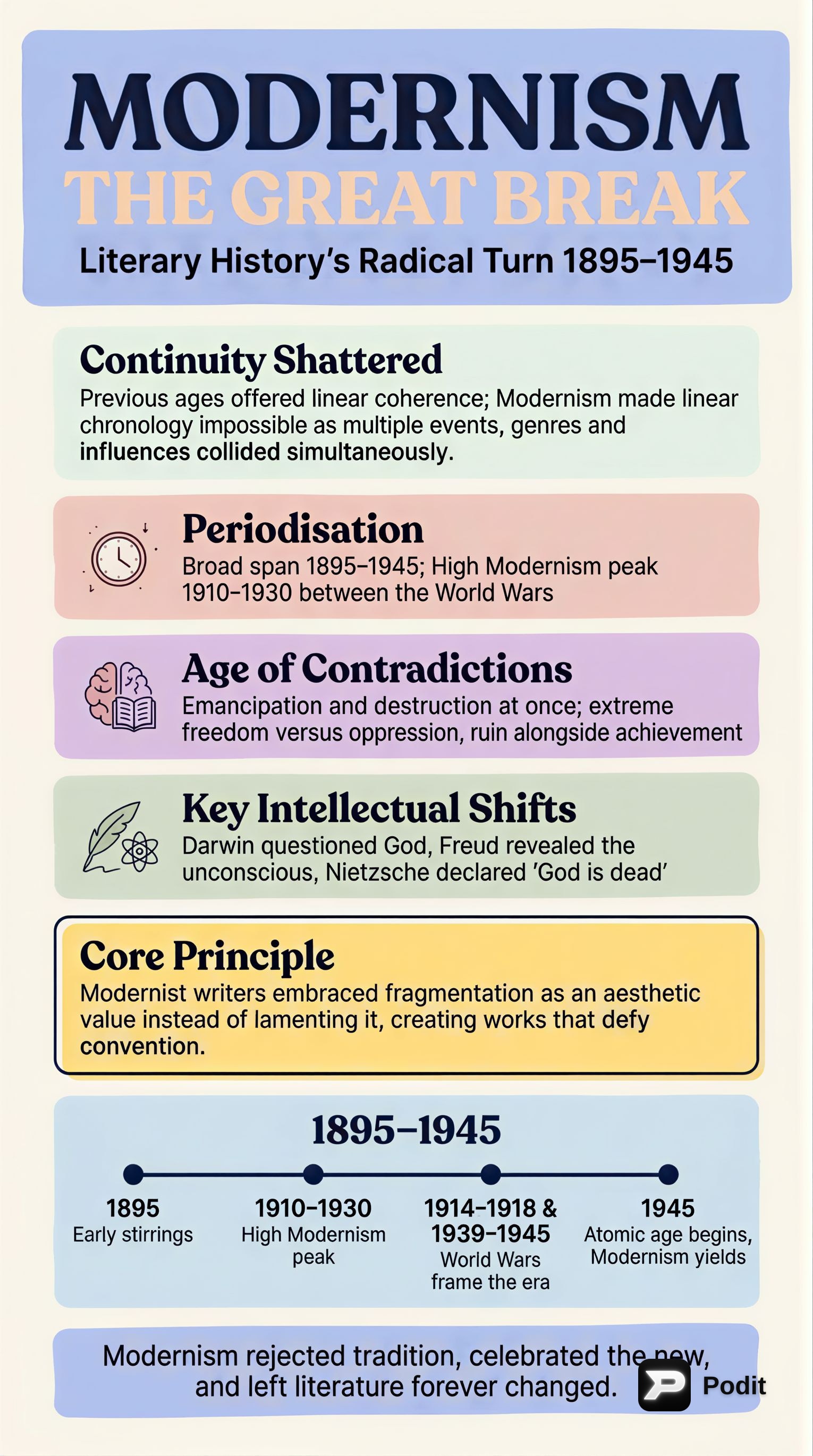
Modernism and Postmodernism in Literary History - görsel özet infografik
Tam boyutta görüntüle →
03

Flash Kartlar

25 kart

Karta tıklayarak çevir. ← → ile gez, ⎵ ile çevir.

1 / 25
Tüm kartları metin olarak gör
  1. 1. What marked the early 20th century's departure from previous literary ages?

    The early 20th century, with the rise of Modernism, marked a significant departure by fragmenting the coherence and linear progression characteristic of earlier literary ages. This made chronological discussion challenging due to simultaneous developments and a lack of a single dominant genre or set of writers, indicating a breakdown of traditional structures.

  2. 2. What is the approximate timeframe for the Modernism literary era?

    The Modernism literary era roughly spans from 1895 to 1945. This period is characterized by immense cultural production and a significant breakdown of traditional structures, reflecting a complex and transformative time in history.

  3. 3. What literary movement emerged after Modernism, specifically post-1945?

    Following Modernism, the period after 1945 introduced Postmodernism. This movement further challenged established norms and definitions in literature and art, building upon the fragmentation and questioning of tradition initiated by Modernism.

  4. 4. Describe the general context of the early 20th century that served as a backdrop for Modernism.

    The early 20th century was an age of profound contradictions, marked by simultaneous emancipation and destruction. Rapid advancements in science and technology, alongside urbanization, intensified its complexity. This era saw both remarkable progress and devastating global conflicts, shaping the Modernist worldview.

  5. 5. How did scientific discoveries influence the Modernist era?

    Key scientific discoveries like DNA and the Theory of Relativity profoundly influenced the Modernist era by redefining human existence and challenging established understandings of the world. These advancements contributed to a sense of intellectual upheaval and a re-evaluation of fundamental truths.

  6. 6. What major global events overshadowed the scientific progress during the Modernist period?

    The progress of the Modernist period was overshadowed by the trauma of two World Wars and a global economic downturn in the 1930s. These events revealed humanity's capacity for destruction and the inherent fragility of existence, deeply impacting the era's literature and art.

  7. 7. What is meant by 'literature of escape' in the context of Modernism?

    'Literature of escape' refers to a trend where artists explored the inner workings of the mind rather than directly confronting the difficult real world. This coincided with a flourishing entertainment industry and a publishing boom, offering a retreat from the harsh realities of the era.

  8. 8. Name two influential thinkers who shaped Modernist thought.

    Sigmund Freud, who highlighted the unconscious drivers of culture, and Friedrich Nietzsche, who declared 'God is dead' fostering atheism, were two profoundly influential thinkers. Their ideas challenged traditional beliefs about human nature and morality, deeply impacting Modernist intellectual currents.

  9. 9. What is the distinction between 'Modernism' and 'Modernity'?

    'Modernism' refers to a specific historical and artistic period, roughly 1895-1945, demanding a radical re-examination of Western culture. 'Modernity,' on the other hand, refers to a longer period from the Enlightenment, encompassing broader societal and intellectual changes.

  10. 10. How did Malcolm Bradbury describe Modernism?

    Malcolm Bradbury described Modernism as a cluster of international movements marked by discontinuity with the past and an awareness of Western civilization's failure. This highlights the era's break from tradition and its critical perspective on societal progress.

  11. 11. According to Peter Barry, what is a widely accepted definition of Modernism?

    Peter Barry's widely accepted definition posits Modernism as an 'earthquake in the arts' dominating the first half of the 20th century. He suggests its epicenter was in Vienna between 1890-1910, with lasting impacts across Europe and beyond, emphasizing its transformative power.

  12. 12. List three key literary figures associated with Modernism.

    Three key literary figures associated with Modernism are T.S. Eliot, James Joyce, and Virginia Woolf. These authors were central to developing new narrative techniques, exploring complex psychological states, and challenging traditional literary forms.

  13. 13. What was the core aesthetic response of Modernist writers to a fragmented world?

    The core aesthetic response of Modernist writers and thinkers to a fragmented world was to embrace fragmentation as an aesthetic value. This meant incorporating disjointed narratives, multiple perspectives, and non-linear structures into their works, reflecting the fractured reality they perceived.

  14. 14. Provide an example of how fragmentation was embraced in Modernist visual arts.

    Pablo Picasso's Cubism is a prime example of fragmentation in Modernist visual arts, where human forms were abstracted and broken into geometric shapes. Marcel Duchamp's 'Fountain,' a urinal presented as art, also dramatically rejected convention and forced a re-evaluation of art itself.

  15. 15. How did Modernist literature depart from traditional narrative techniques?

    Modernist literature moved away from objectivity, rejecting omniscient narration, fixed viewpoints, and clear moral positions. It blurred distinctions between genres and embraced fragmented, discontinuous narratives, often appearing as a 'random-seeming collage' to reflect the complexities of the 20th century.

  16. 16. Explain the concept of 'reflexivity' in Modernist literature.

    Reflexivity in Modernist literature means that the literature became self-aware, examining its own nature and processes rather than solely focusing on external subjects. This involved authors experimenting with form, language, and narrative structure, often drawing attention to the act of writing itself.

  17. 17. What was the role of 'asceticism and minimalism' in Modernist art forms?

    A fierce asceticism and minimalism dominated Modernist art, rejecting the elaborate 19th-century art forms. This was reflected in architectural dictums like 'less is more,' emphasizing simplicity, functionalism, and a stripping away of ornamentation to reveal essential forms.

  18. 18. What does the term 'avant-garde' signify in the context of Modernism?

    The term 'avant-garde' in Modernism signifies a challenge to the status quo and middle-class values. It refers to artists and works that are experimental, innovative, and push the boundaries of what is accepted as art, often leading the way in new artistic developments.

  19. 19. How did High Modernism distinguish between high and low art?

    During High Modernism, a clear distinction between high and low art was cemented. Authors like T.S. Eliot and James Joyce produced difficult, inaccessible works, often without considering the audience, adhering to the dictum 'make it new, make it different, and make it difficult,' thus elevating 'high art.'

  20. 20. What was the dominant literary genre in the 20th century, and what influenced its experimentation?

    Twentieth-century fiction emerged as the dominant literary genre, with vivid experimentation significantly influenced by Freudian psychology. This led to deeper explorations of the human mind, unconscious motivations, and complex psychological states within narrative structures.

  21. 21. Name two Modernist novelists and their specific contributions mentioned in the text.

    James Joyce revolutionized narrative techniques, particularly with his use of stream of consciousness. Virginia Woolf perfected the stream of consciousness technique, delving into the inner lives and perceptions of her characters, profoundly influencing psychological realism in fiction.

  22. 22. What major event ushered in the Atomic Age and contributed to a sense of existential futility after 1945?

    The bombing of Hiroshima and Nagasaki after 1945 ushered in the Atomic Age, creating a pervasive sense of existential futility. This event profoundly impacted the post-war psyche, leading to widespread questioning of humanity's future and purpose.

  23. 23. How did Postmodernism redefine the concept of 'English literature'?

    Postmodernism marked a crucial transition from a singular 'English literature' to 'literatures in English.' This reflected transnational and international phenomena influenced by decolonization, embracing a broader range of voices and cultural perspectives beyond traditional English literary canons.

  24. 24. What are two key characteristics of Postmodern literature regarding the hero concept and identity?

    Postmodern literature features a breakdown of the traditional hero concept, often presenting flawed or anti-heroes. It also emphasizes individual responsibility and foregrounds identity as a contested, multifaceted theme, moving away from fixed or singular notions of self.

  25. 25. What is a key difference between Modernism and Postmodernism regarding the role of the author and reader?

    While Modernism positioned the author as the supreme creator, Postmodernism views the text as unstable, yielding to plural interpretations. This shifts power from the author to the reader, suggesting that the reader's engagement actively shapes the meaning of the text.

04

Bilgini Test Et

15 soru

Çoktan seçmeli sorularla öğrendiklerini ölç. Cevap + açıklama.

Soru 1 / 15Skor: 0

Which period is characterized by a significant departure from previous literary ages, marked by fragmentation and a lack of a single dominant genre or set of writers?

05

Detaylı Özet

8 dk okuma

Tüm konuyu derinlemesine, başlık başlık.

This study material has been compiled and organized from various sources, including copy-pasted text and a lecture audio transcript, to provide a comprehensive overview of Modernism and Postmodernism in literary history.


📚 Modernism and Postmodernism: A Literary Evolution

1. Introduction: The Shifting Landscape of Literary History

The early 20th century marked a profound shift in literary history, moving away from the continuity and coherence that characterized previous ages. This period, known as Modernism, saw a breakdown of traditional structures, making linear chronological discussion challenging due to simultaneous developments and a lack of a single dominant genre or set of writers. This complexity intensified in the post-1945 era, leading to Postmodernism, which further challenged established norms and definitions in literature and art.

2. Modernism: Context, Characteristics, and Key Figures

2.1. Defining Modernism and its Periodization

📚 Definition: Modernism, derived from the Latin "modo" (meaning "current"), is a complex term describing a period of radical re-examination of Western culture. ⏳ Timeframe:

  • Broad Period: 1895 – 1945
  • High Modernism (Consensus): Between the two World Wars (1914-1918 and 1939-1945), peaking from 1910 – 1930.
  • ⚠️ Note: These dates are flexible, indicating overlaps and requiring a non-linear understanding.

2.2. The Early 20th Century: An Age of Contradictions

The backdrop for Modernism was an era of deep contradictions:

  • Emancipation vs. Destruction: Extreme freedom coexisted with extreme oppression.
  • Science, Technology, and Urbanization:
    • Rapid technological dependence and migration to urban centers.
    • Science became a "master discipline," redefining human existence.
    • 💡 Key Discoveries: DNA, radio waves, Theory of Relativity.
  • Trauma of War and Conflict:
    • World Wars revealed humanity's capacity for destruction and the inherent fragility of existence.
    • War no longer brought national accomplishment but an "inherent sense of loss."
  • Economic Downturn: The 1930s saw a worldwide economic depression.
  • "Literature of Escape": In response to hopelessness, artists explored the mind rather than the difficult real world.
  • Cultural Shifts: Flourishing entertainment (radio, cinema), publishing boom (cheap paperbacks), and growth of libraries.
  • Ideological Conflicts: Capitalism vs. Communism, rebellion against imperialism, leading to decolonization and postcolonial literatures.
  • Global Crises: Refugee movements, genocidal wars, and social issues like racism, poverty, and unemployment.

2.3. Intellectual Foundations of Modernism

Modernism was profoundly shaped by groundbreaking thinkers:

  • Charles Darwin – On the Origin of Species: Questioned the existence of God, making Modernism a post-Darwinian phenomenon.
  • Sigmund Freud – Psychological Works: Suggested culture is driven by the unconscious, adding to a sense of human helplessness.
  • Sir James Frazer – The Golden Bough: Influential in redefining understanding of culture and mankind.
  • Friedrich Nietzsche – Philosophy: Declared "God is dead," fostering atheism and questioning traditional ideals.

2.4. Modernity vs. Modernism

It's crucial to distinguish:

  • 📚 Modernity: A long-standing, abstract period from the Enlightenment (late 18th/early 19th centuries), characterized by secularism, mechanization, industrial capitalism, and discourses of emancipation.
  • 📚 Modernism: A specific historical period/state of mind chronologically situated at the beginning of the 20th century.

2.5. Understanding Modernism: Historical Period vs. State of Mind

Modernism can be viewed in two ways:

  1. As a Historical Period: A call for radical re-examination of Western culture, marked by fragmentation ("Things fall apart; the centre cannot hold" - W.B. Yeats).
  2. As a State of Mind:
    • Radical Rejection of Tradition: A delight in rejecting the philosophical, moral, and artistic past.
    • Break in Continuity: Unlike previous transitions, Modernism actively rejected the preceding era.
    • Craving for the New: A conscious decision to "make it new" ("the tradition of the new" - Harold Rosenberg).
    • Chronological Disorder: Often described as having a "beginning, middle and then end, but not necessarily in that order."
    • Rejection of Progress: No faith in the idea of progress, leading to fragmentation.
    • Fragmentation: The central "crisis and dilemma" of the period, stemming from the breakdown of ideological, cultural, moral, religious, and philosophical traditions.

2.6. The Modernist Aesthetic: Embracing Fragmentation

Modernist writers and artists embraced fragmentation as an aesthetic value:

  • Visual Art Examples:
    • 🎨 Pablo Picasso's Cubism: Deliberate move away from realistic depictions, experimenting with abstract forms.
    • 🚽 Marcel Duchamp's Fountain (1917): A urinal presented as art, dramatically rejecting convention and forcing a re-evaluation of what constitutes art. This was a "declaration of hostility towards audiences and art itself."
  • Literary Features:
    • Rejection of Objectivity: Moving away from omniscient narration, fixed viewpoints, and clear moral positions.
    • Blurring of Genres: Novels became lyrical, poems became documentary, challenging traditional definitions.
    • Fragmented & Discontinuous Narrative: Often appearing as a "random-seeming collage," yet possessing an inherent coherence to address 20th-century crises (e.g., T.S. Eliot's "objective correlative").
    • Reflexivity: Literature became self-conscious, raising issues about its own nature and role.
    • Asceticism & Minimalism: Rejecting elaborate 19th-century art forms ("less is more" in architecture).
    • The Avant-Garde: Challenging the status quo and middle-class values.
    • High/Low Art Distinction: Cemented a divide, especially during High Modernism.
    • Author's Attitude: Works were often difficult and inaccessible, produced without considering the audience, following the dictum: "Make it new, make it different, and make it difficult." (e.g., The Waste Land, Ulysses). This led to a boom in secondary critical material.

2.7. Key Figures and Literary Trends

  • Important Figures:
    • British/Anglophone: T.S. Eliot, James Joyce, Ezra Pound, Virginia Woolf, Wallace Stevens, Gertrude Stein.
    • Continental: Marcel Proust, Stéphane Mallarmé, Franz Kafka, Rainer Maria Rilke.
  • Dominance of Fiction: The novel emerged as the most dominant genre, with vivid experimentation influenced by Freudian psychology.
  • Representative Novelists:
    • George Orwell: Political allegories (Nineteen Eighty-Four, Animal Farm).
    • James Joyce: Revolutionized narrative (stream of consciousness), challenging conventions (Ulysses, Finnegans Wake).
    • Virginia Woolf: Feminist writer, perfected stream of consciousness (Mrs Dalloway, To the Lighthouse, A Room of One’s Own).
    • D.H. Lawrence: Explored psychological tendencies and sexuality (Sons and Lovers, Lady Chatterley’s Lover).
    • H.G. Wells: Creator of 20th-century science fiction (The Time Machine).
    • J.R.R. Tolkien: Influenced fantasy writing, revived Old English texts (The Lord of the Rings).
    • Rudyard Kipling: Portrayed Anglo-Indian life (The Jungle Book).
    • E.M. Forster: Bridged British and Commonwealth writings (A Passage to India).
  • Modern Drama: Sustained by Irish playwrights like Bernard Shaw (Pygmalion) and Somerset Maugham.
  • Nonfiction and Literary Criticism: Emerged as a respectable genre.
    • Key Critics: I.A. Richards (Principles of Literary Criticism), F.R. Leavis, T.S. Eliot (objective correlative, Tradition and Individual Talent).
    • Movements: New Criticism (text as self-contained unit), Marxist criticism (Christopher Caudwell), Cultural Studies (Raymond Williams).

3. Post-1945 and the Emergence of Postmodernism

3.1. Historical Context and Conditions

The period after 1945, often termed the Post-modern Age, brought further fragmentation:

  • End of WWII: Did not bring stability but led to political, cultural, and relational confusion.
  • Atomic Age: The bombing of Hiroshima and Nagasaki (1945) introduced a pervasive sense of absurdity and existential futility.
  • Geopolitical Shifts: Decline of British influence, rise of the USA, and the Cold War (communist vs. capitalist blocs).
  • Socio-Cultural Changes in England:
    • 1950s: Austerity.
    • 1960s: "Boom years," age of youth.
    • 1970s: Social unrest, anxiety.
    • 1980s: Materialistic approaches.
    • 1990s: Recession and economic/political preoccupation.
  • Increasing Polarities: Divisions (North vs. South, rich vs. poor) became harder to address.
  • Growth of Other Media: Literature became one among many forms of artistic expression.

3.2. Defining the Post-Modern Age

📚 Core Meaning: Describes attitudes and creative production after WWII, celebrating diversity, eclecticism, and parody across all art forms.

  • Shift in Literature: From a single "English literature" to "literatures in English," reflecting transnational and international phenomena influenced by decolonization.
  • Key Literary Features:
    • No More Heroes: Breakdown of the single hero concept.
    • Individual Responsibility: Emphasis on individual destiny.
    • Identity as Central Theme: Contested and multifaceted (sexual, local, national, racial, spiritual, intellectual).

3.3. Differences from Modernism: Author, Text, and Reader

A crucial distinction lies in the relationship between author, text, and reader:

  • Modernism: Author is the supreme creator, master of the text, with complete authority over interpretation. The text is difficult but has a singular intended meaning (requiring scholarly mediation).
  • Postmodernism: The text is highly unstable, yielding to plural interpretations depending on the reader. Power shifts from author to reader.
    • 💡 Insight: As Roland Barthes famously stated, "the author is already dead." Once a text leaves the author's hands, it becomes the reader's, transforming with each new interpretation.
    • Celebration of Multiple Truths: Unlike Modernist lament over inaccessibility, Postmodernism celebrates diverse access and interpretations.

3.4. Shifting Worldviews: Premodern to Postmodern

  • Premodern: Theocentric world, dictated by Church, belief in divine intervention.
  • Modern: Away from divine right, focus on individual growth and "upwards and onwards" progress.
  • Postmodern: Chaotic, no single center, celebrates anarchy and freedom. The lack of a single truth is celebrated, fostering secular practices and foregrounding marginalized voices (Black writers, women writers, Dalit writings).

3.5. Modernism vs. Postmodernism: A Direct Comparison

| Modernism | Postmodernism | | :-------------------------------- | :-------------------------------------------- | | Rigid form in place, despite chaos | Anti-form and open; does not adhere to strict principles | | Purpose for every single thing | More playful | | Heavily reliant on design | Celebrates chance | | Strict sense of hierarchy | Celebrates anarchy | | Focus on the finished art product | Focus on the process or performance | | Concerned with presence | Also concerned with absence (bringing forgotten voices to the forefront) | | About centring and having a centre| Celebrates dispersal; no priority main-stream | | Concerned with genres and disciplinary boundaries | Concerned with text and inter-text; interdisciplinary | | Focused on depth/root of things | Focused on a more rhizomatic understanding |

3.6. Celebrating Diversity in the Postmodern

Postmodernism allows for:

  • ✅ Inclusion of diverse voices from different countries and social/sexual orientations.
  • ✅ Bringing back forgotten voices (race, caste, gender).
  • ✅ An equal playing field for English and non-English traditions.
  • ✅ Breaking down distinctions between standard and non-standard forms of writing.

4. Conclusion: The Enduring Legacy of Literary Evolution

This journey through literary history, from premodern times to the post-1945 period, reveals a continuous evolution. We've seen how socio-political changes, the rise and fall of dynasties, and shifting ideologies profoundly impact cultural and literary trends. The arc of identity, from the anonymity of Beowulf to the crisis of modernist identity in Virginia Woolf, and ultimately to the postmodern rejection of fixed identities, illustrates this profound transformation. Understanding this context is crucial for interpreting texts and appreciating how literature serves as an expression of shifting socio-political and historical trends.
Kendi çalışma materyalini oluştur

PDF, YouTube videosu veya herhangi bir konuyu dakikalar içinde podcast, özet, flash kart ve quiz'e dönüştür. 1.000.000+ kullanıcı tercih ediyor.

Sıradaki Konular

Tümünü keşfet
Modernism and Postmodernism in English Literature

Modernism and Postmodernism in English Literature

This summary explores the emergence, characteristics, and historical context of Modernism and Postmodernism in English literature, detailing their aesthetic principles, literary forms, and critical reception.

12 dk Özet 25 15 Görsel
Understanding Modernism and Postmodernism in Literature

Understanding Modernism and Postmodernism in Literature

Explore the profound shifts in literary history from Modernism to Postmodernism, examining their intellectual foundations, key characteristics, and impact on art and culture.

Özet 25 15 Görsel
Twentieth-Century Literature and Historical Contexts

Twentieth-Century Literature and Historical Contexts

An academic overview of 20th-century literary movements, key authors, and their works, alongside significant historical and social developments in Britain, Ireland, and America.

6 dk Özet 25 15 Görsel
20th-Century British Poetry: Movements and Themes

20th-Century British Poetry: Movements and Themes

An academic overview of 20th-century British poetry, exploring its historical context, major literary movements, key themes, and influential poets from the Georgian era to the 1970s.

7 dk Özet 25 15 Görsel
American Literature: 20th Century to Post-War Era

American Literature: 20th Century to Post-War Era

An academic overview of American literature from the Jazz Age to post-WWII, covering key authors like Fitzgerald, Faulkner, Steinbeck, Hemingway, Morrison, and major literary movements and historical contexts.

6 dk Özet 25 15 Görsel
American Literature: A Historical and Literary Overview

American Literature: A Historical and Literary Overview

This summary explores the evolution of American literature from its colonial origins through the early 20th century, examining key movements, influential authors, and their seminal works within their historical contexts.

6 dk Özet 25 15 Görsel
Ezra Pound: Life, Artistic Development, and Literary Vision

Ezra Pound: Life, Artistic Development, and Literary Vision

This summary explores Ezra Pound's life, his pivotal role in modern poetry, his artistic development through Imagism and Vorticism, his literary theories, and his monumental work, The Cantos, alongside his controversial political affiliations.

7 dk Özet 25 15
Linguistics, Literature, and Stylistic Analysis

Linguistics, Literature, and Stylistic Analysis

This summary explores the intricate relationship between linguistics and literature, defines stylistics, outlines its major categories and subdisciplines, and highlights its application in analyzing literary texts.

6 dk Özet 25 15 Görsel