 Podit
Podit
This study material is compiled from a copy-pasted text and a lecture audio transcript, providing a comprehensive overview of American literary development from its colonial origins through the early 20th century.
📚 American Literary Development: A Comprehensive Study Guide
🌟 Introduction
American literature has undergone a profound transformation, evolving from its early dependence on European models to forging a distinct national identity. This evolution is deeply intertwined with the nation's historical trajectory, reflecting pivotal moments such as the struggle for independence, westward expansion, social reforms, and industrialization. This guide explores the key periods, movements, and influential figures that shaped this rich literary heritage.
1️⃣ Colonial Foundations (Pre-1781)
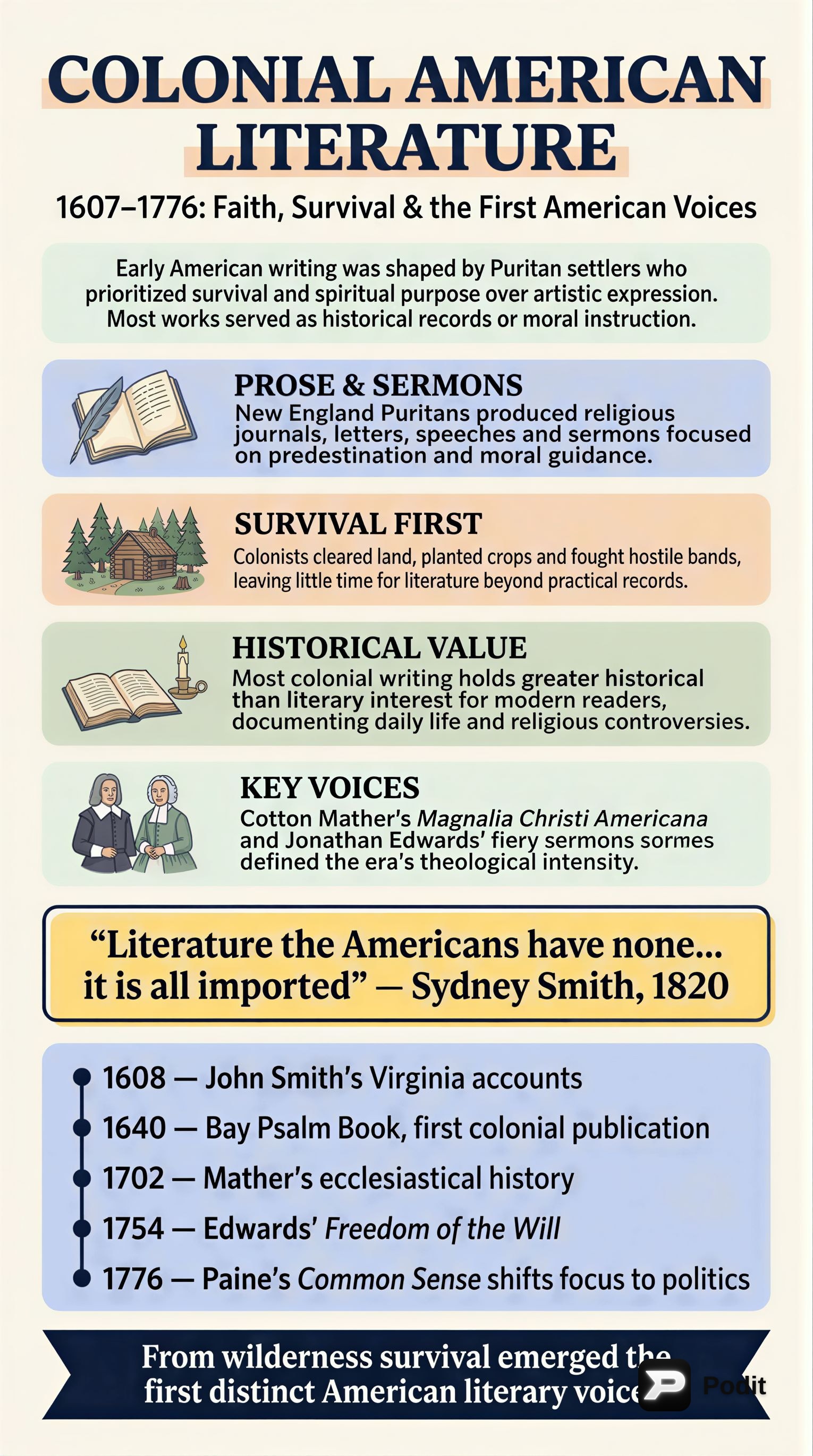
The earliest American literature was primarily functional and religious, reflecting the settlers' immediate concerns with survival and the establishment of a new society.
🌍 Context & Characteristics
- European Dependence: Early American writers often emulated English literary styles and themes.
- Focus on Survival: Literature served practical purposes, documenting daily life, religious experiences, and historical events.
- Religious Dominance: New England writers, particularly Puritans and Calvinists, produced the bulk of early prose, often with a strong moral and instructional purpose. Entertainment value was minimal.
- Emerging Identity: A nascent sense of American identity began to form, distinct from European roots.
📝 Key Genres & Authors
- Religious Prose:
- Cotton Mather (1663-1728): A prolific Puritan writer, known for theological works and his two-volume ecclesiastical history, Magnalia Christi Americana (1702). ✅
- Jonathan Edwards (1703-1758): A Calvinist preacher and leader of the Great Awakening, famous for fiery sermons and the philosophical treatise Freedom of the Will (1754), defending Calvinistic doctrine. ✅
- John Woolman (1720-1772): A Quaker leader and early abolitionist, whose The Journal (1774) is a classic record of spiritual inner life.
- Historical Accounts & Journals:
- Captain John Smith (1580-1631): Documented early colonial life in Jamestown with A True Relation of Such Occurrences and Accidents of Noate as Hath Hapned in Virginia Since the First Planting of That Collony (1608) and The General History of Virginia (1624). ✅
- John Winthrop (1588-1649): Described life in the Massachusetts Bay Colony in his Journal.
- William Bradford (1589-1657): Second Governor of Plymouth Colony, chronicled the Pilgrim Fathers' experiences in Of Plymouth Plantation (1646). ✅
- William Penn (1644-1718): Publicized opportunities in Pennsylvania with Some Account of the Province of Pennsylvania (1681).
- William Byrd (1674-1744): Virginia planter, known for the witty and satirical History of the Dividing Line: Run in the Year 1728.
- Early Poetry:
- Primarily religious, often written for friends and relatives.
- The Bay Psalm Book (1640): The first book published in the colonies, a collection of psalms for church singing.
- The New England Primer: America's first textbook, used for reading instruction.
- Anne Bradstreet (1612-1672): Considered the first original poet, her The Tenth Muse (1650) contained religious poems and simple lyrics on nature. ✅
- Michael Wigglesworth (1612-1672): His Calvinistic ballad The Day of Doom (1662) was highly popular.
- Edward Taylor (1644-1729): A fierce Puritan minister whose poems, influenced by English Metaphysicals, were discovered posthumously.
2️⃣ Revolutionary Period (Mid- to Late-18th Century)
As tensions with Britain escalated, American literature shifted from religious introspection to political advocacy, galvanizing public opinion for independence.
🗣️ Political Discourse & National Identity
- Shift in Focus: Writers abandoned Puritanical concerns for political themes, reflecting new ideas of equality and liberty.
- Orators & Pamphleteers: Their efforts were crucial in shaping public sentiment.
- Emergence of a Middle Class: A more educated American middle class, conscious of national identity, emerged.
✍️ Key Figures & Works
- Benjamin Franklin (1706-1790): Statesman, inventor, publisher. His Poor Richard's Almanack (1733-1758) offered pithy proverbs, and his unfinished Autobiography (1771) became an influential "rags to riches" narrative. He also helped draft the Declaration of Independence. ✅
- Thomas Paine (1737-1809): His forceful prose in Common Sense (1776) and The Crisis (1776-1783) significantly boosted American morale during the War of Independence. ✅
- Michel Guillaume Jean de Crevecoeur (1735-1813): An Americanized Frenchman whose Letters from an American Farmer (1782), particularly the essay "What is an American?", explored the emerging American identity and proved influential. ✅
- Poetry:
- Philip Freneau (1752-1832): Known for patriotic poems and political satires, but also simple nature lyrics, heralding early romantic poetry.
- "Connecticut Wits": A group (John Trumbull, Timothy Dwight, David Humphreys, Joel Barlow) desiring a national literature free from European models, though often continuing English satirical traditions.
3️⃣ 19th Century: Romanticism, Social Critique, and Innovation (1820-1869)
This century saw significant literary growth, paralleling America's territorial expansion and internal conflicts, leading to a rich and diverse literary landscape.
🏞️ Historical & Cultural Context
- Westward Expansion: The "Manifest Destiny" doctrine fueled migration and settlement across the continent.
- Economic Growth: Agricultural surpluses, improved transport (canals, railroads), and early industrialization led to prosperity.
- Social Concerns: Reforms in prisons and asylums, temperance movements, and growing concerns over illiteracy and poverty. Women's rights also gained prominence.
- The Slavery Issue: A divisive issue leading to sectionalism and ultimately the Civil War (1861-1865).
- Post-Civil War: Reconstruction efforts, abolition of slavery (13th Amendment), citizenship for blacks (14th Amendment), and voting rights (15th Amendment), though progress was partial and met with resentment.
🎭 Key Movements & Authors
- Early 19th Century Literary Figures:
- Washington Irving (1783-1859): America's first internationally recognized prose author. His The Sketch Book (1819) included famous tales like "Rip Van Winkle" and "The Legend of Sleepy Hollow," often drawing inspiration from European folk stories. ✅
- William Hill Brown (1765-1793): Wrote Power of Sympathy (1789), considered the first American novel.
- Charles Brockden Brown (1771-1810): Known as the "Father of the American novel," his Gothic novels like Wieland (1798) and Edgar Huntley (1799) featured horror and terror.
- William Cullen Bryant (1794-1878): The "American Wordsworth," known for nature poetry like "Thanatopsis" (1817) and "To a Waterfowl" (1815).
- American Renaissance (Mid-19th Century):
- Transcendentalism: A philosophical movement emphasizing individualism, intuition, and the inherent goodness of humanity, rebelling against materialism.
- Ralph Waldo Emerson (1803-1882): Leader and spokesman, advocated "self-reliance" and intellectual independence in essays like "Self-Reliance" (1841). ✅
- Henry David Thoreau (1817-1862): Put transcendentalist theories into practice, living simply at Walden Pond, documented in Walden or Life in the Woods (1854). His Civil Disobedience (1849) advocated passive resistance. ✅
- Dark Romanticism / Gothic:
- Edgar Allan Poe (1809-1849): Master of psychological depth, mystery, and the supernatural. His Tales of the Grotesque and Arabesque (1839) and stories like "The Fall of the House of Usher" (1839) explored hallucinatory worlds. Credited with inventing the detective story. ✅
- Moral & Philosophical Depth:
- Nathaniel Hawthorne (1804-1864): Explored Puritan themes of sin, guilt, and human motivation, often set in New England. Key works include The Scarlet Letter (1850) and "Young Goodman Brown." ✅
- Epic & Symbolic:
- Herman Melville (1819-1891): His masterpiece Moby Dick (1851) is rich in symbolism and allegory, reflecting a profound, often despairing, vision of humanity's conflict with inscrutable forces. ✅
- Social Commentary:
- Harriet Beecher Stowe (1811-1896): Her abolitionist novel Uncle Tom's Cabin (1851-52) profoundly influenced public sentiment against slavery. ✅
- Poetry Revolution:
- Walt Whitman (1819-1892): Revolutionized American verse with his free verse style in Leaves of Grass (1855), celebrating democracy, the common person, and the American landscape. ✅
- Emily Dickinson (1830-1886): A unique and reclusive poet whose experimental rhythms, unconventional rhymes, and profound themes of love, death, and nature were largely unknown until after her death. ✅
- "Fireside Poets" / "New England Brahmins":
- Henry Wadsworth Longfellow (1807-1882): Most popular American poet of the 19th century, known for adapting European storytelling and American history, e.g., The Song of Hiawatha (1858).
- James Russell Lowell (1819-1891): Editor of The Atlantic Monthly, wrote satirical verses in Yankee dialect (The Biglow Papers, 1847) and anti-slavery poems.
- Oliver Wendell Holmes (1809-1894): America's first "society poet," known for amusing essays and poems.
- John Greenleaf Whittier (1807-1892): Quaker poet, wrote many poems against slavery and about New England country life, e.g., Snowbound.
- Transcendentalism: A philosophical movement emphasizing individualism, intuition, and the inherent goodness of humanity, rebelling against materialism.
4️⃣ Late 19th and Early 20th Century: Realism, Naturalism, and Modernism (1870-1939)
This period was characterized by massive industrialization, urbanization, and social reform, leading to new literary movements that critically engaged with American society.
📈 Historical & Cultural Shifts
- Industrial Expansion: Rapid mechanization, growth of factories, new inventions (typewriter, telephone, automobile).
- Big Business: Rise of millionaires, monopolies, and trusts, alongside growing social inequality.
- Urbanization & Immigration: Population shift to cities, massive influx of immigrants providing cheap labor.
- Social Reform: "Progressive Era" (1890-1917) saw efforts to alleviate poverty, improve working conditions, and regulate business.
- World War I (1917-1918): America's entry, subsequent isolationism.
- "Roaring Twenties": Economic prosperity, social changes (women's suffrage, Prohibition, jazz), but also rising crime and social conservatism.
- Great Depression (1929 onwards): Economic collapse, mass unemployment, and Roosevelt's "New Deal" intervention.
📊 Literary Movements & Authors
- Regionalism / Local Color: Focused on specific regions, dialects, and customs.
- Mark Twain (Samuel Langhorne Clemens, 1835-1910): Master of Midwestern humor and realism. The Adventures of Tom Sawyer (1876) and The Adventures of Huckleberry Finn (1884) captured local dialects and critiqued societal hypocrisy. ✅
- Bret Harte (1836-1902): Known for tales of mythical California.
- Joel Chandler Harris (1848-1908): Creator of Uncle Remus stories.
- Realism: Emphasized truthful depiction of everyday life.
- William Dean Howells (1837-1920): Influential critic and editor, advocated for "truthful treatment of material." His The Rise of Silas Lapham (1885) exemplified this. ✅
- Naturalism: Depicted human behavior as determined by environmental and biological forces, often portraying characters as victims.
- Theodore Dreiser (1871-1945): Explored characters driven by "chemical compulsions" and societal forces, e.g., Sister Carrie (1900). ✅
- Stephen Crane (1871-1900): Portrayed overwhelming circumstances in Maggie: A Girl of the Streets (1893) and The Red Badge of Courage (1895).
- Frank Norris (1870-1902): Explored corporate power in The Octopus (1901).
- Hamlin Garland (1860-1940): Depicted hardships of Midwestern farmers in Main-Travelled Roads (1891).
- "Muckrakers": Writers using social naturalism to expose societal evils.
- Upton Sinclair (1878-1968): His The Jungle (1906) exposed unsanitary conditions in the meatpacking industry, leading to federal reforms. ✅
- Psychological Realism / International Theme:
- Henry James (1843-1916): Bridged 19th and 20th-century literature, exploring complex inner lives and the clash between Old World sophistication and New World innocence. Major works include The American (1877) and The Portrait of a Lady (1881). ✅
- Early 20th Century Poetry:
- Edwin Arlington Robinson (1869-1935): Known for short, dramatic poems with character sketches of people in fictional Tilbury Town, Maine. ✅
- Robert Frost (1874-1963): Celebrated New England rural life with accessible yet complex verse, often loaded with symbolic meaning, e.g., "The Road Not Taken" (1916). ✅
- Midwest Poets:
- Edgar Lee Masters (1869-1950): Spoon River Anthology (1915) presented free verse epitaphs revealing small-town mentalities.
- Carl Sandburg (1878-1967): Celebrated life on the Prairies and in Midwestern cities with Whitmanesque free verse, e.g., Chicago Poems (1914).
- Modernism (Inter-war Period, 1917-1939): Characterized by experimentation, critique of established norms, and new psychological interpretations of reality.
- "Revolt Against the Village":
- Sherwood Anderson (1876-1941): Explored psychological frustrations of small-town inhabitants in Winesburg, Ohio (1919). ✅
- Sinclair Lewis (1885-1951): First American Nobel laureate in literature. Critiqued small-town hypocrisy and middle-class conformity in Main Street (1920) and Babbitt (1922).
- Social Protest & "American Dream" Critique:
- F. Scott Fitzgerald (1896-1940): Charted the social and moral decline of post-war society and critiqued the "American Dream" in works like The Great Gatsby (1925). ✅
- John Steinbeck (1902-1968): Depicted the hardships of the poor and migrant workers, notably in The Grapes of Wrath (1939). ✅
- Richard Wright (1908-1960): Addressed the problems of blacks in a white-dominated society, e.g., Native Son (1940). ✅
- "Lost Generation" (Disillusionment & Alienation):
- Ernest Hemingway (1899-1961): Known for terse, economical prose, exploring themes of war, death, and individual courage in The Sun Also Rises (1926) and A Farewell to Arms (1929). ✅
- William Faulkner (1897-1962): Explored the decline of the American "Deep South" using complex narratives, multiple viewpoints, and stream of consciousness, e.g., The Sound and the Fury (1929). ✅
- Poetic Movements:
- Imagism: Led by Ezra Pound (1885-1972) and Amy Lowell (1874-1925), emphasized precise, clear visual imagery, everyday speech, and new rhythms.
- William Carlos Williams (1883-1963): Imagist poet, focused on making the ordinary extraordinary with concise images.
- Other Major Poets: Marianne Moore, Wallace Stevens, E. E. Cummings (known for unorthodox punctuation and visual poetry).
- Harlem Renaissance: A movement celebrating black culture and advocating for racial dignity.
- Claude McKay (1890-1948): Harlem Shadows (1922) provided an early independent political voice for African-Americans.
- Langston Hughes (1902-1967): Incorporated rhythms of black music (blues, jazz) into his verse, e.g., The Weary Blues (1926). ✅
- Jean Toomer (1894-1967): Experimental novel Cane (1923) celebrated African-American life.
- Countee Cullen (1903-1946): Believed in using traditional English forms to relate black experience.
- American Drama:
- Eugene O'Neill (1888-1953): First great American dramatist, known for experimental, psychologically motivated plays like Beyond the Horizon (1920) and Desire Under the Elms (1924). ✅
- Other Dramatists: Elmer Rice (The Adding Machine, 1923), Thornton Wilder (Our Town, 1938), Clifford Odets (socially conscious "proletarian" plays).
- "Revolt Against the Village":
✨ Conclusion
From its practical and religious colonial roots, American literature blossomed into a vibrant and diverse tradition. It moved beyond mere imitation to critically engage with the American experience, exploring psychological depths, social realities, and the complexities of the human condition. This journey established a unique and influential literary heritage, marked by a continuous willingness to innovate and reflect the evolving national identity.