American Literature: 20th Century to Post-War Era - kapak
Edebiyat#american literature#20th century literature#jazz age#great depression

American Literature: 20th Century to Post-War Era

An academic overview of American literature from the Jazz Age to post-WWII, covering key authors like Fitzgerald, Faulkner, Steinbeck, Hemingway, Morrison, and major literary movements and historical contexts.

carpedi3mMay 23, 2026 ~28 dk toplam
01

Sesli Özet

7 dakika

Konuyu otobüste, koşarken, yolda dinleyerek öğren.

Sesli Özet

American Literature: 20th Century to Post-War Era

0:006:38
02

Görsel Özet

İnfografik

Konunun tüm parçalarını tek bakışta gör.

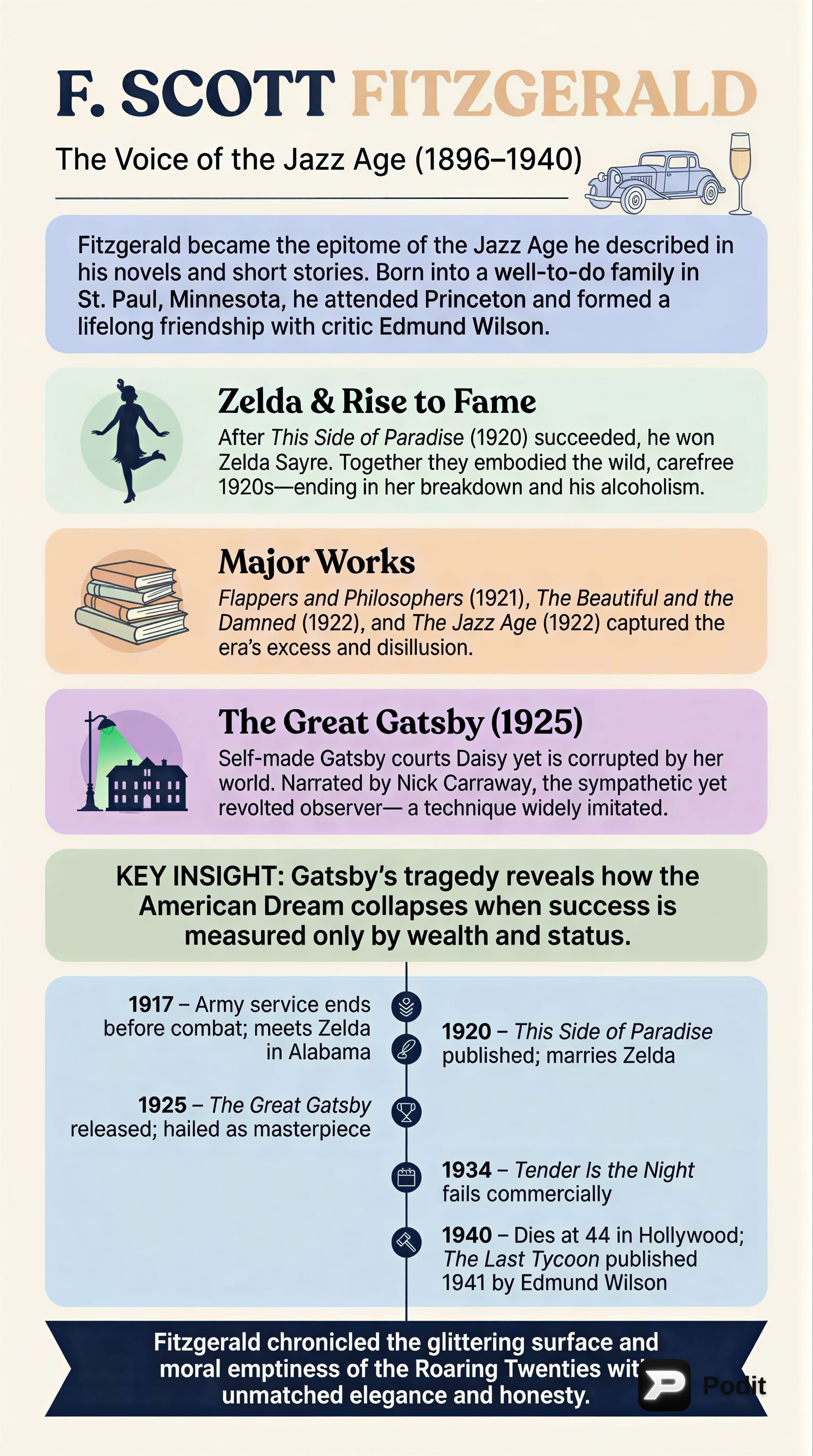
American Literature: 20th Century to Post-War Era - görsel özet infografik
Tam boyutta görüntüle →
03

Flash Kartlar

25 kart

Karta tıklayarak çevir. ← → ile gez, ⎵ ile çevir.

1 / 25
Tüm kartları metin olarak gör
  1. 1. Who was F. Scott Fitzgerald, and what era did he represent?

    F. Scott Fitzgerald was a prominent American novelist, widely regarded as an emblem of the Jazz Age. His works, such as 'The Great Gatsby,' captured the essence of the 1920s, reflecting its glamour, excess, and underlying disillusionment. His personal life, marked by his relationship with Zelda and struggles with alcoholism, often mirrored the themes of his era.

  2. 2. What are the main themes explored in F. Scott Fitzgerald's 'The Great Gatsby'?

    'The Great Gatsby' explores themes of the American Dream's corruption, the pursuit of an idealized past, and the superficiality of wealth. It depicts a self-made man's relentless quest for an idealized woman, Daisy Buchanan, and his eventual downfall due to the hollow values of the society he tries to enter. The novel critiques the moral decay hidden beneath the glittering surface of the Jazz Age.

  3. 3. Describe William Faulkner's literary setting and narrative style.

    William Faulkner was deeply rooted in the American South, creating the fictional Yoknapatawpha County as the setting for many of his novels. His narrative style is characterized by its complexity, often employing multiple perspectives, stream of consciousness, and a fluid temporal structure. Works like 'The Sound and the Fury' exemplify his intricate storytelling, which delves into the deep psychological and historical layers of his characters and region.

  4. 4. What social issues did John Steinbeck often address in his works?

    John Steinbeck's work frequently championed society's marginalized and dispossessed. He focused on the struggles of the working class, migrant laborers, and those affected by economic hardship. His narratives vividly portrayed social and economic injustices, advocating for empathy and understanding for those on the fringes of society.

  5. 5. What is the historical context and main subject of John Steinbeck's 'The Grapes of Wrath'?

    'The Grapes of Wrath' is set during the 1930s Great Depression and the Dust Bowl era. It vividly portrays the plight of the Joad family, who are forced to migrate from their farm in Oklahoma to California in search of work and a better life. The novel highlights the severe social and economic injustices, exploitation, and dehumanization faced by these displaced populations, making it a powerful commentary on American society during that period.

  6. 6. How did Richard Wright contribute to American literature?

    Richard Wright offered a powerful and groundbreaking vision of race relations in America. His works, including 'Native Son' and 'Black Boy,' are foundational in depicting the harsh realities of the African-American experience. He challenged prevailing societal norms and confronted the nation's conscience regarding racial inequality, bringing the struggles and psychological impact of racism to the forefront of American literature.

  7. 7. Who were the 'Lost Generation' writers, and what influenced Ernest Hemingway's style?

    The 'Lost Generation' refers to a group of American writers who came of age during World War I and often lived as expatriates in Europe. Ernest Hemingway was a central figure among them, profoundly influenced by his experiences in WWI. This influence led to his distinctive minimalist style, characterized by its directness, conciseness, and absence of rhetorical flourish, focusing on intense, personal experience rather than abstract concepts like 'glory'.

  8. 8. What defines Ernest Hemingway's minimalist writing style?

    Ernest Hemingway's minimalist writing style is defined by its directness, conciseness, and economy of language. He famously rejected abstract concepts and flowery prose in favor of concrete details and straightforward sentences. This style aimed to convey intense personal experiences and emotions without overt sentimentality, allowing readers to infer deeper meanings from what was left unsaid, as seen in works like 'A Farewell to Arms'.

  9. 9. What was Imagism, and who was a key figure in its development?

    Imagism was a poetic movement of the early 20th century that advocated for precision, clear visual imagery, and the use of ordinary, exact language. Ezra Pound was a highly influential figure and pioneer of Imagism, emphasizing the direct treatment of the 'thing' whether subjective or objective. He encouraged poets to 'make it new' and to use no superfluous word, as demonstrated in his poem 'A Pact'.

  10. 10. Explain William Carlos Williams' poetic philosophy 'No ideas but in things'.

    William Carlos Williams' poetic philosophy 'No ideas but in things' emphasizes that abstract ideas should not be stated directly but rather conveyed through concrete, tangible objects and experiences. He believed that poetry should focus on the local world and everyday objects, allowing meaning to emerge from the precise depiction of reality. This approach is famously encapsulated in his poem 'The Red Wheelbarrow,' where simple imagery evokes profound understanding.

  11. 11. What were the main characteristics of E.E. Cummings' poetry?

    E.E. Cummings challenged traditional poetic forms through his innovative use of visual arrangements and unconventional capitalization and punctuation. His poetry often featured fragmented lines, unique spacing, and a disregard for standard grammar rules, creating a distinctive visual and auditory experience. He used these devices, along with words like 'etcetera,' to convey a cynical perspective, particularly regarding war and societal conventions.

  12. 12. How did Langston Hughes contribute to the Harlem Renaissance?

    Langston Hughes was a key voice of the Harlem Renaissance, a cultural, social, and artistic explosion in the 1920s. He integrated the rhythms of jazz and blues into his poetry, creating a unique and authentic voice for the African-American experience. His works, such as 'Dream Variations' and 'Song for a Dark Girl,' articulated the joys, sorrows, and aspirations of Black Americans, celebrating their culture and challenging racial prejudice.

  13. 13. What significant societal transformations occurred in the U.S. after World War II?

    After World War II, American society underwent significant transformations. The nation emerged as a global superpower, engaging in the Cold War and conflicts in Korea and Vietnam. Domestically, economic prosperity coexisted with persistent social divisions, particularly racial inequality. This era also saw the rise of the Civil Rights Movement, which actively challenged discrimination and reshaped the social and political landscape.

  14. 14. What was the impact of the Civil Rights Movement on American society and literature?

    The Civil Rights Movement, spearheaded by figures like Martin Luther King Jr. and Malcolm X, profoundly impacted American society by challenging racial discrimination and advocating for equality. In literature, it led to a greater recognition and amplification of diverse voices, particularly African-American writers. This movement inspired narratives that confronted racial injustice, explored identity, and contributed to a more inclusive literary landscape.

  15. 15. How did post-World War II American literature become more diverse?

    Post-World War II American literature became remarkably diverse by moving beyond a singular mainstream to embrace a multitude of voices and perspectives. The overarching theme of individuality resonated across works by Jewish, African-American, Native-American, and Hispanic writers. This period saw a proliferation of narratives that explored varied cultural experiences, challenging traditional literary boundaries and reflecting the changing demographics and social consciousness of the nation.

  16. 16. Which author is known for his powerful war novel 'The Naked and the Dead'?

    Norman Mailer is the author known for his powerful war novel 'The Naked and the Dead.' Published in 1948, it was one of the first significant literary works to emerge from World War II. The novel offers a stark and realistic portrayal of American soldiers fighting in the Pacific, exploring themes of power, fear, and the dehumanizing effects of war, establishing Mailer as a major voice in post-war American literature.

  17. 17. What were the key influences and characteristics of the Beat Generation?

    The Beat Generation was a counter-cultural literary movement that emerged in the 1950s, drawing inspiration from Walt Whitman, jazz music, and Zen Buddhism. They celebrated freedom, spontaneity, and non-conformity, often rejecting mainstream societal values. Their works, like Jack Kerouac's 'On the Road' and Allen Ginsberg's 'Howl,' were characterized by their experimental forms, raw honesty, and exploration of themes such as spirituality, sexuality, and drug use.

  18. 18. Which novel by Jack Kerouac is considered a seminal work of the Beat Generation?

    Jack Kerouac's 'On the Road' is considered a seminal work of the Beat Generation. Published in 1957, the novel chronicles the cross-country adventures of Sal Paradise and Dean Moriarty, embodying the Beat ethos of freedom, rebellion, and the search for meaning. Its spontaneous, jazz-influenced prose style captured the restless spirit of a generation seeking authenticity outside conventional society.

  19. 19. Who wrote 'Lolita,' and what kind of insights did it offer?

    Vladimir Nabokov wrote 'Lolita,' a highly controversial yet critically acclaimed novel published in 1955. The book is known for its sophisticated prose, intricate wordplay, and dark humor. It offers satirical insights into modern America, particularly its consumer culture and moral ambiguities, while exploring complex psychological themes through the unreliable narration of Humbert Humbert.

  20. 20. Name two authors known for satire and dark humor in post-war American literature.

    Two prominent authors known for their use of satire and dark humor in post-war American literature are J.D. Salinger and Joseph Heller. Salinger's 'The Catcher in the Rye' uses Holden Caulfield's cynical voice to satirize phoniness and hypocrisy in society. Heller's 'Catch-22' employs absurdism and dark humor to critique the irrationality and bureaucracy of war, creating a lasting impact on the genre.

  21. 21. What were Isaac Bashevis Singer's main contributions to literature?

    Isaac Bashevis Singer, a Nobel laureate, made significant contributions by preserving Eastern European Jewish folklore and Yiddish culture in his works. Writing primarily in Yiddish, he explored themes of faith, doubt, worldliness, and the supernatural, often set in the vibrant Jewish communities of Poland. Novels like 'The Magician of Lublin' showcase his unique blend of realism and mysticism, offering a window into a disappearing world.

  22. 22. What was Saul Bellow's primary focus in his novels?

    Saul Bellow, another Nobel recipient, primarily focused on the search for identity and meaning in modern life. His novels often feature intellectual protagonists grappling with existential questions, alienation, and the complexities of urban existence. Bellow articulated the novel's profound role in helping individuals find meaning and understand their place in a rapidly changing world, as exemplified in works like 'Looking for Mr. Green'.

  23. 23. How did Toni Morrison enrich American literature?

    Toni Morrison, a Nobel and Pulitzer Prize winner, enriched American literature with her poetic prose, mythic elements, and profound exploration of the African-American experience. Her novels, such as 'The Bluest Eye,' portray the journey from slavery to the present, delving into themes of racial identity, trauma, and the perception of beauty. She gave voice to marginalized experiences, challenging conventional narratives and reshaping the literary landscape.

  24. 24. Who were the Confessional poets, and what characterized their work?

    Confessional poets were a group of poets who emerged in the mid-20th century, known for exploring intense personal experiences, emotions, and psychological states. Figures like Sylvia Plath openly addressed taboo subjects such as mental illness, trauma, and family relationships with raw honesty and vulnerability. Their work often blurred the lines between autobiography and poetry, making the poet's private life a central subject.

  25. 25. What themes did Tennessee Williams explore in his plays?

    Tennessee Williams' plays, deeply influenced by his personal life and Southern background, explored themes of desire, illusion, and the decay of the Southern aristocratic tradition. His characters often grapple with loneliness, sexual repression, and the fragility of their dreams in a harsh reality. Williams was also notable for addressing previously taboo subjects, bringing psychological depth and emotional intensity to the American stage in works like 'A Streetcar Named Desire'.

04

Bilgini Test Et

15 soru

Çoktan seçmeli sorularla öğrendiklerini ölç. Cevap + açıklama.

Soru 1 / 15Skor: 0

Which author is considered an emblem of the Jazz Age and captured its essence in novels like 'The Great Gatsby'?

05

Detaylı Özet

11 dk okuma

Tüm konuyu derinlemesine, başlık başlık.

📚 American Literature: Early 20th Century to Post-WWII Era

This study material provides a comprehensive overview of American Literature from the early 20th century through the post-World War II period. It synthesizes information from a copy-pasted text and an audio lecture transcript, focusing on key authors, literary movements, significant works, and the socio-historical contexts that shaped them.


1. 🌍 Literary Voices of the Early 20th Century: Jazz Age & Great Depression

The early 20th century witnessed profound societal changes in America, reflected vividly in its literature. Authors of this era often captured the spirit of their times, from the exuberance of the Jazz Age to the despair of the Great Depression.

1.1. F. Scott Fitzgerald (1896-1940)

Fitzgerald is widely regarded as the epitome of the Jazz Age, a period of economic prosperity and cultural dynamism.

  • Biography: Born into a well-to-do family, he attended Princeton University. His early struggles to win the heart of Zelda Sayre, who initially rejected him due to his lack of wealth, fueled his ambition. The success of his first novel, This Side of Paradise, allowed him to marry Zelda.
  • Key Themes: The excesses and eventual disillusionment of the Jazz Age. His personal life, marked by Zelda's mental breakdown and his own alcoholism, mirrored the era's consequences.
  • Major Works:
    • This Side of Paradise (1920)
    • Flappers and Philosophers (1921) and The Jazz Age (1922) (short story collections)
    • The Beautiful and the Damned (novel)
    • The Great Gatsby (1925) ✅: Often considered his masterpiece, it tells the story of Jay Gatsby, a self-made man pursuing the idealized Daisy Buchanan. The novel brilliantly exposes the superficial and cynical nature of upper-middle-class American society during the "Roaring Twenties." Nick Carraway, the narrator, observes Gatsby's corruption by the world Daisy inhabits. An excerpt reveals Daisy's profound cynicism about life and her daughter's future, hoping she'll be a "beautiful little fool" to navigate a harsh world.
    • Tender is the Night (1934)
    • The Last Tycoon (unfinished, published posthumously in 1941)

1.2. William Faulkner (1897-1962)

Faulkner, a Nobel laureate, is renowned for his complex narratives rooted in the American South.

  • Biography: Born in Mississippi, he had limited formal education but was deeply influenced by his Southern heritage. He served in the Royal Canadian Air Force during WWI. Sherwood Anderson encouraged him to write about his native Mississippi.
  • Literary World: He created the fictional Yoknapatawpha County, a rich and diverse setting peopled by characters from various races, social groups, and historical periods.
  • Narrative Style: Known for his complex, multi-voiced, and fluid temporal structures.
  • Major Works:
    • Soldier's Pay (1926)
    • Sartoris (1929): His first novel set in Yoknapatawpha County.
    • The Sound and the Fury (1929) ✅: Recounts the downfall of the Compson family through four different narrative voices, including that of the mentally retarded brother, Benjy. The disjointed narrative, moving freely between past and present (often indicated by italics), reflects Benjy's incapacity to reason normally and his sensual perception of events without judgment.
    • Sanctuary (1931): His only commercially successful novel during his lifetime.
  • Recognition: Despite initial commercial struggles, his literary significance was recognized with the Nobel Prize in Literature in 1949, partly due to critic Malcolm Cowley's efforts to present his works chronologically.

1.3. John Steinbeck (1902-1968)

Steinbeck's works often championed the marginalized and working-class individuals of American society.

  • Biography: Born in California's Salinas Valley, he traveled extensively and worked various odd jobs before achieving literary success.
  • Key Themes: Social injustice, the plight of the poor, and the resilience of the human spirit.
  • Major Works:
    • Tortilla Flat (1935)
    • The Grapes of Wrath (1939) ✅: This seminal novel vividly portrays the Joad family's migration from the Oklahoma Dust Bowl to California during the Great Depression. It highlights the social and economic injustices faced by displaced populations, depicting the hostile reception they received from fearful locals. The text uses battle-like language to describe the conflict between migrants and Westerners, revealing the dehumanization of the "Okies."
  • Recognition: Awarded the Pulitzer Prize in 1940 and the Nobel Prize in Literature in 1963.

1.4. Richard Wright (1908-1960)

Wright offered a powerful new vision of race relations in America, becoming a foundational voice in African-American literature.

  • Biography: Born in Mississippi, he experienced racial discrimination firsthand. He moved to Chicago during the Depression, joined the WPA Writer's Project, and became active in the American Communist Party.
  • Key Themes: Racial violence, systemic oppression, and the psychological impact of racism.
  • Major Works:
    • Uncle Tom's Children (1938) (short stories)
    • Native Son (1940) ✅: This novel, along with his autobiography Black Boy (1945), are seminal works. An excerpt from Native Son shows Bigger Thomas, an unemployed black man, navigating a white neighborhood to seek a job. His apprehension, fear of being perceived as a criminal, and the "total absence of human recognition" he experiences highlight the pervasive racial tension and dehumanization of the era.
  • Influence: Ralph Ellison noted that Wright "converted the American Negro impulse toward self-annihilation... into a will to confront the world."

1.5. Ernest Hemingway (1899-1961)

Hemingway, a central figure of the "Lost Generation," developed a distinctive, minimalist literary style.

  • Biography: Born in Illinois, he spent his youth in northern Michigan. His experiences as a volunteer ambulance driver in WWI, where he was seriously wounded, profoundly influenced his worldview. He lived in Paris among other American expatriates.
  • Key Themes: The disillusionment of the post-WWI generation, the rejection of abstract ideals, and the pursuit of intense, personal experience.
  • Literary Style: Characterized by directness, economy of language, and an absence of rhetorical flourish. He famously stated his embarrassment with words like "sacred, glorious, and sacrificed," preferring the concrete reality of "the names of places."
  • Major Works:
    • In Our Time (1925) (short stories)
    • The Sun Also Rises (1926)
    • A Farewell to Arms (1929) ✅: Reflects his WWI experiences and rejection of abstract concepts.
    • For Whom the Bell Tolls (1940)
    • The Killers (1927) (short story) ✅: An excerpt demonstrates his characteristic sparse dialogue and objective narration, creating a sense of unease and unspoken threat.
  • Recognition: Awarded the Nobel Prize in Literature in 1954.

2. 💡 Modernist Poetic Innovations

The early 20th century also saw a revolution in American poetry, moving away from traditional forms towards more experimental and direct expressions.

2.1. Ezra Pound (1885-1972)

Pound was a highly influential and controversial figure who pioneered Imagism.

  • Literary Principles: Advocated for precise, visual imagery, direct treatment of the "thing," and the use of ordinary speech.
  • Key Work: A Pact (1913) ✅: This poem declares a complex relationship with Walt Whitman, acknowledging Whitman's role in "breaking the new wood" for American poetry while asserting a new direction for "carving."
  • Controversy: His later political views, including anti-Semitism and fascism, led to his trial for treason.

2.2. William Carlos Williams (1883-1963)

Influenced by Pound, Williams emphasized the local world and everyday objects.

  • Artistic Credo: "No ideas but in things." He believed poetry should derive from concrete, tangible experiences in one's immediate environment.
  • Key Work: The Red Wheelbarrow (1923) ✅: A prime example of Imagism, this short poem focuses on a simple, everyday scene, highlighting its profound significance through precise imagery and minimalist structure.

2.3. Wallace Stevens (1879-1955)

Stevens explored philosophical themes through his poetry, often drawing inspiration from daily observations.

  • Key Work: The Snow Man (1923) ✅: This poem explores the concept of objective perception, suggesting that one must cultivate a "mind of winter" to perceive the world without imposing human emotions or "misery" upon it.

2.4. E.E. Cummings (1894-1962)

Cummings was known for his experimental forms, challenging traditional poetic conventions.

  • Style: His poetry often features unconventional capitalization, punctuation, and visual arrangements, designed to engage both the eye and the ear.
  • Key Work: my sweet old etcetera (1925) ✅: This poem uses the repeated phrase "etcetera" to convey a cynical and disillusioned attitude towards the rhetoric surrounding war, contrasting the grand narratives with the harsh realities.

2.5. Langston Hughes (1902-1967)

A key voice of the Harlem Renaissance, Hughes integrated the rhythms of jazz and blues into his poetry to articulate the African-American experience.

  • Key Themes: Racial pride, dreams, and the struggles of black Americans.
  • Major Works:
    • Dream Variations (1926) ✅: A lyrical poem expressing a desire for freedom and joy, using color contrasts (white day/dark night) to symbolize racial identity and aspiration.
    • Song for a Dark Girl (1927) ✅: A poignant and powerful poem lamenting racial violence (lynching) in the American South, using the traditional "Dixie" melody to underscore the tragic irony.

3. 📊 Socio-Historical Contexts: Post-World War II America

The post-WWII era dramatically reshaped American society and its global standing.

  • Global Power: The U.S. emerged as a superpower, engaging in the Cold War and conflicts in Korea (1950-53) and Vietnam (1957-75) to contain communism. The Vietnam War, in particular, proved costly in human lives and national morale.
  • Domestic Landscape:
    • Economic Prosperity: Increased material wealth and consumerism, with a rise in population and suburbanization.
    • Social Divisions: Persistent inequality between rich and poor, particularly affecting large minority groups.
    • Civil Rights Movement: The 1950s and 60s saw organized protests and the rise of figures like Martin Luther King Jr. and Malcolm X, challenging discrimination and advocating for equality.
  • Political Shifts: From the Reagan administration's focus on reducing nuclear arms to the Clinton presidency, and the controversial 2000 election, which highlighted concerns about democratic integrity.

4. multicultural Voices in Post-War American Literature

Post-WWII literature became remarkably diverse, moving beyond a singular mainstream to embrace a multitude of voices and perspectives, often centered on the theme of individuality.

4.1. General Trends & Early Post-War Prose

  • Diversity: Important writings emerged from Jewish, African-American, Native-American, Hispanic, and other groups, many gaining prominence in the 1960s and 70s.
  • War Novels: Tough, explicit accounts of the war, such as Norman Mailer's The Naked and the Dead (1948) and James Jones' From Here to Eternity (1951).

4.2. The Beat Generation

This counter-cultural movement celebrated freedom outside mainstream middle-class life.

  • Inspiration: Walt Whitman, jazz (Charlie Parker), and Zen Buddhism.
  • Key Work: Jack Kerouac's semi-autobiographical novel On the Road (1957) became a "bible" for a generation of young rebels.

4.3. Other Notable Prose Writers

  • Vladimir Nabokov: Russian-born novelist, master of English prose, known for complex literary structures and satirical insights into modern America, e.g., Lolita (1955).
  • Satire & Dark Humor: J.D. Salinger's The Catcher in the Rye (1951) (rebellious youth) and Joseph Heller's Catch-22 (1961) (madness of war).
  • Complex Plots: Thomas Pynchon and Kurt Vonnegut (Slaughterhouse-Five, 1969).
  • Chronicler of Middle-Class America: John Updike (Rabbit, Run, 1960).

4.4. Jewish Writers

Gained importance, blending Yiddish tradition with American writing.

  • Isaac Bashevis Singer (1904-1991): Nobel laureate (1978). Wrote primarily in Yiddish, preserving the vanished world of Eastern European Jewish folklore and culture. His works, like Satan in Goray (1935) and The Magician of Lublin (1960) ✅, often feature spirits, psychics, and explore the tension between religious tradition and worldly life. An excerpt from The Magician of Lublin shows Yasha, a magician, grappling with his religious background and the meaning of dogma versus abstract faith.
  • Saul Bellow (1915-2005): Nobel laureate (1976). Explored the search for identity in the modern world. His novel Humboldt's Gift (1975) is a fictional account of his friendship with poet Delmore Schwartz. In Looking for Mr. Green (1968) ✅, Grebe, a relief check deliverer during the Depression, navigates a poor black neighborhood, confronting racial distrust and the harsh realities of poverty, ultimately finding a sense of triumph in the act of connection despite the squalor. Bellow believed the novel could help find meaning amidst "false impressions."

4.5. African-American Writers

Continued to produce exceptional writing, portraying the black experience.

  • Toni Morrison (1931-2019): Nobel (1993) and Pulitzer (1988) laureate. Her poetic prose and mythic elements portray the African-American experience from slavery to the present.
    • Beloved (1987): Won the Pulitzer Prize, tells the story of a mother who kills her daughter to save her from slavery.
    • The Bluest Eye (1970) ✅: Explores themes of racial self-loathing and the perception of beauty. An excerpt depicts Pecola Breedlove, a young black girl, experiencing the dehumanizing "glazed separateness" and "distaste" from a white storekeeper, leading her to internalize feelings of ugliness and find solace in the idealized white image on a candy wrapper.
  • Alice Walker: The Color Purple (1982) describes the double oppression of a young black woman.

4.6. Post-War Poetry

  • Confessional Poets: Robert Lowell, Sylvia Plath. Moved from impersonal poetry to intense personal confessions, often exploring psychological breakdowns.
  • Beat Generation Poets: Allen Ginsberg (Howl, 1955) ✅. Took inspiration from Walt Whitman, jazz, and Zen Buddhism, celebrating diversity and individual holiness. A Supermarket in California (1956) is a notable poem where Ginsberg "talks" to Walt Whitman, exploring themes of abundance, homosexuality, and a lost America.
  • Other Developments: Native American and Chicano (Mexican-American) poetry gained importance, blending written and oral traditions, often in both Spanish and English.

5. 🎭 Post-War American Drama

American drama also flourished, with playwrights exploring complex social and psychological themes.

5.1. Key Playwrights

  • Arthur Miller (1915-2005):
    • Death of a Salesman (1949) ✅: A modern tragedy depicting the life and death of a traveling salesman, Willy Loman.
    • The Crucible (1953): An allegory for McCarthyism, set during the Salem witch trials.
  • Tennessee Williams (1911-1983): Known for his moving and poetic plays about outsiders, deeply influenced by his tormented family and personal life.
    • Themes: Desire, illusion, loneliness, and the decay of the Southern aristocratic tradition. He often addressed previously taboo subjects like sex, rape, and incest.
    • Major Works:
      • The Glass Menagerie (1945): A "memory play."
      • A Streetcar Named Desire (1947) ✅: Won the Pulitzer Prize. Tells the story of Blanche DuBois, an aristocratic woman whose illusions are shattered by her working-class brother-in-law, Stanley Kowalski. An excerpt reveals Blanche's disdain for Stanley's "animal force" and "bestial" nature, contrasting it with Stella's primal attraction to him, highlighting the clash between old Southern gentility and raw desire.
      • Cat on a Hot Tin Roof (1955): Won another Pulitzer Prize.
  • Eugene O'Neill (1888-1953): Though most plays were pre-WWII, his masterpiece Long Day's Journey into Night was performed posthumously in 1956.
  • Edward Albee (1928-2016): Follower of Beckett, known for Zoo Story (1959) and Who's Afraid of Virginia Woolf? (1962).
  • Sam Shepard (1943-2017) & David Mamet (b. 1947): Prominent playwrights from the 1970s, depicting modern American life and working-class struggles.

📚 Glossary of Literary Terms & Resources

Understanding literary terms (e.g., allegory, alliteration, blank verse, Imagism, irony, metaphor, metre, stream of consciousness) is crucial for analyzing these works. Various online and print resources, including university libraries and literary archives, offer valuable tools for further study.
Kendi çalışma materyalini oluştur

PDF, YouTube videosu veya herhangi bir konuyu dakikalar içinde podcast, özet, flash kart ve quiz'e dönüştür. 1.000.000+ kullanıcı tercih ediyor.

Sıradaki Konular

Tümünü keşfet
American Literature: A Historical and Literary Overview

American Literature: A Historical and Literary Overview

This summary explores the evolution of American literature from its colonial origins through the early 20th century, examining key movements, influential authors, and their seminal works within their historical contexts.

6 dk Özet 25 15 Görsel
Twentieth-Century Literature and Historical Contexts

Twentieth-Century Literature and Historical Contexts

An academic overview of 20th-century literary movements, key authors, and their works, alongside significant historical and social developments in Britain, Ireland, and America.

6 dk Özet 25 15 Görsel
Modernism and Postmodernism in Literary History

Modernism and Postmodernism in Literary History

This summary explores the evolution of literary history from Modernism to Postmodernism, examining key characteristics, historical contexts, influential figures, and the shift in literary aesthetics and critical approaches.

10 dk Özet 25 15 Görsel
Understanding Modernism and Postmodernism in Literature

Understanding Modernism and Postmodernism in Literature

Explore the profound shifts in literary history from Modernism to Postmodernism, examining their intellectual foundations, key characteristics, and impact on art and culture.

Özet 25 15 Görsel
20th-Century British Poetry: Movements and Themes

20th-Century British Poetry: Movements and Themes

An academic overview of 20th-century British poetry, exploring its historical context, major literary movements, key themes, and influential poets from the Georgian era to the 1970s.

7 dk Özet 25 15 Görsel
Modernism and Postmodernism in English Literature

Modernism and Postmodernism in English Literature

This summary explores the emergence, characteristics, and historical context of Modernism and Postmodernism in English literature, detailing their aesthetic principles, literary forms, and critical reception.

12 dk Özet 25 15 Görsel
Development of Contemporary African American Fiction

Development of Contemporary African American Fiction

An academic overview of the development of contemporary African American fiction, exploring its narrative techniques, linguistic features, and key socio-historical and theoretical concepts.

7 dk Özet 25 15
Imagist Poetry: Characteristics and Key Figures

Imagist Poetry: Characteristics and Key Figures

This audio summary explores Imagist Poetry, detailing its historical context, core principles, and the contributions of prominent figures such as Amy Lowell, H.D., and William Carlos Williams.

6 dk Özet 25 15