 Podit
Podit
Literary and Philosophical Concepts: A Study Guide
This study material provides a comprehensive overview of significant literary and philosophical movements, periods, and concepts. It synthesizes information from a copy-pasted text and a lecture audio transcript to offer a structured and clear learning resource.
I. Ancient and Medieval Foundations
A. Classic & Classicism 📚
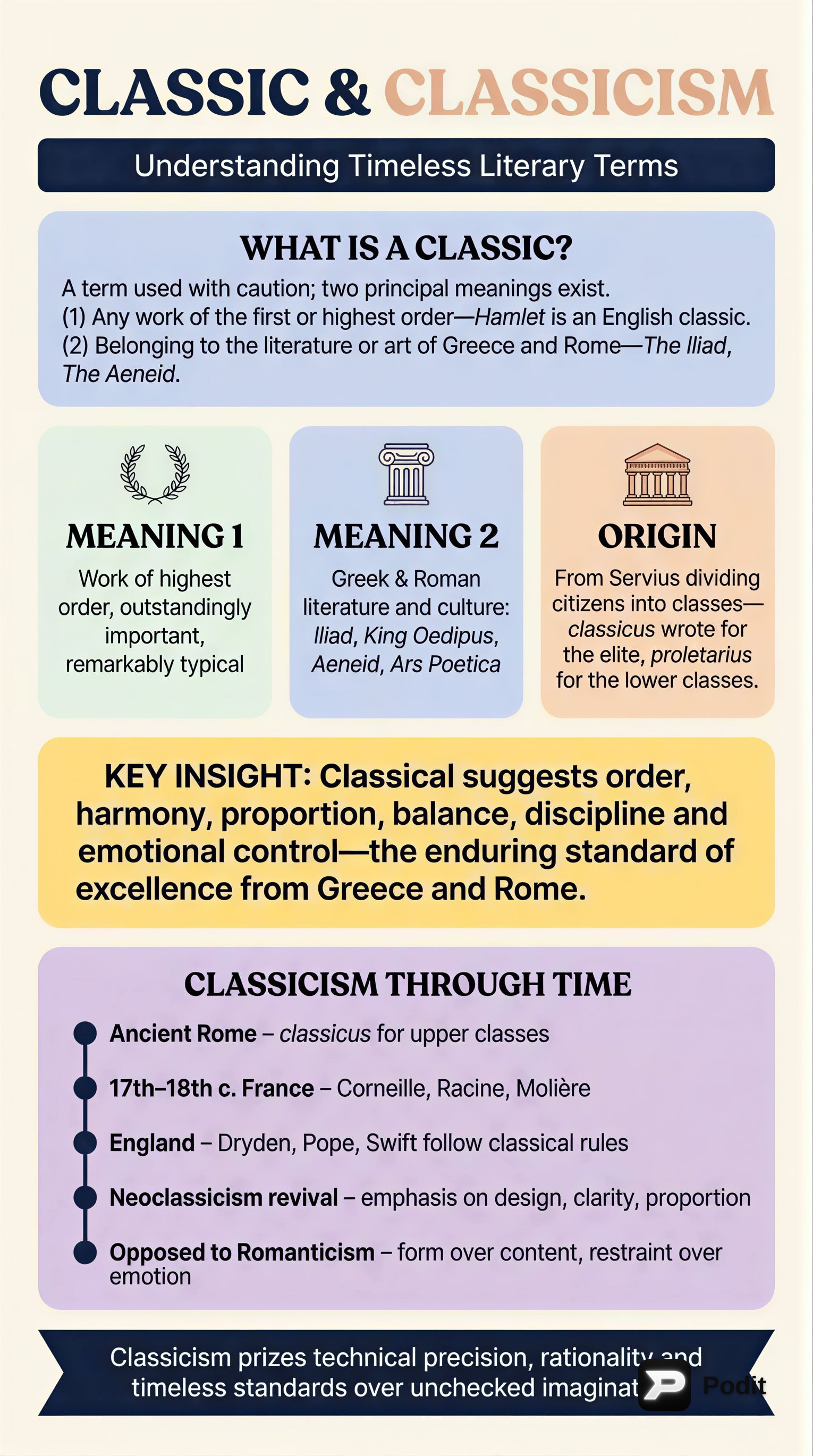
The term "classic" is used with caution due to its varied meanings.
- Highest Order Work: Refers to any work of the first or highest order, such as English classics (e.g., Shakespeare's Hamlet) or French classics (e.g., Flaubert's Madame Bovary).
- Greek and Roman Literature/Art: Pertains to works belonging to the literature or art of ancient Greece and Rome (e.g., Homer's The Iliad, Sophocles' King Oedipus).
💡 Origin: The term dates back to ancient Rome. Citizens of the highest class were called "classicus," while others were "infra classem" (beneath the class). A "scriptor classicus" wrote for the upper classes.
✅ Classical Adjective: Implies a standard of excellence, characterized by qualities like order, harmony, proportion, balance, discipline, and emotional control.
Classicism 🧠 A body of doctrine reflecting the qualities of ancient Greek and Roman culture, particularly in literature, philosophy, art, and criticism. ✅ Key Emphases: * Dominance of form over content. * Technical precision over emotional expressiveness. * Clarity, restraint, and rationality over ambiguity and extravagance. ✅ Historical Context: Strong in England and France during the 17th and 18th centuries. * French Authors: Corneille, Racine, Molière, Voltaire. * English Authors: Ben Jonson, Dryden, Pope, Swift.
Neoclassicism ✍️ A revival or adaptation of classical taste and style in the 17th and 18th centuries, particularly in English literature. It denotes a specific historical period of classicism. ✅ Characteristics: Emphasis on traditional classical values such as design, clarity, and proportion. 💡 Distinction: "Classicism" is a general term for the spirit of Greek/Roman works; "Neoclassicism" refers to its specific revival in the 17th-18th centuries.
B. Platonism & Neoplatonism 💡
Derived from the Greek philosopher Plato (c. 427-348 B.C.), Platonism has profoundly influenced Western literature, despite Plato's skepticism about poetry's ability to reach truth.
✅ Core Doctrines:
- Theory of Ideas (Forms): Plato's most celebrated contribution.
- Concept: Objects seen with our eyes are mere appearances; true reality lies in eternal, unchanging Ideas or Forms. These Forms are more real than material things, existing beyond space and time.
- Example: The "cave" image in The Republic illustrates human perception as shadows of true reality. A horse we see is temporary, but the Idea of "horse" is indestructible and eternal.
- Hierarchy: Ideas can be classified, with the supreme Idea being the Idea of Good.
- Doctrine of Recollection: Implies the pre-existence and immortality of the soul. The soul, having learned in "heaven," forgets much when incarnated but retains the power to "recall" innate ideas.
- Doctrine of Love: Describes an ascent from lower (sensual) to higher (spiritual) beauty. The contemplation of perfect beauty leads to virtue.
Platonic Love (Amor Platonicus) 💖 A concept popularized by Marsilio Ficino, originating from Plato's Symposium. It describes the contemplation of perfect and absolute beauty, where earthly beauty is merely a reflection. Neoplatonists and Renaissance thinkers developed this, seeing physical beauty as an outward expression of inward spiritual beauty, an extension of God's beauty.
Neoplatonism 🧠 A philosophy developed by Plotinus in the 3rd century, synthesizing Plato's ideas with some Aristotelian concepts. ✅ Key Idea: Urges humanity to return to God through reason, positing three levels of reality: non-Being (nature), Being (intellect/Plato's Ideas), and Beyond Being (the One/Good). It emphasizes unity and an upward journey of the soul.
Plato's Works (Summaries) 📚
- Symposium: Explores the nature of Love, from physical attraction to the apprehension of Beauty itself.
- Apology: Socrates' defense against charges of impiety and corrupting the young, emphasizing his awareness of his own ignorance and fearlessness of death.
- Crito: Socrates refuses to escape prison, arguing it would break his implicit agreement with the state's laws and that living honorably is paramount.
- Phaedo: Discusses the immortality of the soul, arguing that the philosopher pursues death to free the soul for knowledge of Ideas.
- Republic: Plato's most famous work, exploring justice, the ideal state (with guardians, auxiliaries, workers), the Theory of Ideas, and the role of education. Famously bans poets for misrepresenting gods.
- Laws: Advocates for a mixed government (democracy and monarchy) and laws designed to ensure freedom, harmony, and virtue.
C. Ancient Greek Philosophies 🧠
- Sophists: Paid professional teachers of logic, philosophy, and rhetoric in ancient Greece (e.g., Gorgias, Protagoras). They systematized thought, but "sophism" later came to mean plausible but false reasoning.
- Cynics: Founded by Antisthenes (a pupil of Socrates), they advocated for happiness through freedom from desires. Diogenes, known for living in a tub and his contempt for worldly goods, exemplified their principles of self-sufficiency and disregard for conventions.
- Stoics: Founded by Zeno of Citium, they taught in the "stoa."
- Early Stoa: Virtue is based on knowledge, living in harmony with nature and reason (identified with God). A wise person's happiness is independent of external circumstances.
- Middle Stoa: Panaetius revised Stoicism, emphasizing progress in wisdom and virtue for all, adapting ethics for active statesmen.
- Late Stoa: Focused on ethical and religious questions (e.g., Seneca, Epictetus, Marcus Aurelius). They stressed self-sufficiency, indifference to pain, and living in accordance with nature.
D. Medieval Concepts 🏰
- Mysticism ✨: Belief in spiritual apprehension of truths beyond ordinary understanding, seeking union with God through contemplation and self-surrender.
- Christian Path: Involves stages like the purgative way (purification), illuminative way (illumination in God's love), unitive way (union with God), and spiritual marriage (perfect knowledge), often including a "dark night of the soul" (alienation).
- Courtly Love 💖: A conventional medieval tradition of knightly love and conduct.
- Characteristics: A gallant knight's idealized, often unconsummated devotion to a beautiful, intelligent, and unattainable noblewoman. He performs noble deeds, suffers, and keeps the love secret, as the lady is often married (love incompatible with marriage).
- Influence: Troubadours (poets in Southern France) glorified adulterous love. Influenced by Ovid's Ars Amatoria and feudal concepts.
- Elements: Humility, courtesy, adultery (often), religion of love, desire, ennobling force, cult of the beloved.
- Examples: Romance of the Rose, Arthurian legends (Lancelot), Tristan and Iseult.
- Scholasticism 🧠: The dominant philosophical and theological system of the Middle Ages.
- Aim: To reconcile Christian principles with the demands of reason, systematizing existing traditional beliefs.
- Method: Applied logical methods to theology, often based on Aristotle.
- Key Figure: St. Thomas Aquinas (1225-74) distinguished between reason (experimental/logical evidence) and faith (revelation), arguing both come from God and cannot conflict. His Summa Theologica is a monumental work.
II. Renaissance to the Age of Reason
A. Humanism & Renaissance 🌍
- Humanism 💡: A Renaissance movement focusing on classical literature (Greek and Latin poets, philosophers) and human interests rather than theological dogma.
- Emphasis: Man's life on Earth, human dignity, reason, and creative capacity. Regarded man as the center of the universe, capable of self-improvement.
- Example: Hamlet's speech, "What a piece of work is a man!"
- Renaissance ("Rebirth") 🎨: A period from the mid-14th to the end of the 16th century.
- Characteristics: Rediscovery and revival of classical literature, immense creativity in arts (painting, literature, sculpture, architecture), increased secularization, growth of individualism, expansion of scientific and philosophical horizons. It was a gradual process, not a sudden event.
B. Reformation 🙏
A 16th-century religious movement against abuses in the Roman Catholic Church, leading to the formation of Protestant churches. ✅ Catalysts: Humanism, printing press, princely reaction against papal interference, wealth of clergy. ✅ Leaders: Martin Luther (Germany, 1517), Huldrych Zwingli (Switzerland), John Calvin (France, introduced predestination). ✅ Impact: Increased nationalism, strengthened the mercantile class, and led to the Catholic Counter-Reformation.
C. Literary Styles & Periods ✍️
- Euphuism 📜: An elaborate, highly artificial, and ornate prose style named after John Lyly's 1579 romance Euphues.
- Characteristics: Heavy alliteration, elaborate antithesis, far-fetched similes, extended comparisons. Demonstrated the capabilities of English prose.
- Metaphysical Poetry ✨: A group of 17th-century poets (e.g., John Donne, George Herbert, Andrew Marvell).
- Characteristics: Blended emotion with intellectual ingenuity, used complex "conceits" (far-fetched imagery), realism, introspection, and irony. Often devotional, exploring themes of love, death, God, and human frailty.
- Critique: Dr. Samuel Johnson famously described their imagery as "the most heterogeneous ideas yoked by violence together."
- Commonwealth Period ⚔️: 1649-1660, following the English Civil War.
- Context: Puritan rule, theatres closed due to moral objections.
- Notable Writer: John Milton.
- Restoration Period 👑: 1660 (monarchy restored under Charles II) to the end of the century.
- Notable Writers: John Dryden, William Congreve.
- Augustan Age (Neoclassical Period/Age of Reason/Enlightenment) 🏛️: Roughly 1700-1750.
- Influence: Writers consciously emulated the style of Roman authors from Emperor Augustus's reign (e.g., Virgil, Horace).
- Characteristics: Classical elegance, harmony, decorum (observance of what is proper in form and substance).
- Notable Writers: Dryden, Pope, Addison, Swift.
III. From Romanticism to Modern Literary Movements
A. Romantic Movement 💖
A European literary and artistic movement beginning in the late 18th century, reacting against Neoclassicism. ✅ Key Emphases: Imagination and emotion over reason and intellect. ✅ Characteristics: Individualism, nature worship, primitivism, spontaneity, importance of natural genius, attraction to the supernatural, morbid, melancholy, and cruel. ✅ Romantic Hero: Characterized by an aspiration towards an ideal, boundless, infinite goal, often unattainable. ✅ English Forerunners: Gray, Collins, Burns, Blake (18th C "Graveyard School"). ✅ Flowering Period (1789-1832): Wordsworth, Coleridge, Shelley, Byron, Keats.
B. Transcendentalism ✨
A 19th-century American philosophic and literary movement centered in New England, a form of philosophical Romanticism. ✅ Core Beliefs: Reliance on intuition and conscience, a reaction against scientific rationalism. ✅ Proponents: Ralph Waldo Emerson (Nature), Henry David Thoreau (Walden). ✅ Practices: Living close to nature, dignity of manual labor, intellectual companionship, self-reliance. 💡 Insight: Believed in the essential unity of all things, ordered by a Supreme Mind or Over-Soul, and the divinity of man.
C. Victorian Period 🕰️
The era of Queen Victoria's reign (1837-1901). ✅ Literary Activity: Intense and prolific, especially in novels and poetry. ✅ Themes: Addressed contemporary social problems (Industrial Revolution, theory of evolution, social reform). ✅ Notable Writers: Charles Dickens, Alfred Tennyson, Robert Browning, George Eliot, Thomas Hardy.
D. Realism 📸
A literary tendency emphasizing the depiction of life "as it is lived" with objectivity, emerging as a reaction against Romanticism. ✅ Characteristics: Authors refrain from taking sides, present factual documentation of character and story, focus on contemporary society, and prioritize character over external nature. ✅ Rejection: Rejects classicism, romanticism, and "art for art's sake." ✅ Examples: Chaucer's Canterbury Tales (early), Stendhal (The Red and the Black), Honoré de Balzac (Eugénie Grandet).
E. Naturalism 🔬
Developed from Realism in the latter half of the 19th century, influenced by Darwin's biological theories and deterministic philosophies. ✅ Characteristics: Objective depiction of the social environment, focusing on its deficiencies and human shortcomings. Emphasizes that characters' destinies are controlled by impersonal social, economic, and biological forces, portraying human free will as weak. ✅ Leading Exponent: Émile Zola (Thérèse Raquin, Germinal, The Dram Shop). His method was scientifically clinical, dissecting life to show the ruinous effects of heredity and environment.
F. Symbolist Movement 🎭
A 19th-century French poetic movement that reacted against Naturalism and Realism. ✅ Aim: To evoke moods and ideas indirectly through suggestion and symbolism, rather than direct description. ✅ Techniques: Used nonliteral, figurative language (tone, association, metaphor), often employing free verse. ✅ Key Figures: Stéphane Mallarmé, Charles Baudelaire (Flowers of Evil). 💡 Poet as Seer: Viewed the poet as a visionary capable of perceiving ideal Forms beyond the material world, transforming reality into a greater, more permanent one.
G. Theatre of the Absurd 🎭
A term applied to works by dramatists active in the 1950s (e.g., Samuel Beckett, Eugène Ionesco, Harold Pinter). ✅ Core Idea: Explores the fundamental absurdity and pointlessness of the human condition. ✅ Influences: Existentialist thought (e.g., Albert Camus' The Myth of Sisyphus), which saw life as purposeless and out of harmony. ✅ Characteristics: Plays often lack conventional plot, character development, or logical structure, reflecting "metaphysical anguish" and the difficulty of communication in a meaningless world. ✅ Example: Beckett's Waiting for Godot.
IV. Conclusion
This study guide has explored a rich tapestry of literary and philosophical thought, from the foundational ideals of ancient Greece and Rome to the complex expressions of modernism. We've seen how concepts like classicism and Platonism shaped early intellectual frameworks, how the Renaissance and Reformation ushered in human-centric views, and how subsequent movements like Romanticism, Realism, Naturalism, and Symbolism continuously redefined humanity's understanding of itself and its world. This journey highlights the enduring human quest to define reality, morality, and artistic expression across diverse historical and cultural contexts.