William Carlos Williams and Modernist Poetry - kapak
Edebiyat#william carlos williams#modernist poetry#american poetry#imagism

William Carlos Williams and Modernist Poetry

An academic summary of William Carlos Williams's life, literary influences, stylistic features, poetic vision, and his distinct role within American Modernist poetry.

kahyaaliJune 3, 2026 ~22 dk toplam
01

Sesli Özet

6 dakika

Konuyu otobüste, koşarken, yolda dinleyerek öğren.

Sesli Özet

William Carlos Williams and Modernist Poetry

0:006:05
02

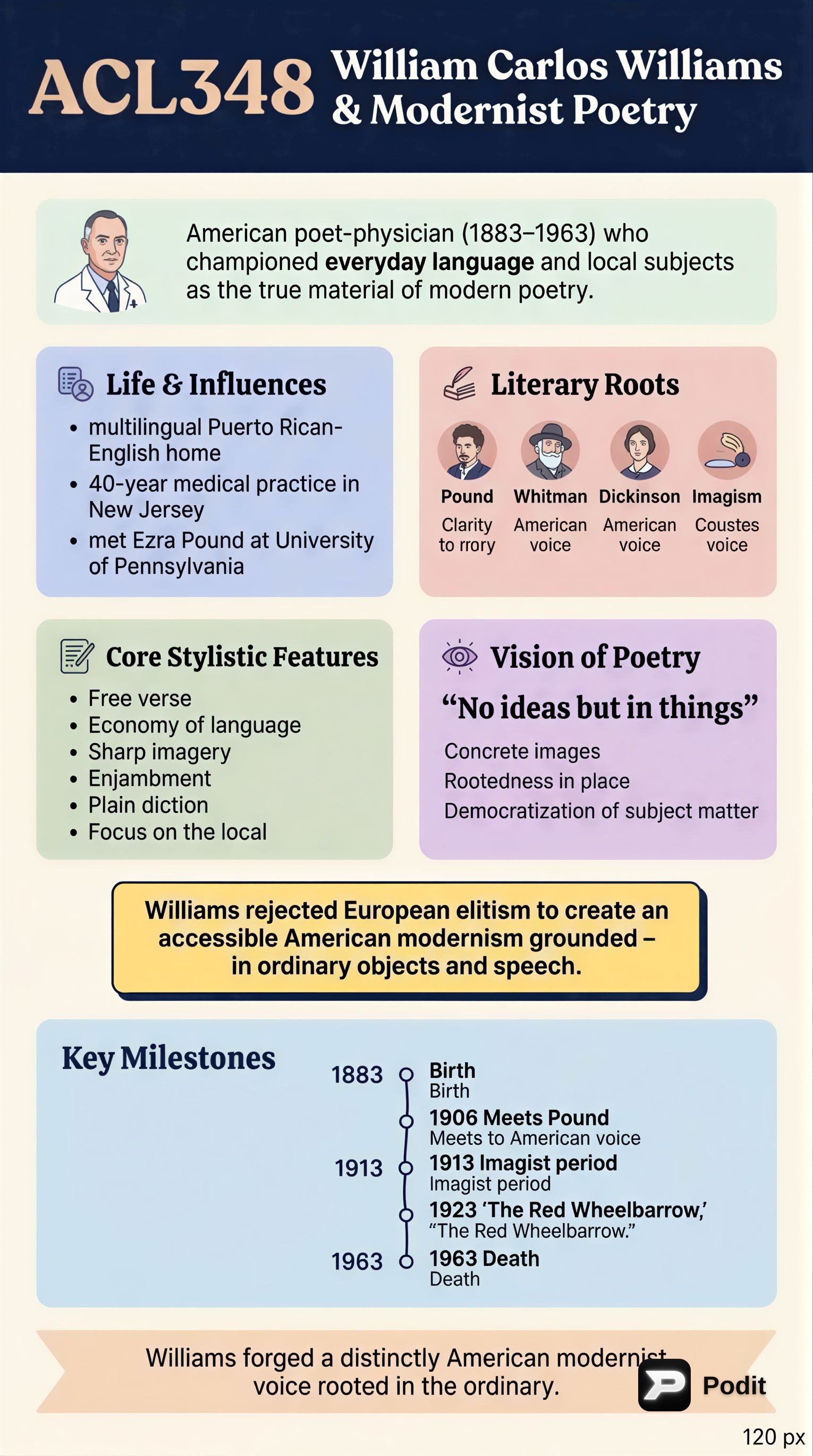
Görsel Özet

İnfografik

Konunun tüm parçalarını tek bakışta gör.

William Carlos Williams and Modernist Poetry - görsel özet infografik
Tam boyutta görüntüle →
03

Flash Kartlar

25 kart

Karta tıklayarak çevir. ← → ile gez, ⎵ ile çevir.

1 / 25
Tüm kartları metin olarak gör
  1. 1. What was William Carlos Williams's primary profession outside of poetry?

    William Carlos Williams was a general practitioner, a physician, for over four decades in his hometown. This profession profoundly influenced his poetry, as it allowed him to integrate the realities of daily life and direct observations of his community into his artistic expression. His medical work provided a constant source of material and a grounded perspective for his literary output.

  2. 2. How did Williams's multilingual background influence his poetic style?

    Born into a multilingual household with a Puerto Rican mother and an English immigrant father, Williams developed a sensitivity to sound and rhythm from an early age. This environment fostered an acute awareness of linguistic nuances. This early exposure to diverse linguistic patterns contributed to the unique musicality and cadence that became a hallmark of his poetic style, emphasizing the natural flow of language.

  3. 3. Which influential poet became a mentor to Williams during his early career?

    Ezra Pound became a key mentor to William Carlos Williams during his early Imagist phase. They forged a lifelong friendship and literary connection while studying medicine at the University of Pennsylvania. Pound's guidance was crucial in shaping Williams's initial poetic development, particularly in adopting principles of clarity and conciseness.

  4. 4. What was Williams's famous dictum regarding poetic meaning?

    William Carlos Williams's iconic dictum was 'No ideas but in things.' This principle asserted that profound meaning in poetry should arise directly from concrete images, tangible realities, and sensory perceptions. He believed that abstract concepts or intellectual constructs were less effective than meaning derived from direct observation of the physical world.

  5. 5. How did Williams's medical practice impact his poetry?

    His medical practice provided invaluable encounters with patients and the community, enriching his poetic voice. It allowed him to observe the realities of daily life firsthand, fostering a democratic perspective that championed the accessible and the everyday as worthy subjects for poetry. These experiences grounded his work in the tangible and immediate world.

  6. 6. Name two poets who influenced William Carlos Williams.

    Walt Whitman and Emily Dickinson were significant influences on William Carlos Williams. Whitman inspired Williams's commitment to American subjects and vernacular voices, advocating for a distinct national poetry. Dickinson's minimalism and economy of expression, on the other hand, shaped his approach to concise and impactful language, emphasizing brevity and precision.

  7. 7. What artistic movement, besides Imagism, influenced Williams's visual approach to poetry?

    Cubism, particularly the work of Cézanne, inspired Williams's visual approach to poetry. He explored how to represent form through suggestion rather than strict realism, much like Cubist painters broke down objects into geometric forms. Williams translated this visual art principle into his poetic technique of presenting vivid, concrete images that allow meaning to emerge from their arrangement.

  8. 8. What philosophical movement resonated deeply with Williams?

    American Pragmatism, with its focus on usefulness and practicality, resonated deeply with William Carlos Williams. This philosophy aligned with his belief in grounding poetry in tangible realities and the immediate, lived experience of people. It reinforced his conviction that art should be relevant and accessible, reflecting the practical concerns of everyday life.

  9. 9. What was a defining characteristic of Williams's poetic language?

    A defining characteristic of Williams's poetic language was his economy of language, presenting minimalist, direct, and often deceptively simple expressions. He aimed for conciseness, stripping away unnecessary words to achieve clarity and directness in his poetic voice. This approach allowed the concrete images to speak for themselves, embodying his 'No ideas but in things' philosophy.

  10. 10. How did Williams typically structure his poems in terms of meter and rhyme?

    Williams predominantly employed free verse, deliberately eschewing traditional meter and rhyme schemes. This choice allowed him to achieve a more natural, conversational rhythm that mirrored everyday American speech patterns. By breaking away from conventional forms, he sought to create a poetry that felt authentic and immediate, reflecting the cadences of spoken language.

  11. 11. What technique did Williams use to create specific rhythms and emphasize words by breaking lines?

    Williams frequently utilized enjambment, strategically breaking lines to create specific rhythms and emphasize certain words or phrases. This technique allowed him to control the pace and flow of his poems, guiding the reader's interpretation and drawing attention to particular images or ideas. Enjambment also contributed to the natural, conversational feel of his free verse.

  12. 12. What kind of diction did Williams favor in his poetry?

    He favored plain diction, meticulously crafted to emulate the cadences and vocabulary of everyday American speech. This choice contributed to the accessibility and authenticity of his work, making it relatable to a broad audience. By using common language, Williams aimed to democratize poetry, bringing it closer to the lived experience of ordinary people.

  13. 13. What was Williams's primary focus regarding subject matter in his poetry?

    Williams's primary focus regarding subject matter was the local and specific, aiming to reflect the life immediately surrounding him. He drew inspiration from the landscapes of New Jersey and urban American settings, finding poetic value in the ordinary and tangible aspects of his environment. This commitment to the local allowed him to explore universal themes through concrete details.

  14. 14. How did Williams's approach to Modernism differ from high modernists like T.S. Eliot?

    Williams consciously sought a distinctly American voice, rejecting the European-centric intellectualism of high modernists like Eliot. He championed local, concrete subjects, believing they offered a more authentic path to poetic truth. In contrast, Eliot's work often relied on classical allusions and a more academic tone, which Williams felt alienated the common American reader.

  15. 15. Why did Williams oppose T.S. Eliot's 'The Waste Land'?

    Williams opposed 'The Waste Land' because he believed it relied excessively on obscure European literary references and classical allusions. He felt this alienated the common American reader and failed to engage with the immediate American experience. Williams advocated for a poetry rooted in the tangible realities of American life, which he felt Eliot's work did not achieve.

  16. 16. Name one of William Carlos Williams's celebrated works.

    'The Red Wheelbarrow' is one of William Carlos Williams's celebrated works. It exemplifies his groundbreaking form, vivid and precise imagery, and deep engagement with the mundane yet profound aspects of the everyday. This short poem perfectly embodies his 'No ideas but in things' philosophy, deriving significant meaning from simple, concrete objects.

  17. 17. What was Williams's stance on the subject matter for poetry?

    He advocated for a radical democratization of subject matter, finding inherent value and poetic potential in ordinary people, fleeting everyday moments, and common language. Williams believed that poetry should not be confined to grand themes or classical subjects. He elevated these seemingly mundane aspects to a position of significant artistic consideration, making poetry accessible and relevant to all.

  18. 18. What did Williams believe was the source of authentic poetry?

    He firmly believed that authentic poetry should be deeply rooted in the poet's lived environment and direct observations. This meant drawing inspiration from the physical and immediate world, rather than from abstract intellectual concepts or historical allusions. For Williams, true poetic insight emerged from a close and empathetic engagement with one's surroundings.

  19. 19. What characteristic of Imagism did Williams adopt?

    While briefly aligning with Imagism, Williams adopted its emphasis on clarity, conciseness, and vivid imagery. These principles became fundamental to his own poetic style, allowing him to present sharp, concrete descriptions in his work. He valued the Imagist focus on presenting an image directly, without unnecessary words or embellishments, to evoke a strong emotional or intellectual response.

  20. 20. In what year was William Carlos Williams born and when did he pass away?

    William Carlos Williams was born in 1883 and passed away in 1963. His life spanned a period of significant change and artistic innovation in American literature. His long career allowed him to contribute profoundly to 20th-century American poetry, evolving his style and influencing subsequent generations of poets.

  21. 21. What kind of household did Williams grow up in?

    Williams grew up in a multilingual household, with a Puerto Rican mother and an English immigrant father. This diverse linguistic environment fostered his sensitivity to the nuances of language, sound, and rhythm. This early exposure to different cultures and languages undoubtedly enriched his poetic sensibility and contributed to his unique voice.

  22. 22. How did Williams's poetry reflect the Modernist era despite his unique approach?

    Despite his divergence from European-centric Modernism, Williams's body of work still reflects the fragmentation, experimentation, and formal innovation characteristic of the era. Crucially, his experimentation remained rooted in the ordinary, tangible fabric of American life and its vernacular. He embraced new forms and techniques but always grounded them in the immediate and accessible.

  23. 23. What was Williams's main goal in cultivating a 'distinctly American voice'?

    Williams's main goal in cultivating a 'distinctly American voice' was to create poetry that was authentic to the American experience, accessible to the common American reader, and free from what he perceived as the elitism and intellectualism of certain European literary traditions. He wanted to celebrate local, concrete subjects and the vernacular of his own country. This was a deliberate effort to forge a national poetic identity.

  24. 24. Name another celebrated work by William Carlos Williams besides 'The Red Wheelbarrow'.

    'This is Just to Say' is another celebrated work by William Carlos Williams. It exemplifies his use of plain diction, sharp imagery, and focus on everyday moments, transforming a simple note into a poignant poetic statement. The poem's directness and reliance on concrete details perfectly illustrate his poetic philosophy.

  25. 25. What was the significance of Williams's medical studies at the University of Pennsylvania?

    His medical studies at the University of Pennsylvania were significant because it was there he forged a lifelong friendship and literary connection with Ezra Pound. This relationship was crucial for Williams's early development as a poet, particularly during his Imagist phase. The intellectual environment also broadened his perspectives, even as he pursued a scientific career.

04

Bilgini Test Et

15 soru

Çoktan seçmeli sorularla öğrendiklerini ölç. Cevap + açıklama.

Soru 1 / 15Skor: 0

What was William Carlos Williams's primary profession for over four decades, which he believed was intrinsically linked to his poetry?

05

Detaylı Özet

6 dk okuma

Tüm konuyu derinlemesine, başlık başlık.

William Carlos Williams and Modernist Poetry: A Study Guide

Source Information: This study material has been compiled from a lecture audio transcript and copy-pasted text provided by the user.


📚 Introduction to William Carlos Williams

William Carlos Williams (1883-1963) stands as a pivotal figure in American Modernist poetry. He championed a distinctively American voice, deeply rooted in everyday life and concrete experience, setting him apart from many of his contemporaries. His unique background as a physician profoundly influenced his literary output and stylistic innovations, making his work both accessible and profoundly insightful.


1️⃣ Biographical Context and Influences

🌍 Personal Background

  • Multilingual Home: Born in 1883, Williams grew up in a household with a Puerto Rican mother and an English immigrant father. This environment fostered a keen sensitivity to sound and rhythm, which became a hallmark of his poetic style.
  • Lifelong Profession: For over four decades, Williams served as a general practitioner (physician) in his hometown of Rutherford, New Jersey. He believed his medical practice was intrinsically linked to his poetry, integrating the realities of daily life and human experience into his artistic expression.

💡 Key Influences

  • Ezra Pound: Met at the University of Pennsylvania Medical School. Pound was a key literary influence and lifelong friend, serving as a mentor during Williams's early Imagist phase.
  • Walt Whitman: Williams shared Whitman's commitment to American subjects and vernacular voices, seeking to capture the essence of the American experience.
  • Emily Dickinson: Her minimalism and economy of expression influenced Williams's approach to language.
  • Imagism: Briefly aligned with this movement, adopting its emphasis on clarity, conciseness, and vivid imagery.
  • Cubism (Cézanne): Inspired by visual artists like Cézanne, Williams explored how form could be conveyed through suggestion rather than strict realism, influencing his poetic structure.
  • American Pragmatism: This philosophical belief in usefulness, practicality, and rootedness resonated deeply with Williams, informing his focus on the tangible and immediate.
  • Medical Practice: His daily encounters with patients and the community provided a rich tapestry of human experience, deeply informing his poetic voice.
  • Democratic Values: Williams advocated for the everyday and the accessible, believing that poetry should reflect and celebrate common life.

2️⃣ Core Stylistic Features

Williams's poetry is characterized by a set of distinctive stylistic choices that aimed to create an authentic American voice:

  • Free Verse: Deliberately avoided traditional meter and rhyme schemes to achieve a more natural, conversational rhythm.
  • Economy of Language: Employed a minimalist, direct, and often deceptively simple style, stripping away unnecessary words.
  • Sharp Imagery: Provided vivid and clear descriptions of physical objects, allowing meaning to emerge directly from the concrete.
  • Use of Enjambment: Strategically broke lines to create specific rhythms, emphasize certain words or phrases, and control the reader's pace.
  • Plain Diction: Meticulously crafted language to emulate the cadences and vocabulary of everyday American speech, enhancing accessibility and authenticity.
  • Focus on the Local and Specific: Aimed to reflect the life immediately surrounding him, particularly the landscapes of New Jersey and urban American settings.

3️⃣ Poetic Vision: "No ideas but in things"

Central to Williams's overarching poetic philosophy was his iconic dictum: "No ideas but in things."

  • 📚 Meaning from Concrete: This principle asserted that profound meaning should arise from concrete images, tangible realities, and sensory perceptions, rather than from abstract concepts or intellectual constructs.
  • Emphasis on the Physical: He placed paramount emphasis on the physical and immediate world, believing that authentic poetry should be deeply rooted in the poet's lived environment and direct observations.
  • Poetry Rooted in Place: Williams believed poetry should grow out of the poet's immediate surroundings and experiences.
  • Democratization of Subject Matter: He found inherent value and poetic potential in ordinary people, fleeting everyday moments, and common language, elevating them to a position of significant artistic consideration.

4️⃣ Role in Modernism

William Carlos Williams occupied a unique and critically significant position within American Modernism.

  • Distinct American Voice: While undeniably a Modernist, his approach diverged from the more intellectual and European-centric "high modernists" like T.S. Eliot. Williams consciously sought to cultivate a distinctly American voice.
  • Rejection of European Elitism: He actively rejected what he perceived as elitism and intellectualism in certain European literary traditions, championing local, concrete subjects instead.
  • Opposition to T.S. Eliot's The Waste Land: Williams famously opposed Eliot's seminal work, arguing it relied excessively on obscure European literary references and classical allusions, thereby alienating the common American reader and failing to engage with immediate American experience.
  • Modernism Rooted in Ordinary Life: Despite this divergence, Williams's work reflects the fragmentation, experimentation, and formal innovation characteristic of the Modernist era, but his experimentation remained firmly rooted in the ordinary, tangible fabric of American life and its vernacular.

5️⃣ Key Poems: Exemplifying Williams's Vision

Williams's profound contributions to American poetry are powerfully exemplified by celebrated works that embody his stylistic features and poetic vision.

🌾 "The Red Wheelbarrow" (1923)

This short, iconic poem is a perfect illustration of Williams's "no ideas but in things" philosophy and his commitment to sharp imagery and plain diction.

  • Structure and Imagery:
    so much depends
    upon
    
    a red wheel
    barrow
    
    glazed with rain
    water
    
    beside the white
    chickens.
    
  • Analysis:
    • "No ideas but in things": The poem presents a simple, concrete image without explicit interpretation or abstract commentary. The meaning arises entirely from the visual details.
    • Sharp Imagery: The vivid description of the "red wheelbarrow," "glazed with rainwater," and "white chickens" creates a clear, almost photographic mental picture.
    • Economy of Language: Every word is essential; there are no superfluous adjectives or adverbs.
    • Enjambment: The line breaks (e.g., "depends / upon") force the reader to pause, emphasizing each word and slowing the reading pace, drawing attention to the significance of the ordinary objects.
    • Significance: The opening line, "so much depends / upon," elevates the seemingly mundane objects to a position of profound importance, suggesting that the beauty and utility of everyday things are fundamental to human experience. It celebrates the overlooked details of rural life.

🌳 "Spring and All" (1923)

This poem, also from 1923, showcases Williams's ability to depict a landscape with stark realism while imbuing it with deeper thematic resonance, reflecting the struggle and renewal of life.

  • Themes and Imagery: The poem opens with a desolate, winter-worn landscape, describing "leafless vines" and "dead, brown leaves." It then shifts to the subtle, almost imperceptible stirrings of spring.
  • Analysis:
    • Modernist Fragmentation: The poem's structure and imagery reflect a sense of fragmentation and disarray, characteristic of Modernism, as it depicts a world recovering from winter's harshness.
    • Struggle and Renewal: Williams portrays the "contagious" and "stiff" new life emerging from the "waste of broad, muddy fields." This isn't a romanticized spring but a gritty, determined rebirth.
    • Plain Diction and Specificity: The language remains grounded and precise, describing the "cold, familiar wind" and "standing water" with unadorned clarity.
    • "No ideas but in things": The poem conveys the idea of renewal and the persistent force of life through the direct observation of the landscape's transformation, rather than through abstract statements about hope or rebirth. The "all" in the title refers to the entire process of life, death, and renewal, observed through concrete details.
    • Focus on the Local: The landscape described feels specific and real, likely drawing from Williams's observations of the New Jersey countryside.

✅ Conclusion

William Carlos Williams stands as a foundational figure in American Modernist poetry. His unique blend of a physician's observational precision and a poet's linguistic sensitivity led to a body of work that celebrated the concrete, the local, and the accessible. Through his commitment to an authentically American voice and his influential principle of "No ideas but in things," Williams profoundly shaped the trajectory of 20th-century poetry, leaving an enduring legacy of clarity, immediacy, and democratic vision.
Kendi çalışma materyalini oluştur

PDF, YouTube videosu veya herhangi bir konuyu dakikalar içinde podcast, özet, flash kart ve quiz'e dönüştür. 1.000.000+ kullanıcı tercih ediyor.

Sıradaki Konular

Tümünü keşfet
e.e. cummings: Poetic Innovation and Influences

e.e. cummings: Poetic Innovation and Influences

This summary explores the life, unique poetic style, major themes, and significant influences of American modernist poet e.e. cummings, focusing on his experimental approach to language and form.

6 dk Özet 25 15
Imagist Poetry: Characteristics and Key Figures

Imagist Poetry: Characteristics and Key Figures

This audio summary explores Imagist Poetry, detailing its historical context, core principles, and the contributions of prominent figures such as Amy Lowell, H.D., and William Carlos Williams.

6 dk Özet 25 15
Ezra Pound: Life, Artistic Development, and Literary Vision

Ezra Pound: Life, Artistic Development, and Literary Vision

This summary explores Ezra Pound's life, his pivotal role in modern poetry, his artistic development through Imagism and Vorticism, his literary theories, and his monumental work, The Cantos, alongside his controversial political affiliations.

7 dk Özet 25 15
Modernism and Postmodernism in Literary History

Modernism and Postmodernism in Literary History

This summary explores the evolution of literary history from Modernism to Postmodernism, examining key characteristics, historical contexts, influential figures, and the shift in literary aesthetics and critical approaches.

10 dk Özet 25 15 Görsel
20th-Century British Poetry: Movements and Themes

20th-Century British Poetry: Movements and Themes

An academic overview of 20th-century British poetry, exploring its historical context, major literary movements, key themes, and influential poets from the Georgian era to the 1970s.

7 dk Özet 25 15 Görsel
Understanding Modernism and Postmodernism in Literature

Understanding Modernism and Postmodernism in Literature

Explore the profound shifts in literary history from Modernism to Postmodernism, examining their intellectual foundations, key characteristics, and impact on art and culture.

Özet 25 15 Görsel
Linguistics, Literature, and Stylistic Analysis

Linguistics, Literature, and Stylistic Analysis

This summary explores the intricate relationship between linguistics and literature, defines stylistics, outlines its major categories and subdisciplines, and highlights its application in analyzing literary texts.

6 dk Özet 25 15 Görsel
Literary & Philosophical Movements: A Comprehensive Overview

Literary & Philosophical Movements: A Comprehensive Overview

An academic summary exploring key literary and philosophical concepts, movements, and periods from ancient times to modernism, highlighting their definitions, characteristics, and influential figures.

10 dk Özet 25 15 Görsel